





What Does an IQ of 150 Mean? Percentile and Rarity
An IQ of 150 is about 1 person in 2,331 on a standard deviation 15 scale, the 99.96th percentile. See how rare it really is, what "genius" cutoffs actually mean, and why scores this high need a real test to trust.

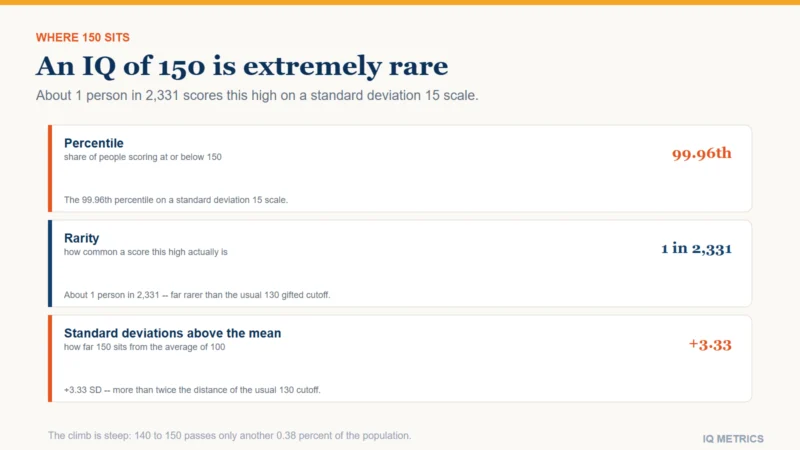
An IQ of 150 is extraordinarily rare. On a test scaled to a mean of 100 and a standard deviation of 15 — the scale used by the Wechsler tests and the current Stanford–Binet — a score of 150 sits 3.33 standard deviations above the mean, at roughly the 99.96th percentile. About one person in 2,331 scores 150 or higher. That is well past the 130 line most sources use for “gifted”, and even past the 140 line some reserve for “genius”. This article covers exactly how rare 150 is, what it looks like next to other very high scores, how much a single number this extreme can be trusted, and what it does and does not predict.
- Rarity: about 1 in 2,331 people score 150 or higher on a standard deviation 15 scale — the 99.96th percentile.
- Context: more than twice as far above average as the usual 130 gifted cutoff, and well past the 140 line some sources use for “genius”.
- Accuracy: a reported 150 on a reliable test (reliability 0.95) has an expected true score around 148, with a 95% range of roughly 141 to 154.
- Reality check: scores this extreme carry real measurement uncertainty, and most 150s reported by short online tests reflect test error rather than true ability.
How rare is an IQ of 150?
On a normal curve with a mean of 100 and a standard deviation of 15, a score of 150 sits at z = +3.33. About 0.043% of people score that high or higher, which works out to about 1 in 2,331. Applied to a world population of roughly 8.2 billion, that implies a little over 3.5 million people, though almost none of them have ever sat a test rigorous enough to confirm it. The IQ percentile calculator places any score on the same curve, and the IQ scale by age page covers how the same raw ability compares across ages.
| IQ score | Percentile | About 1 person in |
|---|---|---|
| 130 | 97.72 | 44 |
| 135 | 99.02 | 102 |
| 140 | 99.62 | 261 |
| 145 | 99.87 | 741 |
| 150 | 99.96 | 2,331 |
| 155 | 99.99 | 8,139 |
| 160 | 99.997 | 31,574 |
The climb gets steep fast. Moving from 130 to 140 passes about another 1.9% of the population; moving from 140 to 150 passes only another 0.38%. The IQ of 135, IQ of 140 and IQ of 160 articles cover the neighbouring bands the same way.
What is a 150 on other IQ scales?
A bare number means little without its scale. The Wechsler tests and the current Stanford–Binet use a standard deviation of 15, but older and alternative scales spread scores further, so the same underlying rarity prints a different number on each one. A result with the same 1-in-2,331 rarity as a Wechsler 150 would print as roughly 153 on the older Stanford–Binet Form L-M scale (standard deviation 16), and roughly 180 on one of Cattell’s scales (standard deviation 24). This is one reason two people who sat different tests should never compare raw numbers directly; the standard deviation 15 versus 16 explainer covers the mechanics.
| Scale | Standard deviation | Score with the same 1-in-2,331 rarity |
|---|---|---|
| Wechsler tests, Stanford–Binet 5 | 15 | 150 |
| Stanford–Binet Form L-M | 16 | ~153 |
| Cattell scales | 24 | ~180 |
Is an IQ of 150 the same as "genius"?
There is no single technical definition of “genius”, and the label gets used loosely well below this level. Mensa’s cutoff sits at the top 2%, around 132 — far below 150. Lewis Terman’s original 1916 Stanford–Binet study used a working cutoff mostly around 140. Some gifted-education frameworks add further bands above 130, sometimes labelled “exceptionally gifted” or “profoundly gifted”, typically starting somewhere between 145 and 160 depending on the source — these labels are not standardised the way a test manual’s own classification table is. Gifted cutoff scores covers how much these lines vary, and is 130 genius, what counts as a genius-level IQ and the highest IQ scores ever recorded go further into how the word gets used.
How accurate is a single score of 150?
Every score carries measurement error, and psychologists correct for it with Kelley’s formula: the expected true score is 100 plus the test’s reliability times the distance of the observed score from 100. For a good test with a reliability of 0.95, an observed 150 implies an expected true score of about 148, with a 95% range of roughly 141 to 154. At this extreme, a second problem compounds the first: most standard IQ tests do not carry enough very hard items to measure reliably this far up the scale, a limitation called a ceiling effect. A genuine score near 150 normally requires a specialised high-range test administered and interpreted by a psychologist, not a standard battery. See IQ ceiling effect and how to read an IQ test report for the same arithmetic applied elsewhere.
Why online tests almost never produce a real 150
A short, unsupervised online quiz has three problems working against it at this extreme: too few items to separate a 140 from a 150 with any precision, a self-selected pool of test-takers who are often already interested in IQ testing and may have seen similar items before, and weak norm data at the tail where genuine high scorers are rare to begin with. A handful of items answered differently can swing a reported score by 10 to 20 points at this range, so a “150” from a twenty-question quiz says far less than a 150 from a full individually administered battery. IQ test accuracy and how to prepare for an IQ test cover what a properly administered test actually involves.
Where would your own score land?
Take the IIF-certified assessment and get your score with the scale it was measured on, the percentile it corresponds to and the confidence range around it — the three figures most online tests leave out.
Find your IQ score now! →What does an IQ of 150 predict?
At the population level, scores this high associate with a stronger chance of academic and professional achievement, but the relationship is a group average, not a guarantee for any one person. Longitudinal research on profoundly gifted children, most famously Terman’s own study, found many went on to notable careers — and also found that raw score alone predicted eminence poorly compared with drive, opportunity and domain-specific skill. Does IQ predict school success? and talent versus practice cover how much of the rest depends on factors a single test score cannot see.
Where a score around 150 tends to show up
Scores this high are unusual everywhere, including inside academically selective settings. Mensa’s own requirement sits far below this, at the top 2% (roughly 132), which means the overwhelming majority of Mensa’s own membership is nowhere near 150 — a useful reminder that “qualifies for Mensa” and “scores 150” describe very different levels of rarity, even though both get casually lumped together as “genius-level.”
Quick answers
- Is 150 a good IQ? Yes, extremely. It is 50 points above average, in the top 0.04% of scores on a standard deviation 15 scale.
- What percentile is an IQ of 150? About the 99.96th, roughly 1 person in 2,331.
- Is an IQ of 150 considered genius? By most common definitions, yes — well above the 130 to 140 range most sources use, though “genius” has no single fixed cutoff.
- Does an IQ of 150 qualify for Mensa? Easily. Mensa requires only the top 2%, roughly 132 — far below 150.
- Can a short online test accurately report a 150? Rarely. Few items exist at this difficulty on a typical online quiz, so scores this high usually need a full, individually administered test to trust.
- Will an IQ of 150 change if retested? Some regression toward the mean is typical on retest at extreme scores; treat any single number this high as an estimate with a real margin of error, not a fixed value.
The bottom line
An IQ of 150 means 3.33 standard deviations above average on a standard deviation 15 scale: the 99.96th percentile, roughly 1 person in 2,331, and comfortably past every common threshold for “gifted” or “genius.” Treat it as a range in the low-140s to mid-150s rather than an exact point, and remember that scores this rare need a proper individually administered test before they can be trusted at all.
Sources
- Wechsler test manuals (WAIS–IV, WISC–V): standard qualitative classification tables and the psychometric basis for treating extreme scores as a range rather than a point.
- Kaufman, A.S., IQ Testing 101: discussion of ceiling effects and the reliability of scores at the extreme tail of standardized cognitive tests.
Keep reading
All articles →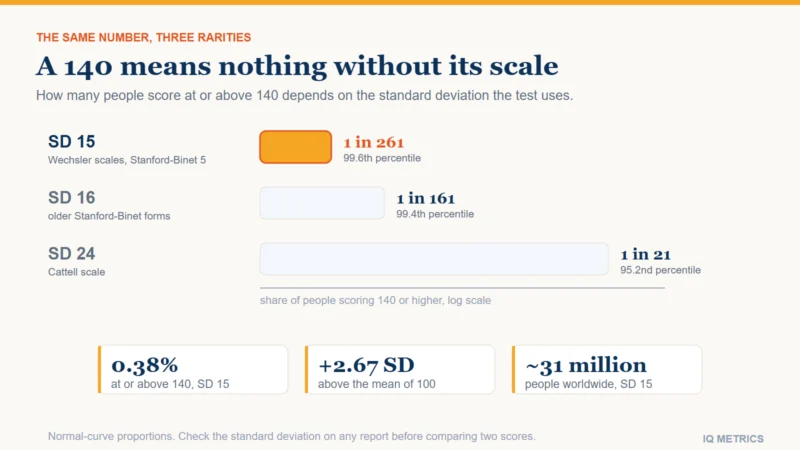 Scores & Scales
What an IQ of 140 Means
An IQ of 140 sits 2.67 standard deviations above the mean, at about the 99.6th percentile: roughly one person in 261 scores that high. It clears the gifted line and most high-IQ society cutoffs, but no current test manual calls it genius, and a single 140 is far less exact than the number suggests.
 Scores & Scales
What an IQ of 160 Means
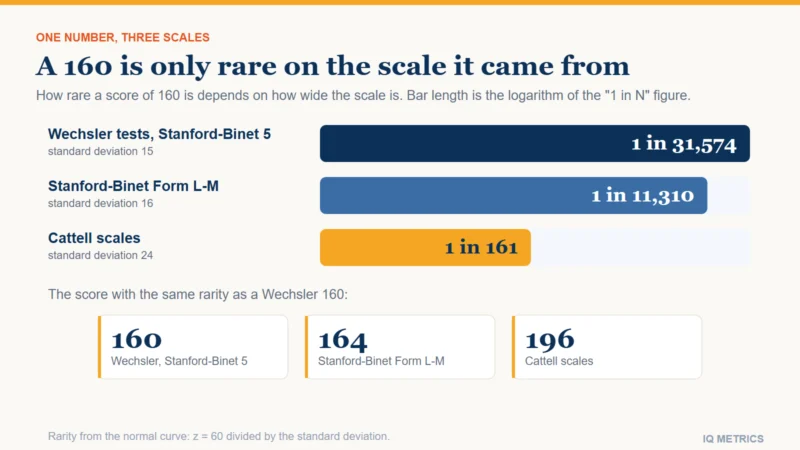
An IQ of 160 is about 1 person in 31,600 on a standard deviation 15 scale, but only 1 in 161 on the Cattell scale. What a 160 means on each scale, which tests can print one, how accurate it is, what it predicts and where the claims come from.
 Taking a Test
GRE and LSAT Scores to IQ
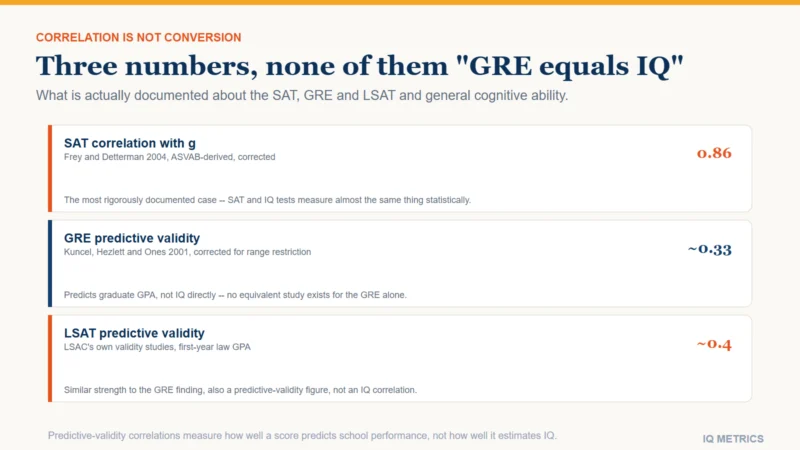
There is no official GRE-to-IQ or LSAT-to-IQ conversion. See what the SAT research actually found, what the GRE and LSAT predict instead, and why online conversion calculators have no scientific basis.