





What Does an IQ of 135 Mean? The Top 1% Explained
An IQ of 135 is the 99th percentile: one person in 102 on the Wechsler scale, but only 1 in 14 on the Cattell scale. Rarity of every score from 130 to 139, the cut-off Terman really used, how precise a 135 is, and what it predicts.

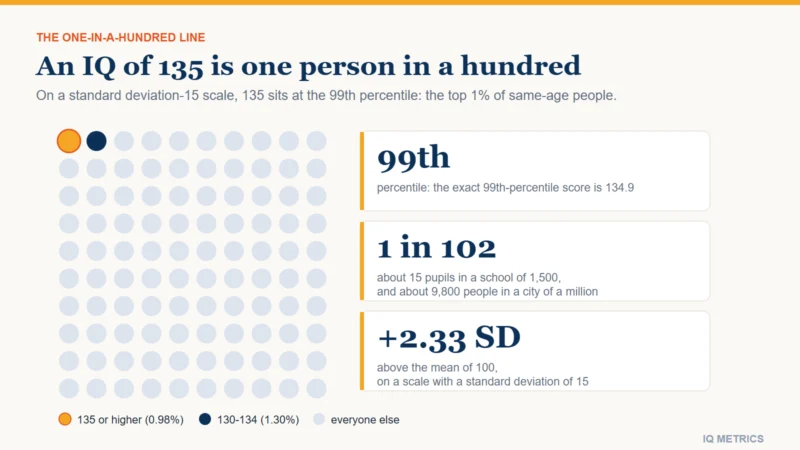
An IQ of 135 is the 99th percentile on the standard deviation-15 scale used by the Wechsler tests and the Stanford-Binet 5. About one person in 100 scores this high or higher (more exactly, 1 in 102), which makes it the top 1% of same-age people. It clears the 98th-percentile line that Mensa uses, sits at the entry point for societies that ask for the top 1%, and falls inside the 130-and-above band that the major test manuals label as very high. It is not a “genius” score on any current test, and the same number means something different on a scale with a different spread.
- Rarity: 99.02nd percentile, 2.33 standard deviations above the mean, 1 in 102. That is about 15 pupils in a school of 1,500 and about 9,800 people in a city of a million.
- Other scales: the same 135 is the 98.6th percentile on a standard deviation-16 scale (1 in 70) and only the 92.8th on the Cattell scale (1 in 14). The person at the 99th percentile scores 134.9, 137.2 and 155.8 on the three.
- Precision: on the current Wechsler tests an observed 135 is best read as a true score of roughly 128 to 139.
- What it predicts: better average outcomes in education and work, weaker links to wealth, and no sign that the benefit stops at the top.
This article covers the rarity of every score from 130 to 139, where 135 turns up as a line (Terman’s study, high-IQ societies, the test manuals), how precise a 135 is on three current tests using the publishers’ own reliability figures, what it predicts in studies that other pages on this site do not cover, and how to read a 135 from an old test or an online quiz. The neighbouring scores have their own pages: is 130 IQ a genius score? and what an IQ of 140 means.
How rare is an IQ of 135?
On a normal curve with a mean of 100 and a standard deviation of 15, an IQ of 135 sits 35 points, or 2.33 standard deviations, above the middle. That leaves 0.98% of people at or above it: 1 in 102. Scaled up, that is about 15 pupils in a school of 1,500, around 9,800 people in a city of a million, roughly 980,000 in a country of 100 million and about 80 million people worldwide. The 130s are not a flat band. Each point removes a larger share of the people still left above it, so a 139 is more than twice as rare as a 135.
| IQ | Percentile | People at or above |
|---|---|---|
| 130 | 97.72nd | 1 in 44 |
| 131 | 98.06th | 1 in 52 |
| 132 | 98.36th | 1 in 61 |
| 133 | 98.61st | 1 in 72 |
| 134 | 98.83rd | 1 in 85 |
| 135 | 99.02nd | 1 in 102 |
| 136 | 99.18th | 1 in 122 |
| 137 | 99.32nd | 1 in 147 |
| 138 | 99.44th | 1 in 177 |
| 139 | 99.53rd | 1 in 215 |
The table picks up where is a 120 IQ high? leaves off and hands over to the 140s table in what an IQ of 140 means. How rare a high IQ score is compares the rarity at every threshold, and the IQ percentile calculator places any score on the same curve.
Is 135 the same on every scale?
No. A score belongs to a scale, and the scale is set by the standard deviation the test uses. Most modern clinical tests use 15. Older Stanford-Binet forms and the CogAT use 16, and the Cattell scale uses 24.
| Scale | Percentile of a 135 | Rarity | Score at the 99th percentile |
|---|---|---|---|
| SD 15 (Wechsler, Stanford-Binet 5) | 99.0th | 1 in 102 | 134.9 |
| SD 16 (older Stanford-Binet forms, CogAT) | 98.6th | 1 in 70 | 137.2 |
| SD 24 (Cattell) | 92.8th | 1 in 14 | 155.8 |
So a 135 on a Cattell-type scale is a good result and not a rare one, and a person who really is in the top 1% would report about 156 on it. Mensa’s own entry table shows the same effect from the other side: its qualifying scores are 130 on the Wechsler tests but 148 on the Cattell scale. The IQ score converter moves a score between scales, and standard deviation 15 versus 16 explains where the two common scales come from.
Where does 135 show up as a line?
The best-known 135 is historical. Lewis Terman’s Genetic Studies of Genius, begun in California in 1921, screened an estimated 168,000 schoolchildren through teacher nominations and successive tests, and followed 1,528 of them by 1928. Terman’s working lower limit was an IQ of about 140 on the 1916 Stanford-Binet for children under 11, relaxed for older children, with 135 accepted for siblings and special cases; most later accounts simply say 135 or above. Those were ratio IQs, mental age divided by chronological age, so the same number was not equally rare at every age (see deviation IQ versus ratio IQ). The group averaged about 150 on that scale, and it grew up less religious than the general public, a finding covered in IQ and religion.
The footnote everyone remembers is that two boys who were tested but missed the cut, William Shockley and Luis Alvarez, went on to win the Nobel Prize in Physics, while none of the selected children did. It is usually read as a failure of IQ testing. A 2020 simulation by Russell Warne and colleagues in Intelligence, which modelled the tests’ reliability and how rare a Nobel Prize is, found that Terman was unlikely to have selected either man: the chance of missing both was between about 53% and 83%, depending on the assumptions, mostly because the prize is so rare and the minimum IQ so high. Shockley’s childhood scores are reported second-hand as 129 and then 125. A cut-off can find high ability without being able to predict very rare outcomes.
Other lines sit near 135 too. High-IQ societies set their rules as percentiles, which is why the qualifying number changes from test to test (high-IQ societies explained covers what each accepts as evidence):
| Society | Line | A 135? |
|---|---|---|
| Mensa | 98th percentile: 130 on the Wechsler tests and Stanford-Binet 5, 148 on the Cattell | Yes, on an approved supervised test; unsupervised online scores are not accepted |
| Intertel | 99th percentile, about 135 | At the line |
| International Society for Philosophical Enquiry | 99.9th percentile | No |
| Triple Nine Society | three standard deviations above the mean: 146 on the WAIS and Stanford-Binet 5 | No |
| Prometheus Society | roughly the top one in 30,000 | No |
The test manuals themselves have no separate label for 135. The WAIS-IV calls 130 and above “Very Superior”, the WISC-V calls it “Extremely High”, and the Stanford-Binet 5 places the 130s in a gifted or very advanced band. None of them uses the word genius.
Who has a documented 135?
Very few public figures have a score anyone can trace. One is the chess champion Garry Kasparov: our Garry Kasparov profile records a test battery commissioned by Der Spiegel in Hamburg in the late 1980s that returned an overall 135, with the memory subtests at the top of the scale, and notes that the 190 attached to his name has no source. That is the pattern to expect: a documented score is usually far more modest than the number that circulates. Celebrity IQ numbers: where they come from explains how the circulating figures get made.
How precise is a 135 on the current Wechsler tests?
Less precise than it looks, and the publishers’ own figures show by how much. Every IQ carries a standard error of measurement, and for a high score the true value is expected to sit slightly closer to 100 than the observed one. Using each test’s reported reliability, an observed full-scale score of 135 works out like this:
| Test | Full-scale reliability | Standard error | Likely true score for an observed 135 | Same-test retest |
|---|---|---|---|---|
| WAIS-IV | .97 to .98 | about 2.1 | about 130 to 138 | about +4 to +5 points |
| WAIS-5 | .97 average | 3.0 | about 129 to 139 | +2 to +4 points |
| WISC-V | .96 | 2.9 average | about 128 to 139 | retest correlation .91 over 26 days |
The ranges use the standard estimated-true-score method: the observed score is pulled toward 100 by the reliability, then widened by 1.96 standard errors. The WAIS-IV standard error is the value implied by its reliability. Two effects pull in opposite directions on a retest. Regression to the mean means a 135 is expected to come back at about 132 to 134 (regression to the mean explains why). Practice pushes the other way: the meta-analysis of retest effects by Scharfen, Peters and Holling found a gain of about a third of a standard deviation, roughly 5 IQ points, on the second sitting of the same kind of test, and on the Wechsler tests themselves the reported gains were about 2 to 5 points (what practice actually changes).
Three further limits apply near 135. First, the tail of the norm sample is thin: on a normal curve only about 22 of the 2,200 children in the WISC-V norm sample would score 135 or higher. Second, the scale has room, because full-scale scores on the WAIS-IV and WISC-V run from 40 to 160 and 135 is nowhere near the ceiling, although online tests often cap lower: Mensa Norway’s own online test reports scores from 85 to 145 and says it is no substitute for professional testing. Third, old norms flatter. Scores rose about 2.8 points a decade in Pietschnig and Voracek’s meta-analysis of 271 samples and roughly four million people, so a 135 earned on 20-year-old norms is worth about 129 on current ones if the 0.3-point-a-year correction used in disability diagnoses is applied. That correction was built for a different purpose, so treat it as a sense of scale. Why IQ norms expire covers the Flynn effect and its recent stall.
Where would your own score land?
Take the IIF-certified assessment and get your score with the scale it was measured on, the percentile it corresponds to and the confidence range around it — the three figures most online tests leave out.
Find your IQ score now! →What does an IQ of 135 predict?
For groups, quite a lot; for one person, much less. The 140 article covers the Study of Mathematically Precocious Youth. Four other bodies of evidence put a 135 in context:
- Education and work. Tarmo Strenze’s meta-analysis of longitudinal studies found intelligence correlated .56 with education, .43 with occupational status and .20 with income. It is a strong predictor but, as does IQ predict income explains, not an overwhelmingly better one than parental status or school grades.
- Money. In a large US cohort (NLSY79), Jay Zagorsky found each extra IQ point went with roughly $200 to $600 more income a year after controls, and correlations of .30 with income but only .16 with net worth. The regressions found no statistically distinguishable link with wealth, and some measures of financial distress, such as missed payments, rose at higher scores. A 135 is not a wealth guarantee.
- Job performance. The widely cited estimate that cognitive ability correlates about .5 with job performance (Schmidt and Hunter, 1998) was revised to about .31 in 2022 by Paul Sackett and colleagues, who argued that earlier corrections for restricted range had overshot. Ability still matters; the older figure overstated it. See what a score predicts at work.
- No ceiling on the benefit. Matt Brown, Jonathan Wai and Christopher Chabris analysed four longitudinal studies with 48,558 participants and found no threshold beyond which higher ability stopped predicting better outcomes, and no disadvantage of high ability. Spearman's law of diminishing returns covers the related question of whether g itself weakens at high ability.
None of these studies isolates a 135. They describe the trend a 135 sits on, and even a strong correlation leaves most of the variation in any one life to other things: a correlation of .43 accounts for about 18% of the variance.
If you or your child scored 135
Read it as a range, not a point: the low 130s to about 139 on a current Wechsler test, on the scale that test used. Before comparing it with anyone else’s number, check four things: which test, which scale (the standard deviation), how old its norms are and whether it was taken under supervision. A proctored result is far stronger evidence than a one-off online quiz, and how to read an IQ test report shows where each of those appears on a real report. For a child, the score is a ranking among children of the same age, not a fixed trait; IQ test questions for kids covers how children’s tests work, how stable their scores are and what programmes do with them.
Quick answers
Is an IQ of 135 good?
Yes. It is the 99th percentile on the standard scale, the top 1%, above the Mensa line and inside the highest band of the Wechsler manuals.
Is 135 IQ genius?
Not by any current manual. None uses the word genius, and a 135 sits inside the “very high” bands. See is 130 IQ a genius score? for the history of the label.
What percentile is an IQ of 135?
The 99.02nd percentile on a standard deviation-15 scale, the 98.6th on a standard deviation-16 scale and the 92.8th on the Cattell standard deviation-24 scale.
Can you join Mensa with an IQ of 135?
Yes, if the score comes from an approved supervised test. Mensa accepts 130 on the Wechsler tests, and unsupervised online scores do not count.
Is 135 IQ gifted?
It is above every gifted line in common use. School programmes range from around the 95th to the 97th percentile on group tests (about 125 to 128 on a standard deviation-15 scale) up to 145 and above at some highly selective ones; gifted cutoff scores explains why one line still misses children it should find.
The bottom line
An IQ of 135 is the top 1%: one person in about 100 on the Wechsler scale, past Mensa’s line, at Intertel’s, and inside the highest band of the test manuals. It is a range of roughly 128 to 139 rather than a point, it means something different on a scale with a different spread, it needs a check for old norms, and it predicts better average outcomes in education and work without guaranteeing wealth or greatness. The number that travels between tests is not 135 but 99, the percentile.
Sources
- Warne, Larsen and Clark (2020), Intelligence: low base rates and a high IQ selection threshold prevented Terman from identifying future Nobelists.
- Leslie (2000), Stanford Magazine: the vexing legacy of Lewis Terman.
- Scharfen, Peters and Holling (2018), Intelligence: retest effects in cognitive ability tests.
- Pietschnig and Voracek (2015), Perspectives on Psychological Science: one century of global IQ gains.
- Strenze (2007), Intelligence: intelligence and socioeconomic success.
- Zagorsky (2007), Intelligence: do you have to be smart to be rich?
- Sackett et al. (2022), Journal of Applied Psychology: revisiting meta-analytic estimates of validity in personnel selection.
- Brown, Wai and Chabris (2021), Perspectives on Psychological Science: can you ever be too smart for your own good?
- US Mensa: qualifying test scores.
Keep reading
All articles →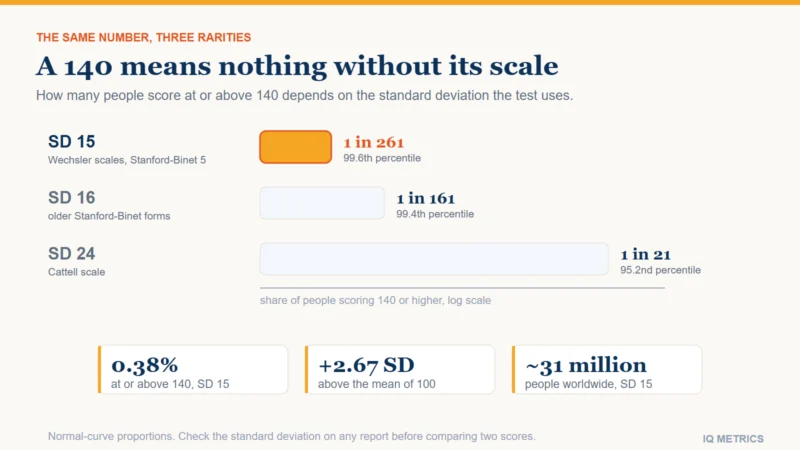 Scores & Scales
What an IQ of 140 Means
An IQ of 140 sits 2.67 standard deviations above the mean, at about the 99.6th percentile: roughly one person in 261 scores that high. It clears the gifted line and most high-IQ society cutoffs, but no current test manual calls it genius, and a single 140 is far less exact than the number suggests.
 Scores & Scales
Is 130 IQ a Genius Score?
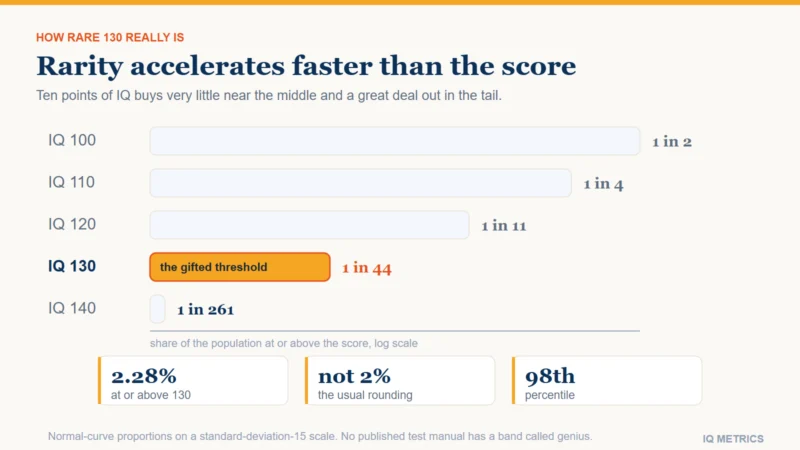
A score of 130 is the conventional threshold for gifted identification and for high-IQ society membership, and it is reached by about one person in 44. It is not, however, a "genius" score, because no published test defines such a band. The word is a popular import, and the difference is worth understanding.
 Scores & Scales
High-IQ Societies Explained
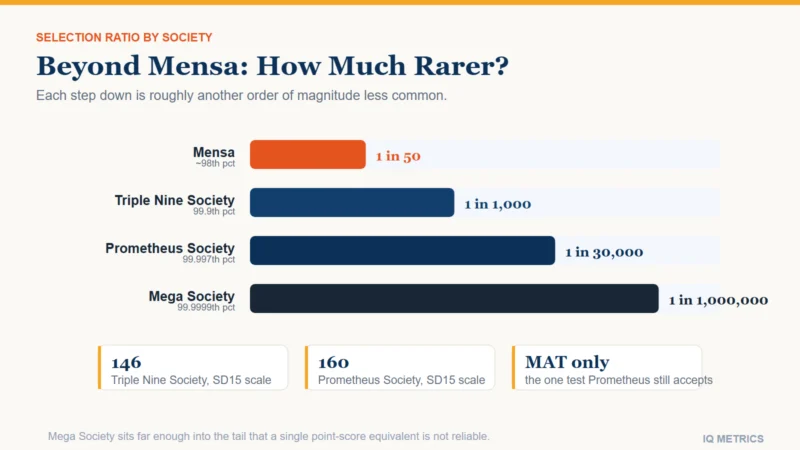
Mensa is the famous one, but it is nowhere near the most exclusive. The Triple Nine Society admits one person in a thousand; the Prometheus Society, one in thirty thousand. Here is how each threshold is actually set, what test you would need, and why the further out you go, the less any single number can be trusted.