





Talent vs Practice: What Decides How Good You Get?
The 10,000-hour rule made a strong claim: expert performance is built by practice, not given by talent. When researchers pooled the studies that had actually measured it, practice explained about a quarter of the difference between people in games and almost none in professional work. Here is what fills the rest of the gap.

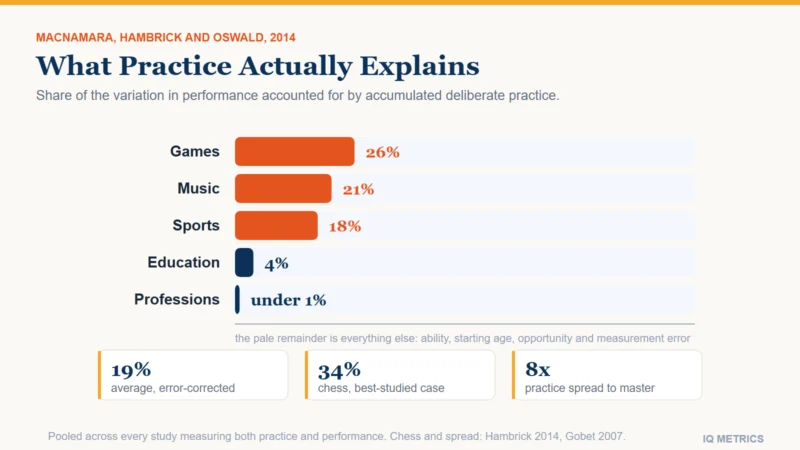
Practice matters enormously and it does not explain most of the difference between people. Those two statements are both supported, and holding them together is the whole of this subject. When Brooke Macnamara, David Hambrick and Frederick Oswald pooled every study that had measured accumulated practice against performance, practice accounted for 26 percent of the variance in games, 21 percent in music, 18 percent in sports, 4 percent in education and less than 1 percent in professional work. Averaged across domains and corrected for measurement error, about 19 percent.
That is a large effect by the standards of psychology and a small one relative to what was claimed. This article traces how the claim got made, what the numbers look like domain by domain, what occupies the remaining variance, and what any of it means for a test score.
Where the 10,000-hour rule came from
The research behind the slogan is a 1993 study by Anders Ericsson and colleagues of violinists at a Berlin music academy. The best students had accumulated substantially more solitary, effortful practice than the good ones. Ericsson called this deliberate practice and drew a sharp distinction between it and merely playing a lot: it is structured, aimed at a specific weakness, and immediately corrected.
Two things then happened. The finding was popularised as a threshold — ten thousand hours and you are an expert — which Ericsson himself disowned, since the figure was an average for one group in one conservatoire and not a target. And the stronger theoretical claim, that individual differences in expert performance are largely or wholly a product of deliberate practice, became the thing everyone remembered. That claim is testable, and it has now been tested a great deal.
What happened when the studies were pooled
The 2014 meta-analysis is the central result. Its design is simple: gather every study that recorded both accumulated deliberate practice and a performance measure, and see how strongly they relate. The domain-by-domain spread turned out to be far more informative than the average.
- Games — 26 percent of variance explained, the strongest domain, and chess supplies most of the data.
- Music — 21 percent, the domain the original claim was built on.
- Sports — 18 percent.
- Education — 4 percent.
- Professions — under 1 percent, which is to say essentially nothing.
The gradient is the finding. Practice explains most where the task is stable, closed and well-defined, and almost nothing where the work is variable and the goalposts move. A chess position obeys the same rules it did a century ago; a job does not. So the ten-thousand-hours framing is least wrong exactly where people are least likely to apply it, and least applicable to the careers it is usually invoked about.
Chess is the best-studied case
Chess is where the evidence is richest, because ratings give a continuous, well-calibrated performance measure that few domains can match. A 2014 reanalysis by Hambrick, Oswald, Altmann, Meinz, Gobet and Campitelli put deliberate practice at 34 percent of the reliable variance in chess skill and 29.9 percent in music. A third is a lot. It is also not most of it.
The more striking number comes from a 2007 study by Fernand Gobet and Guillermo Campitelli of 104 Argentinian players ranging from weak amateurs to grandmasters. The minimum practice needed to reach master level was around 3,000 hours — and the slowest player to get there had needed roughly eight times as much as the fastest. Both reached the same title. If practice hours were the mechanism, that spread should not exist.
Note the boundary of this claim. It is about how much practice buys you at the top of one game, not about whether playing chess makes you generally smarter, which is a different question with a different answer — covered in the article on chess and IQ.
Where would your own score land?
Take the IIF-certified assessment and get your score with the scale it was measured on, the percentile it corresponds to and the confidence range around it — the three figures most online tests leave out.
Find your IQ score now! →So what is the rest of the variance?
Some of it is measurement. Retrospective estimates of practice hours are self-reported and often reconstructed years later, which attenuates any correlation and means the true effect is somewhat larger than the raw numbers suggest. The 2014 meta-analysis corrected for this, which is why its corrected figures run higher, and honest accounting has to concede it.
Beyond that, several factors have real support. Starting age matters independently of total hours. Working memory capacity predicts performance in some domains even among people matched on practice, and it is worth being precise that this is a capacity distinct from reasoning ability — the difference is set out in the piece on working memory and reasoning. And reasoning ability itself predicts the early rate of skill acquisition particularly strongly, which is why measures of fluid ability show up in expertise research at all.
There is also a selection effect that is easy to miss. People who improve quickly tend to enjoy the activity and keep going; people who improve slowly tend to stop. Accumulated practice is therefore partly an outcome of early aptitude rather than purely a cause of later skill, and no correlational design can fully separate the two.
One more caveat cuts the other way, and it is the reason these percentages should not be read as constants. Variance explained depends on who is in the sample. Study only grandmasters and almost everyone has practised enormously, so practice explains little of what separates them; widen the sample to include beginners and the same variable suddenly explains a great deal. Much of the expertise literature deliberately samples near the top, which pushes the practice figure down. The gradient across domains survives this objection, because it compares like with like, but any single number does not travel well outside the sample that produced it.
Ericsson objected, and the objection is partly fair
Ericsson’s response was that the meta-analysis diluted his construct: many of the pooled studies measured accumulated experience or general practice, not deliberate practice in his strict sense of individualised, coached, immediately corrected work on a specific weakness. That is a real methodological objection and it is probably right that the pooled figure understates properly-defined deliberate practice.
It also does not rescue the strong claim. Even within chess and music, where the measures come closest to his definition, the figure lands around a third. And the strict definition creates a problem of its own: if only practice that produces improvement counts as deliberate, the theory becomes difficult to falsify. The defensible position that survives both sides is that deliberate practice is necessary and not sufficient.
Why this is not an argument for giving up
The variance-explained framing answers a question about differences between people who are already competing. It does not tell an individual what returns their own effort will produce, and those are two different questions. Nobody reaches master level at anything on 300 hours. The floor is real even where the ceiling is unevenly distributed, and almost everyone reading this is nowhere near their own floor.
What the evidence does argue against is the inference that someone who improved slowly did not try hard enough. That is the moral sting of the strong practice claim, and it is not supported. It also argues against the reverse error — reading a test score as a verdict on your ceiling. A score is a measurement of current ability under specific conditions, which is why what a score predicts about later outcomes is always a matter of averages and never of individuals.
What it means for your own score
Treat ability and practice as inputs that multiply rather than as rivals. Higher reasoning ability buys a faster rate of return on the same hours, which is why it shows up in early acquisition; sustained practice compounds whatever rate you have, which is why it dominates at the top of narrow, stable domains. Neither substitutes for the other, and a score tells you about one input on one day.
If the underlying question is whether the ability itself can be moved, that is covered in what actually raises a score, and the specific claim that believing ability is malleable changes outcomes is examined in the growth mindset evidence. To get a current measurement rather than an estimate, take a properly normed test.
Keep reading
All articles →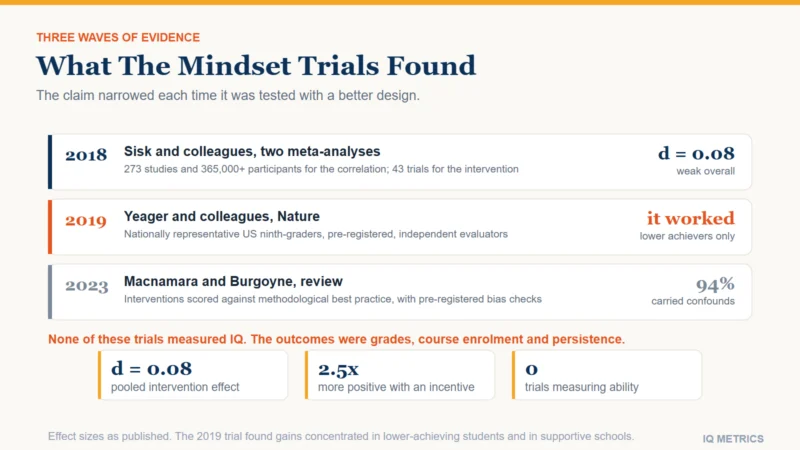 Research & Evidence
Growth Mindset and Intelligence
The claim that believing intelligence is malleable makes you achieve more is one of the most widely taught ideas in education, and one of the most heavily contested in the research literature. Three waves of evidence have now landed. Here is what each found, and the question none of them actually answered.
 Understanding IQ
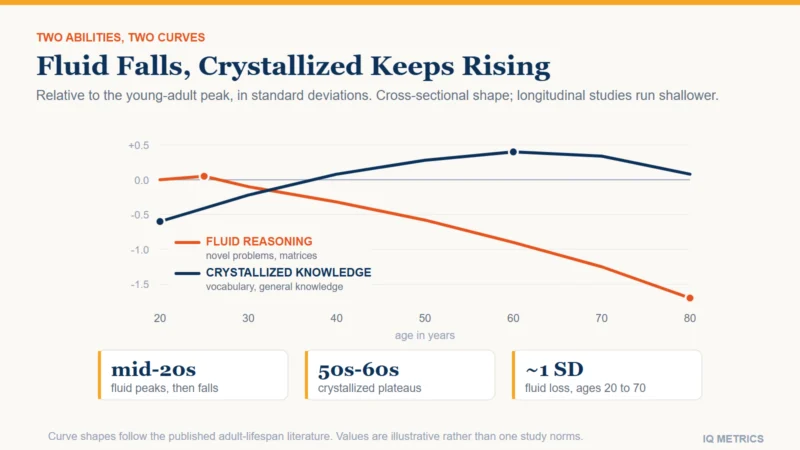
Fluid vs Crystallized Intelligence
Fluid intelligence is what you use on a problem you have never seen before. Crystallized intelligence is everything you have already banked. The distinction has survived eighty years of factor analysis because the two halves genuinely behave differently, and the clearest proof is what happens to each one as you get older.
 Mind & Everyday Life
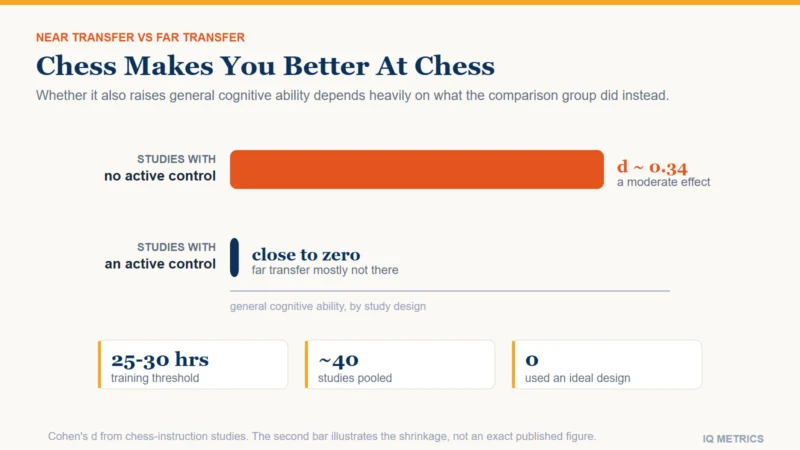
Does Chess Raise Your IQ?
Chess is one of the oldest test cases for a big question: does practicing a demanding mental skill make you generally smarter, or just better at that skill? The honest summary from decades of research: real for chess itself, modest for a couple of related skills, and close to zero for general IQ.