





What Does an IQ of 140 Mean? Rarer Than 1 in 250
An IQ of 140 sits 2.67 standard deviations above the mean, at about the 99.6th percentile: roughly one person in 261 scores that high. It clears the gifted line and most high-IQ society cutoffs, but no current test manual calls it genius, and a single 140 is far less exact than the number suggests.

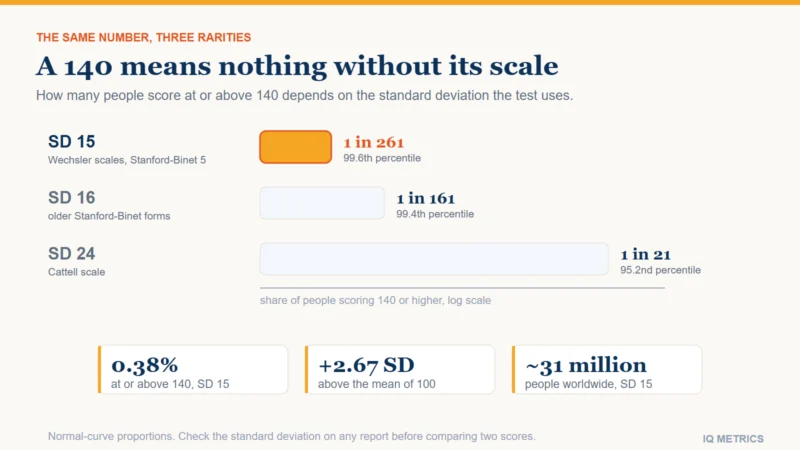
An IQ of 140 is very rare. On a test scaled to a mean of 100 and a standard deviation of 15 — the scale used by the Wechsler tests and the Stanford-Binet 5 — a 140 sits 2.67 standard deviations above the mean, at about the 99.6th percentile. Roughly one person in 261 scores 140 or higher.
That puts 140 in the gifted range on every major test. It is not, on any current test manual, a “genius” score, and the same number means something quite different on a test built on a wider scale. This article covers how rare an IQ of 140 really is, what the manuals call it, how much a single 140 can be trusted, and what it does and does not predict.
How rare is an IQ of 140?
IQ scores describe position, not quantity. A test is normed on a large representative sample, the middle of that sample is set at 100, and one standard deviation is set at 15 points. A 140 is 40 points above the middle, which is 2.67 standard deviations, and on a normal curve that leaves about 0.38% of people at or above it.
- 99.6th percentile: about 996 people in 1,000 score below 140.
- 1 in 261 people score 140 or higher.
- About 380,000 people in a country of 100 million, and on the same arithmetic roughly 31 million worldwide.
Rarity climbs steeply from here, which is why the 140s are not one band but ten quite different levels of rarity. Each extra point removes a larger share of the people still left above it. The IQ percentile calculator places any score on the same curve.
| IQ score | Percentile | At or above |
|---|---|---|
| 140 | 99.62nd | 1 in 261 |
| 141 | 99.69th | 1 in 319 |
| 142 | 99.74th | 1 in 391 |
| 143 | 99.79th | 1 in 482 |
| 144 | 99.83rd | 1 in 596 |
| 145 | 99.87th | 1 in 741 |
| 146 | 99.89th | 1 in 924 |
| 147 | 99.91st | 1 in 1,157 |
| 148 | 99.93rd | 1 in 1,455 |
| 149 | 99.95th | 1 in 1,838 |
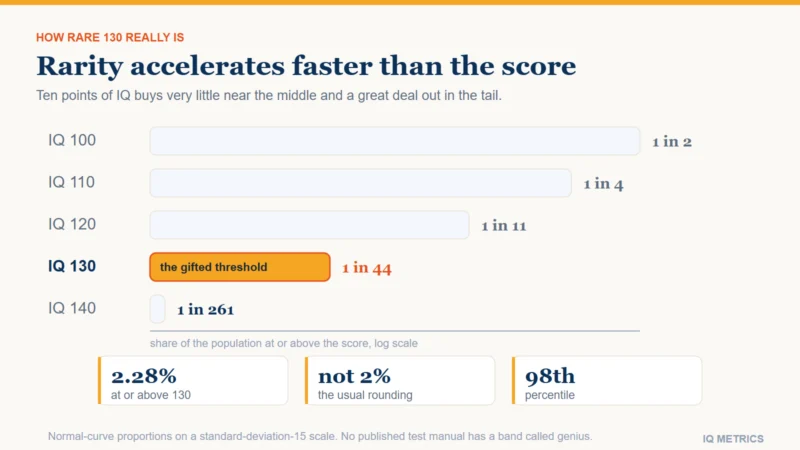
A 145 is almost three times rarer than a 140, and a 149 about seven times rarer. The same acceleration explains the gap below: a 130, the usual gifted threshold, is reached by one person in 44, while 140 is reached by one in 261.
Is 140 IQ genius?
No current intelligence test has a band called genius. The label comes from the first American revision of the Binet scale: in 1916 Lewis Terman described scores above 140 as “near genius or genius,” while calling his own boundary lines “absolutely arbitrary.” Terman dropped the word by the 1937 revision and no major test since has used it, but the number stuck, and it is why 140 is still the figure most often quoted as the genius line.
What the manuals say today is more careful:
- WAIS-IV (adults): 130 and above is Very Superior.
- WISC-V (children): 130 and above is Extremely High.
- Stanford-Binet 5: 130 to 144 is gifted or very advanced; 145 to 160 is very gifted or highly advanced.
Researchers who work with gifted children use finer bands. In Miraca Gross’s widely used scheme, 130 to 144 is moderately gifted and 145 to 159 highly gifted, so a 140 sits near the top of the moderate band. Terman’s own long-running study of 1,528 high-scoring children shows how loosely “genius” fits a test score: two boys who were tested but did not make the cut, William Shockley and Luis Alvarez, both later won the Nobel Prize in Physics, and none of the children who were selected ever won one.
A 140 on one test is not a 140 on another
Every IQ score belongs to a scale, and the scale is set by the standard deviation the test uses. Most modern clinical tests use 15. Some older tests and many online quizzes use 16 or 24, and on those scales a 140 is a much more common result.
| Scale | Percentile of 140 | At or above | Same position on SD 15 |
|---|---|---|---|
| SD 15 (Wechsler, Stanford-Binet 5) | 99.6th | 1 in 261 | 140 |
| SD 16 (older Stanford-Binet forms) | 99.4th | 1 in 161 | about 137 |
| SD 24 (Cattell scale) | 95.2nd | 1 in 21 | about 125 |
A 140 on a standard deviation 24 test sits where a 125 sits on the Wechsler scale: well above average, but short of the usual gifted line. Mensa’s own entry table shows the same effect from the other direction: the top 2% it requires is a 130 on the Wechsler tests but a 148 on the Cattell scale. The IQ score converter moves a score between scales, and why one percentile carries three numbers explains where the different scales came from.
How precise is a score of 140?
Less precise than it looks. Every score carries a standard error of measurement, so test publishers report a 95% confidence interval about 10 to 11 points wide, and for high scores that interval leans back toward the average. Pearson’s own WISC-V sample report shows a full-scale 132 with an interval of 125 to 136. Worked the same way, a measured 140 is best read as a true score probably somewhere between about 133 and 144. An IQ score is a range, not a number shows how that interval is built.
Three things add extra uncertainty to scores this high:
- Thin norms at the top. The WAIS-IV was normed on 2,200 people. On a normal curve only about eight of them would score 140 or higher, so the top of the scale rests on very few real test-takers.
- Regression to the mean. Part of any extreme score is luck on the day, so retested high scorers usually come back a little lower even though nobody lost any ability. In a worked example by researchers David Lohman and Katrina Korb, a 130 on a test with a retest correlation of 0.8 is expected to return as about 124; regression to the mean explains why.
- Old norms. Scores on the modern Wechsler and Stanford-Binet tests drifted upward by close to three points a decade as their norms aged (Trahan and colleagues, 2014), so an outdated edition can flatter a result. See why IQ norms expire.
None of this makes a 140 meaningless. It means the honest statement is a range with a probable center, which is how a proper IQ test report presents it.
Where would your own score land?
Take the IIF-certified assessment and get your score with the scale it was measured on, the percentile it corresponds to and the confidence range around it — the three figures most online tests leave out.
Find your IQ score now! →What does an IQ of 140 predict?
For groups, quite a lot. The Study of Mathematically Precocious Youth followed 2,385 children who all scored in the top 1% on the math section of the SAT at age 13. Twenty-five years later, 33.2% of the top quarter of that group had earned a doctorate, against 15.4% of the bottom quarter, and the top quarter were about six times as likely to hold a patent (Robertson and colleagues, 2010). It was a math reasoning test rather than an IQ test, but the lesson carries over: even inside the top 1%, more ability still made a measurable difference.
For one person, much less. A single score accounts for only a modest share of the differences in income between people, and Terman’s selected children mostly grew into healthy, well-educated professionals rather than a run of historic discoveries. Interests, effort, opportunity and health decide much of what a 140 cannot.
Does 140 qualify for Mensa and other high-IQ societies?
For most of them, yes. Societies set their entry rules as percentiles rather than raw scores, which is why the qualifying number changes from test to test:
- Mensa: the 98th percentile, which is 130 on the Wechsler tests. A 140 qualifies.
- Intertel: the 99th percentile, about 135 on a standard deviation 15 scale. A 140 qualifies.
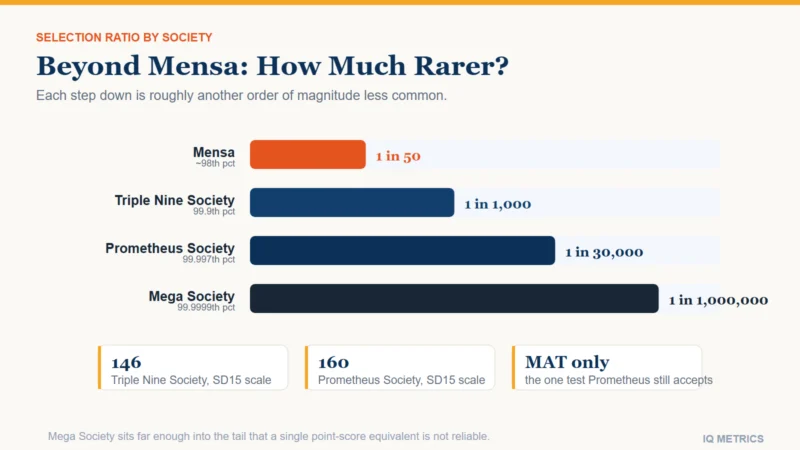
- Triple Nine Society: the 99.9th percentile, about 146. A 140 falls short.
- Prometheus Society: the 99.997th percentile, roughly 1 in 30,000 or about 160. A 140 is far short.
High-IQ societies explained covers what each group accepts as evidence, and Mensa’s score requirements lists the qualifying score test by test.
A child who scores 140 and an adult who scores 140
Statistically the two mean the same thing, because every age group is scored against its own norms. In practice they behave differently. Scores in early childhood are noticeably less stable than adult scores, so a young child’s 140 is a strong reason to support and stretch that child rather than a permanent ranking. Many schools set their gifted line at 130, which a 140 clears with room to spare; gifted cutoff scores explains why a single line still misses children it should find.
Why so many online tests say 140
Scores in the 140s are the most common “high” result on unsupervised online quizzes, and famous people are routinely credited with numbers in the same range. Neither usually has a norm sample behind it. A quiz can choose its own mean and spread, publish no standard deviation at all and let people retake it until the number looks right, and most celebrity IQ figures trace back to no test whatsoever. The word genius travels just as loosely, all the way to rankings of dog breeds.
Before trusting a 140, check three things: which scale produced it, how large and how recent the norm sample was, and what confidence range came with it.
If you scored 140
Read it as a range: probably somewhere in the low 130s to mid 140s on the scale your test used, a genuinely high result shared by roughly one person in a few hundred. Check the standard deviation before comparing it with anyone else’s score, keep the confidence interval attached when you quote it, and treat a professionally administered result as far stronger evidence than a one-off online quiz.
The mirror-image score sits exactly as far below the mean: an IQ of 70 is just as rare as a 140, and it shows even more clearly why a single number is only the start of an assessment.
Keep reading
All articles →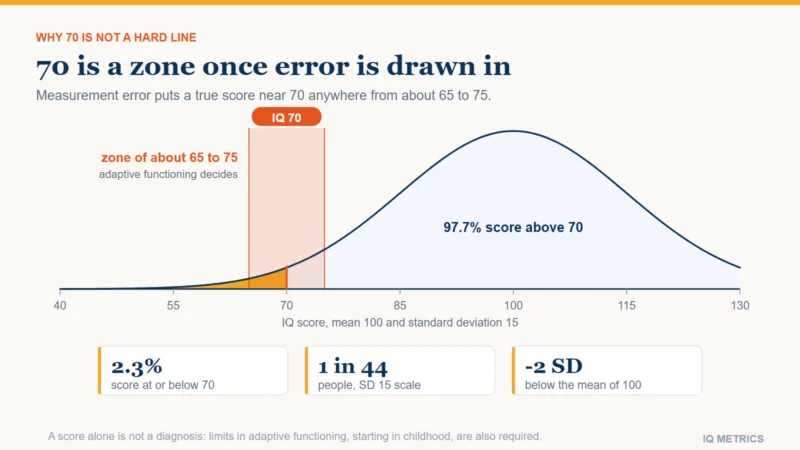 Scores & Scales
What an IQ of 70 Means
An IQ of 70 sits two standard deviations below the mean, at about the 2nd percentile. It is the score most often linked with intellectual disability, but a diagnosis never rests on the number alone: measurement error turns the line into a zone, and adaptive functioning decides who is inside it.
 Scores & Scales
Is 130 IQ a Genius Score?
A score of 130 is the conventional threshold for gifted identification and for high-IQ society membership, and it is reached by about one person in 44. It is not, however, a "genius" score, because no published test defines such a band. The word is a popular import, and the difference is worth understanding.
 Scores & Scales
High-IQ Societies Explained
Mensa is the famous one, but it is nowhere near the most exclusive. The Triple Nine Society admits one person in a thousand; the Prometheus Society, one in thirty thousand. Here is how each threshold is actually set, what test you would need, and why the further out you go, the less any single number can be trusted.