





IQ and Alcohol: What the Research Actually Shows
Heavy drinking clearly harms cognition; moderate drinking is genuinely contested. See what a 2022 UK Biobank study found, why older research claimed a protective effect, and why newer reviews are walking that back.

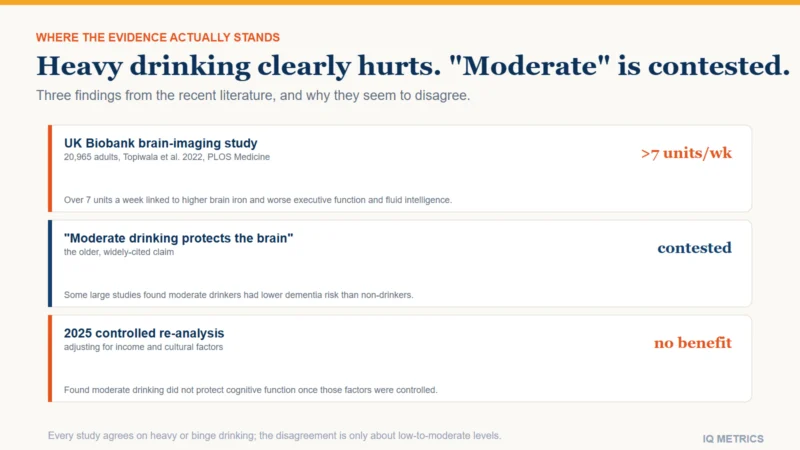
Heavy drinking damages the brain in ways that show up clearly on cognitive tests; that part of the picture is settled. What counts as “moderate” drinking, and whether it carries any real risk to thinking ability, is genuinely contested among researchers right now, with large, well-designed studies reaching different conclusions within the last few years. This article covers what is settled, what a major 2022 brain- imaging study found even at moderate levels, why older research suggested moderate drinking might protect against decline, and why more recent, better-controlled analyses are walking that back.
- Settled: heavy and binge drinking cause measurable, dose-related harm to memory, processing speed and overall brain volume.
- New finding: a 2022 UK Biobank study of 20,965 adults linked drinking more than 7 units a week to higher brain iron and worse executive function and fluid intelligence.
- Contested: some older studies found moderate drinkers had lower dementia risk than non-drinkers; a 2025 re-analysis found that advantage disappears once income and cultural factors are controlled.
- Why the disagreement: a well-known bias in this literature, sometimes called the “sick quitter” problem, inflates the apparent benefit of moderate drinking in many observational studies.
What is settled: heavy drinking and cognition
Chronic heavy alcohol use is one of the more consistently documented threats to cognitive function in the research literature. In severe, sustained cases it can produce Wernicke–Korsakoff syndrome, a serious memory disorder. Well short of that extreme, heavy use associates with dose-related shrinkage of brain volume, particularly in frontal regions tied to the same executive-function tasks an IQ test partly measures, and with measurable declines on standard cognitive batteries. This much has consistent support across decades of research and is not the part in dispute.
The 2022 UK Biobank finding on "moderate" drinking
Topiwala and colleagues (2022, PLOS Medicine) studied 20,965 UK Biobank participants who reported their own alcohol intake and had their brains scanned by MRI, with nearly 7,000 also imaged for liver iron. Drinking more than 7 units a week associated with higher markers of iron in the basal ganglia, a brain region, and higher brain iron in turn linked to worse executive function (measured with a trail-making task) and worse fluid intelligence (measured with puzzle-based tasks). The study also ran a Mendelian randomization analysis, a genetic method used to test for a plausibly causal relationship rather than pure correlation, and it supported iron accumulation as a real mechanism rather than reverse causation alone. See processing speed and IQ, memory and IQ and fluid versus crystallised intelligence for the specific abilities this kind of study measures.
Why "moderate drinking protects the brain" became conventional wisdom
Older epidemiological studies comparing drinkers against non-drinkers often found the non-drinking comparison group had worse cognitive and cardiovascular outcomes, which researchers attributed to moderate alcohol’s apparent benefits. A well-documented bias complicates that reading: many people counted as “non-drinkers” in these studies are former heavy drinkers who quit because their health was already declining, a pattern researchers call the “sick quitter” effect. That drags the comparison group’s average down and can make moderate drinkers look artificially healthy by contrast, even with no true protective effect. A large JAMA Network Open study of low-to- moderate drinking from middle to older age found the picture more mixed than the simple “moderate drinking protects” story suggests once these study-design issues are taken seriously.
What the newest reviews conclude
A 2025 study in Frontiers in Aging Neuroscience found that moderate alcohol consumption does not protect cognitive function once income and cultural factors are controlled for — the apparent benefit shrank substantially once those confounders were accounted for. Separately, a comprehensive 2025 review concluded there is currently insufficient evidence to confidently evaluate the association between moderate alcohol consumption and dementia, Alzheimer’s disease or cognitive decline, compared with never drinking at all. The honest current position is that researchers do not have a confident answer for moderate drinking either way — which is a different claim from “moderate drinking is proven safe.”
Why alcohol-and-cognition research is unusually hard to do
Nobody can ethically randomly assign people to drink a fixed amount for decades, so most of this evidence is observational, leaning on statistical corrections and genetic methods like Mendelian randomization to approximate a controlled experiment. Self-reported drinking is also known to be unreliable in both directions, “moderate” is defined inconsistently across studies (some use 7 units a week, others 14, others a daily threshold), and confounders such as diet, exercise, smoking and income all correlate with drinking patterns too. See socioeconomic status and IQ and nutrition and IQ for how the same kind of confounding complicates other correlational research on this site.
Where would your own score land?
Take the IIF-certified assessment and get your score with the scale it was measured on, the percentile it corresponds to and the confidence range around it — the three figures most online tests leave out.
Find your IQ score now! →What "units" actually means
A UK alcohol unit is 8 grams, or about 10 millilitres, of pure alcohol — roughly two-thirds of a standard US drink, which is defined as 14 grams. So the 7-units-a-week threshold in the UK Biobank study works out to a little under 5 standard US drinks spread across a week, well within what many people would casually call moderate. That unit mismatch matters when comparing findings across countries: a study reporting risk above 14 units a week in the UK is describing a level roughly equivalent to 10 US standard drinks, not 14, and conflating the two systems can make one study look far more permissive than it actually is.
Alcohol exposure before birth is a different question entirely
None of this should be confused with prenatal alcohol exposure, covered separately in fetal alcohol spectrum disorder and IQ. That is a well-established, much larger effect on a developing brain, with a different mechanism from adult drinking’s contested relationship with an already-developed one. Do not treat the two as the same finding at different doses.
What this means if you are weighing how much to drink
This is general information, not medical advice. Heavy and binge drinking carry clear, well-established cognitive risk, and that finding is not contested. For low-to-moderate drinking, the current evidence genuinely does not support a confident claim that it is either protective or clearly harmful at the population level, though the 2022 UK Biobank imaging data leans toward “not obviously safe” even at levels many people would call moderate. Anyone concerned about their own cognitive health, including how drinking history might interact with age-related decline, is better served by a proper clinical screen than by an online IQ test.
Quick answers
- Does alcohol lower your IQ? Heavy and binge drinking clearly harm cognitive function over time; moderate drinking’s effect is genuinely contested.
- How much drinking counts as "heavy"? Definitions vary by country and study, but well above 14 units a week (roughly a bottle and a half of wine) is consistently linked to harm across the literature.
- Does a daily drink protect the brain? The evidence for this once widely repeated claim has weakened considerably in recent, better-controlled studies.
- Is this the same as fetal alcohol spectrum disorder? No. That is prenatal exposure to a developing brain, a separate and more firmly established harm pathway.
- Can alcohol-related cognitive decline be reversed? Partly, in some cases, especially with sustained abstinence; the research on how much recovery is possible is still developing.
The bottom line
Heavy and binge drinking clearly harm cognitive function, a finding with decades of consistent support. Moderate drinking is where the real uncertainty lives: a 2022 UK Biobank study links levels many would call moderate to higher brain iron and worse executive function, while newer, better-controlled reviews are walking back the older belief that moderate drinking protects the brain. Treat any single confident claim in either direction with some caution — the researchers studying this closely have not reached one themselves.
Sources
- Topiwala, A. et al. (2022), PLOS Medicine 19(7): e1004039: associations between moderate alcohol consumption, brain iron and cognition in UK Biobank participants, observational and Mendelian randomization analyses.
- Frontiers in Aging Neuroscience (2025): moderate alcohol consumption does not protect cognitive function when controlling for income and cultural factors.
Keep reading
All articles →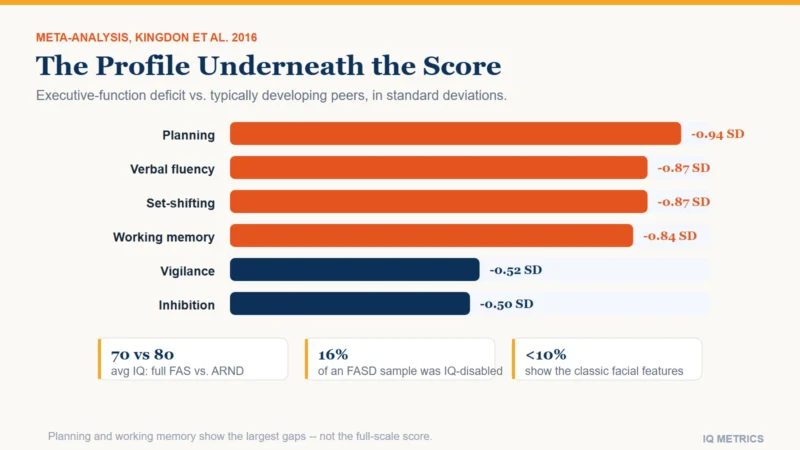 Research & Evidence
Fetal Alcohol Spectrum Disorder and IQ
A clinical study of 473 people diagnosed with fetal alcohol syndrome or its milder forms found that only 16 percent had an IQ in the intellectually disabled range. That statistic is not the reassurance it sounds like -- it is the reason the condition is so often missed. Here is what a normal-looking score can still be hiding.
 Taking a Test
Can an IQ Test Detect Dementia?
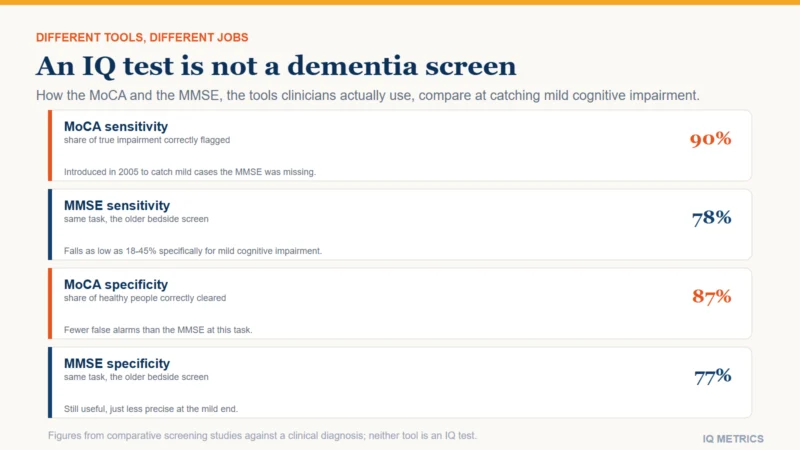
A standard IQ test cannot diagnose dementia; it has no personal baseline and was not built to screen for decline. How the MMSE and the more sensitive MoCA compare, why a normal score can hide early decline, and what actually helps catch it.
 Research & Evidence
IQ and BMI
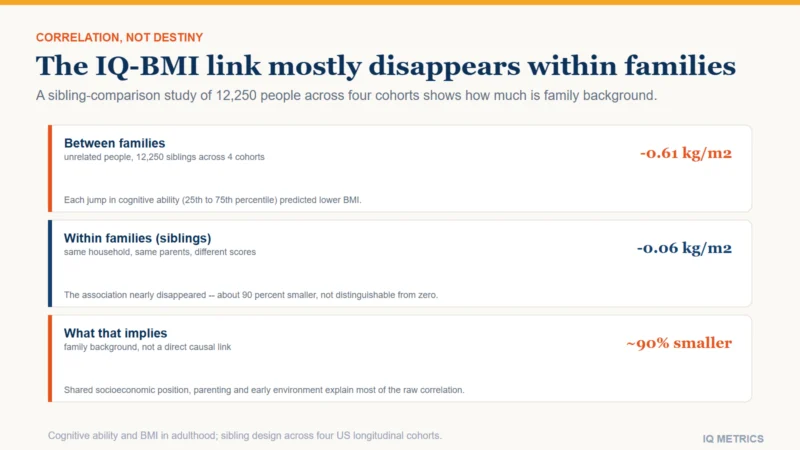
Cognitive ability and adult BMI correlate, but a sibling-comparison study found the link shrinks by about 90 percent within families. See what that implies about family background versus a direct causal effect.