





Fetal Alcohol Spectrum Disorder and IQ: The Profile a Score Hides
A clinical study of 473 people diagnosed with fetal alcohol syndrome or its milder forms found that only 16 percent had an IQ in the intellectually disabled range. That statistic is not the reassurance it sounds like -- it is the reason the condition is so often missed. Here is what a normal-looking score can still be hiding.

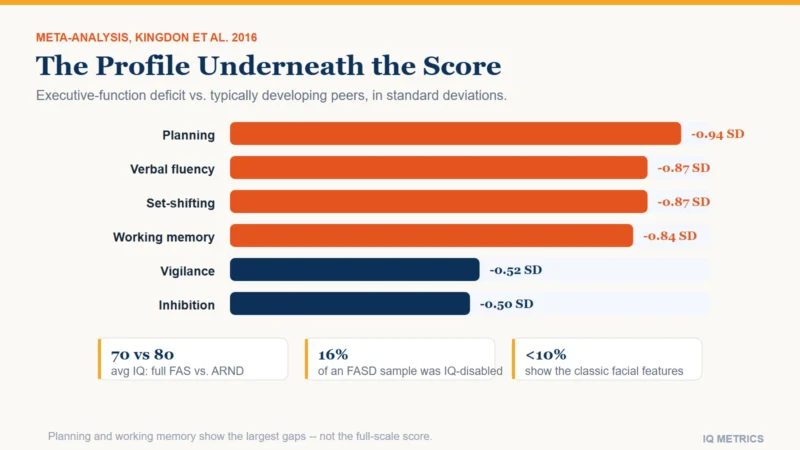
Less often than you would guess, and that gap between expectation and reality is exactly why the condition is so frequently missed. A clinic-referred study of 473 people diagnosed with fetal alcohol syndrome or a milder related condition found that only 16 percent scored in the intellectually disabled range on an IQ test. Most had an average, low-average or even above-average full-scale score — while showing a specific, measurable pattern of difficulty in a handful of other cognitive skills the score never touches.
That combination, an unremarkable composite number sitting on top of a real and specific deficit, is not a loophole in the diagnosis. It is close to the central clinical problem with fetal alcohol spectrum disorder (FASD), and it is the reason researchers have spent two decades pushing clinicians away from IQ alone and toward a specific cognitive profile instead.
What prenatal alcohol exposure does, and why there is no established safe amount
Alcohol crosses the placenta freely and can interfere with neuronal migration and brain development at multiple stages of pregnancy, with the developing brain vulnerable throughout, not only in a single early window. The CDC states plainly that "there is no known safe amount of alcohol use during pregnancy" and "no safe time during pregnancy to drink alcohol," a position the American College of Obstetricians and Gynecologists and the U.S. Surgeon General have separately reached as well. It is worth being precise about what that guidance actually claims: it is a statement that no safe threshold has been established, not a claim that every exposure at every level produces measurable harm. Heavy and frequent drinking in pregnancy is well documented to carry real, dose-related risk; the effects of very light or one-time exposure are far less firmly established either way, and treating the two claims as identical overstates what the evidence supports in either direction.
Why FASD is an umbrella, not one diagnosis
An Institute of Medicine panel in 1996 set out four categories under the FASD umbrella: fetal alcohol syndrome (FAS, the most severe, defined by a specific triad of growth deficiency, facial features and central nervous system dysfunction), partial FAS, alcohol-related neurodevelopmental disorder (ARND), and alcohol-related birth defects. The DSM-5 added a research category in 2013, neurobehavioral disorder associated with prenatal alcohol exposure, that drops the facial-feature requirement entirely and defines the condition by function instead. Worth saying plainly rather than glossing over: there is still no single international diagnostic standard. Several systems, the original IOM categories, a 2016 Canadian guideline built around impairment across specific neurodevelopmental domains, and a separately developed 4-Digit Diagnostic Code used in Washington State, currently coexist, and a 2025 systematic comparison found only fair-to-moderate agreement between them. That lack of consensus is itself a clue to what makes this condition hard to pin down.
Fewer than 1 in 10 people with an FASD diagnosis show the facial features most people associate with it. The rest, the large majority, look physically typical, which is one reason — alongside the ordinary-looking IQ scores below — that the condition is so easy to overlook entirely.
The number that surprises people
Full FAS, the most visibly affected end of the spectrum, carries a reported average full-scale IQ of around 70. The much larger nondysmorphic group, most of ARND, averages closer to 80, solidly in the low-average range and well outside the range most people picture as "intellectually disabled." The 1996 clinical study cited above found that even inside a sample of people who had already received an FAS or related diagnosis, only 16 percent scored low enough on IQ testing to meet criteria for intellectual disability. The obvious implication is the one that matters clinically: an ordinary IQ score is common in FASD, not an exception to it, and cannot be used on its own to rule the condition in or out.
Where would your own score land?
Take the IIF-certified assessment and get your score with the scale it was measured on, the percentile it corresponds to and the confidence range around it — the three figures most online tests leave out.
Find your IQ score now! →The profile underneath an ordinary-looking score
A 2016 meta-analysis in the Journal of Child Psychology and Psychiatry pooled the executive-function research and found a specific, consistent pattern relative to typically developing peers: large deficits in planning (0.94 standard deviations below average), verbal fluency (0.87), set-shifting (0.87) and working memory (0.84), with smaller but still real gaps in sustained attention (0.52) and inhibitory control (0.50). Other work has found working-memory deficits specifically that hold up even after global IQ is statistically controlled for — meaning the memory problem is not simply a byproduct of a lower overall score, but something that shows up on top of it. The same meta-analysis compared FASD directly against ADHD, since the two conditions are frequently confused: fluency and planning deficits were significantly worse in FASD, while vigilance and inhibition were not reliably distinguishable between the two groups, a genuinely useful and specific finding for anyone trying to tell them apart.
A complication worth stating honestly
Not every study finds executive function singled out this cleanly. A large 2021 analysis pooling six prospective U.S. cohorts, adjusted for socioeconomic status and other substance exposure, found alcohol-associated effects of roughly similar size across learning and memory, executive function, reading and math, rather than one domain standing out sharply from the rest — and found no statistically significant effect on sustained attention specifically, where the meta-analysis above did find one. The honest summary is that a specific, disproportionate executive-function signature is well supported by a substantial body of clinical research, but it is not uncontested, and the most recent large multi-cohort analysis complicates a version of the story that treats it as fully settled.
Why the diagnosis gets missed so often
A school-based study cited in a 2019 Lancet Neurology review found that fewer than 1 percent of the children who actually met FASD criteria on structured assessment had ever received a clinical diagnosis. An ordinary-looking composite score, a lack of the facial features most people expect, and a genuine lack of international diagnostic consensus among clinicians themselves all point the same direction: this is a condition that hides in plain sight far more often than it announces itself. Current U.S. prevalence estimates, from active-screening studies in four communities, run from roughly 11 to 50 per 1,000 children by a conservative count and considerably higher, 31 to 98 per 1,000, in a more thorough weighted estimate — CDC's rounded public figure, "up to 1 in 20," is the upper end of that range, not a single settled number.
None of this is about assigning blame. Research on how this condition gets discussed has moved deliberately away from framing centered on a mother's choices, in part because messaging that reads as accusatory has not been shown to change drinking behavior and can make people less willing to seek a diagnosis or support once a child is already showing signs. The clinical goal is identifying the actual cognitive profile early enough to help, not assigning responsibility for it after the fact.
What this means for testing and support
The practical lesson runs the same direction as it does for the conditions covered in this site's companion piece on ADHD, autism and dyslexia: a single composite score was never built to capture a profile this specific, and for FASD in particular, a normal full-scale number is common enough that it should never be treated as evidence against the diagnosis on its own. Formal neuropsychological testing, the kind used in a full child assessment rather than a single screening number, is what actually surfaces the planning, fluency and working-memory pattern described above, and it is that pattern, not the IQ score sitting on top of it, that should drive decisions about accommodations and support.
This is one entry in a small set of ways early life can shape later cognitive outcomes through a mechanism that has nothing to do with inherited ability — see this site's companion piece on chronic early-life stress for a very different kind of exposure that leaves a recognizably similar signature: an average score that is not the whole story. For the much broader question of how much of any IQ score is inherited in the first place, see is IQ genetic.
Keep reading
All articles →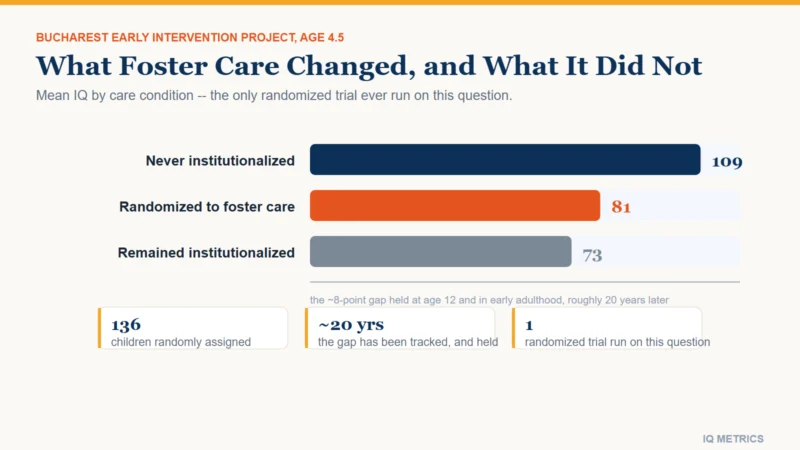 Research & Evidence
Toxic Stress and IQ
Researchers in Romania did something that can never be done again for ethical reasons: they randomly assigned some institutionalized children to foster care and left others in the institution, then followed both groups for twenty years. The IQ gap that opened up has held at every check-in since. What has not held up as cleanly is the famous claim about exactly when the window closes.
 Taking a Test
ADHD, Autism and Dyslexia in IQ Testing
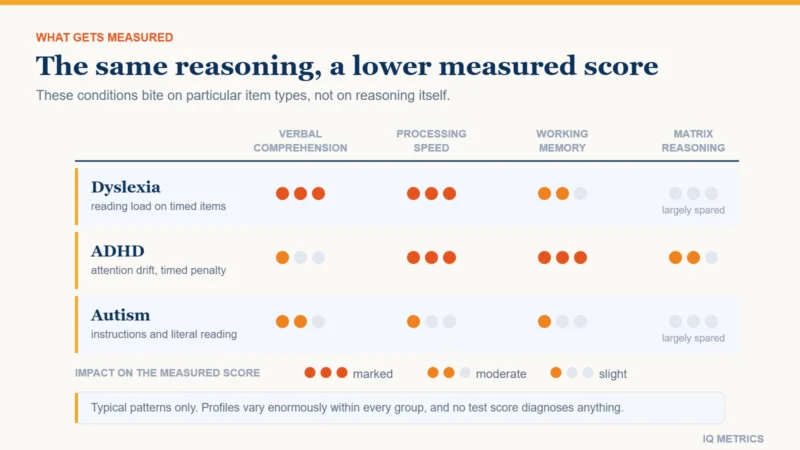
A test score is a measurement, and a measurement can be biased by the conditions under which it is taken. ADHD, autism and dyslexia each depress performance on particular kinds of item without lowering the reasoning underneath. Here is what actually interferes, condition by condition, and what to do next.
 Taking a Test
IQ Testing for Children
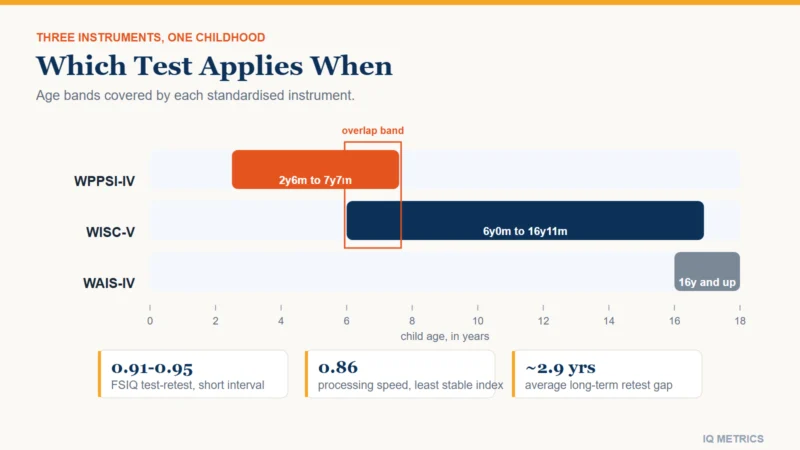
Children are not tested on the same instrument as adults, and the test itself changes twice before age eighteen. Here is which one applies when, how reliable an early score really is, and what a parent should and should not conclude from a single number.