





IQ and BMI: What a Sibling-Comparison Study Found
Cognitive ability and adult BMI correlate, but a sibling-comparison study found the link shrinks by about 90 percent within families. See what that implies about family background versus a direct causal effect.

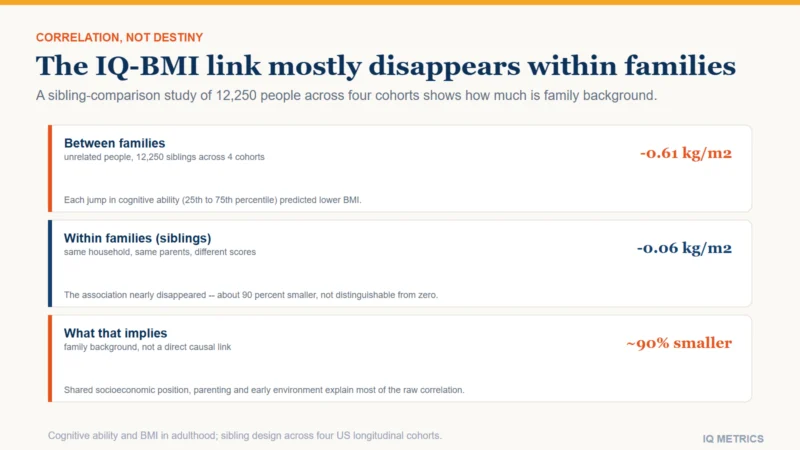
Higher childhood cognitive ability does predict a somewhat lower body mass index in adulthood, and the correlation is real and well replicated. But a 2023 sibling-comparison study spanning four long-running cohorts and more than 12,000 people found that comparing brothers and sisters raised in the same household — who share genes, parents and a childhood environment — shrinks the association by about 90%, to something no longer statistically distinguishable from zero. That is strong evidence the raw population-level correlation is mostly explained by family background, not by intelligence itself acting directly on body weight. This article covers how strong the population correlation is, what the sibling design shows, the competing explanations researchers consider, and what none of it means for any one person.
- Population level: moving from the 25th to 75th percentile of childhood cognitive ability predicts roughly 0.6 to 1.0 kg/m2 lower adult BMI, depending on which controls are applied.
- Within families: the same comparison among siblings shrinks to about -0.06 kg/m2, no longer distinguishable from zero.
- What that implies: shared family background, not a direct effect of intelligence on body weight, explains most of the raw correlation.
- Direction is debated: researchers have proposed both "ability shapes long-term health habits" and "shared early-life factors affect both the brain and metabolism" as explanations for what remains.
How strong is the population-level correlation?
A 2023 sibling-comparison study drew on four major United States longitudinal cohorts — the National Longitudinal Survey of Youth 1979, its Children and Young Adults supplement, the National Longitudinal Survey of Youth 1997, and the Wisconsin Longitudinal Study — following more than 12,000 siblings from adolescence into later adulthood. Comparing unrelated people across different families, moving from the 25th to the 75th percentile of childhood cognitive ability predicted about 0.95 kg/m2 lower adult BMI; adjusting for socioeconomic position narrowed that to about 0.61 kg/m2, still a real and statistically clear association.
| Comparison | BMI difference (25th to 75th percentile of ability) | Statistically distinguishable from zero |
|---|---|---|
| Between families, unadjusted | -0.95 kg/m2 | Yes |
| Between families, adjusted for socioeconomic position | -0.61 kg/m2 | Yes |
| Within families (siblings) | -0.06 kg/m2 | No |
Why comparing siblings is a stronger test
Siblings share on average half their genes, the same household, the same parents and largely the same neighbourhood, schooling access and upbringing. If the population-level correlation were mostly caused by family-level factors, such as parental education, household income or shared food and activity patterns, it should shrink dramatically when the comparison moves from unrelated children across different families to siblings within the same one. That is exactly the roughly 90% shrinkage the study found. The same logic underlies how twin and family designs separate genetic and environmental explanations more broadly, and how assortative mating research uses family structure to test causal stories rather than relying on raw correlation alone.
How small is a 0.6 kg/m2 difference, really?
Kilograms per square metre is an abstract unit, so it helps to translate it. For an adult of average height, a BMI difference of 0.6 to 1.0 kg/m2 works out to roughly 2 to 3 kilograms, about 4 to 7 pounds, of body weight — noticeable on a bathroom scale, but small next to the natural spread of body weight within any group of people who score similarly on a cognitive test. A correlation this size explains only a few percent of the variation in BMI between people at most, which is why the population-level pattern coexists with enormous overlap: plenty of people with high cognitive scores carry a higher BMI than plenty of people with average or low scores, and vice versa. For comparison, a correlation researchers usually call strong, such as IQ’s relationship with school grades, sits closer to 0.5 — several times the size of anything found here.
Two competing explanations for the small remaining link
Researchers weighing what is left after the sibling correction generally point to two possibilities, neither of them proven. One is that executive function and planning ability, both part of what cognitive tests measure, help people manage diet, exercise and weight more consistently over decades, producing a small but real metabolic advantage over a lifetime. The other is that shared early biology, such as prenatal nutrition, birth weight or early-childhood health, independently shapes both brain development and a person’s later metabolic set point, producing a correlation between cognitive ability and body weight without either one causing the other. The sibling result mainly shows the effect is not large at the individual level; it does not settle which, if either, of these stories explains what remains.
Does obesity lower IQ, or does IQ predict obesity?
The research literature runs in both directions at once. Some pooled analyses of school-age children have found a substantially lower average IQ among children already classified as obese, on the order of several points in some pooled estimates. A separate line of research, sometimes called cognitive epidemiology, asks the reverse question: whether childhood IQ predicts adult body weight decades later, which is the direction the sibling-comparison study addresses directly. The honest summary is that a correlation shows up in both temporal directions, but the sibling evidence suggests neither a purely “obesity causes lower IQ” nor a purely “IQ causes lower BMI” story explains most of it — family background does a great deal of the work either way. See socioeconomic status and IQ and nutrition and IQ for related confounders that touch both traits at once.
Where would your own score land?
Take the IIF-certified assessment and get your score with the scale it was measured on, the percentile it corresponds to and the confidence range around it — the three figures most online tests leave out.
Find your IQ score now! →What this does not mean for any one person
Within any cognitive-ability group there is enormous variation in body weight, and within any BMI group there is enormous variation in cognitive ability. Even the largest, unadjusted population correlation here explains only a small share of the difference between people, and the within-family result suggests the true individual-level effect is close to zero. This is a population-level pattern about averages across thousands of people, not a rule for judging any one individual’s intelligence from their weight, or the reverse.
How this compares with other physical correlates of IQ
Height and IQ show a similarly shaped story, covered separately in a related piece on alcohol and cognition and in the site’s own height-and-IQ article: both are small, real, population-level correlations that shrink substantially under a stronger causal design. Where height’s correlation leans more toward a shared genetic explanation once nutrition is accounted for, BMI’s leans more heavily toward shared family environment once the sibling design is applied — a useful reminder that similarly sized correlations do not always come from similar underlying causes.
Quick answers
- Does a high IQ mean someone will stay thin? No. The population-level link is small, and it nearly disappears when comparing siblings raised together.
- Does obesity cause lower intelligence, or the other way around? Research finds a correlation in both directions; the sibling evidence suggests family background, not a direct causal arrow either way, explains most of it.
- Is the IQ-BMI link genetic? Partly plausible, but the sibling design points more toward shared family environment than a strong direct genetic effect.
- How big is the effect really? Small. Even the unadjusted population correlation explains only a modest share of the variation between people.
- Should this change how anyone thinks about their own weight or intelligence? No. A correlation this size has no diagnostic value for a single person.
The bottom line
Cognitive ability and adult BMI correlate at the population level, but a rigorous sibling-comparison study found that correlation shrinks by about 90% when comparing siblings raised in the same household, landing on a figure no longer distinguishable from zero. Family background, not a direct effect of intelligence on body weight, explains most of the original finding, and the data says nothing useful about any one individual either way.
Sources
- The association between cognitive ability and body mass index: a sibling-comparison analysis in four longitudinal studies (2023): the between-family and within-family BMI figures used throughout this article.
- Yun, J. et al. (2024), Obesity Reviews: a systematic review and updated meta-analysis on the link between obesity and intelligence.
Keep reading
All articles →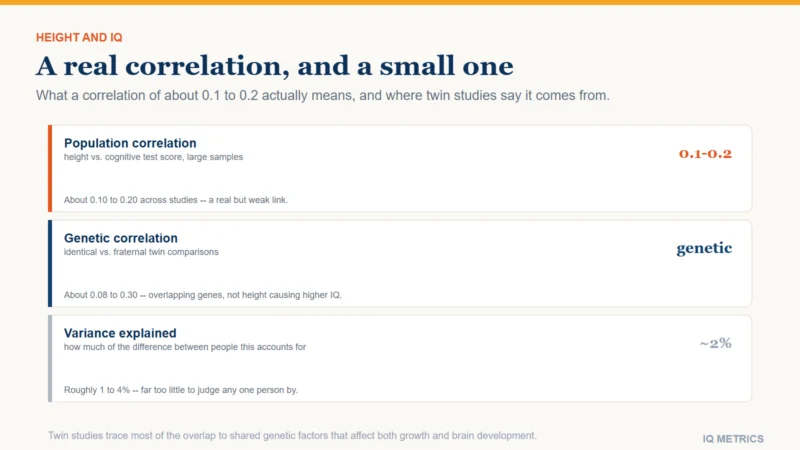 Research & Evidence
Height and IQ
Height and IQ correlate at about 0.1 to 0.2, a real but small link. What twin studies say about where it comes from, how much is childhood nutrition, and why it means nothing for judging any one person.
 Research & Evidence
IQ and Alcohol
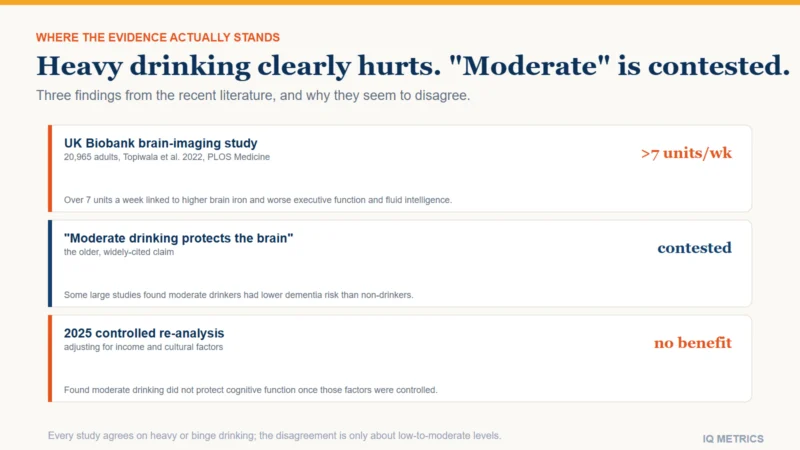
Heavy drinking clearly harms cognition; moderate drinking is genuinely contested. See what a 2022 UK Biobank study found, why older research claimed a protective effect, and why newer reviews are walking that back.
 Research & Evidence
Socioeconomic Status and IQ
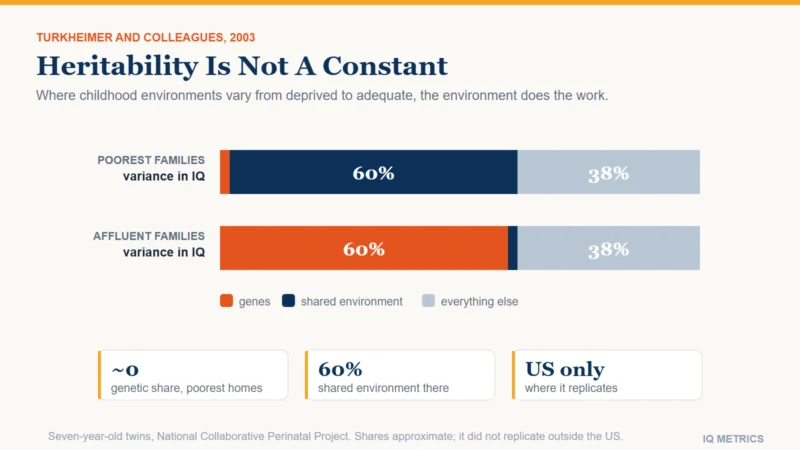
Family circumstances track IQ scores, and the relationship is stranger than a simple gap. In the poorest families studied, genes explained almost none of the variation in childhood scores and shared environment explained most of it. In affluent families the pattern reversed. Here is what that finding does and does not support.