





Woodcock-Johnson IQ Test (WJ V): Scores and What They Mean
The Woodcock-Johnson V has 20 cognitive tests, 26 achievement tests on the same norms, and a GIA score with an SD of 15. See what each cluster measures, why the same score can carry different labels on different reports, and how it differs from the WISC-V and WAIS.

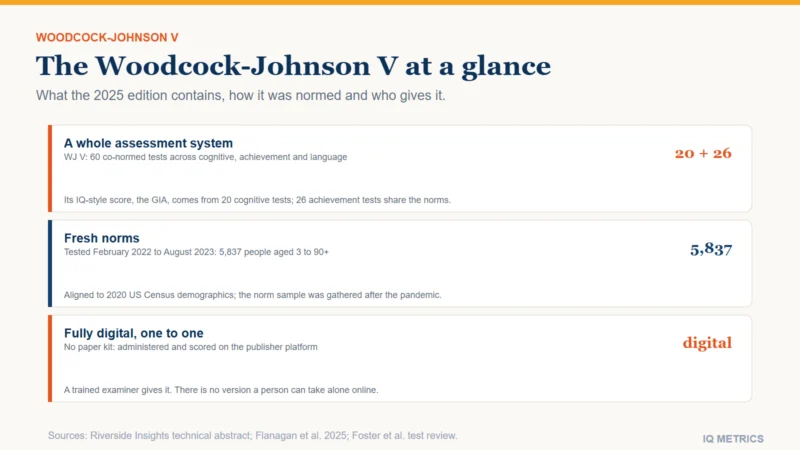
The Woodcock-Johnson IQ test is not one test but a family. The current edition, the WJ V (published in February 2025), pairs a battery of 20 cognitive tests with 26 achievement tests, including oral language, all normed on the same people. Its IQ-style score is the General Intellectual Ability (GIA) cluster, reported as a standard score with a standard deviation of 15. It is given one to one by a trained examiner, commonly in school and clinical evaluations. This guide explains what the cognitive tests measure, how Woodcock-Johnson scores and labels work, how the WJ V differs from the WJ IV, the WISC-V and the WAIS, and the limits reviewers have flagged.
- Ages: the WJ V measures from age 4 through 90+; the WJ IV covered ages 2 to 90+.
- Norms: 5,837 people aged 3 to 90+, tested from February 2022 to August 2023.
- Main IQ-style scores: GIA, the Brief Intellectual Ability (BIA) and the Gf-Gc Composite.
- Where you cannot take it: online, on your own. It is administered by a trained examiner on the publisher’s digital platform.
What is the Woodcock-Johnson test?
The Woodcock-Johnson battery dates from the 1970s and has been revised several times; the fourth edition appeared in 2014 and the fifth in 2025. The WJ V assessment system comprises 60 co-normed tests across cognitive, achievement and language domains, according to Flanagan, Sotelo-Dynega and Alfonso’s 2025 overview. “Co-normed” is the key idea: the same people took the cognitive and the achievement tests, so a child’s reasoning scores and reading or maths scores can be compared against a single reference group. That is why it is a common choice in educational assessment (our overview of professional IQ tests places it beside the Wechsler and Stanford-Binet families), and how it differs from the achievement tests and IQ tests that schools use separately.
What the WJ V cognitive tests measure
The cognitive battery has 20 tests: 14 standard tests, which combine in pairs to form seven broad ability clusters, and 6 extended tests that add single-test measures. The framework is the Cattell-Horn-Carroll (CHC) model, explained in our news piece on CHC theory, and the seven broad clusters map onto it directly.
| Cluster | What it captures | Note |
|---|---|---|
| General Intellectual Ability (GIA) | An overall estimate of general intelligence (g) | Median reliability .97 |
| Brief Intellectual Ability (BIA) | A shorter general estimate | Median reliability .91 |
| Gf-Gc Composite | General ability built on reasoning and knowledge | Median reliability .94 |
| Comprehension-Knowledge (Gc) | What you have learned: vocabulary and general knowledge | Broad cluster |
| Fluid Reasoning (Gf) | Solving new problems with no learned method | Broad cluster |
| Auditory Working Memory Capacity (Gwm) | Holding and using information in the moment | Broad cluster |
| Cognitive Processing Speed (Gs) | Speed on simple tasks | Broad cluster |
| Retrieval Fluency (Gr) | How fluently stored ideas and words come back | New broad cluster in the WJ V |
| Long-Term Storage (Gl) | Learning and holding new associations | Broad cluster |
| Visual Processing (Gv) | Working with shapes and spatial patterns | Broad cluster |
Two numbers from the publisher’s technical abstract help you judge the GIA. Its reliability is about .97, which is high for a test score. And it correlates .66 to .85 with the general-intelligence totals of other batteries, such as the WAIS-IV and WISC-V, in the validity studies described there. That is strong agreement, not identity: a child can land a few points apart on two good tests, as our note on the margin of error in an IQ score explains.
How Woodcock-Johnson scores and labels work
WJ V standard scores are standardised so that the expected standard deviation is 15, the same metric as the Wechsler scales. Reports also give percentile ranks, age and grade equivalents and a relative proficiency index, and they carry descriptive labels. The table uses the labels on Riverside’s WJ IV interpretation chart; check the chart printed with your own report if it comes from a different edition.
| Standard score | Label | Percentile at the lower edge |
|---|---|---|
| 131 and above | Very Superior | 98th |
| 121 to 130 | Superior | 92nd |
| 111 to 120 | High Average | 77th |
| 90 to 110 | Average | 25th |
| 80 to 89 | Low Average | 9th |
| 70 to 79 | Low | 2nd |
| 69 and below | Very Low | below the 2nd |
The percentiles are ours, read from a normal curve with a mean of 100 and a standard deviation of 15; you can check any score with the IQ percentile calculator. One trap: other publishers draw the average band differently. This chart runs the Average label to 110, while the band on our own IQ classifications page is 90 to 109. The same 110 can be “Average” on one report and “High Average” on another, so compare numbers, not labels. The IQ score converter handles scale differences between tests.
Woodcock-Johnson versus WISC-V, WAIS and Stanford-Binet
| Battery | Ages | What is distinctive |
|---|---|---|
| WJ V | 4 to 90+ | Cognitive, achievement and oral language tests normed together |
| WJ IV | 2 to 90+ | Predecessor: 18 cognitive tests, 7,416 people in the norm sample |
| WISC-V | 6 to 16 | The most widely used child battery; five index scores |
| WAIS | 16 to 90 | The adult Wechsler battery |
| WPPSI-IV | 2 years 6 months to 7 years 7 months | The Wechsler preschool battery |
| Stanford-Binet 5 | 2 to 85+ | Very wide age span in a single instrument |
The design difference that matters most is co-norming. Because the WJ V cognitive and achievement tests share norms, it offers 144 comparison procedures: intra-ability comparisons (a child’s strengths against their own average) and ability-to-achievement comparisons, on age norms or grade norms. Whether a gap between ability and achievement is required to qualify for services depends on the rules of the education system where you live, so the score is one input, not a ruling. For a child’s Wechsler report, see WISC-V index scores explained; for how the age bands compare, see IQ testing for children.
What changed from the WJ IV to the WJ V
- More tests. 20 cognitive tests against 18. Five tests were added and three removed, including measures of Auditory Processing (Ga), according to a published test review.
- A new cluster. Retrieval Fluency (Gr) is a new broad ability cluster.
- A different GIA. Auditory Processing was removed from the GIA and its composition was substantially revised, so WJ IV and WJ V GIA scores are not interchangeable.
- Fully digital. The publisher describes the WJ V as fully digital, with no physical kit; administration and scoring sit on its online platform.
- Fresh norms. A nationally representative sample tested from February 2022 to August 2023 and aligned to 2020 US Census demographics, so the norms are post-pandemic.
- A Virtual Test Library. Fifteen specialised tests, including phonological awareness, rapid automatized naming and memory measures used when dyslexia is being evaluated.
- Alternate forms. Parallel second forms of 27 tests are provided, for use if a speeded test is spoiled by an interruption or when a person is retested.
Fresh norms matter more than they sound. Test norms age, and scores measured against older norms can read high, which is the subject of our news piece on why IQ norms expire.
Where would your own score land?
Take the IIF-certified assessment and get your score with the scale it was measured on, the percentile it corresponds to and the confidence range around it — the three figures most online tests leave out.
Find your IQ score now! →Woodcock-Johnson in dyslexia, ADHD and autism evaluations
A Woodcock-Johnson result is one part of a full evaluation and never a diagnosis. The Virtual Test Library’s phonological and rapid-naming measures are aimed at dyslexia; the working-memory and processing-speed clusters are where ADHD-related gaps tend to appear (see our ADHD and IQ guide); and for how a single composite can hide an uneven profile in autism, see autism and IQ. Our general piece on how these conditions change what an IQ test measures covers the test-day mechanisms.
Limits worth knowing
- Young children. A published review of the WJ V cognitive battery found the evidence less convincing for children under six, and the publisher’s technical abstract says fewer test indicators are available at ages 4 to 5, so one factor analysis was not run for that group.
- Digital only. The same review notes that some examiners may find the digital requirement limiting, while calling the battery an engaging and psychometrically sound option.
- Not a self-test. There is no legitimate way to take the WJ V online on your own. For a self-serve estimate use one of our IQ tests, which are screeners and not the same instrument.
- One sitting. Sleep, anxiety and effort move any score; see test anxiety and IQ scores.
Quick answers
- Is the Woodcock-Johnson an IQ test? Its cognitive battery yields IQ-style scores (GIA, BIA and Gf-Gc), but the full system also measures achievement and oral language.
- What is a good Woodcock-Johnson score? On the WJ IV chart, 90 to 110 is Average and 111 and above is High Average or higher; the mean is 100.
- What is the GIA? General Intellectual Ability: the WJ V’s overall estimate of general intelligence, with a median reliability of about .97.
- Can I take the Woodcock-Johnson online? No. It is given by a trained examiner.
- How does it compare with the WISC-V? Both are individually administered; the Woodcock-Johnson is co-normed with achievement tests, the WISC-V is the more widely used child battery.
The bottom line
The Woodcock-Johnson V is best understood as an assessment system, not a single IQ number: 20 cognitive tests with a GIA at the top, 26 achievement tests on the same norms, fresh post-pandemic norms and a fully digital format. Read the cluster scores and the labels together, remember that labels differ between publishers, and treat the result as one part of an evaluation carried out by someone qualified to interpret it.
Sources
- Flanagan, D.P., Sotelo-Dynega, M. and Alfonso, V.C. (2025): overview of the Woodcock-Johnson V Tests of Cognitive Abilities and Virtual Test Library.
- Foster, L.B., Perazzo, D.C. and Decker, S.L., test review: Woodcock-Johnson V Tests of Cognitive Abilities.
- Riverside Insights, WJ V overview: test counts and digital format.
- Riverside Insights, WJ V Technical Abstract: test structure, norming sample, reliability and validity tables.
- Riverside Insights, WJ IV standard score and RPI interpretation charts: the descriptive labels used in the table.
- Test review of the WJ IV Tests of Cognitive Abilities (2015): the predecessor battery.
Keep reading
All articles →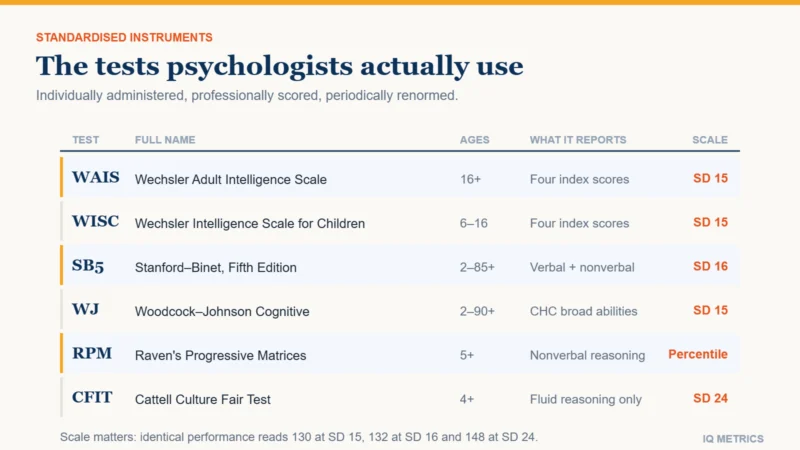 Taking a Test
Professional IQ Tests
When a psychologist measures intelligence, they reach for one of a small number of standardised instruments. This guide covers what the Wechsler scales, Stanford-Binet, Woodcock-Johnson and Raven's Progressive Matrices each measure, who each one is for, and where an online test genuinely fits.
 Scores & Scales
How to Read an IQ Test Report
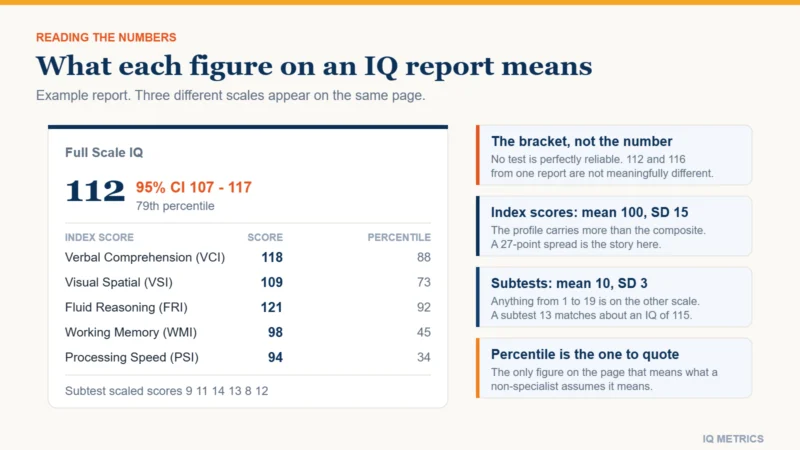
An IQ report puts numbers on at least three different scales and almost never explains which of them matters. Here is what FSIQ, the index scores, the subtest scaled scores, the percentile rank and that bracketed range each mean, and when the headline number should not be read at all.
 Understanding IQ
ADHD and IQ
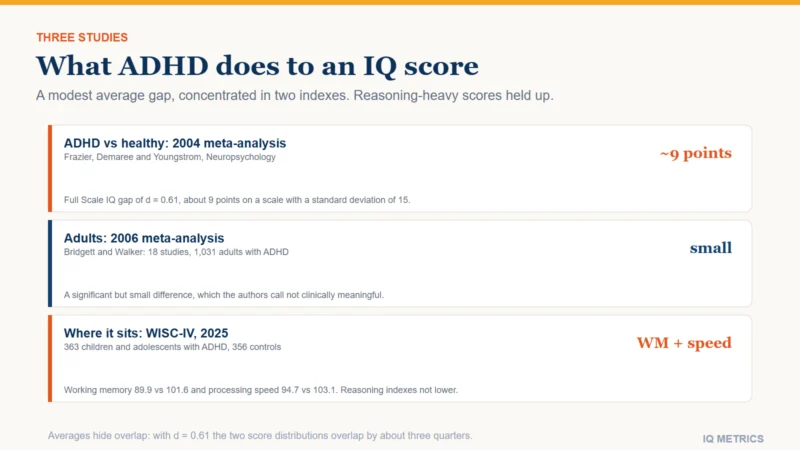
ADHD lowers average IQ scores by about 9 points across pooled studies, but the gap sits in working memory and processing speed, not reasoning, and the groups overlap heavily. See the meta-analyses, the index profile and what an IQ test cannot diagnose.