





IQ Testing for Children: Ages, Norms, and What a Score Means
Children are not tested on the same instrument as adults, and the test itself changes twice before age eighteen. Here is which one applies when, how reliable an early score really is, and what a parent should and should not conclude from a single number.

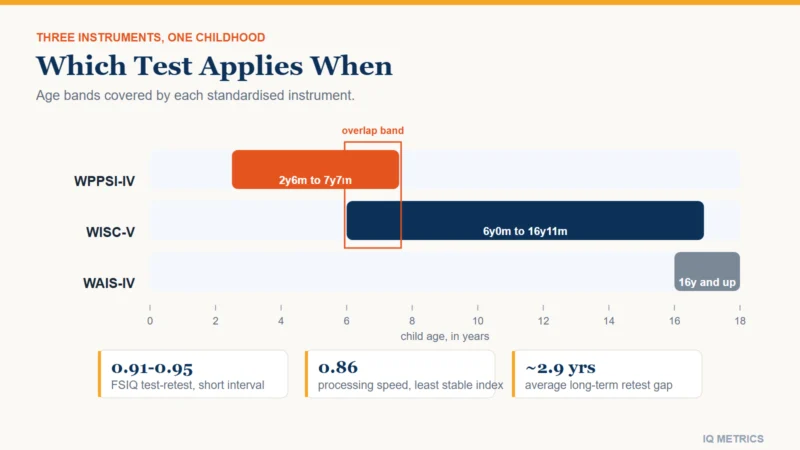
Children are tested on different instruments than adults, and on more than one instrument across childhood. A five-year-old, a ten-year-old and a sixteen-year-old sitting for a cognitive assessment are not taking scaled-down or scaled-up versions of the same test — they are on entirely different instruments, built and normed separately for their age band, with different weighting between verbal and non-verbal tasks.
Knowing which test applies when, and how much weight to put on an early result, matters more than the score itself. A number produced at age five behaves differently — statistically — from the same number produced at age fourteen, even though both are reported on the identical 100-centred scale.
Which test, at which age
The Wechsler Preschool and Primary Scale of Intelligence (WPPSI) covers ages 2 years 6 months through 7 years 7 months. The Wechsler Intelligence Scale for Children (WISC) covers ages 6 years 0 months through 16 years 11 months, overlapping the WPPSI for roughly eighteen months, during which a clinician can choose either instrument depending on the child. From 16 onward, testing moves to the adult scale, the WAIS.
The practical difference is not just item difficulty. The youngest WPPSI band leans heavily on non-verbal and receptive tasks — block patterns, picture matching, object assembly — because expressive vocabulary and sustained attention are still developing and are poor proxies for reasoning ability at that age. By the WISC years, verbal comprehension carries much more weight, and by WAIS the index structure (verbal comprehension, visual spatial, fluid reasoning, working memory, processing speed) is what a full adult report is built from. Each transition is also a renorming: a child moving from the WPPSI to the WISC is not just handed harder versions of the same items, but compared against a different standardisation sample entirely, one drawn specifically from children in that older age band.
What the index scores actually measure
A modern child’s report is built from several separate indices, not one number. Verbal comprehension covers vocabulary, reasoning with words and general knowledge. Visual spatial covers reading and reconstructing spatial patterns. Fluid reasoning covers spotting a rule in material the child has never seen before, independent of what they have been taught. Working memory covers holding and manipulating information briefly, such as repeating a sequence backward. Processing speed covers how quickly a child can complete simple visual tasks accurately under mild time pressure. The Full Scale IQ is a composite of all five, which means two children can arrive at the identical overall number by completely different routes — one strong across the board, another with a real strength in one area balancing a real weakness in another.
How stable is a child's score, really
More stable than most parents expect, and less stable than a single adult retest would be. Short-term test-retest studies (children retested after a few weeks) put Full Scale IQ reliability in the 0.91-0.95 range. Longer-term studies, retesting children after an average gap of nearly three years, still found Full Scale IQ correlating around 0.91 between the two sittings. The weakest link is not the overall score but one specific index: processing speed, which is the least stable of the four main indices across repeat testing, sitting closer to 0.86.
This is a different question from the one answered in our piece on the best age to take an IQ test, which covers how much a result can move between sittings for a given child. This article is about the testing framework itself — which instrument, what it measures, and what a session looks like once you are in the room.
Where would your own score land?
Take the IIF-certified assessment and get your score with the scale it was measured on, the percentile it corresponds to and the confidence range around it — the three figures most online tests leave out.
Find your IQ score now! →What a session actually involves
A child’s IQ assessment is individually administered by a trained examiner, not a timed group test and nothing like a rapid online instrument. A full WISC or WPPSI session typically runs one to two hours, often split across a break, and moves between verbal questions, physical manipulatives (blocks, puzzle pieces, picture cards) and timed tasks scored for both speed and accuracy. The examiner is watching for more than the final number: how a child approaches an unfamiliar problem, whether attention holds up across the session, and whether a low score on one subtest reflects ability or something else, such as fatigue or anxiety about the setting. Most examiners spend the first several minutes building rapport rather than presenting test items, precisely because a nervous or unfamiliar child under-performs relative to their real ability, and a thorough report will usually note explicitly whether effort, attention or anxiety appeared to affect any particular score.
The output is not one number but several: an overall Full Scale IQ plus index scores for the separate domains, each with its own percentile. A parent handed only the composite score is missing most of what the assessment actually found; reading the individual indices is usually more informative than the single headline figure.
When a score does not match the classroom
One of the more common reasons a child ends up tested at all is a mismatch: a teacher reporting a struggling student who seems sharp in conversation, or a child who reads well above grade level but cannot finish timed classwork. A full index breakdown is built for exactly this situation. A child can score in the gifted range on verbal comprehension and fluid reasoning while scoring only average on processing speed, and on paper that produces a merely-above-average Full Scale IQ that undersells what is actually a twice-exceptional profile — high ability alongside a specific processing difference. This is also where ADHD, autism and dyslexia intersect with IQ testing: each of those can depress one or two specific indices without touching the others, and a composite score alone will hide exactly the pattern a parent or teacher needs to see.
When, and whether, to retest
Practice effects are real: a child retested soon after an initial assessment will often score somewhat higher on the same instrument simply from familiarity with the item types, not from a genuine change in ability. This is why professionals typically space formal retests at least a year apart, and why a single early result — particularly one from the WPPSI years — should be treated as one data point rather than a permanent label. How much of any later change reflects real development versus test familiarity is exactly the kind of question that made researchers go looking for domains where practice and repetition explain most of what separates high and low performers, which turns out to depend enormously on the domain — chess ratings are a particularly well-studied case.
What parents should actually do with a score
- Read the percentile, not just the number. A percentile calculator converts any composite score into where it sits against same-age peers, which is what the number is actually for.
- Do not over-weight one low or high index. A single depressed processing-speed score inside an otherwise average profile is common and is the least stable index for exactly that reason.
- Treat a WPPSI-era score as provisional. The instrument is good at what it is designed for, but young children’s scores move more between sittings than an older child’s.
- Use a licensed psychologist for anything with real stakes — a diagnosis, a placement decision, a gifted-programme application. A screening result is a starting point, not a substitute for a full evaluation.
- Ask for the index breakdown, not just the composite. A flat profile and a spiky one can share the same headline number while calling for completely different next steps.
If you are exploring an assessment rather than pursuing a clinical evaluation, the site’s own IQ test for kids, built for ages 4 to 17, gives instant access with no signup. For anything with academic, clinical or legal weight attached to the result, a licensed examiner administering a full WISC or WPPSI battery is the only appropriate route.
Keep reading
All articles →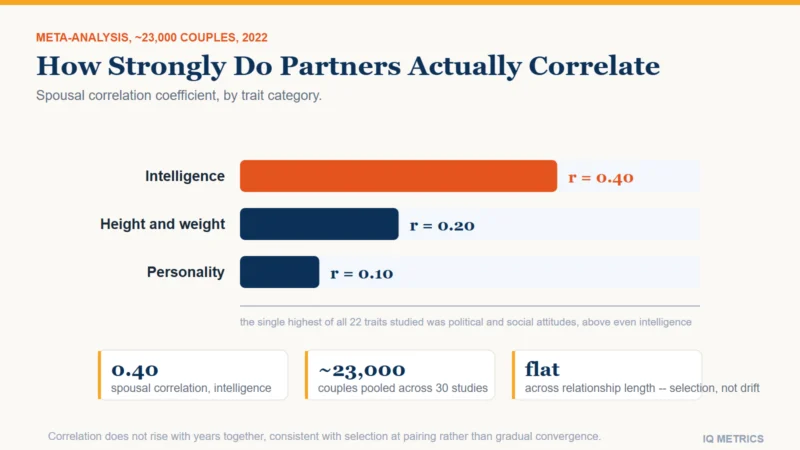 Research & Evidence
Assortative Mating and IQ
Married and long-term partners score more alike on IQ than on almost any other trait psychologists measure, personality included. The correlation is about 0.40, it shows up before the relationship starts, and it has real downstream effects on how heritability studies get interpreted.
 Research & Evidence
Chess Ratings and IQ
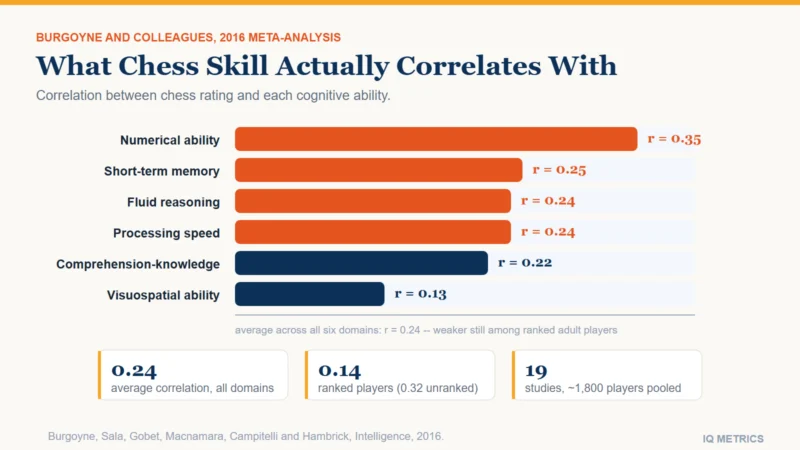
Chess has a reputation as a proxy for raw intelligence. The best available meta-analysis puts the real correlation at a modest 0.24, and it gets noticeably weaker once you look only at ranked, adult tournament players.
 Scores & Scales
IQ Scale By Age
the IQ scale reveals that IQ levels fluctuate with age, suggesting that the mind is inherently unstable. The plethora of variables influencing cognitive capacities and the large range of IQs make it feasible for there to be differences in IQ between age groups.