





Autism and IQ: What the Scores Show and What They Miss
About 40% of 8-year-olds with autism and an IQ score on record had an IQ of 70 or below, and 36% scored above 85. See the CDC figures and their caveats, the Raven's gap of 30 percentile points, and what an IQ number cannot tell you.

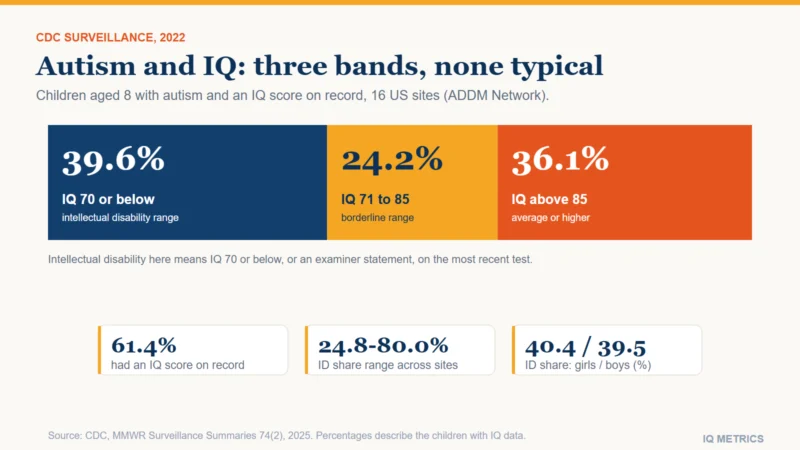
There is no single IQ for autism. In the CDC’s 2022 surveillance of 8-year-olds, among children with autism and an IQ score on record, 39.6% had an intellectual disability (IQ 70 or below), 24.2% were in the borderline range (71–85) and 36.1% scored above 85. So autism and IQ are related but separate: autism is defined by differences in social communication and by restricted, repetitive behaviour, not by a score, and autistic people are found at every level of measured ability. This article gives the current CDC figures with their caveats, shows how the choice of test can move a score by 30 percentile points, and says what an IQ number does and does not tell you about a person.
A note on scope: this site publishes tests and explains scores. It has no clinical standing, and nothing here is a diagnosis or medical advice.
- Prevalence, age 8, 2022: 32.2 per 1,000 children (1 in 31) across 16 US sites, 3.4 times as common in boys as in girls.
- Cognitive data on record: for 61.4% of the 8-year-olds with autism (5,292 of 8,613); the percentages in this article describe that group.
- Intellectual disability share: 39.6%, but from 24.8% at one site to 80.0% at another.
What is the average IQ of an autistic person?
There is no single average worth quoting, because the answer depends on who was tested, with which test and at what age. What the CDC data show is the spread. The table gives the split for children aged 8 with autism and a most-recent IQ score on record across the 16 surveillance sites in 2022.
| IQ band | Share of children | Label used in the report |
|---|---|---|
| 70 or below | 39.6% | Intellectual disability |
| 71 to 85 | 24.2% | Borderline range |
| Above 85 | 36.1% | Average or higher |
In the report, intellectual disability means an IQ of 70 or below, or an examiner’s statement of intellectual disability, on the child’s most recent IQ test. (Intellectual disability is the term used in the United States; the UK says learning disability.) Two caveats matter. First, data on cognitive ability were available for only 61.4% of children with autism (5,292 of 8,613), from 21.3% at one site to 90.2% at another, so the percentages describe the tested children, who may differ from the untested ones. Second, the share with intellectual disability ranged from 24.8% at one site to 80.0% at another. The report notes that sites differ in where children are identified, how often cognitive and IQ testing is done and how autism is diagnosed, so the spread reflects practice as well as children.
Girls and boys with autism had similar shares of intellectual disability (40.4% and 39.5%). By race and ethnicity the share was 52.8% for Black children and 32.7% for White children. The CDC authors say such differences could be related to social determinants of health, such as low income, housing and food insecurity and transportation barriers, and they list lead poisoning among causes of intellectual disability tied to those conditions (see our piece on lead exposure and IQ).
Who gets identified has changed
A study of CDC surveillance data from 2000 to 2016 (Furnier and colleagues, Autism Research) shows what shifted. Among 8-year-olds, the prevalence of autism with mild, borderline or no significant adaptive challenges rose from 5.1 to 17.6 per 1,000, while autism with moderate to profound challenges dipped slightly, from 1.5 to 1.2 per 1,000. The rise was larger for autism without a co-occurring intellectual disability than with one. The authors read the pattern as improved identification of milder forms of autism, and note that better access to therapies that improve intellectual and adaptive functioning may also have contributed.
In other words, the growth in the headline autism rate has come mostly from children who are easier to miss. That is why a statement such as “most autistic people have an intellectual disability” does not match the current CDC figures (39.6% of tested children). Diagnosis timing follows the same logic: in the 2022 data, children with autism and intellectual disability were identified earlier (median 43 months) than those without (49 months).
Does autism lower IQ? The test matters
It depends on the test, and one study made that vivid. In 2007 Michelle Dawson, Isabelle Soulières, Morton Ann Gernsbacher and Laurent Mottron (Psychological Science) gave 38 autistic children Raven’s Progressive Matrices, a test of fluid reasoning that needs no spoken answers. Their scores were on average 30 percentile points higher, and in some cases more than 70 percentile points higher, than their scores on the Wechsler scales of intelligence. Typically developing control children showed no such gap, and a similar contrast appeared when autistic adults were compared with non-autistic adults. The authors concluded that intelligence has been underestimated in autistic people.
Treat that as a signal, not a rule. It is one study of 38 children, and we would not assume the same gap for every autistic person. What it shows is that the same child can land in different places on two respected tests, because a Wechsler battery includes verbal subtests that need spoken answers while matrices do not. Our explainer on Raven’s Progressive Matrices scores and our comparison of verbal and non-verbal IQ scores show how to read a split like that, and the culture-fair IQ test is built from figures rather than sentences.
Why one IQ number hides so much
A Full Scale IQ averages several indexes, and autistic profiles are often uneven, with verbal and non-verbal scores diverging in either direction. Our companion piece on how ADHD, autism and dyslexia change what an IQ test measures covers the mechanisms (instructions read literally, unfamiliar rooms, timed items). Here the point is arithmetic: a composite of 100 can be a flat line or a 30-point gap between indexes. Ask for the index scores, not only the composite, and read how to read an IQ test report and the WISC-V index-score explainer.
Savant syndrome, the rare pairing of exceptional skill with wider difficulties, is a different question again; it is covered in savant syndrome and IQ tests.
Where would your own score land?
Take the IIF-certified assessment and get your score with the scale it was measured on, the percentile it corresponds to and the confidence range around it — the three figures most online tests leave out.
Find your IQ score now! →IQ is not the same as how a person functions day to day
Surveillance studies now use adaptive behaviour — everyday skills such as communicating, self-care and getting around — alongside IQ, because adaptive scores carry information about support needs that an IQ score alone does not (Furnier and colleagues make this point). A person with an IQ in the average range can need substantial support, and a person with an IQ near 70 can live with considerable independence. That is why 70 is a cut-off used with other evidence and not a verdict; see what an IQ of 70 means and our piece on low IQ versus learning disability.
Can an online IQ test tell you anything about autism?
No. An IQ score cannot diagnose or rule out autism, and least of all one from an unproctored online test. Autism is identified through developmental history and structured observation by a qualified clinician, and IQ testing is used alongside that to understand strengths and support needs. If you do take an online test, choose the format that removes the obstacle you know about: an untimed classical test if the clock is the problem, or a culture-fair test if reading load is. Neither is a formal accommodation.
Quick answers
- Do all autistic people have a low IQ? No. In the 2022 CDC data, 36.1% of tested 8-year-olds with autism scored above 85.
- What percentage of autistic people have an intellectual disability? 39.6% of the tested 8-year-olds in the CDC 2022 surveillance, with wide variation between sites.
- Can autism and a high IQ go together? Yes. Autism is not defined by IQ. The twice-exceptional idea is explained in high IQ and ADHD.
- Is IQ used to diagnose autism? No. Diagnosis rests on behaviour and development; IQ testing helps describe strengths and needs.
- Does autism affect IQ scores? The test matters: in one study, 38 autistic children scored about 30 percentile points higher on Raven’s than on Wechsler tests.
The bottom line
Autism and IQ overlap without being the same thing. The best recent numbers say that among tested 8-year-olds with autism roughly four in ten have an intellectual disability, roughly a quarter are borderline and a bit over a third score above 85, and that the mix has been changing as milder cases are found. Which test you use can move a score a long way, and no score describes how a person lives. For a condition with a very different intellectual profile, read Down syndrome and IQ; for a condition where the gap sits in specific indexes, read our ADHD and IQ guide.
Sources
- CDC (2025), MMWR Surveillance Summaries 74(2): 1–22: prevalence and early identification of autism among children aged 4 and 8 years, ADDM Network, 16 sites, United States, 2022.
- Dawson, M., Soulières, I., Gernsbacher, M.A. and Mottron, L. (2007), Psychological Science 18: 657–662: the level and nature of autistic intelligence.
- Furnier et al., Autism Research (published online December 2025): trends over time in the prevalence of autism by adaptive and intellectual functioning levels.
Keep reading
All articles →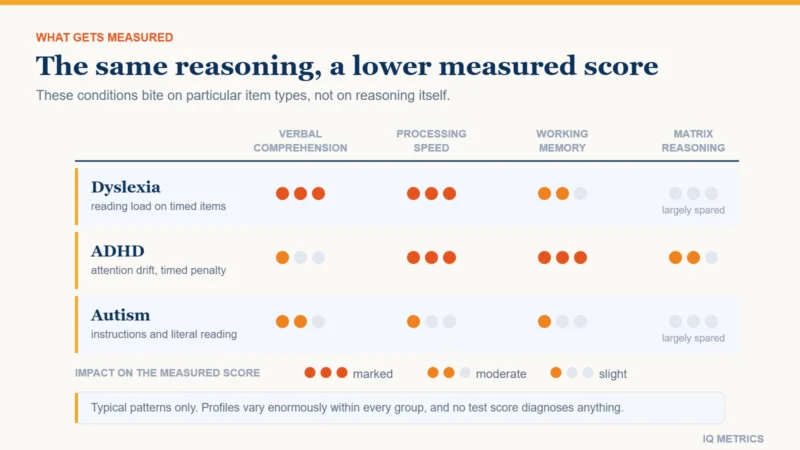 Taking a Test
ADHD, Autism and Dyslexia in IQ Testing
A test score is a measurement, and a measurement can be biased by the conditions under which it is taken. ADHD, autism and dyslexia each depress performance on particular kinds of item without lowering the reasoning underneath. Here is what actually interferes, condition by condition, and what to do next.
 Understanding IQ
Down Syndrome and IQ
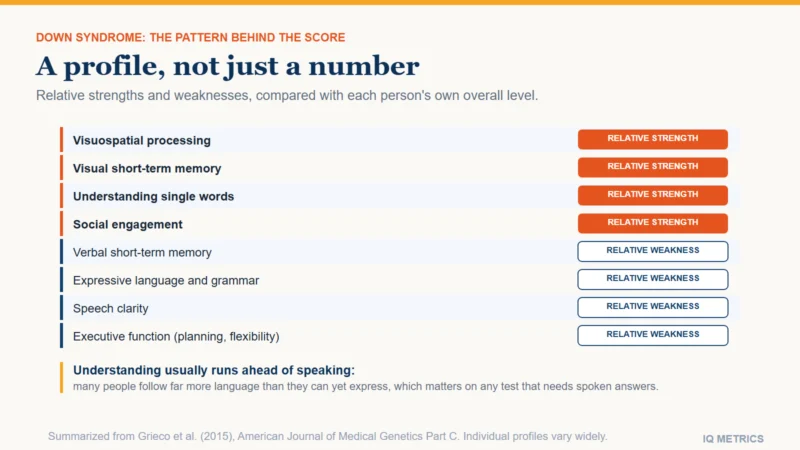
Most people with Down syndrome score in the mild to moderate range of intellectual disability, with an average IQ of around 50 and a typical range of about 30 to 70. The number hides a wide spread, a consistent profile of strengths, and test limits that matter more here than almost anywhere else.
 Understanding IQ
Baby IQ Test
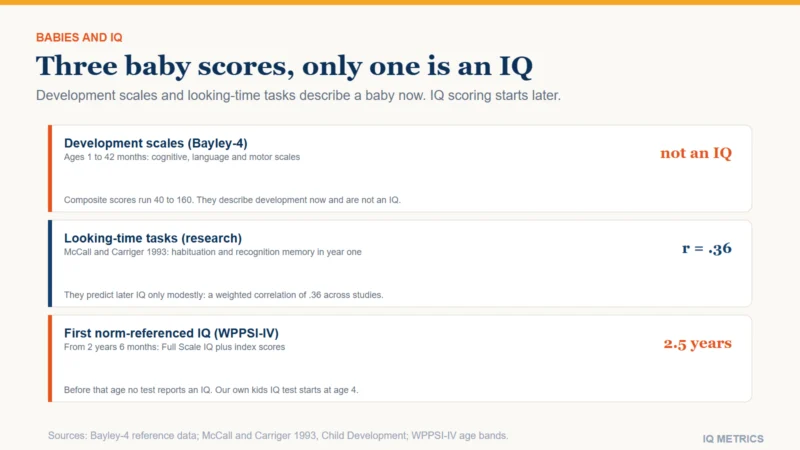
No test can give a baby an IQ. Bayley scores describe development, not intelligence, looking-time tasks predict later IQ only modestly (r = .36), and real IQ scoring starts at 2 years 6 months. See what each early score means.