





ADHD and IQ: Does ADHD Lower IQ?
ADHD lowers average IQ scores by about 9 points across pooled studies, but the gap sits in working memory and processing speed, not reasoning, and the groups overlap heavily. See the meta-analyses, the index profile and what an IQ test cannot diagnose.

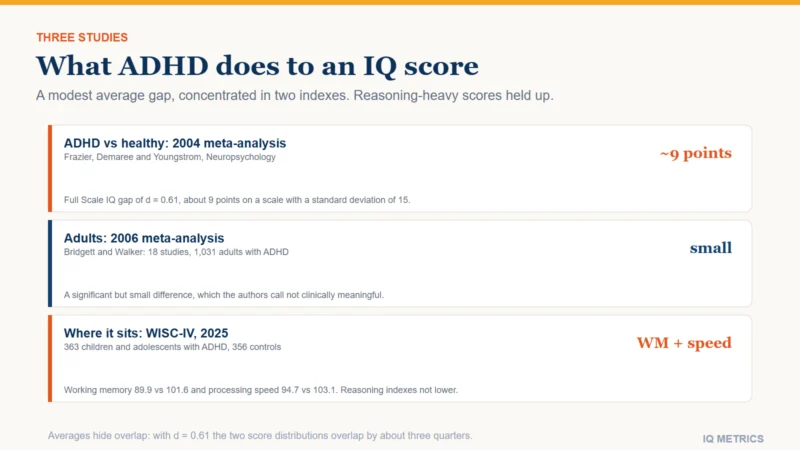
On average, ADHD goes with a modestly lower IQ score, but not with lower intelligence in any simple sense. A 2004 meta-analysis found people with ADHD scored about 0.61 standard deviations below healthy comparison participants on Full Scale IQ, roughly 9 points on the usual scale, while a 2006 meta-analysis of adults found a difference the authors called small and not clinically meaningful. The two groups overlap heavily, so no IQ score can diagnose ADHD or rule it out. This guide to ADHD and IQ sets out the meta-analyses, shows where in a Wechsler report the gap actually sits (working memory and processing speed, not reasoning), and explains what the CDC prevalence figures and the newest genetic work do and do not add.
This site publishes tests and explains scores; it is not a clinic, and nothing here is a diagnosis. For how ADHD changes what a test measures on the day, read how ADHD, autism and dyslexia change what an IQ test measures; for the gifted side, read high IQ and ADHD.
- Pooled studies (2004 meta-analysis): Full Scale IQ gap of d = 0.61, about 9 points.
- Adults (2006 meta-analysis): lower, but small and not clinically meaningful.
- Where the gap sits: in a 2025 WISC-IV study, working memory and processing speed, not verbal or perceptual reasoning.
- How common: 11.4% of US children aged 3 to 17 had ever been diagnosed by 2022.
Does ADHD lower IQ? What the meta-analyses found
Two large reviews answer the average-difference question. Frazier, Demaree and Youngstrom (2004, Neuropsychology) pooled studies comparing people with ADHD and healthy participants and found a weighted effect size of d = 0.61 on Full Scale IQ between ADHD and healthy participants. On the usual scale, with a standard deviation of 15, that is about nine points. They also found the IQ gap was comparable to the gap on most other intellectual and neuropsychological measures, and smaller than the gaps on spelling and arithmetic achievement tests. Their reading: overall cognitive ability is significantly lower among people with ADHD, and Full Scale IQ shows as large a difference as most other measures.
For adults, Bridgett and Walker (2006, Psychological Assessment) analysed 18 studies covering 1,031 adults with ADHD and 928 comparison adults, all with Wechsler Adult Intelligence Scale Full Scale IQ scores or estimates. Adults with ADHD scored lower, but the difference was small and not clinically meaningful. The moderators suggested that only a subset, for example people with comorbid disorders, may have lower general intellectual ability than comparison adults.
| Study | Who | Result |
|---|---|---|
| Frazier et al. 2004 | People with ADHD versus healthy participants, studies pooled | Weighted d = 0.61, about 9 points on an SD-15 scale |
| Bridgett and Walker 2006 | 18 studies: 1,031 adults with ADHD, 928 comparison adults | Lower, but small and not clinically meaningful |
What does d = 0.61 mean for one person? If both groups are roughly bell-shaped, the two score distributions overlap by about three quarters, and a randomly chosen person without ADHD outscores a randomly chosen person with ADHD about two times in three — so in roughly one pairing in three, the person with ADHD scores higher. (Those figures are our calculation from the effect size under normal-distribution assumptions, not results from the paper.) If the comparison group averages 100, the ADHD average lands near 91, inside the average band, which is why IQ classifications cannot sort people by diagnosis.
Where the gap sits: working memory and processing speed
A Wechsler report breaks the composite into indexes, and the ADHD gap is not spread evenly. A 2025 study in Behavioral Sciences compared 363 children and adolescents with ADHD with 356 controls on the WISC-IV. Working memory averaged 89.9 in the ADHD group against 101.6 in controls (d = 0.85), and processing speed 94.7 against 103.1 (d = 0.63). The Cognitive Proficiency Index, which combines those two, was 90.5 against 102.2 (d = 0.91).
On the reasoning-heavy indexes the ADHD group did not score lower. Perceptual reasoning averaged 105.4 against 102.3, the General Ability Index 107.0 against 103.4, and the Full Scale IQ gap was only about three points (99.9 against 103.0). The authors also report that the working-memory, processing-speed and proficiency gaps were stable across age groups and more pronounced in males.
| Index | ADHD group | Controls | Effect size (d) |
|---|---|---|---|
| Working Memory Index | 89.9 | 101.6 | 0.85 |
| Processing Speed Index | 94.7 | 103.1 | 0.63 |
| Cognitive Proficiency Index | 90.5 | 102.2 | 0.91 |
| Perceptual Reasoning Index | 105.4 | 102.3 | 0.22 (ADHD higher) |
| General Ability Index | 107.0 | 103.4 | 0.25 (ADHD higher) |
| Full Scale IQ | 99.9 | 103.0 | 0.23 |
The pattern is the one usually described for ADHD: a composite that can look ordinary while one or two indexes sit well below the rest. It also shows why the size of an ADHD “IQ gap” depends on the sample: about nine points in the 2004 pooled data, about three in this clinic sample. Our explainers on processing speed and IQ, working memory versus reasoning and full-scale IQ versus index scores show how to read those indexes.
Is it ADHD, or is it the test?
Both readings have support. Some of the gap reflects the abilities that working-memory and speed tasks measure; some reflects how attention behaves during a long, timed, repetitive test. Our companion article separates time pressure, sustained-attention drift and working-memory load. What this article adds is the size of the effect: real on average, modest in most samples, and concentrated where attention and speed carry the most weight.
Genetics adds a related hint. The largest ADHD genome-wide study, by Demontis and colleagues (Nature Genetics, 2023; 38,691 people with ADHD, 186,843 controls and 27 risk loci), found a genetic correlation of −0.55 between ADHD and educational attainment. That means many of the common variants that raise ADHD risk are linked to fewer years of schooling. It is not an IQ figure, and educational attainment reflects motivation, opportunity and behaviour as well as ability. A genetic correlation shows overlap, not direction: it does not say whether ADHD lowers test performance, whether lower ability raises ADHD risk, or whether shared influences drive both. For the wider genetics question, see is IQ genetic?.
How common is ADHD, and can an IQ test diagnose it?
In 2022, 11.4% of US children aged 3 to 17 (7.1 million) had ever been diagnosed with ADHD by a health care provider, according to parent report in the CDC’s analysis of the National Survey of Children’s Health, and 10.5% (6.5 million) currently had it. IQ is not part of the diagnosis, which rests on symptom criteria, history across settings and ruling out other explanations. Because the score distributions overlap by about three quarters, no cut-off separates people with ADHD from those without: an IQ test cannot diagnose ADHD. It can only describe strengths and weaknesses once ADHD is being evaluated.
Where would your own score land?
Take the IIF-certified assessment and get your score with the scale it was measured on, the percentile it corresponds to and the confidence range around it — the three figures most online tests leave out.
Find your IQ score now! →Reading an ADHD evaluation: GAI and CPI
Wechsler reports offer two composites that split the profile. The General Ability Index (GAI) combines verbal comprehension and perceptual reasoning; the Cognitive Proficiency Index (CPI) combines working memory and processing speed. In the 2025 study the two pointed in opposite directions for the ADHD group (GAI 107.0, CPI 90.5). A large gap between them is a reason to read the profile, not to distrust the person, and it does not mean that the higher composite is the “real” IQ. Start with how to read an IQ test report, and see the WISC-V index-score explainer.
Which test was used also matters. The Woodcock-Johnson batteries report working-memory and processing-speed clusters separately from the general-ability composite; our Woodcock-Johnson IQ test guide explains that structure, and our guide to autism and IQ shows a different pattern in a different condition.
Quick answers
- What is the average IQ of someone with ADHD? There is no separate ADHD average. Pooled studies put the gap at about 9 points below healthy comparison groups, and the adult-only meta-analysis shows a small difference.
- Does ADHD lower IQ? It lowers average scores modestly, mostly through working memory and processing speed, and the groups overlap heavily.
- Can you have ADHD and a high IQ? Yes. See high IQ and ADHD.
- Can an IQ test diagnose ADHD? No. Diagnosis rests on symptoms and history, not on a score.
- Is ADHD linked to low intelligence? Not in a simple way: the adult gap is small and, in the 2025 child and adolescent sample, the gap was concentrated in specific indexes.
The bottom line
ADHD lowers average IQ scores a little, mostly where attention and speed are being measured, and left reasoning-heavy indexes intact in the 2025 sample. That is a statement about groups. For any one person, an ADHD evaluation should read the index profile, not the composite alone, and the label says nothing about how high a person’s ceiling is. If you are looking at a score from a test taken with ADHD, start with the index scores.
Sources
- Frazier, T.W., Demaree, H.A. and Youngstrom, E.A. (2004), Neuropsychology 18: 543–555: meta-analysis of intellectual and neuropsychological test performance in ADHD.
- Bridgett, D.J. and Walker, M.E. (2006), Psychological Assessment 18: 1–14: intellectual functioning in adults with ADHD.
- Behavioral Sciences (2025), 15(9): 1279: cognitive profiling of children and adolescents with ADHD using the WISC-IV.
- Demontis, D. et al. (2023), Nature Genetics 55: genome-wide analyses of ADHD identify 27 risk loci.
- CDC, Journal of Clinical Child & Adolescent Psychology (2024): ADHD prevalence among US children and adolescents in 2022.
Keep reading
All articles →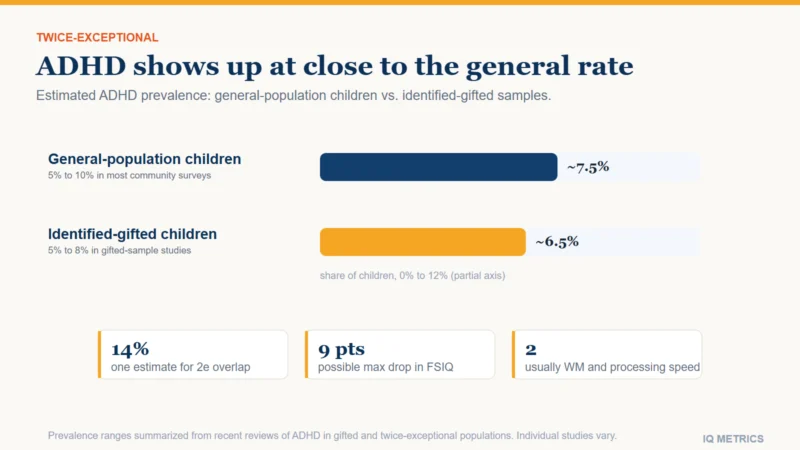 Understanding IQ
High IQ and ADHD
High IQ and ADHD can and do coexist, at close to the general-population rate. What twice-exceptional actually means, why the combination gets missed in both directions, and how ADHD can pull down a full-scale IQ score without touching real reasoning ability.
 Understanding IQ
Processing Speed and IQ
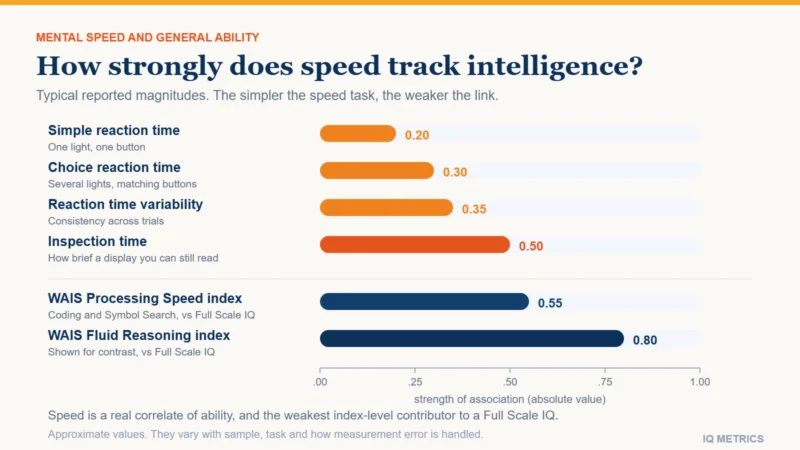
Fast thinkers are assumed to be smart thinkers, and there is a real finding underneath the stereotype: people who score higher on IQ tests do respond faster on tasks with no reasoning content at all. But the link is weaker than the folklore, and on a professional battery the speed index is the least g-loaded.
 Scores & Scales
Woodcock-Johnson IQ Test
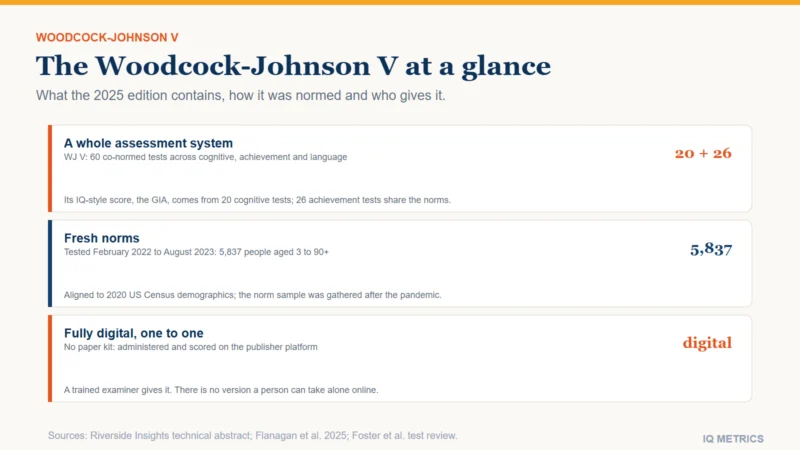
The Woodcock-Johnson V has 20 cognitive tests, 26 achievement tests on the same norms, and a GIA score with an SD of 15. See what each cluster measures, why the same score can carry different labels on different reports, and how it differs from the WISC-V and WAIS.