





Does COVID Lower IQ? What the Largest Studies Found
Does COVID lower IQ? The largest study found a cognitive-test gap of about 3 IQ points after resolved COVID, 6 with unresolved symptoms and 9 after intensive care. See what that measures, what other studies add, and why it is not an IQ test.

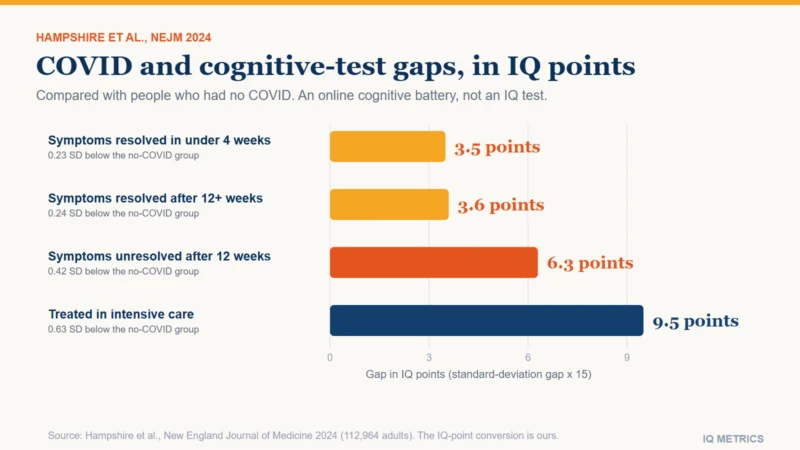
Does COVID lower IQ? On average, slightly, according to the largest study so far. An English study of 112,964 adults found a cognitive-test gap equivalent to about 3 IQ points after a COVID-19 infection that had cleared, about 6 points for people whose symptoms were still unresolved after 12 weeks and about 9 points for people who had been treated in intensive care. Those figures describe group averages on an online cognitive battery, not on IQ tests, and nobody was tested before infection, so they show an association rather than a measured loss. This guide explains what was measured, what other studies add, whether the gap fades, and what to do if you notice brain fog.
- Largest study: 112,964 adults in England completed eight online cognitive tasks (Hampshire and colleagues, New England Journal of Medicine, 2024).
- Size of the gap: 0.23 to 0.24 standard deviations after COVID that had cleared (about 3 IQ points), 0.42 with unresolved symptoms (about 6) and 0.63 after intensive care (about 9).
- Not an IQ test: the researchers converted standard-deviation gaps into IQ points for comparison; they did not give an IQ test.
- No baseline: nobody was tested before infection, so the study cannot show that anyone lost points.
What the largest study measured
The study, published in February 2024, drew on the REACT programme in England. The researchers invited 800,000 adults to take an online assessment; 141,583 started it and 112,964 completed all eight tasks, about 14% of those invited (our arithmetic). Each person’s results were combined into a global cognitive score, adjusted for demographics and pre-existing health conditions, and each group was compared with a no-COVID group of people who had not been infected or whose infection was unconfirmed.
Three findings stand out. People whose symptoms resolved in under 4 weeks and people whose symptoms resolved after 12 weeks or more showed similar small deficits (0.23 and 0.24 standard deviations below the no-COVID group). People with unresolved persistent symptoms showed a larger one (0.42). And deficits were larger for infections in the original-virus and Alpha periods than in later ones (0.17 standard deviations larger) and for people who had been hospitalised (intensive care: 0.35 below non-hospitalised cases). Among people with unresolved symptoms, memory, reasoning and executive-function tasks showed the biggest gaps (0.20 to 0.33), and those tasks correlated only weakly with recent symptoms such as poor memory and brain fog.
What the gap means in IQ points
The authors described a gap of about 0.2 standard deviations for resolved mild cases as small by conventional effect-size labels, equal to about 3 points on a standard 15-point IQ scale, and put the intensive-care gap of 0.63 standard deviations at about 9 points. Multiplying each gap by 15 gives the rest. The Cognitron tasks are not an IQ test, and an earlier paper from the same group describes that kind of online battery as not an IQ test in the classic sense. The conversion is a way to picture a small statistical difference, and it assumes a standard deviation of 15 points.
| Group | Gap (SD) | IQ points (SD x 15) | Average person ranks at |
|---|---|---|---|
| Symptoms resolved in under 4 weeks | 0.23 | 3.5 | 41st percentile |
| Symptoms resolved after 12 weeks or more | 0.24 | 3.6 | 41st percentile |
| Symptoms unresolved after 12 weeks | 0.42 | 6.3 | 34th percentile |
| Treated in intensive care | 0.63 | 9.5 | 26th percentile |
The IQ-point and percentile columns are our conversions (the authors round to about 3 and about 9). Read the last column as a picture of overlap. A gap of 0.23 standard deviations moves the average person in the COVID group from the 50th percentile to about the 41st percentile of the no-COVID group, and the groups overlap heavily: pick one person from each at random and the person from the COVID group scores lower only about 56% of the time. For one person, a 3-point gap is also about the size of the 2 to 3 point standard error of an IQ score, explained in our piece on the margin of error in an IQ score, and a little smaller than the roughly 4-point gain a second sitting of the same test typically brings from practice alone.
Long COVID and brain fog: how common are they?
The UK Office for National Statistics estimated that 2.0 million people in private households (3.1% of the population) were experiencing self-reported long COVID, meaning symptoms lasting more than four weeks that were not explained by something else, as of 2 January 2023. Fatigue was the most common symptom (71%), followed by difficulty concentrating (52%). The NHS lists problems with memory and concentration, also called brain fog, among the common symptoms of long COVID.
A meta-analysis of 43 studies of people at least 12 weeks after diagnosis put the pooled proportion with cognitive impairment at 0.22 (95% confidence interval 0.17 to 0.28). The studies varied enormously (I-squared 98%) and were searched only to June 2021 (Ceban and colleagues, 2022), so treat the figure as a rough signal of how often cognitive problems are found rather than a rate for today.
What other studies add
- 81,337 people tested in 2020. The same group’s earlier study found deficits in people who had recovered, largest for those who had been ventilated: 0.47 standard deviations, about 7 IQ points by the authors’ comparison. They set that beside the average 10-year decline in the same data between ages 20 and 70, and beside the deficits of people who reported a stroke (0.24, 480 people) or learning disabilities (0.38, 998 people).
- Brain scans before and after. Douaud and colleagues (Nature, 2022) re-scanned 785 UK Biobank participants aged 51 to 81; 401 had tested positive between scans, 141 days before the second scan on average. Infected people showed a greater reduction in grey-matter thickness in two regions, a greater reduction in global brain size and a greater cognitive decline, and the effects remained after excluding the 15 who had been hospitalised.
- A pre-pandemic baseline, older adults. Demmer and colleagues (JAMA Network Open, 2025) followed 3,525 people with a mean age of 80.8 who had cognitive tests before the pandemic. Cognition declined faster after infection in people who had been hospitalised, in memory and executive function but not language, and not in infected people who were not hospitalised.
- A small counter-example. Daher and colleagues (2025) followed 110 adults (median age 45) who had a cognitive test before infection and a second one about a year later; 55 caught COVID in between. They found no statistically significant difference in overall cognitive scores between those who did and did not.
Does the gap fade? What we know about recovery
The evidence is mixed and mostly short-term. In the largest study, people whose persistent symptoms had resolved scored much like people with shorter illnesses, and the authors concluded that the longer-term persistence of cognitive deficits and any clinical implications remain uncertain. The association with early infection weakened after adjusting for markers of illness severity, and the deficits were smaller for later variants. In the study with baseline scores, only hospitalised infection was linked to faster decline. The fair summary is a small average gap in cross-sectional data, larger with severe illness, unresolved symptoms and early variants, and follow-up with baselines that is still thin.
Where would your own score land?
Take the IIF-certified assessment and get your score with the scale it was measured on, the percentile it corresponds to and the confidence range around it — the three figures most online tests leave out.
Find your IQ score now! →What about babies and children?
The pandemic-era studies of young children measure development, not IQ, and they try to separate infection from the pandemic environment. In a New York study of 255 infants, maternal infection during pregnancy was not associated with differences on any Ages & Stages Questionnaire subdomain at 6 months, but infants born during the pandemic scored lower on gross motor skills (a mean difference of 5.63 points) than a historical group of 62 born before it (Shuffrey and colleagues, 2022). A meta-analysis of 8 studies and 21,419 infants found that overall neurodevelopment in the first year was not changed by being born or raised during the pandemic or by exposure in the womb, although communication delay was more likely (odds ratio 1.70; Hessami and colleagues, 2022).
Neither used an IQ test. Our guide to the baby IQ test explains why no valid IQ score exists before age 2 years 6 months, the WPPSI-IV guide covers the first true preschool IQ test, and IQ testing for children covers the rest. Falling school test scores after the pandemic are a separate matter: see why falling reading scores are not falling IQ.
How to read a headline that says COVID lowers IQ
- Group average, not you. A small average gap leaves the two groups overlapping heavily and says nothing certain about any one person.
- No before-and-after. The largest study had no pre-infection scores. Its authors say they could not assess change and could not infer causality from observational data.
- A self-selected online sample. About 14% of those invited completed the tasks, and the authors note that a study requiring active participation has some self-selection bias.
- A battery, not an IQ test. The IQ-point figures are a translation of standard-deviation gaps.
- Infection and pandemic are tangled. An accompanying editorial asked what a 3-point loss means in daily functioning and how to separate infection from pandemic effects such as isolation, grief and trauma.
If you notice memory or thinking problems after COVID
Brain fog after COVID is recognised enough that the NHS lists it as a long COVID symptom and advises seeing a GP if you think you might have long COVID. A consumer IQ test is the wrong tool: it has no baseline for you, its score moves by a few points between sittings, and fatigue, poor sleep, stress and low mood also lower performance (see sleep and IQ and how sleep loss changes test scores). Other temporary dips are documented too, for example in menopause and with hearing loss. Clinicians use screening tools such as the MoCA and, where needed, a full neuropsychological assessment; our guide to whether an IQ test can detect dementia explains the difference between screening and IQ testing. If you have an earlier score from an individually administered test such as the Stanford-Binet, a psychologist can use it as a baseline; see also what retesting shows about IQ change.
Quick answers
- Does COVID lower IQ? On average, slightly: the largest study found gaps of about 3 IQ points after resolved COVID, 6 with unresolved symptoms and 9 after intensive care, on a cognitive battery rather than an IQ test.
- How many IQ points does long COVID cost? About 6 points on average in the largest study (0.42 standard deviations times 15), with wide overlap between people.
- Is COVID brain fog permanent? Not established. Small average gaps were found even after recovery, but longer-term persistence and clinical importance remain uncertain.
- Does mild COVID affect thinking? The largest study found a small gap; a study with pre-pandemic baselines found faster decline only after hospitalisation.
- Can an IQ test detect COVID brain fog? Not reliably: it has no personal baseline and its score varies by a few points between sittings. See a GP if you are worried.
The bottom line
COVID-19 is associated with a small average drop on cognitive tests, larger with long-lasting symptoms and severe illness. The 3, 6 and 9 IQ-point figures are conversions of standard-deviation gaps from an online battery, taken with no pre-infection scores and from a self-selected sample, so they describe groups and leave the long-term picture open. If your own thinking has changed, the useful step is a conversation with a clinician, not an online score.
Sources
- Hampshire, A. et al. (2024): Cognition and memory after Covid-19 in a large community sample, New England Journal of Medicine 390:806-818.
- Al-Aly, Z. and Rosen, C.J. (2024): editorial, Long Covid and impaired cognition.
- Hampshire, A. et al. (2021): cognitive deficits in people who have recovered from COVID-19, eClinicalMedicine.
- Douaud, G. et al. (2022): SARS-CoV-2 is associated with changes in brain structure in UK Biobank, Nature.
- Ceban, F. et al. (2022): fatigue and cognitive impairment in post-COVID-19 syndrome, a meta-analysis.
- Demmer, R.T. et al. (2025): COVID-19 and cognitive change in a community-based cohort, JAMA Network Open.
- Daher, J. et al. (2025): cognitive function 1 year after COVID infection, Open Forum Infectious Diseases.
- Shuffrey, L.C. et al. (2022): birth during the COVID-19 pandemic and neurodevelopment at 6 months, JAMA Pediatrics.
- Hessami, K. et al. (2022): COVID-19 pandemic and infant neurodevelopmental impairment, a meta-analysis.
- Office for National Statistics, 2 February 2023: prevalence of ongoing symptoms following coronavirus infection in the UK.
- NHS, long COVID: symptoms, brain fog and when to see a GP.
Keep reading
All articles →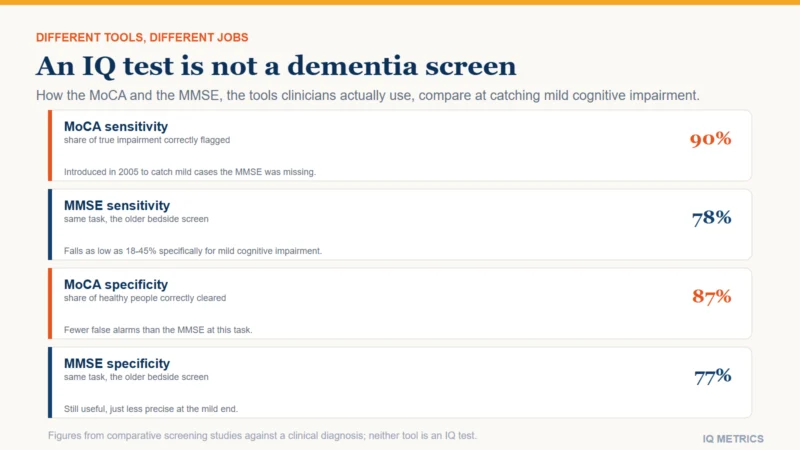 Taking a Test
Can an IQ Test Detect Dementia?
A standard IQ test cannot diagnose dementia; it has no personal baseline and was not built to screen for decline. How the MMSE and the more sensitive MoCA compare, why a normal score can hide early decline, and what actually helps catch it.
 Research & Evidence
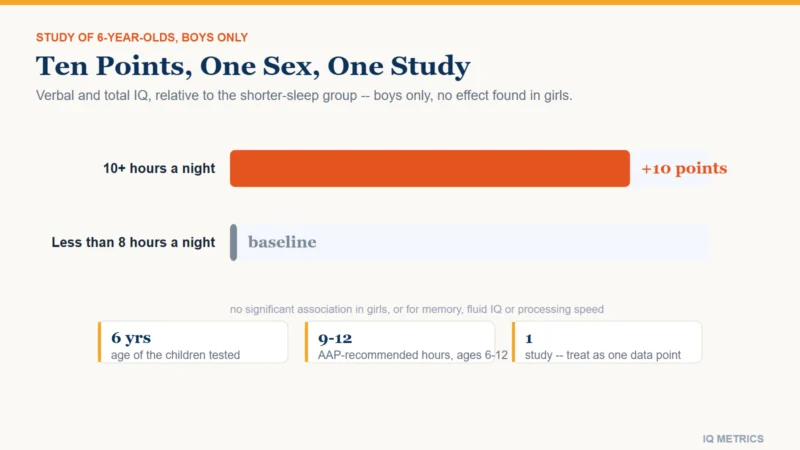
Sleep and IQ
This site's news desk has already covered what one bad night does to a test score on the day it is taken. This is a different and, for children especially, more consequential question: what years of too little sleep do to the cognitive systems an IQ test measures in the first place.
 Research & Evidence
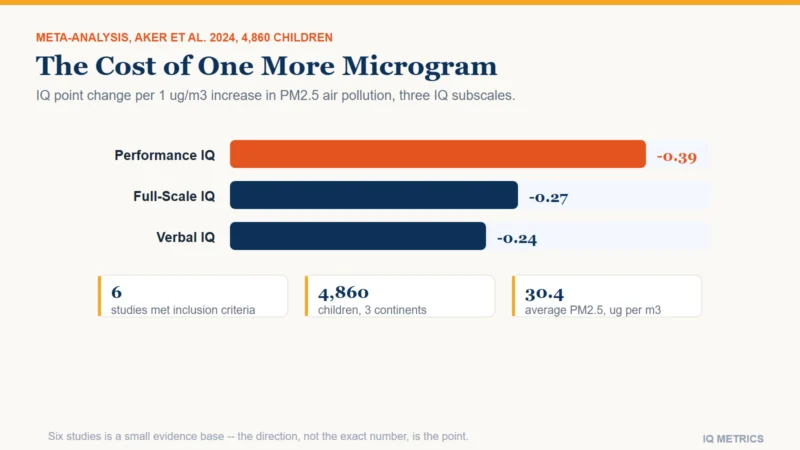
Air Pollution and IQ
A 2024 meta-analysis pooling six studies and 4,860 children found that every rise in fine-particle air pollution came with a small, statistically significant drop in IQ scores. The same pattern shows up in aging adults living near traffic, and in a household exposure route this conversation usually leaves out entirely.