





WPPSI-IV Test: Age Range, Subtests and Scores Explained
The WPPSI-IV test covers ages 2:6 to 7:7 in two bands, with 15 subtests, five index scores and a Full Scale IQ. See what each subtest asks, how a published sample report reads, how the score labels work, and what a preschool score can and cannot tell parents.

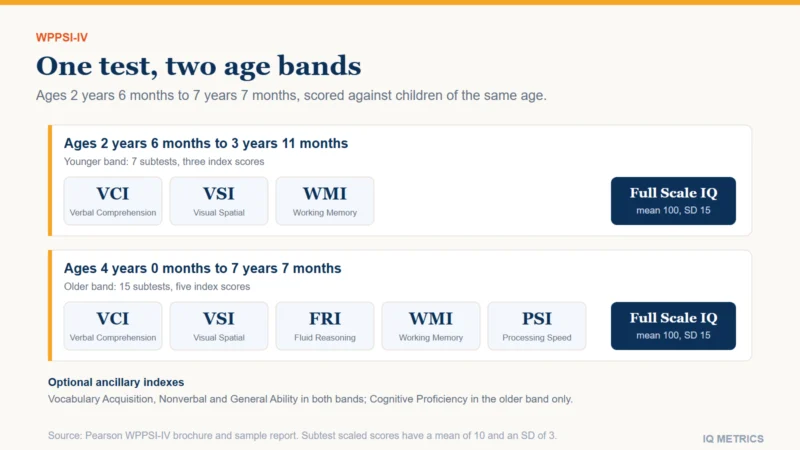
The WPPSI-IV test (Wechsler Preschool and Primary Scale of Intelligence, Fourth Edition) is an individually given intelligence test for children aged 2 years 6 months to 7 years 7 months. It comes in two age bands, with 7 subtests for ages 2:6 to 3:11 and 15 for ages 4:0 to 7:7, and reports a Full Scale IQ plus index scores on a scale with a mean of 100 and a standard deviation of 15. Published by Pearson in 2012 and normed on 1,700 children, it is used to evaluate developmental delay, disability and giftedness and, Pearson notes, private-school admission. This guide covers the age bands, the subtests, how to read a report, the score labels, reliability, and what a preschool score can and cannot tell you.
- Ages: 2:6 to 7:7, in two bands: 2:6 to 3:11 and 4:0 to 7:7.
- Subtests: 7 in the younger band and 15 in the older; the 2012 edition dropped four WPPSI-III subtests and added five.
- Scores: a Full Scale IQ, three (younger) or five (older) primary index scores, and optional ancillary indexes.
- Norms: 1,700 children (600 in the younger band, 1,100 in the older), matched to US census data.
- Time: 30 to 45 minutes (younger) or 45 to 60 minutes (older) for the core subtests.
- Who gives it: a trained examiner (Pearson qualification level C). There is no version a parent can give at home.
What is the WPPSI-IV?
The WPPSI is the youngest member of the Wechsler family: the WPPSI covers preschool and early school ages, the WISC covers school age (see WISC-V index scores) and the WAIS covers adults (see WAIS index scores). Pearson lists its uses as identifying and qualifying children with cognitive delays for special services, evaluating children for cognitive delays, intellectual disabilities, autism and giftedness, and determining admittance eligibility for private schools. Another individually given battery that starts at age 2 is the Stanford-Binet; see also IQ testing for children and why babies cannot be given an IQ score.
The fourth edition was a substantial revision of the WPPSI-III. Four subtests were dropped (Word Reasoning, Picture Completion, Symbol Search and Coding) and five were added (Picture Memory, Zoo Locations, Bug Search, Cancellation and Animal Coding), according to the Buros review of the test. The publisher says it added a working-memory composite, new measures of processing speed and separate visual-spatial and fluid-reasoning composites for ages 4:0 to 7:7, and it extended the age range up to 7 years 7 months.
WPPSI-IV age range and age bands
| Feature | Ages 2:6 to 3:11 | Ages 4:0 to 7:7 |
|---|---|---|
| Subtests | 7 | 15 |
| Primary index scores | Verbal Comprehension, Visual Spatial, Working Memory | Verbal Comprehension, Visual Spatial, Fluid Reasoning, Working Memory, Processing Speed |
| Full Scale IQ | Yes | Yes |
| Norm sample | 600 children | 1,100 children |
| Core testing time | 30 to 45 minutes | 45 to 60 minutes |
Ages are written years:months, so 2:6 means 2 years 6 months. The boundary matters because the younger band has no Fluid Reasoning or Processing Speed index: a child tested at 3:10 gets three index scores, and the same child tested three months later gets five. The upper limit of 7:7 overlaps the WISC-V, which starts at 6:0; see the section on choosing between them below.
The WPPSI-IV subtests
| Index | Ages 2:6 to 3:11 | Ages 4:0 to 7:7 |
|---|---|---|
| Verbal Comprehension (VCI) | Receptive Vocabulary, Information (Picture Naming supplemental) | Information, Similarities (Vocabulary and Comprehension supplemental) |
| Visual Spatial (VSI) | Block Design, Object Assembly | Block Design, Object Assembly |
| Fluid Reasoning (FRI) | Not reported | Matrix Reasoning, Picture Concepts |
| Working Memory (WMI) | Picture Memory, Zoo Locations | Picture Memory, Zoo Locations |
| Processing Speed (PSI) | Not reported | Bug Search, Cancellation (Animal Coding supplemental) |
Pearson’s published sample report describes what a child does on the older-band tasks:
- Block Design: view designs and use blocks to re-create each one.
- Object Assembly: put together the pieces of puzzles to make pictures of common objects.
- Information: answer general knowledge questions.
- Similarities: say how two common objects or ideas are alike.
- Matrix Reasoning: pick the missing piece of an incomplete pattern.
- Picture Concepts: choose pictures from two or three rows that share a trait.
- Picture Memory: memorise pictures and find them on later pages.
- Zoo Locations: memorise where animal cards sit on a map, then place the cards there.
- Bug Search and Cancellation: scan pictures and mark the ones that match a target.
One point surprises parents: the Full Scale IQ is not simply built from every index. In the sample report for the older band, the Full Scale IQ is derived from six subtests (Information, Similarities, Block Design, Matrix Reasoning, Picture Memory and Bug Search), and the authors of a standard guide note that a subtest that is core for an index is not necessarily core for the Full Scale IQ. So the Full Scale IQ is not an average of the five index scores.
How WPPSI-IV scores work
Subtest scores are scaled scores with a mean of 10 and a standard deviation of 3, from 1 to 19; scores between 7 and 12 are usually considered average. Composite scores, the Full Scale IQ and the index scores, have a mean of 100 and a standard deviation of 15, and an index score can range from 40 to 160. Pearson’s sample report treats 90 to 109 as average. A report also gives a percentile rank, a 95% confidence interval and a descriptive label for each composite. Here is the composite table from Pearson’s sample report for a fictional child:
| Composite | Score | Percentile | 95% confidence interval | Label |
|---|---|---|---|---|
| Verbal Comprehension | 90 | 25 | 84 to 97 | Average |
| Visual Spatial | 118 | 88 | 107 to 125 | High Average |
| Fluid Reasoning | 106 | 66 | 98 to 113 | Average |
| Working Memory | 103 | 58 | 95 to 111 | Average |
| Processing Speed | 94 | 34 | 85 to 104 | Average |
| Full Scale IQ | 99 | 47 | 93 to 105 | Average |
Three things stand out. The Visual Spatial score is 28 points above Verbal Comprehension, which is the kind of uneven profile the index scores exist to show. The Full Scale IQ of 99 has a 95% confidence interval 12 points wide, so it is a range and not a point; our note on the margin of error in an IQ score explains why. And the labels follow the score bands: 90 to 109 is Average and 110 to 119 is High Average. Test-prep summaries list Superior for 120 to 129 and Very Superior for 130 and above; check the labels printed in your child’s own report, because publishers draw the bands differently. You can convert any score to a percentile with the IQ percentile calculator.
There are also four optional ancillary indexes: the Vocabulary Acquisition Index (receptive vocabulary and picture naming), the Nonverbal Index (subtests that need no spoken response, useful for English language learners, deaf or hard-of-hearing children and children with suspected language or autism spectrum conditions), the General Ability Index (less reliant on working memory and processing speed) and the Cognitive Proficiency Index (working memory and processing speed, older band only). In the sample report the General Ability Index is 108, nine points above the Full Scale IQ of 99, because the child’s weaker working-memory and processing-speed results count less in it; our news piece on full-scale IQ versus index scores covers how to read differences like that.
How reliable is the WPPSI-IV?
Internal-consistency reliability is high for the composite: .96 overall for the Full Scale IQ, with a range of .95 to .96 across the age groups, and from .86 for Processing Speed to .94 for Verbal Comprehension across the primary indexes overall (Raiford and Coalson, 2014). In a retest of 172 children after 7 to 48 days (23 on average), uncorrected stability was .88 for the Full Scale IQ and .78 to .88 for the index scores (Buros review). Those are short-term figures. Retesting the same child soon raises the score a little through familiarity; see our piece on what practice changes on a cognitive test.
Independent analysis adds a caution. Watkins and Beaujean (2014) tested a bifactor model on the normative sample and found that the general factor accounted for more variance in every subtest than its domain-specific factor, and that the domain-specific factors had poor reliability independent of it (coefficients of 0.05 to 0.33). Their conclusion was that only the general intelligence dimension was robust and precise enough for clinical use. In practice that means the Full Scale IQ deserves more weight than any single index difference.
The publisher says the subtests have improved floors and ceilings that allow more accurate measurement at the extremes of ability. We could not find an independent test of how well that holds for very young or very gifted children, so treat the claim as the publisher’s.
Where would your own score land?
Take the IIF-certified assessment and get your score with the scale it was measured on, the percentile it corresponds to and the confidence range around it — the three figures most online tests leave out.
Find your IQ score now! →WPPSI-IV or WISC-V at ages 6 and 7?
Between 6:0 and 7:7 a clinician can choose either test. A Finnish study compared Swedish versions in typically developing children aged 6:1 to 7:2, 38 tested with the WPPSI-IV and 24 with the WISC-V, in a between-subjects design. The WISC-V group scored significantly lower on Verbal Comprehension, Fluid Reasoning and the Full Scale IQ, and the authors concluded that the two tests produce partly different cognitive profiles (Salonen and colleagues, 2023). The samples were small, but the practical point stands: a WPPSI-IV score at 7 and a WISC-V score a year later come from different instruments, so small differences between them should not be over-read.
Gifted testing and the WPPSI-IV
No single WPPSI-IV score qualifies a child as gifted everywhere: schools, gifted programmes and private schools set their own rules, and one may focus on the Full Scale IQ while another looks at particular indexes. American Mensa, for example, accepts a Wechsler Full Scale IQ of 130 (the WPPSI-IV is on its list), provided the test was given in its entirety by a neutral, qualified third party. Our guides to gifted cutoff scores and the signs of a gifted child cover the rest, and the news pieces on CogAT and NNAT scores and universal screening cover group tests. Any preschool score is a snapshot with a margin of error: see what retesting shows about IQ change and the margin of error.
Can you prepare a child, or take the WPPSI-IV at home?
The WPPSI-IV is a paper-and-pencil kit sold at qualification level C, scored by hand or on Pearson’s Q-global platform, so it cannot be given at home or online. We found no study that measures the effect of coaching on WPPSI-IV scores, so nobody can honestly promise a gain. What the tasks reward is ordinary play with pictures, blocks, puzzles and questions, and a rested, comfortable child is the best preparation. Retesting is a different matter: across cognitive tests generally, a second sitting raises scores by about a quarter of a standard deviation on average. For a home screener use our IQ test for ages 4 to 7, which is a screening tool and not the WPPSI-IV, and see our IQ test questions for kids for how child items work.
Quick answers
- What does WPPSI-IV stand for? Wechsler Preschool and Primary Scale of Intelligence, Fourth Edition.
- What is the WPPSI-IV age range? 2 years 6 months to 7 years 7 months, in two bands.
- How many subtests does it have? 15 in all: 7 for ages 2:6 to 3:11 and 15 for ages 4:0 to 7:7.
- What is a good WPPSI score? The mean is 100 and 90 to 109 is the Average band. There is no universal pass mark or gifted cutoff; programmes set their own.
- How long does it take? About 30 to 45 minutes for the younger band and 45 to 60 minutes for the older band, core subtests only.
- Can parents give it? No. It needs a trained examiner (level C).
- Is there a WPPSI-V? We found no announcement of a fifth edition; Pearson still lists the WPPSI-IV.
The bottom line
The WPPSI-IV is a well-built individual test: 15 game-like subtests, two age bands, a Full Scale IQ and index scores normed on 1,700 children. Its composite is reliable in the short term, but an independent analysis suggests the general score deserves more trust than the index differences, and a confidence interval of about 12 points is a reminder that a score is a range. Read a report for the pattern, not for a single number, and leave the interpretation to the examiner who gave it.
Sources
- Pearson, WPPSI-IV brochure (2012): age range, structure, norm sample, timing and qualification level.
- Pearson, WPPSI-IV product page: publication date and stated uses.
- Pearson, WPPSI-IV sample interpretive report (2013): the sample composite table, task descriptions and score ranges.
- Canivez, G.L. (2014), Buros Mental Measurements Yearbook review: subtest changes, reliability and retest stability.
- Raiford, S.E. and Coalson, D.L. (2014), Essentials of WPPSI-IV Assessment (excerpt): subtest counts, core subtests and composite reliability.
- Watkins, M.W. and Beaujean, A.A. (2014): bifactor structure of the WPPSI-IV, School Psychology Quarterly.
- Salonen, J. et al. (2023): WPPSI-IV and WISC-V cognitive profiles in 6- and 7-year-old children, Child Neuropsychology.
- American Mensa, qualifying test scores.
- TestingMom, WPPSI overview: how programmes use gifted scores.
Keep reading
All articles →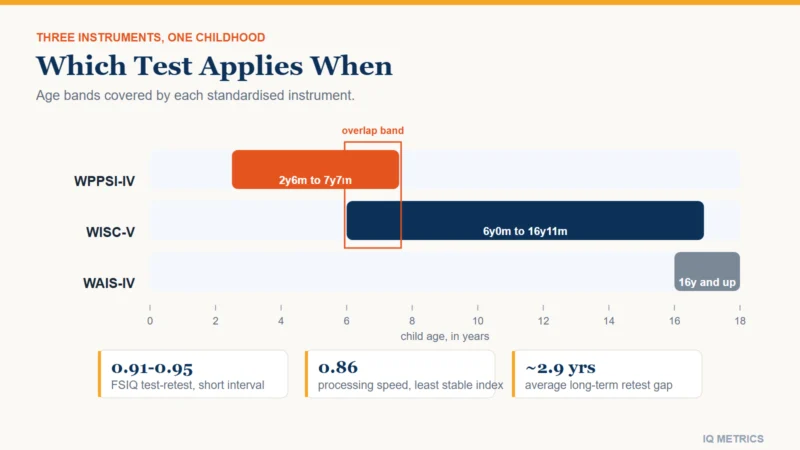 Taking a Test
IQ Testing for Children
Children are not tested on the same instrument as adults, and the test itself changes twice before age eighteen. Here is which one applies when, how reliable an early score really is, and what a parent should and should not conclude from a single number.
 Understanding IQ
Baby IQ Test
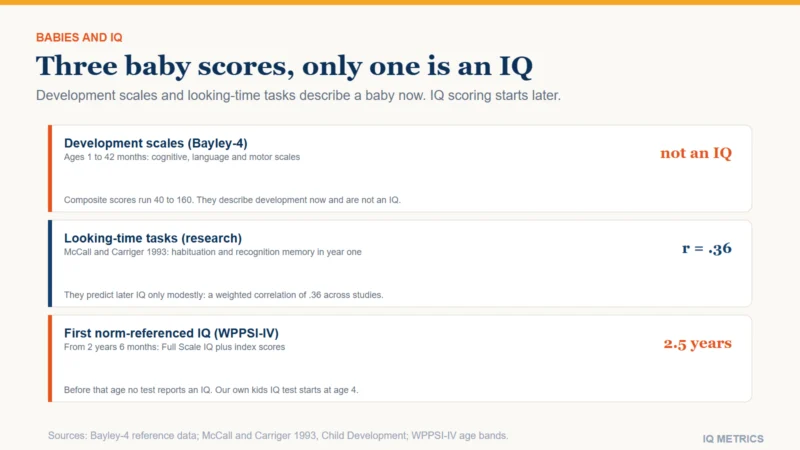
No test can give a baby an IQ. Bayley scores describe development, not intelligence, looking-time tasks predict later IQ only modestly (r = .36), and real IQ scoring starts at 2 years 6 months. See what each early score means.
 Understanding IQ
Signs of a Gifted Child
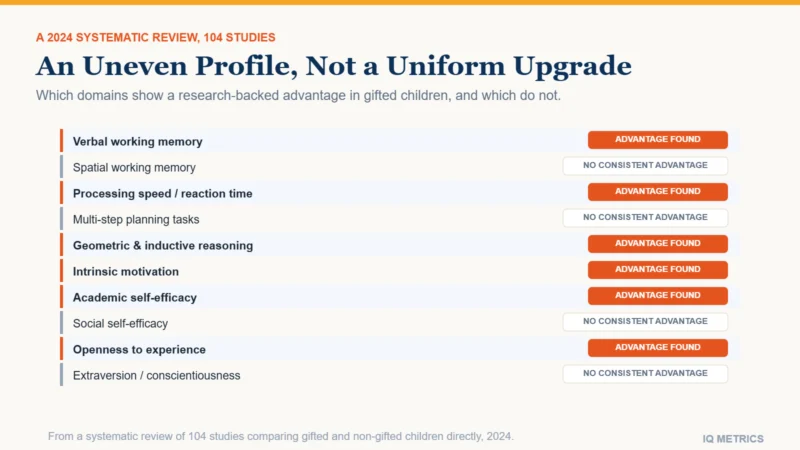
The "reads early, has a big vocabulary" checklist misses what a 2024 systematic review actually found: an uneven cognitive profile, a documented speed-accuracy tradeoff, asynchronous development, and real gaps in who gets identified. What the research says, and what to do with a hunch.