





OLSAT Test: The Otis-Lennon School Ability Test Explained
The OLSAT test (Otis-Lennon School Ability Test) is a group-administered reasoning test scored on a School Ability Index with mean 100 and SD 16, best known for New York City Gifted and Talented admissions. See how it works, its history, and the NYC admissions cutoffs and controversy.

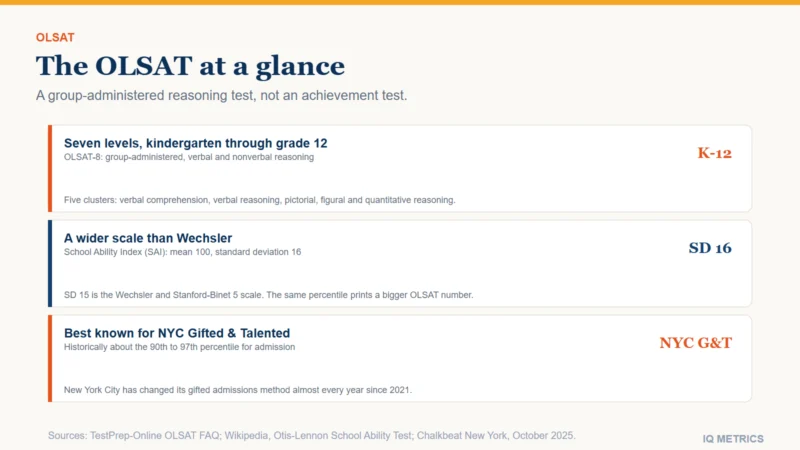
The OLSAT test, or Otis-Lennon School Ability Test, is a group-administered reasoning test used mainly for school placement and gifted-program admission in the United States, most visibly for New York City’s Gifted and Talented program. It reports a School Ability Index, or SAI, on a scale with a mean of 100 and a standard deviation of 16 — wider than the 15 used by the Wechsler scales and the current Stanford-Binet, which is why the same percentile prints a different number on each. This guide covers what OLSAT actually tests, how the SAI scale works, its history back to World War One-era army testing, how New York City has used and repeatedly changed its cutoffs, and how it compares with the CogAT and the NNAT.
- What it measures: verbal comprehension, verbal reasoning, pictorial reasoning, figural reasoning and quantitative reasoning — a reasoning test, not a test of taught content.
- Levels: the current eighth edition (OLSAT-8) has seven levels, A through G, spanning kindergarten through grade 12.
- Scale: the School Ability Index has a mean of 100 and a standard deviation of 16; a score of about 132 sits near the 97th to 98th percentile.
- Format: group-administered, multiple choice, roughly 60 to 75 minutes including directions.
- Best-known use: New York City Gifted and Talented admissions, historically alongside the NNAT.
What is the OLSAT?
OLSAT stands for the Otis-Lennon School Ability Test. It is a group-administered test, given with paper and pencil or on a computer to a classroom at once, unlike the one-to-one clinical batteries covered in our guides to professional IQ tests, the Stanford-Binet and the WPPSI-IV. It is built to measure reasoning ability rather than what a student has been taught, which is the same distinction our guide to the Woodcock-Johnson draws between its cognitive and achievement batteries. Schools and districts use OLSAT results for gifted-program screening, placement decisions and, in some private schools, admission. A different kind of school-administered assessment, the international PISA survey, gets confused with an IQ test for a different reason; see our guide to PISA versus IQ tests.
A short history: from Army testing to the classroom
The test traces to Arthur S. Otis, who studied under Lewis Terman at Stanford in the years before World War One. Otis had been developing a group-administered, multiple-choice approach to mental testing, and his item-writing work fed into the Army Alpha, the test the US Army used to screen recruits in 1917 and 1918 — the same wartime testing effort covered in our piece on the eugenics era of IQ testing. After the war Otis published the Otis Group Intelligence Scale (1920) and the Otis Self-Administering Tests (1922) through World Book Company. The test later passed to Roger T. Lennon, who oversaw its growth and gave it the combined Otis-Lennon name. Ownership of the current edition changed hands again in February 2022, when Pearson transferred OLSAT-8 to Multi-Health Systems (MHS) as part of a wider product transfer.
What the OLSAT actually tests
The OLSAT is organised around five reasoning clusters: verbal comprehension, verbal reasoning, pictorial reasoning, figural reasoning and quantitative reasoning. In practice this means analogies (both worded and picture-based), figural series that ask a child to continue a visual pattern, and classification items that ask which picture or word does not belong. Younger levels lean on pictures and symbols for children who cannot yet read fluently; older levels shift toward printed words and numbers. Nothing on the test asks a student to recall a taught fact, which is the point of calling it an ability test rather than an achievement test.
The School Ability Index: mean 100, SD 16
OLSAT results are reported as a School Ability Index (SAI), scaled to a mean of 100 and a standard deviation of 16. That is a different scale from the Wechsler tests and the current Stanford-Binet 5, both of which use a standard deviation of 15; our news piece on standard deviation 15 versus 16 explains why the same percentile prints a different raw number depending on which scale a test uses. A commonly cited reference point: an SAI of about 132 sits near the 97th to 98th percentile, which is why 132 shows up repeatedly in gifted-admission cutoffs built around the OLSAT.
| SAI score | Approximate percentile |
|---|---|
| 116 | 84th (about +1 SD) |
| 132 | 97th to 98th (about +2 SD) |
| 148 | 99.9th (about +3 SD) |
These are reference points on the SAI’s own scale, not a conversion to a Wechsler or Stanford-Binet number; see Mensa IQ score requirements for how a single percentile requirement is expressed differently across several named tests.
New York City Gifted and Talented: a moving target
The OLSAT’s highest-profile use is New York City’s Gifted and Talented (G&T) admissions process, and the city’s cutoffs and methods have changed repeatedly. For years, admission combined the OLSAT with the Naglieri Nonverbal Ability Test (NNAT), which reportedly replaced an earlier school-readiness screener as the nonverbal component around 2012. Through the 2010s, a combined percentile of about the 90th typically qualified a child for a district gifted program, and about the 97th for one of the five citywide or specialized gifted schools.
| Period | Method |
|---|---|
| Through 2020-21 | OLSAT plus NNAT; roughly 90th percentile for a district program, roughly 97th for a citywide school |
| 2021 | Mayor de Blasio proposed eliminating the gifted track entirely; not enacted before he left office |
| 2022-23 | Mayor Adams shifted district-level screening toward teacher and family nominations |
| 2023 | An admissions lottery open to children rated "4" (the top rating) on early-childhood assessments |
| 2024 | The lottery expanded to include children rated "3" as well as "4" |
| 2025 | Gifted admission folded into the single general kindergarten application |
| Proposed for fall 2027 | Mayor Mamdani has proposed ending kindergarten-entry gifted admission altogether; about 68% of surveyed parents opposed the idea in a February 2026 poll |
Two things are worth separating here. First, a single test score deciding a 4- or 5-year-old’s school track drew sustained criticism on equity grounds: in the last year the old system ran in full, only about 12% of kindergarten gifted seats went to Black or Latino students in a school system where those groups make up a much larger share of enrollment. Second, the Mamdani proposal is exactly that, a proposal, not a decided policy; if you are evaluating a specific school year’s admissions process, confirm the current method directly with the NYC Department of Education rather than relying on any single year’s description, including this one.
Where would your own score land?
Take the IIF-certified assessment and get your score with the scale it was measured on, the percentile it corresponds to and the confidence range around it — the three figures most online tests leave out.
Find your IQ score now! →Does the OLSAT predict other test scores?
An older but still-cited study gave both the OLSAT and the WISC-R to 431 students referred for evaluation in Alabama and found the two correlated significantly for most groups — but not for the group of students already identified as gifted, where the relationship weakened. The same study reported evidence of predictive bias by race in how OLSAT scores related to outcomes, an equity concern in the same territory covered by our guide to cultural bias in IQ tests. Two patterns follow from findings like this: a screening test’s accuracy can be worse at the extreme scores that matter most for gifted selection, and a group-administered reasoning test is not interchangeable with an individually administered clinical battery even when both report a reasoning-based score.
OLSAT versus CogAT versus NNAT
| Test | Format |
|---|---|
| OLSAT | Blends verbal and nonverbal reasoning in one combined score (the SAI). |
| CogAT (Cognitive Abilities Test) | Three separate batteries: verbal, quantitative and nonverbal, each scored on its own. |
| NNAT (Naglieri Nonverbal Ability Test) | Fully nonverbal and figural; designed to reduce the effect of language and educational background. |
Districts pick among these partly on what they want to measure and partly on cost and testing time; some, like New York City historically, use two of them together to cover both a verbal-inclusive score and a purely nonverbal one. Our news piece on CogAT and NNAT scores explained covers the other two in more detail, and IQ test questions for kids covers the item types children encounter across all three.
Quick answers
- What does OLSAT stand for? Otis-Lennon School Ability Test.
- What is a good OLSAT score? The SAI has a mean of 100. Scores used for gifted admission commonly sit around 128 to 132, roughly the 97th to 98th percentile.
- Is the OLSAT an IQ test? It is a school-ability reasoning test that behaves like one, reported on a mean-100 scale, but it is group-administered rather than the individually administered format of a clinical IQ test.
- What age or grade is the OLSAT for? The current edition, OLSAT-8, spans seven levels from kindergarten through grade 12.
- Who publishes the OLSAT now? Pearson published earlier editions; ownership of OLSAT-8 passed to Multi-Health Systems (MHS) in February 2022.
- Does New York City still use the OLSAT for Gifted and Talented? The city has changed its admissions method several times since 2021 and, as of early 2026, a further change is proposed for 2027. Confirm the current year’s method directly with the NYC DOE.
The bottom line
The OLSAT is a group-administered reasoning test, not a taught-content achievement test, scored on a School Ability Index with a mean of 100 and a standard deviation of 16 — a full point wider per step than the Wechsler and Stanford-Binet 5 scale of 15. It descends from Arthur Otis’s World War One-era testing work, and its highest-profile modern use, New York City’s Gifted and Talented admissions, has changed method almost every year since 2021. Read any single score, especially one near a gifted-program cutoff, as one data point rather than a verdict.
Sources
- Pearson, product transfer announcement (February 2022).
- Wikipedia, Otis-Lennon School Ability Test: the five reasoning clusters.
- University of Missouri Assessment Resource Center, OLSAT-8: current levels and testing time.
- TestPrep-Online, OLSAT FAQ: SAI scale, mean and standard deviation.
- Avant, A.H. and O'Neal, M. (1986): OLSAT and WISC-R score relationships in referred students, ERIC ED286883.
- Chalkbeat New York (October 2025): the history of NYC Gifted and Talented admissions changes.
- The 74 (2025): NYC gifted admissions changes and research context.
- PlaceNYC (February 2026): the proposal to end kindergarten-entry gifted admission by 2027.
- Wikipedia, Army Alpha: Arthur Otis and World War One-era group testing.
Keep reading
All articles →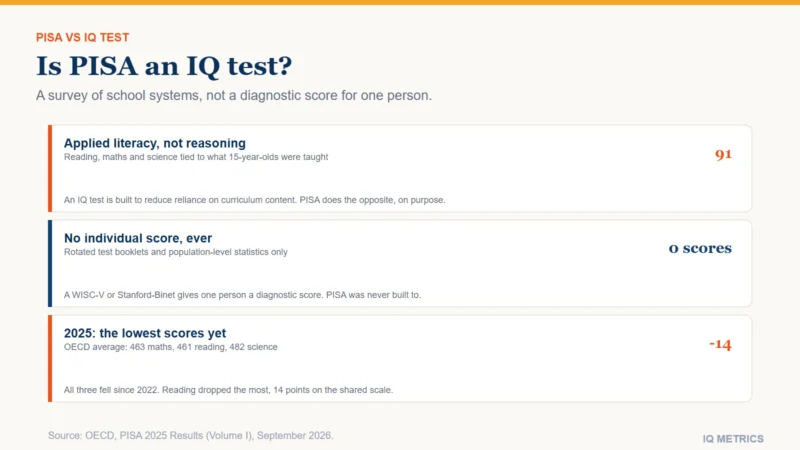 Understanding IQ
PISA Test vs IQ Test
Is PISA an IQ test? No. PISA surveys applied school literacy across whole education systems and returns no individual score, while an IQ test diagnoses one person. See the new PISA 2025 results, published September 2026, and the real debate over using PISA as a national IQ proxy.
 Scores & Scales
Gifted Cutoff Scores
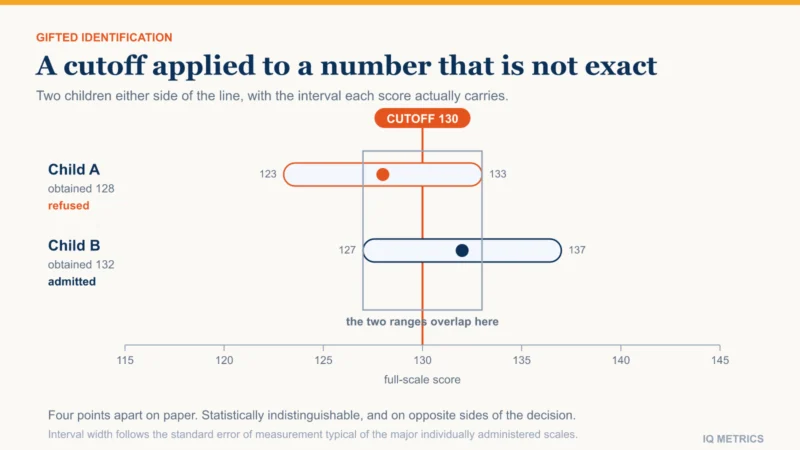
Most gifted programmes draw their line at an IQ of 130. The number is a statistical convention rather than a boundary in nature, and three well-documented features of how the score is produced and used mean a strict cutoff reliably excludes children who belong on the other side of it.
 Taking a Test
IQ Test Questions for Kids
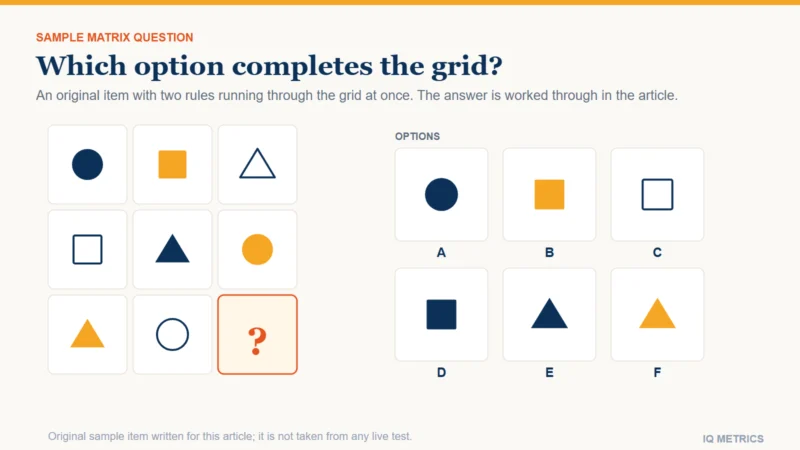
Original IQ test questions for kids with answers, by age: sample items for 4-7, 8-12 and 13-17, a matrix puzzle worked through, how a child's score is set, how stable it is, and what practice really does.