





Army Alpha and Beta: How IQ Testing Got Tangled Up With Eugenics
Between 1917 and 1919, the United States Army tested roughly 1.75 million recruits in the largest intelligence-testing program the world had yet seen. Within a decade, one psychologist had turned that data into a case for restricting immigration by race. Thirteen years after that, the same psychologist published a retraction few people have ever heard of.

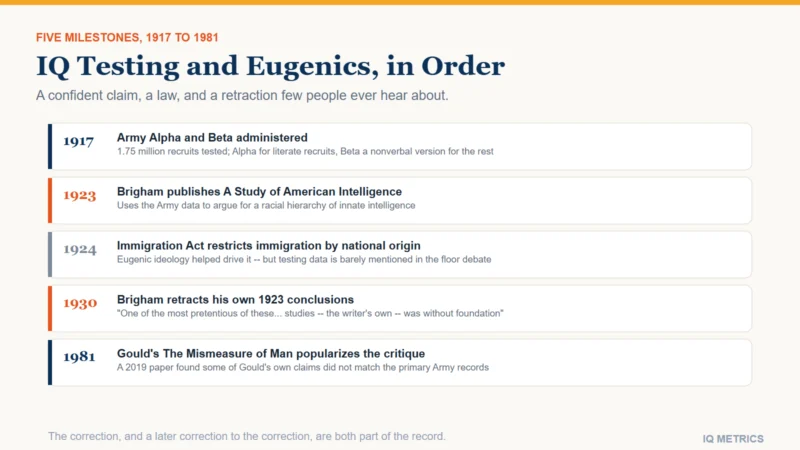
Closely, and unhappily, for a specific stretch of the early 20th century — though less directly, and less simply, than the popular version of this story usually has it. Between 1917 and 1919, the U.S. Army tested roughly 1.75 million recruits using two new instruments, Army Alpha and Army Beta, in what was at the time the largest intelligence-testing program ever conducted. Within a few years, a young psychologist named Carl Brigham had turned that wartime data into a book arguing for a fixed racial hierarchy of innate intelligence. Within a decade after that, Brigham published a retraction of his own conclusions that almost nobody who cites his 1923 book seems to know about.
That is the responsible, checkable version of a history that gets told two ways: either as a footnote nobody looks at closely, or as a much simpler morality tale than the actual documentary record supports. Both the original claims and the standard modern correction to them turn out to have real, specific problems worth naming.
The largest intelligence-testing program in history, to that point
The Army program was directed by the psychologist Robert Yerkes, with a committee of the era's leading testers including Henry Goddard and Lewis Terman, the psychologist who would go on to adapt the Stanford-Binet scale. Army Alpha was a written, group-administered test of analogies, arithmetic and judgment for literate, English-speaking recruits; Army Beta was a nonverbal, pictorial equivalent built for recruits who were illiterate or did not speak English. The stated purpose was practical rather than ideological on its face: classify recruits for duty assignment, screen out roughly 8,000 men judged unfit for service, and help select officer candidates, ultimately factoring into the selection of something like two-thirds of the war's 200,000 commissioned officers.
Ellis Island, and a study smaller than its reputation
A few years earlier, the psychologist Henry Goddard had sent researchers, and later went himself, to test immigrants arriving at Ellis Island, publishing the results in 1917. The study is still cited as if it were a broad survey of immigrant intelligence; it was nothing close to that. Government physicians had already pulled aside anyone visibly disabled before Goddard's team arrived, and the researchers then set aside anyone who looked obviously capable as well, testing only a small, deliberately ambiguous remainder. Using a looser, group-adjusted scoring standard on that unrepresentative slice, Goddard reported that more than 40 percent of the Jewish immigrants he tested scored as "feebleminded." The study's sampling problem, not just its conclusions, is the part worth remembering: a small, pre-filtered group testing poorly on an unfamiliar, culturally loaded exam in a language many of them did not speak was reported as if it described immigrants generally.
The book that turned Army data into a racial hierarchy
In 1923, Brigham published A Study of American Intelligence, using the wartime Army Alpha and Beta results to argue for a ranked hierarchy of racial and national groups, Nordic peoples at the top, and to warn that continued immigration was driving a decline in American intelligence. The book was taken seriously in exactly the circles working to restrict immigration at the time, and it gave that political project something it wanted badly: a veneer of hard, quantitative science behind an argument that was, underneath, about who counted as fit to become American.
Where would your own score land?
Take the IIF-certified assessment and get your score with the scale it was measured on, the percentile it corresponds to and the confidence range around it — the three figures most online tests leave out.
Find your IQ score now! →How much this actually shaped the Immigration Act of 1924
Here is where the popular version of this story runs ahead of the documentary record. A detailed 1983 review of the actual congressional hearings and floor debate behind the Immigration Act of 1924 found intelligence testing unmentioned in the law's text, raised exactly once across more than 600 pages of floor debate, and criticized there without any rebuttal from supporters. None of the era's prominent testers, not Yerkes, not Goddard, not Terman, testified before Congress or had their work entered into the official record. The reviewers' own conclusion was that the test results were "surely not crucial" to the legislation and "most likely... immaterial" to it, a conclusion an independent 1982 review reached separately. None of that erases eugenic ideology from the story of the 1924 Act — a broader movement, and Brigham's book specifically, were genuinely invoked in committee testimony supporting the restrictions. What the documentary record does not support is the stronger, more dramatic claim that Army intelligence-testing data was a direct or decisive cause of the law.
The retraction almost nobody remembers
In 1930, Brigham published a short paper in Psychological Review with a title that undersells what is inside it, "Intelligence Tests of Immigrant Groups." In it, he wrote that his own 1923 study — "one of the most pretentious of these comparative racial studies" — "was without foundation." His specific point was that comparing groups on a test given in English, when many test-takers had limited English fluency and limited schooling, measured language and educational access far more than it measured innate ability — exactly the kind of cultural and linguistic bias this site covers in a separate piece on test bias. It is worth being precise that the 1930 retraction focused on that methodological problem specifically; it is not a line-by-line repudiation of every claim in the 1923 book. One further, genuinely strange footnote: Brigham went on, in the years between the book and the retraction, to become the chief architect of the SAT, adapting it directly from the Army testing methodology he would later renounce for a very different purpose.
The standard modern critique, and a critique of the critique
The biologist Stephen Jay Gould's 1981 book The Mismeasure of Man is the most widely read modern account of this history, arguing that the Army testing program was scientifically compromised, from testing conditions to culturally loaded content, and that the resulting data, filtered through Brigham, helped drive the 1924 restrictions. Two layers of scholarly pushback have followed, and they are worth keeping separate. The first, the 1983 congressional-record review described above, argues Gould overstated how directly the testing data shaped the actual legislation. The second is narrower and more recent: a 2019 paper in the Journal of Intelligence checked Gould's specific claims about the Army Beta test itself against the original Army records and found real discrepancies — Gould described "vast numbers" of test-takers scoring zero, where the actual rate ran from under 1 to about 10 percent per subtest, and Gould cited a single unfavorable administration report while roughly a dozen more favorable ones existed in the same archive. That paper's own conclusion is that Army Beta was, by the standards of 1917, a reasonably well-designed test. No published rebuttal of that specific finding exists yet. The pattern worth noticing is not that any one side was simply right: it is that a confident claim about what IQ data proved, made in 1923, was substantially corrected in 1930 by the person who made it, and a confident modern correction to that same history has itself since been checked, and partly corrected, against the primary record.
What actually holds up, a century later
Eugenic ideology, as a broader movement, was real, influential and genuinely tied to American immigration and sterilization policy in this period — that much is not in dispute among historians. What the specific documentary record does not support is treating IQ-testing data itself as the direct engine of that policy, rather than one piece of scientific-sounding cover recruited into an argument that was already being made on other grounds. The durable, checkable lesson is narrower than either the popular story or its detractors usually make it: a test built and interpreted carelessly, given in an unfamiliar language to people with unequal access to schooling, was read as measuring fixed, innate group differences it was never capable of measuring — and the field's own literature, from Brigham's 1930 paper onward, has been correcting that specific mistake in some form ever since, right up to modern work on what a heritable trait does and does not mean for group differences and to this site's own piece on why national IQ-ranking claims do not support what people use them to argue, a modern descendant of exactly the same error. This is also not the only place on this site where a confident, well-published claim about what an IQ-adjacent measure proves did not survive later scrutiny — a very different, much more recent example plays out over years rather than decades in this site's piece on the bilingual advantage. For the broader arc this one chapter sits inside, see this site's general history of IQ testing.
Keep reading
All articles →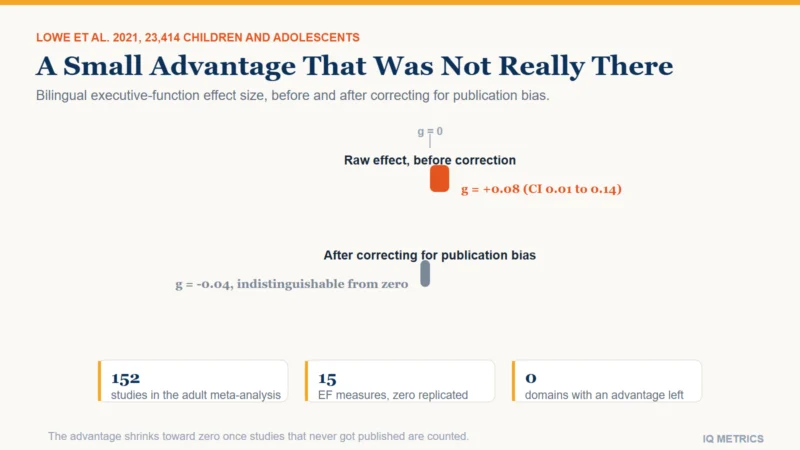 Research & Evidence
Bilingualism and IQ
For about a decade, a well-known finding held that bilingual children and adults show sharper executive function than monolinguals. Then researchers tried to replicate it across 15 separate measures and found almost nothing. A study of conference abstracts explained part of why the early evidence looked so much stronger than what came next.
 Research & Evidence
Cultural Bias in IQ Tests
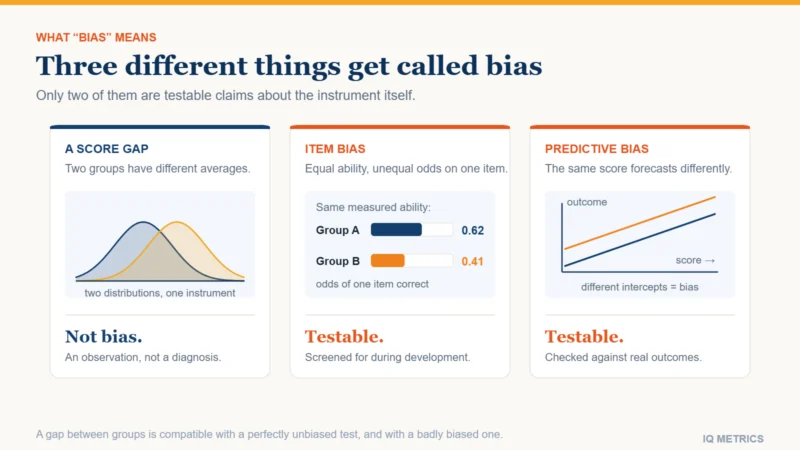
Ask whether IQ tests are culturally biased and you get two confident, opposite answers. Both are partly right, because the word means something far narrower to a psychometrician than it does in ordinary use. Here is what the item-level evidence shows, and where culture really does get into a score.
 Research & Evidence
Is IQ Genetic?
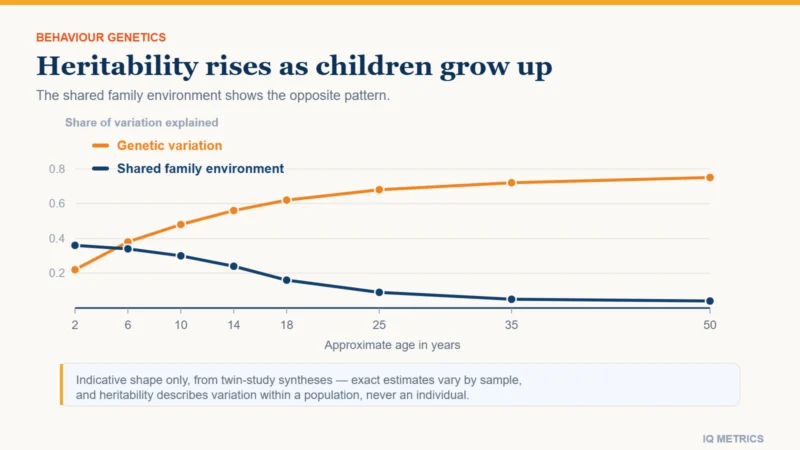
Heritability estimates for IQ rise from roughly 0.4 in childhood to 0.7 or higher in adulthood, which sounds decisive until you know what heritability measures. Here is what twin and adoption studies actually show, and the four conclusions people draw from them that the statistic does not support.