





Are IQ Tests Culturally Biased? What the Evidence Shows
Ask whether IQ tests are culturally biased and you get two confident, opposite answers. Both are partly right, because the word means something far narrower to a psychometrician than it does in ordinary use. Here is what the item-level evidence shows, and where culture really does get into a score.

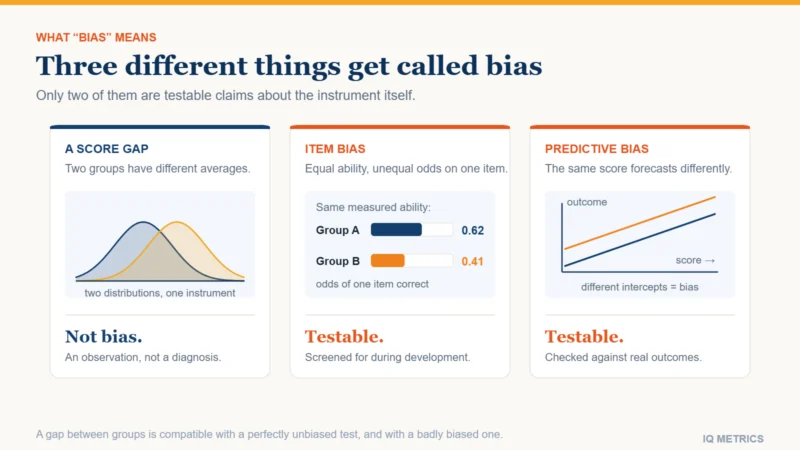
Cultural bias in IQ tests is real, but it is narrower and stranger than the phrase suggests. When psychometricians test for bias in modern batteries they usually find little of it in the technical sense they mean — and that finding does almost nothing to settle the question most people are actually asking. The confusion is not carelessness on either side. The word bias has a narrow statistical meaning in test development and a broad, moral one in ordinary use, and the two answers to "are IQ tests culturally biased" are answers to two different questions.
This article separates them. First what bias means to the people who build the tests, then what their own studies find, then the four places culture genuinely does get into a score — most of which are not in the questions at all.
Three different things get called bias
Almost every argument about this topic is two people using one word for three separate claims.
- A score gap. Two groups have different average scores. This is an observation, not an explanation. A thermometer is not biased because two cities differ.
- Measurement bias. Two people of genuinely equal ability have different chances of getting an item right, because of something about the item other than the ability it is meant to tap. This is testable, and it is what test developers screen for.
- Predictive bias. The same score forecasts a real-world outcome — a grade, a job rating — differently depending on which group the test-taker belongs to. Also testable, using regression slopes and intercepts.
Only the last two are bias in the technical sense. A gap on its own is compatible with a perfectly unbiased instrument, and equally compatible with a badly biased one. That is why the existence of group differences settles nothing on its own, and why national IQ rankings cannot support the conclusions drawn from them regardless of which direction the numbers point.
The regatta question, and why it was removed
The most-cited example of a culturally loaded item is real. An SAT analogy question asked test-takers to complete runner is to marathon as oarsman is to ___, with regatta as the answer. The word belongs to a leisure activity distributed very unevenly across social classes, and the item behaved exactly as you would predict. It was dropped, and analogy items were eventually dropped from the SAT altogether.
This is worth dwelling on for a reason people usually skip: the item was identified and removed by the statistical screening process. It is evidence that the screening works, not that it does not. But it also shows where the danger sits. Vocabulary and general-knowledge subtests are the most culturally loaded parts of any battery, and they are loaded by design, because they measure acquired knowledge rather than novel reasoning. That is the distinction between crystallized and fluid ability covered in our guide to how IQ tests work, and it is exactly why a verbal reasoning section cannot be culture-free even in principle.
What the item-level studies actually find
Major batteries such as the Wechsler scales and the Stanford-Binet run differential item functioning analyses during development. An item is flagged when test-takers matched on overall ability still differ in their odds of answering it correctly, and flagged items are revised or cut before publication. Expert review panels screen content separately.
The published result is consistent and, to many people, counter-intuitive: within a single country and language, residual differential item functioning in well-constructed batteries tends to be small, and measurement invariance broadly holds across major demographic groups. Reviews of predictive bias reach a similar place — where tests are validated against school or job outcomes, they generally do not under-predict performance for lower-scoring groups.
Two honest caveats belong with that finding. Invariance within a country is a much weaker claim than invariance across countries and languages, where translation, adaptation and separate norming samples make the comparison far shakier. And invariance means the test measures the same construct in the same way for everyone; it says nothing about whether the construct itself was shaped by unequal opportunity long before test day.
Where would your own score land?
Take the IIF-certified assessment and get your score with the scale it was measured on, the percentile it corresponds to and the confidence range around it — the three figures most online tests leave out.
Find your IQ score now! →Where culture actually gets into a score
If the items are largely clean, the interesting question is what is left. Four things, none of them a question on the page.
The culture of test-taking itself
Sitting alone with a stranger, working fast, guessing when unsure rather than staying silent, treating an obviously artificial puzzle as worth serious effort — these are learned conventions, and they are learned unevenly. Someone taught that admitting ignorance is more honest than guessing will lose real points on a scored-right test. Familiarity with the format is itself worth points, which is the same mechanism behind the practice effect on repeated testing.
The language of administration
A bilingual test-taker assessed in their second language is being measured partly on that language. This is the single largest and least controversial source of cultural distortion in practice, and it is why a large verbal-nonverbal split is a flag for a clinician rather than a finding — see what a gap between your verbal and non-verbal scores means.
Stereotype threat
The proposal is that awareness of a negative stereotype about your group consumes working memory during the test itself. The original laboratory demonstrations were striking. The picture since has become genuinely contested: several large replications have found much smaller effects than the early studies, and meta-analyses report evidence consistent with publication bias. The fair summary is that the mechanism is plausible and probably real in some settings, and that its size in a routine testing session is unresolved. Ordinary test anxiety, which is better established, points the same way.
The norm group your score is compared against
An IQ score is not a count of correct answers. It is a position relative to a standardisation sample, so who was in that sample is part of the measurement. A score from a sample that under-represents you is a comparison you did not consent to. This is also why the same raw performance yields different numbers on scales with different spreads, as our percentile calculator and the note on standard deviation 15 versus 16 both show.
Content bias versus construct bias
There is one more distinction worth having, because it is where the two sides of this argument genuinely disagree rather than merely talk past each other.
Content bias is an item behaving unfairly. It is what the screening catches, and modern batteries are reasonably good at it. Construct bias is a deeper claim: that the ability being measured is itself a culturally particular thing — that valuing speed over deliberation, abstraction over context, and the lone solver over the group is a set of choices about what counts as intelligent, made by a particular tradition.
Cross-cultural work gives this some support. Studies of everyday cognition have documented people performing complex practical reasoning fluently in their own setting — market arithmetic, navigation, agricultural planning — while scoring poorly on the formal-school version of the same operations. Whether that makes the test biased or simply narrow is partly a question about words. What is not in dispute is that it makes a low score, on its own, a weak claim about a person's reasoning.
Culture-fair tests: what they fix and what they do not
The response to all this, from the 1930s onward, was to strip out language and acquired knowledge. Raven's Progressive Matrices and the Cattell Culture Fair scales present abstract visual patterns with a rule to be found. Our own culture-fair IQ test is built on the same principle, and these instruments do remove the most obvious problem.
They do not remove culture. Reading a two-dimensional grid as a representation, scanning left-to-right and top-to-bottom, accepting that an abstract puzzle has exactly one defensible answer — all of these are schooled habits. The decisive evidence is the Flynn effect: across the twentieth century the largest score gains were on Raven's-type tests, the ones designed to be culture-free. Whatever changed in those decades, it was not the human genome. A test that gains twenty points in fifty years is exquisitely sensitive to environment, which is the opposite of culture-free. Our note on why IQ norms expire covers what happened next.
What to do with your own score
None of this makes a score meaningless. It makes it a measurement with conditions attached, which is what every measurement is. Three habits follow.
- Read the confidence interval, not the point. A single number hides a band of several points either side, as test accuracy and error explains.
- Ask what the score is being used for. Prediction of school achievement is well evidenced; ranking human worth is not a use the instrument supports, and what a score predicts about school is narrower than most people expect.
- Treat a low score in an unfamiliar language or format as uninformative until it is repeated under better conditions.
The short answer to the question in the title: modern tests are far less biased at the item level than their critics assume, and far less culture-free than their defenders imply. Both halves of that sentence are load-bearing.
Keep reading
All articles →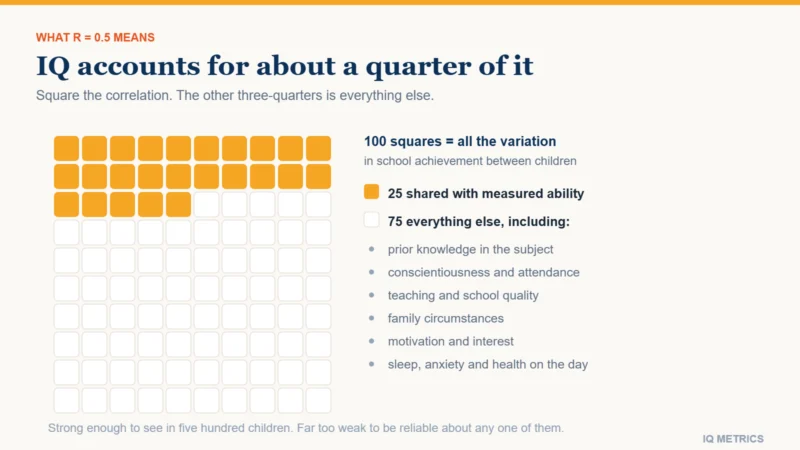 Research & Evidence
Does IQ Predict School Success?
IQ predicts school achievement better than any other single measure psychologists have found, and still leaves roughly three-quarters of the variation unexplained. Both halves of that sentence get ignored by somebody. Here are the actual correlations, what they mean for one child, and what accounts for the rest.
 Research & Evidence
Is IQ Genetic?
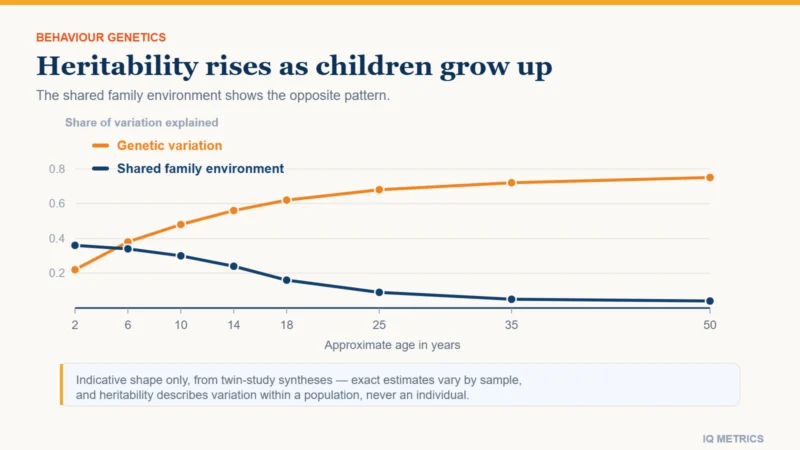
Heritability estimates for IQ rise from roughly 0.4 in childhood to 0.7 or higher in adulthood, which sounds decisive until you know what heritability measures. Here is what twin and adoption studies actually show, and the four conclusions people draw from them that the statistic does not support.
 Taking a Test
Professional IQ Tests
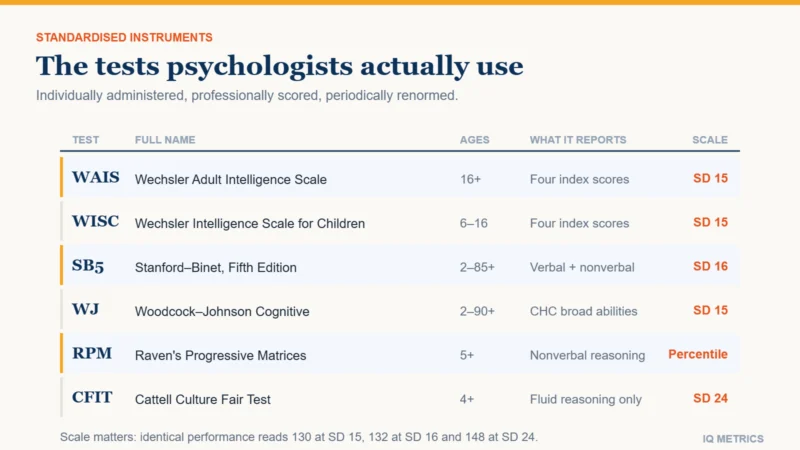
When a psychologist measures intelligence, they reach for one of a small number of standardised instruments. This guide covers what the Wechsler scales, Stanford-Binet, Woodcock-Johnson and Raven's Progressive Matrices each measure, who each one is for, and where an online test genuinely fits.