




Is PISA an IQ Test? What PISA Actually Measures
Is PISA an IQ test? No. PISA surveys applied school literacy across whole education systems and returns no individual score, while an IQ test diagnoses one person. See the new PISA 2025 results, published September 2026, and the real debate over using PISA as a national IQ proxy.

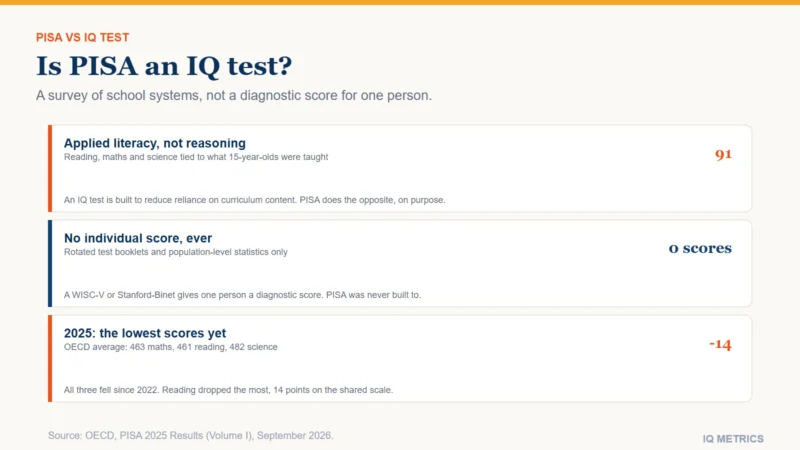
Is PISA an IQ test? No. The Programme for International Student Assessment, run by the OECD, measures how well 15-year-olds can apply reading, maths and science knowledge to real-world problems, using a survey design that never even returns an individual score to the student who sat it. An IQ test, by contrast, is given one to one and produces exactly that: one person’s diagnostic score. The two are correlated at the level of whole countries, but that correlation itself has been strongly challenged. This guide covers what PISA actually measures, the September 2026 results from the newest cycle, how it differs structurally from an IQ test, and the real debate over using PISA scores as a stand-in for national IQ.
- What PISA measures: applied reading, maths and science literacy in 15-year-olds, not general cognitive ability.
- No individual score: PISA uses rotated test booklets and reports statistical estimates for a population, not a score for any one student.
- Newest results: PISA 2025, published September 2026, covered about 91 countries and education systems and recorded the lowest OECD-average scores yet in all three subjects.
- The IQ link is contested: national PISA averages correlate strongly with one controversial "national IQ" dataset, but that dataset’s sampling has been heavily criticised.
What PISA actually is
PISA stands for the Programme for International Student Assessment. The OECD has run it since 1997, first administering it in 2000 and repeating it roughly every three years since (the 2022 round was delayed a year by the pandemic; the OECD is moving to a four-year cycle after 2025). In its own words, “PISA is a regularly-conducted survey of 15-year-old students around the world that assesses the extent to which they have acquired key knowledge and skills essential for full participation in social and economic life,” and it deliberately goes beyond recall: it “assess[es] how well students can extrapolate from what they have learned... and apply it to real-life problems.” That is an applied-literacy test tied to what 15-year-olds have been taught and have practised, not a culture-fair test of general reasoning ability like the ones covered in our guide to professional IQ tests. A different group-administered school test, the OLSAT, blurs the line with an IQ test more than PISA does; see our guide to the OLSAT test.
The September 2026 results: PISA 2025
The newest cycle, PISA 2025, covered 15-year-olds across 38 OECD countries and 53 partner countries and economies, about 91 education systems in total, with initial results published by the OECD in September 2026. On the programme’s shared scale, where each subject was originally set to a mean of 500 with a standard deviation of 100 in its baseline year, the 2025 OECD average came to 482 in science, 461 in reading and 463 in mathematics. All three fell from the 2022 cycle (science down 3 points, not a significant change; reading down 14; mathematics down 9), which the OECD describes as the lowest OECD-average performance recorded so far in all three core subjects.
| Subject | 2025 OECD average | Change since 2022 |
|---|---|---|
| Mathematics | 463 | -9 points |
| Reading | 461 | -14 points |
| Science | 482 | -3 points, not significant |
The highest scores in the 2025 cycle came from the Chinese provinces tested as a group under the label B-S-J-Z (Beijing, Shanghai, Jiangsu and Zhejiang), which led in both mathematics (612) and science (597), and from Singapore, which led in reading (535) and also scored highly in science (560) and mathematics (563). Macao, Chinese Taipei, Japan and Korea also placed near the top across subjects. Bear in mind that B-S-J-Z represents specific, more developed Chinese provinces rather than the country as a whole, a distinction the OECD itself is explicit about.
Why PISA does not work like an IQ test
The structural differences run deeper than subject matter. PISA uses a rotated-booklet design: no single student answers every question, and item response theory combines everyone in a school or country into population-level statistical estimates (“plausible values”) rather than individual scores. The programme’s own technical documentation is explicit that PISA is low-stakes for the student: results are used to compare education systems, and students taking it do not receive individual feedback on their own performance at all. An individually administered test such as the Stanford-Binet or the Wechsler Intelligence Scale for Children works the opposite way: one person sits with a trained psychologist for roughly 45 to 65 minutes and receives a Full Scale IQ plus several index scores, a diagnostic result meant to describe that individual. PISA was never built to produce that kind of number for anyone.
| Feature | PISA | Individual IQ test (e.g. WISC-V) |
|---|---|---|
| Purpose | Compare education systems across countries | Diagnose one person’s cognitive profile |
| Administration | Group, rotated booklets, often computer-based | One to one with a trained examiner |
| Individual score returned? | No, only population-level estimates | Yes, a Full Scale IQ plus index scores |
| What it targets | Applied reading, maths and science literacy tied to schooling | General reasoning ability, designed to reduce dependence on curriculum content |
| Stakes for the student | Low; no individual feedback given | High; used for diagnosis, placement or eligibility |
The real debate: do national PISA scores measure "national IQ"?
National average PISA scores correlate strongly with one specific dataset of estimated national IQs: Rindermann (2007) reported a correlation of .88 (adjusted to .84) between a combined student-assessment score, PISA included, and the national IQ estimates published by Lynn and Vanhanen (2006) across 46 to 47 countries. That is a strong correlation, and it is often cited as evidence that PISA is, in effect, measuring the same thing an IQ test would. The trouble is the national IQ dataset itself. Volken (2003) found the underlying samples were not representative at the national level for many countries, and a systematic review by Wicherts, Dolan and van der Maas (2010) found the exclusion criteria used to build the Lynn and Vanhanen estimates were never published; when they added back studies that had been excluded without a stated reason, the estimated average IQ for sub-Saharan Africa rose from 67 to 82, a very large change driven entirely by which studies were counted. Our own page on average IQ by country publishes figures from this same contested tradition, and our news piece on what country IQ rankings data cannot support sets out the wider case against treating any national IQ ranking as settled science. A strong country-level correlation between two measurements does not make them interchangeable, especially when one side of the correlation is itself disputed.
Where would your own score land?
Take the IIF-certified assessment and get your score with the scale it was measured on, the percentile it corresponds to and the confidence range around it — the three figures most online tests leave out.
Find your IQ score now! →What about one person? Does a PISA-style score predict an individual IQ score?
At the level of one student rather than one country, the relevant comparison is the long-studied link between intelligence and school achievement generally. A large meta-analysis by Roth and colleagues (2015), pooling 240 samples and 105,185 people, found intelligence correlated with school grades at ρ = .54. Earlier meta-analyses looking specifically at standardised achievement tests, the closer comparison to what PISA measures, found correlations in a similar range: .48 (Boulanger, 1981), .43 (Fleming and Malone, 1983) and .34 (Steinkamp and Maehr, 1983). No peer-reviewed study was found that measured the correlation between an individual PISA-style assessment score and an individual IQ score directly, so the honest answer is that the relationship is inferred from the broader achievement-intelligence literature, not measured on PISA itself.
Quick answers
- Is PISA an IQ test? No. It is an applied-literacy assessment of reading, maths and science for 15-year-olds, built to compare education systems, and it does not return an individual score to any student.
- What is the most recent PISA result? PISA 2025, published by the OECD in September 2026: OECD averages of 463 in mathematics, 461 in reading and 482 in science, the lowest recorded so far in all three.
- Which country scored highest on PISA 2025? B-S-J-Z (Beijing, Shanghai, Jiangsu and Zhejiang, in China) led mathematics and science; Singapore led reading.
- Do PISA scores measure national IQ? They correlate strongly with one specific, heavily disputed national-IQ dataset. The correlation is real; whether that dataset is trustworthy is a separate and contested question.
- Can a school or a parent get an individual child’s PISA score? No. PISA is designed as a population survey and does not report individual results at all.
The bottom line
PISA and an IQ test measure different things in different ways for different purposes: PISA surveys applied school-taught literacy across whole education systems and tells a student nothing about their own score, while an IQ test diagnoses one person’s general reasoning ability. The two are related at the national level, strongly enough that some researchers treat PISA as a proxy for national cognitive ability, but that proxy rests on a national-IQ dataset whose sampling methods critics have directly challenged. Read PISA rankings for what they are, a measure of applied literacy under a specific school system, rather than as a national intelligence test.
Sources
- OECD (2026): PISA 2025 Results (Volume I).
- US National Center for Education Statistics: PISA technical notes on scoring and plausible values.
- Rindermann, H. (2007): the g-factor of international cognitive ability comparisons, European Journal of Personality, 21:667-706.
- Volken, T. (2003): IQ and the wealth of nations, a critique of Richard Lynn and Tatu Vanhanen's recent book, European Sociological Review, 19(4):411-412.
- Wicherts, J.M., Dolan, C.V. and van der Maas, H.L.J. (2010): a systematic literature review of the average IQ of sub-Saharan Africans, Intelligence, 38:1-20.
- Roth, B. et al. (2015): intelligence and school grades, a meta-analysis, Intelligence, 53:118-137.
Keep reading
All articles →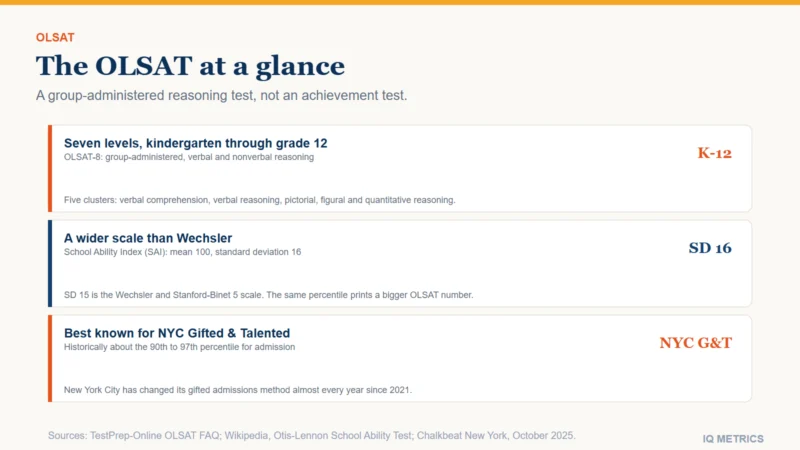 Scores & Scales
OLSAT Test
The OLSAT test (Otis-Lennon School Ability Test) is a group-administered reasoning test scored on a School Ability Index with mean 100 and SD 16, best known for New York City Gifted and Talented admissions. See how it works, its history, and the NYC admissions cutoffs and controversy.
 Understanding IQ
Is Intelligence limited to IQ?
As we explore the fascinating world of intelligence, we will uncover the truth about IQ and the limitations of the human intellect. Beyond traditional measures of intellect, this article explores a wider range of aptitudes that impact our perception and engagement with the natural world.
 Research & Evidence
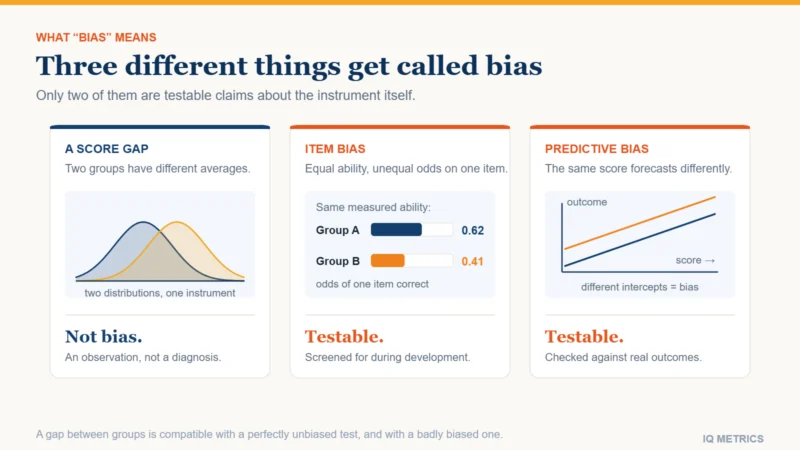
Cultural Bias in IQ Tests
Ask whether IQ tests are culturally biased and you get two confident, opposite answers. Both are partly right, because the word means something far narrower to a psychometrician than it does in ordinary use. Here is what the item-level evidence shows, and where culture really does get into a score.