



Is Human Attention Span 8 Seconds, Less Than the Attention Span of a Goldfish?
The claim that people focus for 8 seconds and a goldfish for 9 sits on one 2015 Microsoft Canada slide credited to Statistic Brain. We opened the report and the BBC's 2017 check of it, and read what peer-reviewed work measures instead.


What you need to know
- The claim that human attention span is 8 seconds, shorter than the attention span of a goldfish, appears once in Microsoft Canada's 2015 Attention Spans report, on a slide whose source line reads Statistic Brain (12 seconds in 2000, 8 in 2013, goldfish 9).
- The BBC (10 March 2017) found that neither source Statistic Brain listed could find research behind the numbers, and that experts call an average attention span task-dependent and meaningless. No evidence that human attention spans are shrinking was found.
- What peer-reviewed work measures instead: a median of 40 seconds of online screen focus in 40 workers (Mark and colleagues, CHI 2016). It is a small workplace study, not a capacity.
- Goldfish are a standard laboratory model for learning and memory. We found no study that gives a goldfish attention span in seconds.
No. The claim that the average human attention span is 8 seconds, shorter than the attention span of a goldfish, has no study behind it. It sits on one slide of a 2015 Microsoft Canada report, which gives the goldfish 9 seconds and credits a website called Statistic Brain. The BBC found that neither source Statistic Brain listed could confirm the numbers. Researchers it spoke to said an average attention span is meaningless, because attention depends on the task.
Below: where the 8-second figure came from, what the Microsoft report did measure, what we know about goldfish, one peer-reviewed measure of how long workers stay on a screen, and whether attention spans are shrinking. We opened the BBC article and the Microsoft report themselves on 12 November 2026.
Is the average human attention span 8 seconds?
The human attention span 8 seconds figure is not a measured result. The figure appears once in Microsoft Canada's Consumer Insights report Attention Spans (Spring 2015), on a slide headed "We know human attention is dwindling", with the source line "Statistic brain". The slide lists the average human attention span as 12 seconds in 2000 and 8 seconds in 2013, and the average attention span of a goldfish as 9 seconds.
- The claim: human attention span 12 seconds in 2000 and 8 seconds in 2013, goldfish 9 seconds (one slide, Microsoft Canada, Spring 2015)
- The source named on the slide: Statistic Brain
- What the BBC found in 2017: the two sources Statistic Brain listed, the US National Center for Biotechnology Information and the Associated Press, could find no research behind the numbers
- What researchers told the BBC: an average attention span is "task-dependent", so one number is meaningless
- What the peer-reviewed work we read measures instead: a median of 40 seconds of online screen focus in 40 office workers (CHI 2016)
Microsoft's own research was different. The report describes a gamified online survey of 2,000 Canadians (fielded in the fourth quarter of 2014) and a study of 112 Canadians wearing portable EEG headsets (December 2014). The report is a marketing document from Microsoft Canada's consumer insights team, not a peer-reviewed study. Its executive summary even says "Good news! It's not as bad as you think" and "Don't believe everything you read".
Where did the goldfish comparison come from?
It came from that same slide, and it spread because it was easy to repeat. The word goldfish appears once in the whole report, on the slide, next to the Statistic Brain credit. The BBC's Simon Maybin wrote in March 2017 that all the references he found led back to the Microsoft report. He listed Time, the Telegraph, the Guardian, USA Today, the New York Times and the National Post as having carried the statistics.
The BBC also noted that the number itself did not come from Microsoft's research. The report's own measurements were the survey and the EEG study. When Maybin asked Statistic Brain's listed sources, neither could find any record of research that backed the figures. He could not reach Statistic Brain, and people who study attention for a living told him they had no idea where the numbers came from.
Can anyone measure the attention span of a goldfish?
We found no study that reports a goldfish's attention span in seconds, and none of the abstracts we read tries to. People also search for goldfish memory 3 seconds, and the BBC found no evidence that goldfish or fish in general have particularly short attention spans or memories. Researchers do study goldfish learning and memory a great deal. Felicity Huntingford, who has studied fish behaviour for almost half a century, told the BBC that goldfish have become a model system for studying learning and memory because they learn and remember. She said hundreds of papers exist, and the BBC found a reference to a fish-memory study from as early as 1908.
The recent literature points the same way. In a 2023 study in Brain Research Bulletin, goldfish were trained in two navigation tasks to reach a reward and then retested after brain lesions (Givon and colleagues). In a 2018 study in Annals of Neurosciences, goldfish were trained with contextual fear conditioning and tested for fear memory 24 hours later. Culum Brown's 2015 review in Animal Cognition says there is a large gap between people's perception of fish intelligence and the scientific reality. None of this makes a goldfish a genius, and none of it supports a 9-second span.
How long do people really stay on one screen?
In one small study of office workers, the median was 40 seconds. Mark and colleagues (CHI 2016) tracked the online activity of 40 information workers for two work weeks and found a median duration of online screen focus of 40 seconds. Neuroticism was linked to shorter focus. Shorter focus was linked to lower assessed productivity at day's end. A median is a middle value, not a limit.
This is not the myth's 8 seconds, and it is not a measure of what a person can do. It counts how long 40 workers stayed on one screen before switching, in their offices, in one study. An earlier study by the same group followed 32 workers for five days. It found more focused attention than boredom at work, with focus peaking mid-afternoon and boredom highest in early afternoon (CHI 2014). Attention moves with the task and the time of day.
Is human attention span really shrinking?
We found no study that shows a shrinking human attention span. The BBC reported in 2017 that there is no evidence that human attention spans are shrinking. Dr Gemma Briggs of the Open University called the idea that it is getting shorter something she did not think was true at all, because psychologists do not try to measure attention that way. Our searches did not turn up a study that overturns this.
One peer-reviewed paper finds a faster pace of a different kind. Lorenz-Spreen and colleagues (Nature Communications, 2019) analysed data across several domains over decades and found steeper rises and shorter periods in how cultural items receive collective attention. That is the public's attention to topics, not one person's attention span. Their model suggests that more content competing for limited attention explains it. Microsoft's report said that moderate to heavy social media users had lower sustained attention overall but more short bursts of attention, a claim from a marketing study that we did not test.
The 8-second goldfish statistic sits on one slide, credited to Statistic Brain, and neither source that site listed could confirm it.
What does attention have to do with IQ?
An IQ test reports no attention span in seconds. Modern tests such as the WISC-V and WAIS-5 report five areas: verbal comprehension, visual spatial, fluid reasoning, working memory and processing speed. Attention and working memory are tied, and our guide to working memory and reasoning explains why they are not the same ability. Our Stroop test guide covers a classic attention task.
To try attention yourself, play the Stroop Test, where your result is your own Stroop effect in milliseconds, or check your speed in the reaction time test. For other claims about the brain that do not survive a check, read the left-brain, right-brain myth and our list of brain myths about intelligence. For a number that does sit on a scale, our IQ percentile calculator turns an IQ into a percentile.
Where would your own score land?
Curious how your reasoning compares with other adults? The IQ Metrics test reports a result with its percentile.
Find your IQ score now! →To see a result on the standard scale, take the IQ Metrics test.
Common questions
Is the average human attention span 8 seconds?
No study measures it. The figure appears on one slide of Microsoft Canada's 2015 Attention Spans report, credited to Statistic Brain, and the BBC found that neither source Statistic Brain listed could back it.
Is human attention span shorter than a goldfish's?
The comparison has no evidence behind it. The 9-second goldfish figure sits on the same slide, and the BBC reported that there is no evidence goldfish have short attention spans or memories.
How long do people stay on one screen?
In one study of 40 information workers followed for two work weeks, the median online screen focus was 40 seconds (Mark and colleagues, CHI 2016). That is a small workplace study, not a human limit.
Are attention spans getting shorter?
We found no study showing a shrinking human attention span, and the BBC reported no evidence for it. One 2019 Nature Communications paper finds that public attention to topics now rises and falls faster, which is a different thing.
Sources for this story
- Maybin S. Busting the attention span myth. BBC News, 10 March 2017 (read in full) — BBC News
- Microsoft Canada Consumer Insights. Attention Spans (Spring 2015); read in full on 12 November 2026 from the Internet Archive's copy of Microsoft's PDF dated 2 February 2017 — Microsoft Canada
- Mark G, Iqbal ST, Czerwinski M, Johns P, Sano A. Neurotics Can't Focus: an in situ study of online multitasking in the workplace. CHI 2016, doi 10.1145/2858036.2858202; and Mark G, Iqbal ST, Czerwinski M, Johns P. Bored Mondays and focused afternoons. CHI 2014, doi 10.1145/2556288.2557204 (abstracts read) — ACM
- Lorenz-Spreen P, Mønsted BM, Hövel P, Lehmann S. Accelerating dynamics of collective attention. Nature Communications 10 (2019), doi 10.1038/s41467-019-09311-w (abstract read) — Springer Nature
- Brown C. Fish intelligence, sentience and ethics. Animal Cognition 18(1):1-17 (2015), doi 10.1007/s10071-014-0761-0; Givon S et al., Brain Research Bulletin 204:110802 (2023), doi 10.1016/j.brainresbull.2023.110802; Thangaleela S et al., Annals of Neurosciences 25(2):90-97 (2018), doi 10.1159/000486842 (abstracts read) — Springer / Elsevier / SAGE
Corrections: spotted an error? Email corrections@iqmetrics.org and we will update this story and note the change here.
Related stories
All news →
The Left-Brain/Right-Brain Myth: What Brain Scans Actually Show
The idea that everyone leans on one dominant hemisphere — logical on the left, creative on the right — traces back to a real, Nobel Prize-winning discovery. It is not what that discovery found.
Stroop Test Explained: What It Measures and the IQ Link
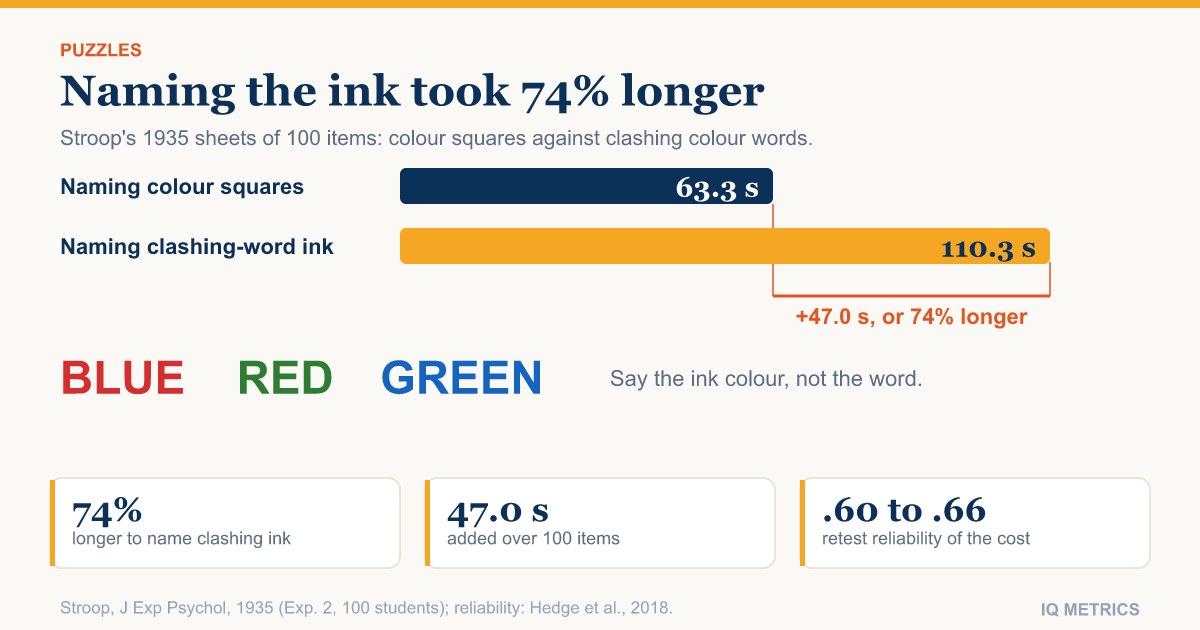
In Stroop's 1935 study, naming the ink colour of 100 conflicting colour words took 47 seconds longer than naming coloured squares. The effect is among the most reliable in psychology, yet one person's score is not, and it tracks IQ only weakly.

Do Video Games Rot Your Brain? What a Study of 9,855 US Children Found
In a US study of 9,855 children aged 9 to 10, more gaming went with a gain in intelligence two years later, not a loss. It was observational, covered US children only, and a pooled analysis finds little carry-over to general ability.
Read the research.
Then find your own number.
Our IIF-certified assessment reports your score with its scale, percentile and confidence range — and a breakdown of the cognitive domains behind it.
Start IQ Test →