



How Many Brain Cells Does a Human Have? 86 Billion Neurons and a 10-to-1 Myth
A human brain holds about 86 billion neurons and about as many other cells. The famous figures, 100 billion neurons and 10 glial cells per neuron, came from decades of repeated claims, and the cell counts do not support them.


What you need to know
- How many brain cells does a human have? About 86 billion neurons and about 85 billion non-neuronal cells, roughly 170 billion in all (Azevedo et al., 2009). The review gives 67 to 86 billion neurons across counts.
- About 80% of the neurons are in the cerebellum and only 19% in the cortex, which holds about 16 billion by our arithmetic.
- The 10-to-1 ratio of glia to neurons is a myth. Glial cells are well below 85 billion, and the ratio is below 1 to 1. A 1980s textbook claim of up to 50 trillion glial cells had no support in the research.
- Large daily neuron loss in healthy ageing was also a measurement error: brain shrinkage after preservation depends on age. Real loss happens in diseases such as Alzheimer's.
How many brain cells does a human have? About 86 billion neurons, and about as many other cells, so roughly 170 billion in all. Those are the counts from Azevedo and colleagues (2009), checked in a 2016 review of 150 years of cell counting. The famous figures, 100 billion neurons and 10 glial cells for every neuron, are wrong. The real ratio is below 1 to 1.
Below: where the neurons sit, how many glial cells there are, where the 10-to-1 myth came from, whether we lose brain cells every day, and what the numbers say about intelligence.
How many brain cells does a human have?
A human brain holds about 86 billion neurons and about 85 billion non-neuronal cells. Azevedo and colleagues counted them in adult male brains with a method called the isotropic fractionator. It dissolves the brain into a suspension of cell nuclei, then counts the nuclei with a stain that marks neurons.
- Neurons: 86.1 billion on average (give or take 8.1 billion between brains)
- Non-neuronal cells: 84.6 billion on average (give or take 9.8 billion)
- All cells together: about 170 billion, our sum of the two
How many brain cells does the average human have, then? There is no single exact figure, because brains differ. The review gives a range of 67 to 86 billion neurons for the counts made with this method. The 86 billion is the best-known value, not a fixed constant.
Why do the counts differ? Brains vary a lot from person to person, and human tissue is hard to work with. The review notes that some published counts, from older microscope methods, had to be revised. Azevedo's brains were also adult male brains, so the figure is not a count for every person.
How many neurons are in the human brain, and where are they?
Most of them are in the cerebellum, not the cortex. About 80% of all neurons in the human brain sit in the cerebellum, the structure at the back of the head that helps with movement and balance. Only 19% are in the cerebral cortex, the folded outer layer.
That is about 16 billion neurons in the cortex, by our arithmetic (19% of 86.1 billion). About 1% are left for everything else. The cortex makes up 82% of the brain's mass, so a large part of the brain holds a small share of its neurons.
Put another way, how many neurons in the human brain are in the cortex? About 16 billion. Our guides to human brain vs dog brain and cat brain size use these counts to compare species.
How many glial cells does the human brain have?
Well below 85 billion, and probably fewer than the number of neurons. Glial cells are the brain's support cells. The 85 billion non-neuronal cells include about 20 to 25 billion endothelial cells, which line the blood vessels, so the glial total is smaller.
So how many glial cells does the brain hold? The 2016 review puts the true figure closer to 40 to 50 billion, the estimate Haug made in 1986, than to the 100 to 130 billion Blinkov and Glezer gave in 1968. Are there more glia than neurons, then? No. The ratio of glia to neurons in the whole brain is less than 1 to 1.
Is the human brain 100 billion neurons with 10 glial cells for each one?
No. Both numbers are wrong, and the review explains how they spread. For about 50 years the brain was said to hold 100 billion neurons and one trillion glial cells, a ratio of 10 to 1. The review says the 10 to 1 ratio had, in its words, "prematurely and mistakenly" become common knowledge.
The old data never supported it. The largest glial count in the original research was 130 billion. Yet two editions of a leading neuroscience textbook, in 1981 and 1985, suggested as many as 50 trillion glial cells. Neuron estimates were closer to today's counts: 70 to 80 billion in 1986, and 85 billion in 1988.
For half a century the textbook said 10 glial cells per neuron. The cell counts say about one.
The review lists several causes. Researchers failed to notice that the numbers did not add up. They focused on parts of the brain that were not representative, and they neglected the cerebellum, which holds about 80% of the neurons. They also copied earlier reviews without checking them and were slow to challenge the accepted view.
The 2009 counts finally made the gap with the textbooks hard to ignore. Our guide to human brain facts gives more of the basics, and our article on how much of our brain we use covers another brain myth.
Do we lose brain cells every day, and can new ones grow?
Not in the large numbers once claimed. Studies from the 1950s to the 1980s said the normal ageing brain loses many neurons every day after age 30. One summary even held that a 60-year span of adult life would mean losing half the cerebral neurons.
That belief rested on a flaw. The shrinkage of brain tissue after it is preserved depends on the person's age, so the reference volumes of older brains differed from those of younger brains. When this was taken into account, there was very little, if any, normal loss of neurons in most parts of the brain. The review notes that the old idea can still be found in recent papers.
Real neuron loss does happen in diseases such as Alzheimer's. The review argues that the old myth of normal loss delayed research into the cause of that loss. Whether adults can also grow new neurons is a separate question, which our research page on whether adults can grow new brain cells covers.
So do we lose brain cells every day? The honest answer is that no one has shown a large daily loss in healthy adults. We found no figure for a daily count that the sources support, so we give none.
Does the number of brain cells set intelligence?
Not by itself. Azevedo and colleagues found that the human brain is a scaled-up primate brain, with the numbers of neurons and other cells that a primate of our size would be expected to have. The 2016 review adds that a 10 to 1 ratio would have made the human brain extraordinary, but it is not. So efforts to explain human thinking, it says, must look elsewhere.
Brain size is a weak guide too. In people, brain volume and IQ correlate at only r = .24, as our guide to brain size and IQ explains. A cell count says what the brain is made of. It does not give anyone an IQ.
Weight does not give neuron counts either. In the carnivoran data on our cat page, a brown bear's cortex of 222.0 g held 251 million neurons, the same as the cat's much lighter 24.2 g cortex, at 250 million.
Where would your own score land?
Counting cells does not measure thinking. To see where your own reasoning score sits, take the IQ Metrics test.
Find your IQ score now! →For where a score sits among adults, see our IQ tools or take the IQ Metrics test.
Common questions
How many brain cells does a human have?
About 86 billion neurons and about 85 billion non-neuronal cells, roughly 170 billion in all. These are the averages from Azevedo and colleagues (2009) in adult male brains, and a 2016 review gives a range of 67 to 86 billion neurons for counts made with the same method.
How many glial cells does the human brain have?
Well below 85 billion. The 85 billion non-neuronal cells include about 20 to 25 billion endothelial cells, and the 2016 review places glia closer to the 40 to 50 billion that Haug estimated in 1986 than to 100 billion or more. The ratio of glia to neurons is below 1 to 1.
Are there more glia than neurons in the human brain?
No. The idea of 10 glial cells for every neuron became common knowledge for about 50 years, but the isotropic fractionator counts and older histology both point to a ratio near or below 1 to 1.
Do we lose brain cells every day?
Not in the large numbers once claimed. Older studies reported heavy daily loss after age 30, but they did not allow for age-related shrinkage of preserved brains. Corrected studies found very little, if any, normal loss of neurons in most parts of the brain.
Sources for this story
- von Bartheld CS, Bahney J, Herculano-Houzel S. The search for true numbers of neurons and glial cells in the human brain: a review of 150 years of cell counting. Journal of Comparative Neurology 524(18):3865-3895 (2016), doi 10.1002/cne.24040; full text read 15 November 2026 — Wiley
- Azevedo FAC, Carvalho LRB, Grinberg LT, et al. Equal numbers of neuronal and nonneuronal cells make the human brain an isometrically scaled-up primate brain. Journal of Comparative Neurology 513(5):532-541 (2009), doi 10.1002/cne.21974; abstract read — Wiley
- IQ Metrics computation, 15 November 2026: 86.1 + 84.6 billion = about 170 billion cells; 19% of 86.1 billion = about 16 billion cortical neurons — IQ Metrics
- IQ Metrics, Human Brain vs Dog Brain: How Many Neurons Does Each Have? (published 6 November 2026), which uses the same human counts — IQ Metrics
Corrections: spotted an error? Email corrections@iqmetrics.org and we will update this story and note the change here.
Related stories
All news →
Human Brain vs Dog Brain: How Many Neurons Does Each Have?
A human cerebral cortex holds about 16 billion neurons. In the one study that counted them in carnivorans, two dogs had 429 and 623 million and one cat had 250 million. Brain size turns out to be a poor guide to how many neurons a brain holds.
How Much of Our Brain Do We Use? The 10% Myth and What Scans Show
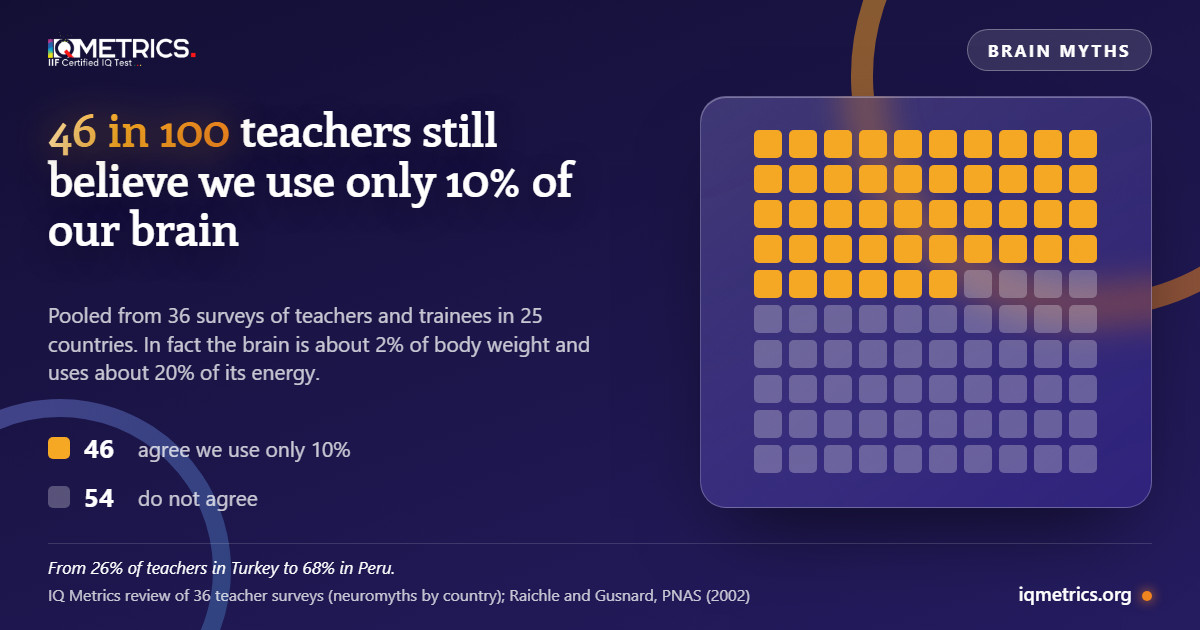
We use virtually all of our brain over a day. The 10% figure has no scientific source: it grew out of a 1907 essay that never mentioned brain tissue, yet about half of teachers in 36 surveys still agree with it.

How to Improve Reaction Time: What Actually Changes It, and by How Much
Ten sessions of a ruler drop test cut reaction time by almost 13 ms in young adults, sleep loss slows it the most and caffeine adds a small boost. Here is each lever in milliseconds, and why the device you test on matters more.
Read the research.
Then find your own number.
Our IIF-certified assessment reports your score with its scale, percentile and confidence range — and a breakdown of the cognitive domains behind it.
Start IQ Test →