





Situational Judgement Test Examples: 6 Sample Questions, the Best Answer and How Each Is Scored
Six original situational judgement test examples, each with the best answer and the marks every option earns under five question formats, including worked scores. See how SJTs are scored, why they are not IQ tests, and which of our practice tests matches each employer test.

Situational judgement test examples are short workplace scenarios followed by four or five possible actions. You pick the best (and sometimes the worst) response, or rate or rank every option, and each answer earns marks against a key written by people who know the job. Below are six original examples, the best answer to each and exactly how every option is scored.
New here: each example shows the marks for every option, not only the best answer, and the six use five different question formats. Two include a worked score. At the end, a map shows which employer test type each of our practice tests covers. The US spelling is situational judgment test examples; the format is the same.
Key takeaways
- An SJT gives a work scenario and 4 or 5 actions. You choose the best or worst, rate each, rank them or pick the two best.
- Marks come from a key of preferred answers. Closer to the key earns more marks in rating and ranking formats.
- The rules on this page are simplified teaching rules. A real test publishes its own, so read the candidate guide before you sit one.
- An SJT is a judgement test, not an IQ test: it is scored against a key, not on a scale with a mean of 100.
What is a situational judgement test?
A situational judgement test (SJT) shows a realistic work problem and asks what you would do or what is most effective. It checks judgement in the situations a job really throws up.
Employers use SJTs for graduate roles, police and public-sector jobs and medical-school selection. A research review of SJTs describes them as scenarios where examinees “evaluate each response option” (Whetzel, Sullivan and McCloy, 2020, abstract). The same review covers how scenarios, response instructions and response formats are written, and how tests are scored. Our own situational judgement test lets you try the format on a full set of questions.
An SJT differs from a reasoning test in one way that matters. A reasoning test has one provable answer, such as the next shape in a pattern. An SJT has a best answer by agreement, so two sensible people can disagree about the middle options, and the key settles it.
What do situational judgement test examples and questions look like?
Situational judgement test questions follow one pattern: a scenario of two or three sentences plus four or five options. Here are six situational judgement test example questions and answers, written by us. Cover the table, choose your answer, then check the marks. The scoring rules are simplified: each real test has its own.
Example 1: Work. Choose the most effective and the least effective response
Your manager asks you to update a client spreadsheet by 5 pm. You are halfway through a report due at the same time, and you can only do both if you rush.
| Option | What it does | If chosen as most effective | If chosen as least effective |
|---|---|---|---|
| A. Tell your manager you can do one by 5 pm and one tomorrow, and ask which comes first | Raises the clash early and lets the manager decide | 1 | 0 |
| B. Rush both and send them without checking | Risks errors the client will see | 0 | 0 |
| C. Finish the report and say nothing about the spreadsheet | Leaves the manager unaware that work will be missed | 0 | 1 |
| D. Ask a colleague to do the spreadsheet without telling your manager | Hands off work behind the manager’s back | 0 | 0 |
Best answer: A. The key rewards telling the manager early and offering a choice. The worst is C because nothing is said and one task silently fails.
Example 2: Teamwork. Rate each option from 1 (very ineffective) to 4 (very effective)
A teammate keeps talking over others in meetings. Two colleagues have told you privately that it makes them stop speaking up.
| Option | Key rating | Why | Marks if you rate it 3 |
|---|---|---|---|
| A. Raise it privately with your teammate and describe the effect on the meeting | 4 | Direct, fair and specific | 1 |
| B. Tell your manager your teammate is rude, without speaking to your teammate first | 2 | Skips the easy first step and labels the person | 1 |
| C. Suggest that everyone gets two minutes before discussion starts | 3 | Fixes the process without blame | 2 |
| D. Ignore it, because it is not your problem | 1 | Leaves colleagues unheard | 0 |
A worked score: rate A 3, B 2, C 4 and D 2. That earns 1 + 2 + 1 + 1 = 5 of 8. You earn partial marks when you are close, which is why rating formats reward a sense of the right direction.
Example 3: Ethics. Choose the single best action
You notice a supplier invoice was paid twice. The extra payment sits in your team’s budget line, which is over target, and nobody else has spotted it.
| Option | What it does | Marks |
|---|---|---|
| A. Tell finance about the double payment and ask how to return it | Corrects the error openly | 1 |
| B. Wait to see whether the supplier complains | Lets a known error stand | 0 |
| C. Move the money to another budget line quietly | Hides the error | 0 |
| D. Tell only your manager and leave the decision to her | Passes the duty on without acting | 0 |
Best answer: A. Ethics items usually key the open, honest action. D is not dishonest, but it leaves the error unreported, so it earns nothing here.
Example 4: Customer. Rank the options from most to least effective
A customer phones, angry that a delivery is two days late, and says she will cancel. You can see the parcel is held at a depot.
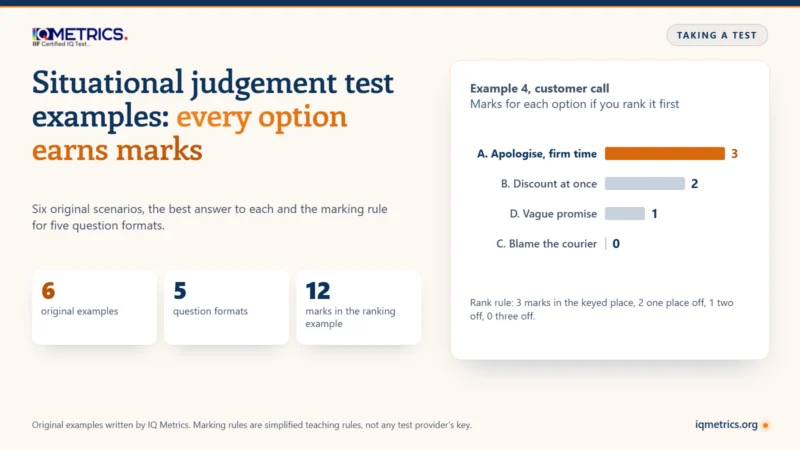
| Option | Keyed rank | Why | Marks if you rank it 1st |
|---|---|---|---|
| A. Apologise, say what you can see, and give a firm time for your next update | 1 | Acknowledges, informs, commits | 3 |
| B. Offer a discount at once, before she says what she wants | 2 | Kind, but premature | 2 |
| C. Say the courier is to blame and she should call them | 4 | Blames and hands the problem back | 0 |
| D. Say you will look into it and end the call | 3 | Vague, with no next step | 1 |
A worked score: rank B, A, D, C. A is one place off (2 marks), B is one place off (2), D and C are in their keyed places (3 + 3). The total is 10 of 12.
Example 5: Pressure. Choose the two best actions
It is Thursday and three deadlines now fall on Friday. A colleague is off sick, and your manager is in meetings until tomorrow.
| Option | What it does | Marks if chosen |
|---|---|---|
| A. List the three jobs with a time estimate each and ask your manager which can move | Shows the trade-off and asks early | 1 |
| B. Start the biggest job and see how far you get | No plan and no warning | 0 |
| C. Ask an available colleague whether she can take one small task | Uses the help that exists | 1 |
| D. Work late every night without telling anyone | Hides the problem and risks quality | 0 |
| E. Do the easiest job first | Feels productive, solves nothing | 0 |
Best answers: A and C. Under pressure the key favours making the load visible and sharing it, not working silently.
Example 6: Leadership. Choose what you would most and least likely do
You lead a small team. A new colleague’s first task was poor, and she looks embarrassed.
| Option | What it does | If chosen as most likely | If chosen as least likely |
|---|---|---|---|
| A. Meet her one to one, say what worked, show what to change and agree a check-in | Coaches and keeps her confidence | 1 | 0 |
| B. Redo the work yourself tonight and tell no one | Removes the chance to learn | 0 | 1 |
| C. Send the whole team a note on the quality standard | Singles her out without helping her | 0 | 0 |
| D. Wait to see whether her next task is better | Delays help | 0 | 0 |
This item asks what you would do, not what you should do. Tests differ in which instruction they give. Under either one, the key here rewards A and treats B as the weakest.
What do the best answers have in common?
The best answers raise a problem early, stay honest, share the load and help the person involved. The weak ones hide the problem, blame someone, wait or take over. The six examples show the same pattern.
- Say it early: option A in examples 1 and 5 raises the clash or the overload before it becomes a failure.
- Stay honest: option A in example 3 reports the error, while option C shows the cost of hiding it.
- Fix the cause, not the person: option C in example 2 changes the meeting process, and option A in example 6 coaches instead of redoing the work.
- Give the next step: option A in example 4 gives the customer a firm time, while option D leaves her with nothing.
A key is not a law of nature. It is what the test writers and their job experts agreed is effective in that role, and another employer can key a different answer. So read the role’s own values before you sit a real test. A practice test shows the format, not the key of the test you will face.
Where would your own score land?
Take the IIF-certified assessment and get your score with the scale it was measured on, the percentile it corresponds to and the confidence range around it — the three figures most online tests leave out.
Find your IQ score now! →How are situational judgement tests scored?
Situational judgement tests are scored by comparing your answers with a key of preferred responses. The more of your choices match the key, the more marks you earn.
The five formats above are the common ones. Rating and ranking formats usually give partial marks for answers near the key, while best-answer formats give all or nothing. Test writers choose the format, the instruction and the key, and a research review lists scoring options such as key stretching and within-person standardization (Whetzel, Sullivan and McCloy, 2020, abstract). This page does not cover those, and no real test’s rule is copied here.
| Format | What you do | How marks are given | Example |
|---|---|---|---|
| Most and least effective | Name the best and the worst option | 1 mark for each match with the key | 1 and 6 |
| Rate each option | Give every option a score from 1 to 4 | Full marks for the keyed rating, partial for one step away | 2 |
| Single best answer | Pick one option | 1 mark for the keyed option, none otherwise | 3 |
| Rank the options | Order all options | More marks the closer each is to its keyed place | 4 |
| Pick the best two | Choose two options | 1 mark for each keyed option chosen | 5 |
How do you prepare, and is it an IQ test?
No, a situational judgement test is not an IQ test. It scores your choices against a key of preferred actions, not your result against a norm group on a scale with a mean of 100. For how an IQ score is read, see what an IQ of 122 means.
For situational judgement test practice, start with the role. Read the employer’s values and the job description, because the key follows what that employer treats as good practice. Then work through scenarios, note why each option is better or worse, and check whether you favour speed, caution or openness more than the key does. If you are applying to medical school, our report on the UCAT situational judgement section covers that exam’s version of the format.
Employers often pair an SJT with reasoning tests. This map shows which of our practice tests covers which type, and our guides explain how employer test scores and norm groups work and the police verbal reasoning test.
| Employer test type | What it checks | Practice test |
|---|---|---|
| Situational judgement | Choices in work scenarios | Situational judgement test |
| Critical thinking | Judging arguments and evidence | Critical thinking test |
| Logical reasoning | Patterns and sequences | Logical reasoning test |
| Numerical reasoning | Numbers, charts and tables | Numerical reasoning test |
| Verbal reasoning | Reading and inference | Verbal reasoning test |
| Mixed aptitude | All of the above | Aptitude tests hub |
To see where your general reasoning score falls on the curve, take the IQ test.
Quick answers
- What are situational judgement test examples? Work scenarios with four or five actions, where you choose, rate or rank the options.
- What are situational judgement test questions like? A two or three sentence scenario, then options such as tell the manager early, hide the error or wait.
- How are situational judgement tests scored? Against a key of preferred answers: all or nothing for best answer, partial marks for rating and ranking.
- Is a situational judgement test an IQ test? No. It is scored against a key of preferred actions, not on an IQ scale.
- How do I practise? Learn what the employer values, work through scenarios and check why each option is better or worse.
Sources
- Whetzel, D. L., Sullivan, T. S. and McCloy, R. A. (2020). Situational Judgment Tests: An Overview of Development Practices and Psychometric Characteristics. Personnel Assessment and Decisions 6(1) (abstract read on 19 November 2026).
- The six scenarios, options and marking rules are original to IQ Metrics and are simplified teaching rules, not any test provider’s key.
- Our own pages: situational judgement test, aptitude tests hub and critical thinking test.
Keep reading
All articles →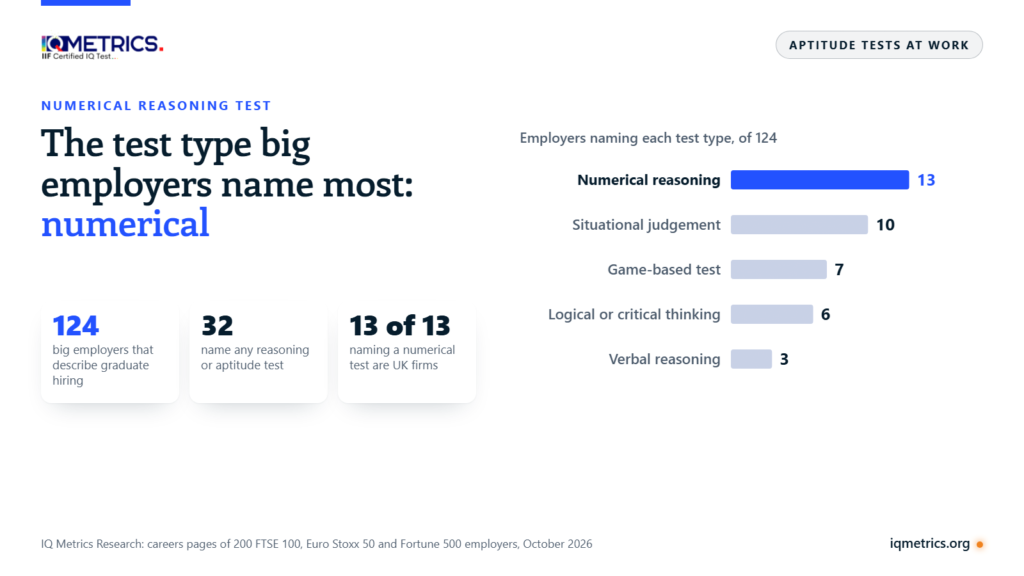 Taking a Test
Numerical Reasoning Test
A numerical reasoning test asks you to read tables and charts against the clock. Five worked example questions with answers, the mistakes that cost the most points, what a good score means, and the 13 big employers in our study of 124 that name a numerical test.
 Taking a Test
Verbal Reasoning Test
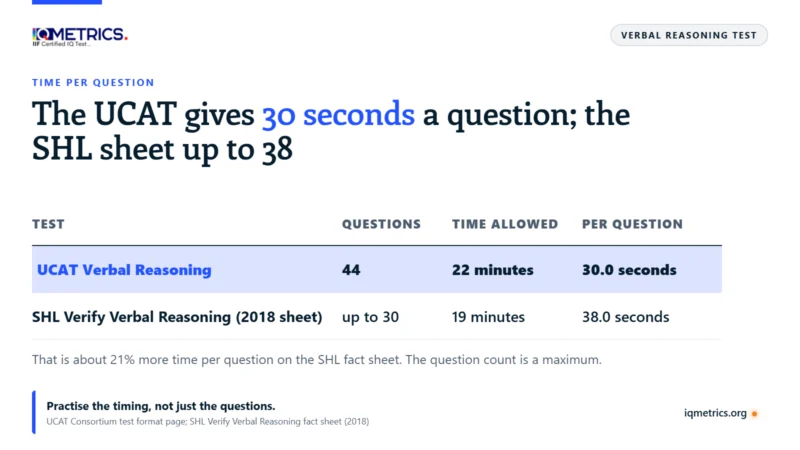
A verbal reasoning test asks whether a passage supports a statement: True, False or Cannot Say. Three worked examples with answers, the time per question on the UCAT (30 seconds) and the SHL fact sheet (38), how scores work and what the UK police recruitment process uses.
 Taking a Test
IQ Tests in Job Interviews
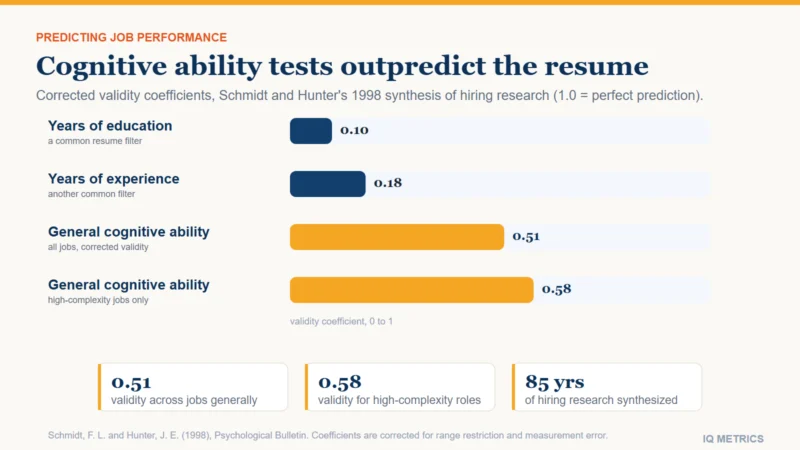
An IQ test for a job interview is usually branded a cognitive ability assessment, like the Wonderlic. What it actually measures, why a 1998 meta-analysis made employers take it seriously, whether it is legal, and how to prepare.