



Nonverbal Intelligence Tests Compared: TONI-4, CTONI-2, UNIT-2 and Leiter-3
Four named nonverbal tests side by side: ages from 3 to 89, testing time from 15 minutes to an hour, and very different score tables. All four are given one-to-one by a trained examiner.


What you need to know
- A nonverbal intelligence test measures reasoning with shapes, pictures and patterns, so the person being tested needs little or no spoken language. The TONI-4, CTONI-2, UNIT-2 and Leiter-3 are individually given tests for people who may be hard to test in words.
- They are not interchangeable. The Leiter-3 starts at age 3, the UNIT-2 at 5, and the TONI-4 and CTONI-2 at 6. The UNIT-2 stops at 21 years 11 months, while the TONI-4 and CTONI-2 run to 89 years 11 months. Testing time runs from 15 to 20 minutes for the TONI-4 to about an hour for the CTONI-2.
- A nonverbal score is not a full-scale IQ. Each test has its own norm sample, its own norm year and its own score table. Three of the pages give the size of the norm sample, from 1,802 to 2,827 people. So two scores of 110 on two tests are not the same claim.
- None of the four can be taken online. The publishers grade them by the buyer's qualification level, and the pages we read give no item content. We describe the tests and reproduce no items.
A nonverbal intelligence test measures reasoning with pictures, shapes and patterns, so the person being tested needs little or no spoken language. The TONI-4, CTONI-2, UNIT-2 and Leiter-3 are four named examples. All four are given one-to-one by a trained examiner, and they differ in age range, testing time and score tables.
The new finding: side by side, the four tests cover ages 3 to 89, run from 15 minutes to about an hour, and do not mean the same thing by "nonverbal". Only the UNIT-2 stops short of adulthood, at 21 years 11 months.
Below: what a nonverbal test is, how these four differ, why a nonverbal score is not a full-scale IQ, and whether you can take one online. We read the publishers' and sellers' pages on 22 November 2026 and describe the tests without reproducing any item.
What is a nonverbal intelligence test, and who takes one?
It is a test of reasoning that cuts or removes the need for spoken language, so people who speak little can still show what they can do. Examinees are usually children or adults with language, hearing or motor difficulties, or people from a different language or culture.
The publishers say as much. PRO-ED calls its Test of Nonverbal Intelligence (TONI-4) ideal for people with language, hearing or motor impairments, or those unfamiliar with mainstream American culture. The seller Stoelting lists the UNIT-2 for people with speech, language or hearing impairments, or different cultural or language backgrounds.
"Nonverbal" does not mean the same on every test. The TONI-4 uses simple oral instructions, and the examinee answers by pointing, nodding or blinking. The UNIT-2 is listed with an entirely nonverbal stimulus-and-response format. For the idea behind it, see our guide to verbal and nonverbal IQ scores.
How do TONI-4, CTONI-2, UNIT-2 and Leiter-3 differ?
They differ most in age range, testing time and what the tasks look like. Here is each test as its publisher or seller describes it: the TONI-4 test, the CTONI-2, the UNIT-2 test and the Leiter-3.
- TONI-4 (PRO-ED, 2010): ages 6-0 to 89-11, 15 to 20 minutes, two forms of 60 abstract figural items, answers by pointing, nodding or blinking, norm sample of 2,272 people
- CTONI-2 (PRO-ED, 2009): ages 6-0 to 89-11, 1 hour, six subtests (analogies, categories and sequences, each with pictures and with geometric designs), norms collected in 2007 and 2008 from about 2,827 people
- UNIT-2 (listed by Stoelting): ages 5-0 to 21-11, 10 to 15 minutes for the abbreviated battery, 30 for a standard battery and 45 to 60 for the full scale, six subtests, norm sample of 1,802 people keyed to census estimates reported in the 2014 Statistical Abstract
- Leiter-3 (Stoelting, 2013): ages 3 to 75 and older, 20 to 45 minutes for the cognitive scales, four subtests that give a Nonverbal IQ from 30 to 170
Start with age, because it decides which test is even possible. A three-year-old can be given the Leiter-3, a five-year-old the UNIT-2 or Leiter-3, and a six-year-old any of the four. A 40-year-old can be given the TONI-4, CTONI-2 or Leiter-3, but not the UNIT-2, which stops at 21-11.
Then look at the clock. The CTONI-2 takes 1 hour and the TONI-4 15 to 20 minutes, so the CTONI-2 takes 3 to 4 times as long (our arithmetic). The UNIT-2 lets the examiner choose a shorter or longer battery. The Leiter-3 adds a separate 30-minute attention and memory battery, which we cover in our Leiter-3 scores guide.
The tasks differ too. The CTONI-2 splits reasoning into analogies, categories and sequences. The UNIT-2 has memory, reasoning and quantity subtests, such as Symbolic Memory, Analogic Reasoning and Numerical Series. The TONI-4 uses one kind of abstract figural item, built from eight features such as shape, position, direction and rotation.
Nonverbal does not mean identical: these four tests cover ages 3 to 89 and take from 15 minutes to an hour.
What scores do these tests report, and how reliable are they?
Each reports age-based scores, but the scales and extras differ. Here is what each publisher or seller lists.
- TONI-4: age-based standard scores with a mean of 100 and a standard deviation of 15, percentile ranks and stanines (Pearson)
- CTONI-2: standard scores, percentile ranks and age equivalents (PRO-ED)
- UNIT-2: subtest scores with a mean of 10 and a standard deviation of 3, and seven composites with a mean of 100 and a standard deviation of 15 (Stoelting)
- Leiter-3: a Nonverbal IQ from 30 to 170, with a mean of 100 and a standard deviation of 15 (our Leiter-3 guide)
Reliability tells you how consistent a score is: a coefficient near 1.0 means a test gives similar results each time. PRO-ED says the CTONI-2 composite coefficients are mostly in the .90s and that it correlates in the high .70s with well-known intelligence tests. The UNIT-2 listing gives coefficient alpha of .88 to .96 for subtests and .93 to .98 for composites.
These are the publishers' and sellers' own figures, and we have not checked the manuals. A standard score of 100 is average on each test, and about two-thirds of people score between 85 and 115 on a mean-100, SD-15 scale. Our IQ percentile calculator turns any such score into a percentile. A single score is still a band, as our guide to the margin of error in IQ scores explains.
Is a nonverbal score the same as a full-scale IQ?
No. A nonverbal score comes from reasoning tasks without language, and a full-scale IQ from a wider mix, so the two can differ for the same person. Each test also has its own norms.
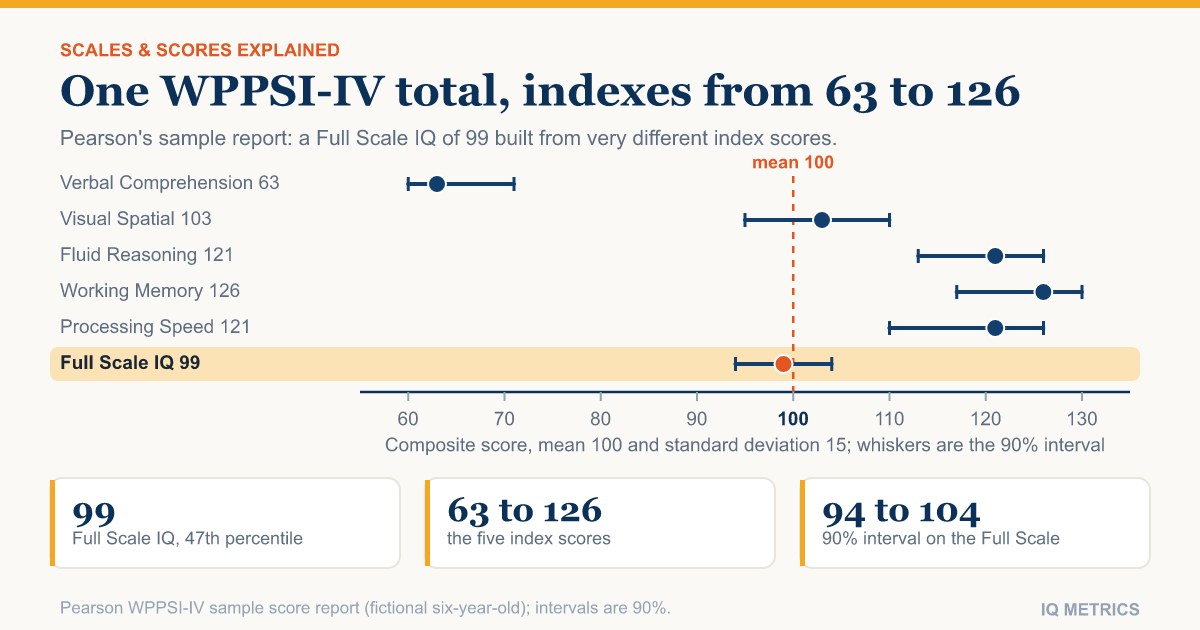
Even one Wechsler test reports both kinds. Pearson's WPPSI-IV has a Full Scale IQ and a separate Nonverbal Index, built from subtests that need no verbal response. Our WPPSI-IV scores guide shows how a single total can hide a wide spread across indexes.
Gaps can be large. In a 2026 study of 44 minimally verbal autistic children, the mean Leiter-3 Nonverbal IQ was 92.45 against 69.57 on a verbal measure, a gap of 22.9 points by our arithmetic. Our Leiter-3 guide sets out that study and its limits.
Norm samples and years matter as well. The CTONI-2 norms were collected in 2007 and 2008, and the UNIT-2 sample is keyed to census estimates reported in 2014. Our guide to why IQ norms expire explains why a norm year changes what a score means. Use the IQ score converter only to move between scales, such as the UNIT-2 subtest scale (mean 10, SD 3) and the IQ scale (mean 100, SD 15).
Can you take a nonverbal IQ test online?
Not these four. They are individually given by a trained examiner, and the publishers grade them by buyer qualification level. An online reasoning test is a different, shorter thing and cannot replace a clinical result.
PRO-ED lists the TONI-4 at test level B and the CTONI-2 at level C, and our Leiter-3 guide records Stoelting's level B. We did not read a qualification level for the UNIT-2. If you want a nonverbal IQ test for kids for a school or clinical decision, ask a psychologist which test they use and why.
For a language-light reasoning test you can take yourself, our culture-fair IQ test uses shapes and patterns. It is not one of the four tests above, and it does not replace them. Our guides to the Cattell Culture Fair test and Raven's matrices cover older nonverbal formats, and CHC theory explains the abilities behind them.
Where would your own score land?
Want to see how a language-light reasoning test reports a score? Take the IQ Metrics test, and keep it separate from any clinical assessment.
Find your IQ score now! →A result on our test is a score on the standard scale, with a percentile beside it. Take the IQ Metrics test to see where you fall, and read our guide to second-language speakers and IQ scores if English is not your first language.
Common questions
What is a nonverbal intelligence test?
A nonverbal intelligence test measures reasoning with pictures, shapes and patterns, so the person being tested needs little or no spoken language. The TONI-4, CTONI-2, UNIT-2 and Leiter-3 are individually given examples, used for people who are hard to test in words.
What ages do the TONI-4, CTONI-2, UNIT-2 and Leiter-3 cover?
The TONI-4 and CTONI-2 cover ages 6-0 to 89-11, the UNIT-2 covers 5-0 to 21-11, and the Leiter-3 covers ages 3 to 75 and older. Testing time ranges from 15 to 20 minutes for the TONI-4 to about an hour for the CTONI-2.
Is a nonverbal IQ the same as a full-scale IQ?
No. A nonverbal score comes from reasoning tasks that need no language, while a full-scale IQ combines a wider mix of tasks. Each test has its own norm sample and year, so scores from different tests are not interchangeable.
Can you take a nonverbal IQ test online?
Not the TONI-4, CTONI-2, UNIT-2 or Leiter-3, which are given one-to-one by a trained examiner. An online reasoning test with shapes and patterns exists, but it is not a clinical nonverbal test and cannot replace one.
Sources for this story
- TONI-4: Test of Nonverbal Intelligence, Fourth Edition, Complete Kit (ages, time, forms, norm sample, test level) — PRO-ED
- TONI-4 product page: score types and qualification level — Pearson Assessments
- CTONI-2: Comprehensive Test of Nonverbal Intelligence, Second Edition, Complete Kit — PRO-ED
- Universal Nonverbal Intelligence Test, Second Edition (UNIT-2) Kit: ages, time, subtests, norm sample — Stoelting
- Leiter International Performance Scale, Third Edition: product page and scoring notes (as read for our Leiter-3 guide, 23 October 2026) — Stoelting
Corrections: spotted an error? Email corrections@iqmetrics.org and we will update this story and note the change here.
Related stories
All news →
Leiter-3 Scores Explained: Nonverbal IQ, Composites and Classification Ranges
The Leiter-3 gives a Nonverbal IQ from 30 to 170 (mean 100, SD 15) built from four subtests, with no spoken instructions. Four scaled scores of 10 produce 98, not 100. Its labels are not Wechsler's, and its memory and speed composites are, in the manual's words, not equated with IQ.
WPPSI-IV Scores Explained: Score Ranges, Composites and IQ
Pearson's WPPSI-IV covers ages 2:6 to 7:7 and reports composites on the familiar 100-and-15 scale. Its sample report shows a Full Scale IQ of 99 built from indexes that run from 63 to 126, and no public table says what score is gifted.

Mensa Norway IQ Test: How the 35 Puzzles Are Scored and What 145 Means
The Mensa Norway IQ test has 35 puzzles, 25 minutes and a scale that stops at 85 and 145. Here is what the test page says, what it leaves out, and what 130 and 145 mean on the bell curve.
Read the research.
Then find your own number.
Our IIF-certified assessment reports your score with its scale, percentile and confidence range — and a breakdown of the cognitive domains behind it.
Start IQ Test →