



What was Emmy Noether’s IQ?
Einstein gave her a tribute. Nobody gave her a test.

Albert Einstein’s 1935 New York Times tribute called Emmy Noether the most significant creative mathematical genius produced since women gained access to higher education. No test ever measured her — she died before any figure could exist, and a modern ranking site’s “170+” says so itself.
Emmy Noether’s estimated IQ
- Earned a doctorate summa cum laude from the University of Erlangen in 1907 under Paul Gordan, in invariant theory.
- Recruited to Göttingen in 1915 by David Hilbert and Felix Klein specifically to resolve a technical problem in Einstein’s new general theory of relativity — whether energy is locally conserved.
- Published “Invariante Variationsprobleme” (1918), proving what is now called Noether’s theorem: every continuous symmetry of a physical system corresponds to a conserved quantity. It underlies both general relativity and the Standard Model of particle physics.
- Supervised more than a dozen doctoral students at Göttingen despite going without a salary for her first eight years there.
Noether was never administered an intelligence test — none existed in usable form until she was already an adult, and she died in 1935 with no test record of any kind. She also falls outside Catharine Cox’s 1926 historiometric study, which covered only subjects born 1450–1850; Noether was born in 1882. This range is an achievement-based reading of an unusually well-documented technical record, not a recovered score.
- Born
- 23 March 1882, Erlangen, Germany
- Died
- 14 April 1935, Bryn Mawr, Pennsylvania
- Doctorate
- University of Erlangen, 1907, summa cum laude
- Known for
- Noether’s theorem (1918)
- Documented IQ test
- None — she died before any score could exist
What an IQ of 165–185 actually means
Set the claim aside for a moment. If someone genuinely scored in this range, here is what that would represent.
Average is 100 by construction, and about two-thirds of people fall between 85 and 115. Take the test to place your own score on this scale.
| Score range | Classification | Share of people | What it indicates |
|---|---|---|---|
| 85 – 114 | Average | ~68% | The range most people fall into. |
| 115 – 129 | Above average | ~13.6% | Roughly one person in seven. |
| 130 – 144 | Gifted | ~2% | The threshold most high-IQ societies use. |
| Above 144 | Highly gifted | ~0.1% | Figures above this range are extrapolated from the curve rather than measured. |
Percentages are approximate and describe a normal distribution. The same number means different things on tests with different standard deviations.
Thirty questions gives you a measured position on this exact scale — your score, your percentile and the ability breakdown behind it.
Find out in 30 minutes →Who Emmy Noether was
Emmy Noether earned her doctorate at Erlangen in 1907, then worked for years at Göttingen without pay or formal rank because the university would not certify a woman to teach — her courses were listed under David Hilbert’s name. She was not granted even the unpaid title of Privatdozent until 1919, and did not draw a salary until 1923.
Hilbert and Klein had recruited her in 1915 for a specific reason: general relativity, published that year, appeared to violate conservation of energy, and they needed an invariant-theory specialist to find out why. Her 1918 paper resolved it and went further, proving that every continuous symmetry in physics implies a conservation law — the result now called Noether’s theorem, still foundational in both general relativity and particle physics.
Dismissed by the Nazi government in April 1933 under the law purging Jewish academics from state positions, she emigrated to the United States that October, teaching at Bryn Mawr College until her death in 1935.
 By Elora Mercer, Celebrity Research WriterFigures checked by Leon Falkner, Data & Research Analyst
Reviewed by Aarav Vardhan, Editor-in-Chief · Last reviewed August 2026
.jpg)
Where the 170 figure came from
Following a claim back to its first appearance is the part almost nobody does — and it is what most people are actually asking.
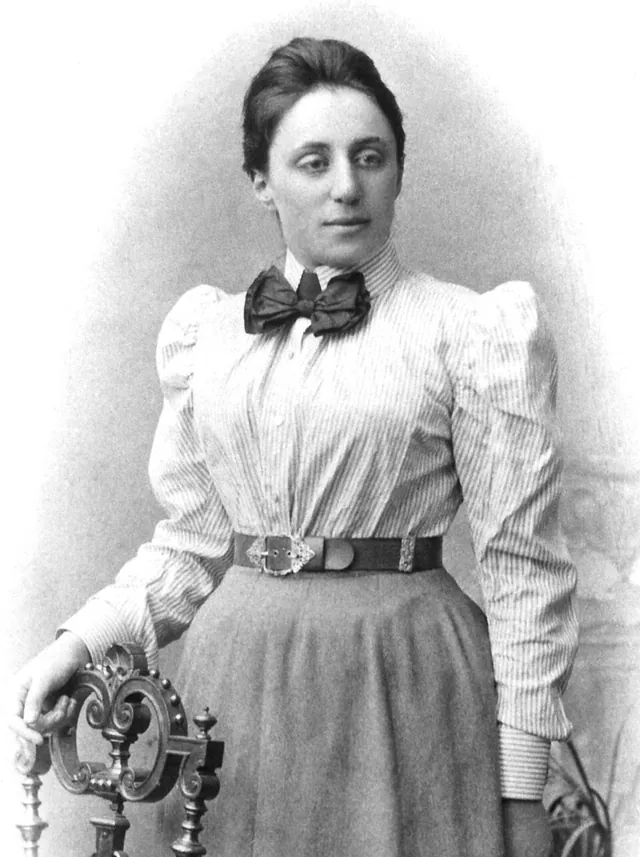
Noether’s case for inclusion here rests on a letter, not a number. Einstein wrote to the New York Times after her death that she was, in the judgment of the most competent living mathematicians, the most significant creative mathematical genius produced since women gained access to higher education — a real, dated, primary-sourced tribute from a source whose own profile appears elsewhere on this site.
The circulating “170+” is a much weaker thing than that sentence, and the site that publishes it says so itself. Reaching for an invented precision when a real, checkable superlative already exists is exactly the substitution this site exists to flag.
See Albert Einstein, whose own profile discusses the figures that circulate about him — the two pages cite the same 1935 letter from opposite directions.
How we read a number →The tribute this profile is built around: most significant creative mathematical genius produced since higher education of women began.
The paper proving Noether’s theorem.
Source of the circulating “170+” figure; the site itself states its entries are not recovered test results.
Cox’s historiometric study covered subjects born 1450–1850. Noether, born 1882, was never eligible.
The sources behind our estimate
The figures that circulate for Emmy Noether, what we were able to confirm, and where the two diverge.
A ranking site, lifescoretest.com, lists “Emmy Noether IQ: 170+” under what it calls a Historical Intelligence Index.
lifescoretest.com states directly that “no entry in this directory should be read as a recovered test result.” No other major listicle site carries a figure for Noether at all — several general “smartest scientists” rankings omit her entirely. What is real and checkable is Einstein’s tribute: in a New York Times letter dated 1 May 1935, he called her, in the judgment of the leading mathematicians of the time, the most significant creative mathematical genius produced since higher education opened to women — a specific, bounded, sourced claim, and it isn’t a number.
The spread here is narrow because there is almost nothing to disagree about: one self-disclosed estimate, and a documented record everyone points to instead.
Want a number that does hold up? Every figure on this page is somebody’s claim. Take the 30-question test and get a percentile you can check rather than a figure you have to trust.
Emmy Noether — frequently asked
What was Emmy Noether’s IQ?
No verified score exists. She died in 1935 with no record of ever taking an intelligence test. A figure of “170+” circulates on one ranking site, which states outright that its numbers are not recovered test results.
Why is Emmy Noether called a genius?
Because of a specific, dated tribute: Albert Einstein’s May 1935 New York Times letter, written after her death, calling her the most significant creative mathematical genius produced since women gained access to higher education.
Was Emmy Noether ever IQ-tested?
No record of a test exists. She also falls outside Catharine Cox’s 1926 historiometric study of historical geniuses, which only covered people born between 1450 and 1850.
What is Noether’s theorem, in plain terms?
It states that every continuous symmetry of a physical system corresponds to a conserved quantity — time symmetry gives conservation of energy, for instance. It explains why physics has conservation laws at all, and underlies both general relativity and the Standard Model.
Was Emmy Noether paid for her work at Göttingen?
Not for years. She lectured from 1915 with her courses formally credited to David Hilbert, wasn’t granted even an unpaid teaching title until 1919, and didn’t draw a salary until 1923.
What did Emmy Noether actually achieve?
A 1907 doctorate in invariant theory; recruitment to Göttingen in 1915 to solve a specific problem in general relativity; the 1918 theorem bearing her name; and supervision of more than a dozen doctoral students before her 1933 dismissal by the Nazi government and emigration to the United States.
How does my IQ compare with Emmy Noether?
You can find out in about fifteen minutes. The IQ Metrics assessment is 30 questions, scored on the same 100-mean scale used throughout this page, so your result and the estimate above are at least expressed in the same units — one measured, one inferred. Once you have a number, the leaderboard shows where it would sit, and how we score and norm it explains the benchmarking.
Where does this estimate come from?
From the documented record rather than a test — the method is named above and set out in full under how we read a number. Compare it against the other scientists profiles, starting with Albert Einstein.
- Take the 30-question IQ test — get a measured score and percentile of your own
- Average IQ by country — how the scale behaves across populations
- How IQ Metrics scores its assessment — the method behind our own number
- More on how IQ testing works — reliability, error and what a score can and cannot say
- More scientists profiles — same field, same method
More scientists



Photograph by George Bergman (Berkeley, September 1993; re-scanned), CC BY-SA 4.0. · Photograph by Montclair Film Festival (photo by Neil Grabowsky, May 2017), CC BY 2.0. Background removed for the portrait above. · Photograph by Newhcrossaint (2025), CC BY-SA 4.0. Background removed for the portrait above.
_(cropped).jpg)


An estimate is an inference.
Yours can be measured.
Thirty questions, scored against general-population benchmarks. Your score, your percentile, your ability breakdown and a printable IIF certificate.
Find your IQ score now! →