



Do High-Scoring Children at Age 7 Stay High? What 11,119 Children Show
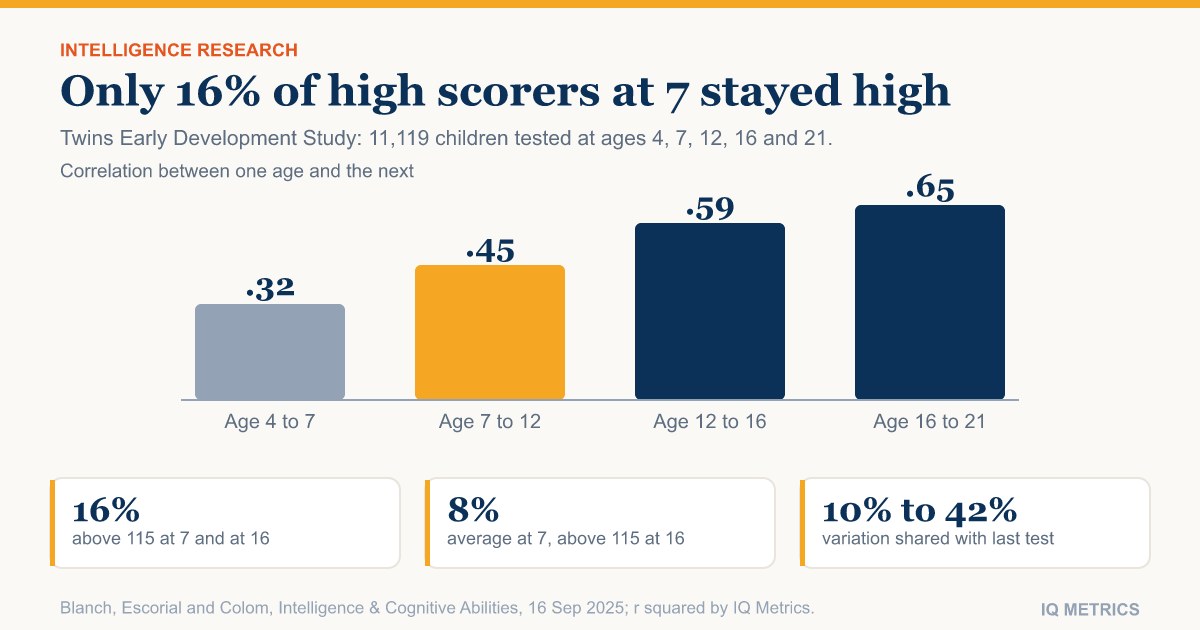
In a study that followed children from age 4 to 21, only 16% of those scoring above 115 at age 7 were still above it at 16. Test-to-test correlations of .32 to .65 explain why an early high score is a snapshot, not a verdict.

What you need to know
- Blanch, Escorial and Colom (Intelligence & Cognitive Abilities, 16 September 2025) analysed 11,119 children from the Twins Early Development Study, tested at ages 4, 7, 12, 16 and 21. Of 1,580 children scoring above 115 at age 7, only 16% were still in the high-ability group at 16. Of 3,958 children scoring 99 to 115 at 7, 8% had moved up into it by 16.
- The authors report that most children above 130 at age 7 (207 of them) did not keep scores that high afterwards. Their conclusion in the abstract is that most children are "cognitively mobile", so early identification of high ability must be seen with reservations.
- The correlations between one age and the next are .32 (4 to 7), .45 (7 to 12), .59 (12 to 16) and .65 (16 to 21). Squared, an earlier score explains 10%, 20%, 35% and 42% of the variation in the next. At .45, a child at 115 at age 7 is expected to average about 107 at age 12.
- This is one cohort, and the tests changed at every age (parent-administered tasks at 4, telephone-administered subtests at 7, web-based matrices at 12 and 16, a gamified test at 21). It has not been replicated here, and school gifted cut-offs, such as the 97th percentile, are stricter than the study's 115 line.
Many U.S. school districts test every second grader in the autumn. In Chandler, Arizona, the district will give the Cognitive Abilities Test (CogAT, Form 8) to all second graders from 12 to 23 October 2026, and a child who reaches the 97th percentile on any one of its three batteries, or the 95th percentile on the composite, qualifies for gifted services. A study of 11,119 children published on 16 September 2025 asks what a high score at age 7 predicts nine years later. Its answer is less than most parents expect, and it is worth reading before a score report arrives.
What did the study measure?
The paper, by Angel Blanch, Sergio Escorial and Roberto Colom, appeared in the journal Intelligence & Cognitive Abilities (DOI 10.65550/001c.144062). It uses the Twins Early Development Study, one of the largest twin cohorts in the world, and follows children at ages 4, 7, 12, 16 and 21. The researchers built a general cognitive ability score at each age and set it on a scale with a mean of 100. They then picked two groups using the age-7 score: a high-ability group scoring above 115 (1,580 children) and a comparison group scoring 99 to 115 (3,958 children).
A score of 115 is one standard deviation above the mean, the 84th percentile, so the high-ability group is roughly the top one child in six. That is a broader group than the "gifted" cut-offs most districts use, a point we return to below. Because different tests suit different ages, the score is a composite of whatever was measured: parent-administered tasks plus vocabulary and grammar measures at 4, four subtests (two verbal, two non-verbal) given by telephone at 7, web-based tests including Raven's matrices at 12 and 16, and a short gamified test at 21.
How many children stayed in the high group?
- Of the 1,580 children above 115 at age 7, 16% kept their high scores at age 16
- Of those above 115 at age 12, 23% kept them at the next test, age 16; of those above 115 at 16, 24% kept them at 21
- Of the children scoring 99 to 115 at age 7, 8% had risen into the high range by age 16
- Staying high was about three times as likely as rising into it from the average band, and the share who stayed settled at around 24% from age 12
- Of the 207 children above 130 at age 7, most did not keep scores that high afterwards (the authors' supplementary figure)
The authors read this as strong mobility in both directions. Children moved up and down within and between the two groups, and the early group was mostly not the later one. The paper also reports that the changes were predicted mainly by personal rather than situational factors, a pattern its authors describe as the guiding force of nature through nurture. We cannot assess that modelling from the text alone, so treat that claim as the authors' interpretation.
Why do early scores move so much?
Part of the answer is in the correlations between ages. The score at age 4 correlated .32 with the score at 7, the score at 7 correlated .45 with the one at 12, the one at 12 correlated .59 with the one at 16, and the one at 16 correlated .65 with the one at 21. Squaring a correlation gives the share of variation the two measures have in common: about 10%, 20%, 35% and 42%. An age-7 score therefore leaves four-fifths of the age-12 variation unexplained.
Low correlations produce a well-known effect, regression to the mean. When two scores are only partly related, people far from the average on the first test tend to land closer to the average on the second, simply because part of what made the first score extreme was chance. For two tests on the same scale, the expected second score is 100 plus the correlation times the distance of the first score from 100. At a correlation of .45, a child at 115 at age 7 is expected to average about 107 at age 12 (100 + .45 x 15), and a child at 130 about 113.5. These are group averages on an idealised model, not predictions for any one child. Our page on regression to the mean explains the effect, and how IQ scores change over time shows real-life trajectories.
- A child at 115 at age 7 is expected to average about 107 at age 12 (100 + .45 x 15)
- A child at 120 is expected to average about 109, and one at 125 about 111
- A child at 130 is expected to average about 113.5, and one at 140 about 118
- The pull works in both directions: a child at 85 at age 7 is expected to average about 93 at age 12
The age-4 result is the starker one. A correlation of .32 between the scores at 4 and 7 means a preschool score accounts for about a tenth of the variation at primary-school age. The paper's introduction contrasts this with the 1932 and 1947 Scottish Mental Surveys, in which scores at about age 11 correlated .73 to .78 with scores in old age (Deary, 2014, as cited by the authors). Rank order is not fixed in early childhood, and it hardens through adolescence; the authors note it tends to settle from about age 12.
Squared, a score at age 7 explains about a fifth of the variation in the score at age 12, which leaves most of a child's later standing open.
What does this mean for gifted testing?
The authors conclude that identifying high-ability children early must be seen with reservations, that the age at which identification makes most sense is about 12 on average, and that follow-up assessments are needed to check that a level has held. They do not argue against supporting children who are ready for more challenge now; they argue against treating one early score as a settled label.
The study's high-ability line is not a district's gifted line, so its 16% cannot be dropped onto a CogAT result. A 97th percentile on an IQ-style scale with a mean of 100 and a standard deviation of 15 corresponds to about 128, and the 95th percentile to about 125, both well above the study's 115. The 207 children above 130 at age 7 are the closest group, and they show the same pattern: most did not keep a score that high. Our guide to CogAT and NNAT scores explains how those percentile bands are built, and our report on universal screening for gifted programs shows why testing every child changes who is identified.
What should parents and teachers do with an early score?
- Treat a score at age 7 as a snapshot with a margin of error; our guide to IQ score margin of error shows how wide it is
- Look at several measures, such as classwork and teacher observation, rather than one test
- Re-test or re-screen at later ages before treating a label as fixed, as the authors recommend
- Do not read a missed cut-off as a ceiling: 8% of children in the average band moved up by 16
- Use a score report to plan support now, and compare it with the cut-offs in our gifted cut-off scores guide
Where would your own score land?
Curious how a child's reasoning scores on the standard IQ scale? IQ Metrics offers age-banded tests for children and a full report with percentiles.
Find your IQ score now! →Our IQ Metrics test is for adults, and the kids IQ tests are age-banded. You can place any percentile on the IQ scale with the IQ percentile calculator, and our signs of a gifted child guide covers what teachers look for in the classroom. For an adult-age companion to this evidence, see whether your IQ can change over time.
Common questions
Do gifted children stay gifted?
Often not on the same score. In a study of 11,119 children, only 16% of those scoring above 115 at age 7 still did so at age 16, and most children above 130 at 7 did not keep scores that high. Early scores are only moderately related to later ones, with correlations of .32 to .45 before age 12.
How reliable is an IQ test at age 7?
Moderately. In the Twins Early Development Study the correlation between the age-7 score and the age-12 score was .45, meaning the two share about 20% of their variation. The correlation rises to .59 between 12 and 16 and .65 between 16 and 21, so scores become more stable with age.
At what age is a gifted test most reliable?
The study's authors suggest that about age 12, on average, is when identification makes the most sense, because scores stabilise from then. They also recommend follow-up assessments to confirm that a level has held. That is one team's recommendation from one cohort, not a rule.
What percentile is gifted on the CogAT?
It depends on the district. Chandler Unified School District in Arizona, for example, uses the 97th percentile on any one of the three CogAT batteries or the 95th percentile on the composite. On an IQ-style scale with a standard deviation of 15, those are about 128 and 125.
Sources for this story
- Blanch, Escorial and Colom, Developmental Changes in High Cognitive Ability Children: The Role of Nature and Nurture, Intelligence & Cognitive Abilities (16 September 2025) — Intelligence & Cognitive Abilities
- Gifted testing, 2026-27 (CogAT Form 8, October 2026 dates and criteria) — Chandler Unified School District
- Most children identified as gifted at age 7 do not maintain high cognitive ability by adolescence (29 November 2025) — PsyPost
- Regression toward the mean (definition and the formula for standardised variables) — Wikipedia
Corrections: spotted an error? Email corrections@iqmetrics.org and we will update this story and note the change here.
Related stories
All news →
Universal Screening Finds the Gifted Students Teacher Referral Misses
When a large Florida district began testing every second grader instead of waiting for a teacher's nomination, the population it identified as gifted changed sharply — not because more students became capable, but because fewer of them had ever been tested at all.
Can Your IQ Change Over Time? What Retesting Shows
A Scottish cohort sat the same test at age 11 and again at 79, and the two sets of scores correlated at about 0.66. That single number refutes the claim that IQ is fixed and the claim that it is easily moved, because it is neither close to zero nor close to one.

Gen Z IQ: Is Gen Z Less Intelligent Than Its Parents? What the Data Show
A neuroscientist told the US Senate in January 2026 that Gen Z is the first generation to underperform its parents, "even general IQ". The written testimony does not say it, and the best IQ data stop with people born in 1991.
Read the research.
Then find your own number.
Our IIF-certified assessment reports your score with its scale, percentile and confidence range — and a breakdown of the cognitive domains behind it.
Start IQ Test →