



Intelligence Research
New peer-reviewed findings on how reasoning, memory and general ability actually work — reported with the sample size and the error bars.

Does Aphantasia Affect IQ? What the Studies Measured
No study has measured IQ in a representative sample of people with aphantasia, the lifelong absence of mental pictures. The two small studies that report IQ-style scores disagree on direction, +5.5 and -4.0 points, and neither gap was significant.

Gen Z IQ: Is Gen Z Less Intelligent Than Its Parents? What the Data Show
A neuroscientist told the US Senate in January 2026 that Gen Z is the first generation to underperform its parents, "even general IQ". The written testimony does not say it, and the best IQ data stop with people born in 1991.
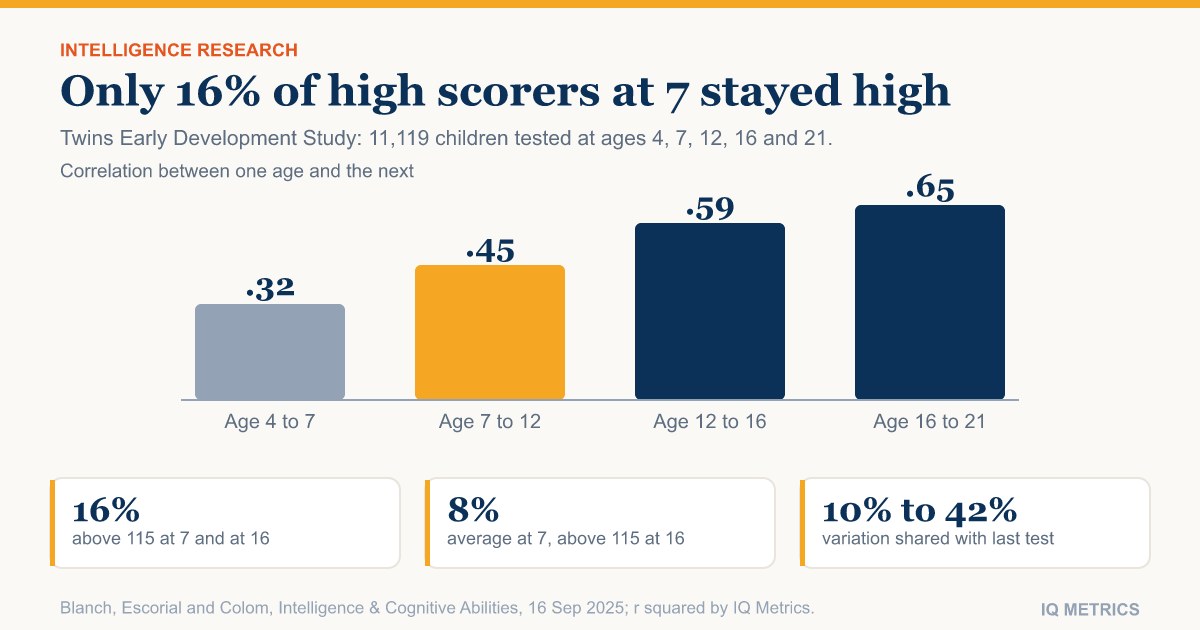
Do High-Scoring Children at Age 7 Stay High? What 11,119 Children Show
In a study that followed children from age 4 to 21, only 16% of those scoring above 115 at age 7 were still above it at 16. Test-to-test correlations of .32 to .65 explain why an early high score is a snapshot, not a verdict.

Average Reaction Time by Age (in Milliseconds) and What It Says About IQ
A typical simple reaction time is roughly 215 to 240 milliseconds in a calibrated lab and 273 ms on Human Benchmark's online test. Age adds about 0.55 ms a year, and the link to IQ is about -.3.

Does IQ Above 120 Stop Mattering? What a 50-Year Study Found
The "threshold hypothesis" holds that intelligence stops predicting achievement past roughly 120. A 50-year study tracking thousands of gifted 13-year-olds into midlife found the opposite: finer differences within the top 1% still predict who earns a doctorate, a patent or tenure.

Childhood Adversity and Cognition: What a PNAS Study Found
A September 2026 PNAS study scanned people aged 0 to 21 and linked stressful life events to one brain circuit and cognition to another. The effects are small, and one did not replicate.

An MRI Map of the Gifted Brain: What the Scans Show
A 2021 imaging study compared children with IQ scores above 145 to typically developing peers and found specific, named memory structures that were measurably different. Here is what the scan actually found, and what it does not prove.

Would People Screen Embryos for Low IQ? A New Study Answers
A survey of nearly 1,500 Americans found people say IQ screening is less acceptable than disease screening — then, given real genetic risk scores, avoid a high-risk-for-low-IQ embryo almost as often as a high-risk-for-heart-disease one.

Hitler's IQ Was Never Tested: The Nuremberg IQ Scores of 21 Nazi Defendants
Before the main Nuremberg trial opened in November 1945, the prison psychologist gave 21 of the defendants an IQ test. Their scores ran from 106 to 143 and averaged 128. Adolf Hitler, dead since April 1945, was never tested, and any IQ you see quoted for him is invented.

CHC Theory: The Model Behind Every Modern IQ Test Score
A full-scale IQ is not one thing a test measures directly. It is a composite built from several index scores, and the theory that decides which ones is called Cattell-Horn-Carroll — CHC for short.

Spearman's Law of Diminishing Returns: Does g Weaken at High Ability?
Cognitive tests correlate less strongly with each other among high scorers than among low scorers. If that holds, a single full-scale figure carries less information the higher it goes — and the evidence for it is real but smaller and shakier than the idea's popularity suggests.
Savant Syndrome and IQ Tests: Why a Single Score Can Miss an Extraordinary Ability
Savant syndrome pairs an ordinary or low Full-Scale IQ with one narrow ability that is exceptional, and it is the clearest case for why the index profile matters more than the total.
Brain Size and IQ: What a Correlation of 0.24 Means
The largest synthesis of the question pooled 88 imaging studies and put the association between brain volume and IQ at roughly 0.24. That is about six per cent of the variation in scores, which is enough to rule out the strong claim and the flat denial at the same time.
What Is the g Factor in Intelligence? A Pattern, Not a Substance
Scores on tests that look nothing alike still correlate positively with one another. g is the factor pulled out of that pattern — which is what makes a single summary number defensible, and also what makes it far less than the whole story.
A Century of Rising IQ Scores Has Stalled in Wealthy Countries
Average scores climbed for decades, then flattened and in places slipped. None of it shows on a score report, because every test is reset so the average is 100 again — which is why a 1990 score is not a 2026 score.
Working Memory and Reasoning Are Closely Related. They Are Not the Same Thing
The correlation between them is one of the sturdier findings in cognitive psychology. How strong it is, and what it implies about training either one, is where the agreement stops.
Written to be checked, not just clicked
Every number carries its scale
An IQ figure is meaningless without the scale it was measured on and the range around it. Every story here reports all three, or says plainly that the source did not.
Sources are listed, not implied
Each story ends with the studies, datasets and documents it draws on, named and attributed, so you can go and read them yourself.
We correct in public
Spotted an error? Write to corrections@iqmetrics.org. Corrections are made on the story and noted at the bottom of it — never quietly.
Read the research.
Then find your own number.
Our IIF-certified assessment reports your score with its scale, percentile and confidence range — and a breakdown of the cognitive domains behind it.
Start IQ Test →