



Monty Hall Problem: Why Switching Wins and What Pigeons Did
Switching doors wins 2 times in 3, and Marilyn vos Savant was right to say so. In a 2010 experiment six pigeons learned to switch 96% of the time within 30 days, while 13 students did not reach the best strategy.


What you need to know
- Switching wins the car 2 times in 3; staying wins 1 time in 3. The rule holds when the host knows where the car is and always opens a door with a goat. List the three equally likely car positions and count.
- Marilyn vos Savant answered "switch" in her Parade column in September 1990 and was widely told she was wrong. Her famous 228 IQ is a childhood ratio score, a separate matter from solving the puzzle.
- In a 2010 experiment, six pigeons switched on 36.33% of trials on Day 1 and on 96.33% by Day 30. Thirteen undergraduates, given the same kind of game, "failed to adopt optimal strategies, even with extensive training".
- The result shows learning from repeated feedback, not that birds are cleverer. The samples were tiny, and the pigeons had up to 100 trials a day for 30 days with grain as the prize.
Should you switch doors in the Monty Hall problem? Yes. Switching wins the car 2 times in 3 and staying wins 1 time in 3, as long as the host knows where the car is and always opens a door with a goat. Most people stay, and in a 2010 experiment six pigeons learned to switch more reliably than a group of 13 students did. That says more about learning from feedback than about intelligence.
Below: the puzzle and its answer, a way to see it without algebra, the argument over Marilyn vos Savant's column, what the pigeon study found, and what a puzzle like this does and does not say about IQ.
What is the Monty Hall problem?
It is a three-door game-show puzzle, sometimes called the Monty Hall paradox because the answer feels wrong. A car sits behind one door and goats behind the other two. You pick a door. The host, who knows what is behind each one, opens a different door to show a goat. Then he asks whether you want to switch to the remaining door.
The answer is yes. Staying with your first choice wins one time in three, and switching wins two times in three. That is the "doubling" the researchers behind the pigeon study mention: switching "doubles the probability of winning".
Why does switching win 2 out of 3 times?
Because your first pick is wrong two times in three. Say you pick door 1. The car is equally likely to be behind any of the three doors, so there are three cases:
- The car is behind door 1 (1 case in 3). The host opens a goat door. If you switch, you lose.
- The car is behind door 2 (1 case in 3). The host must open door 3. If you switch to door 2, you win.
- The car is behind door 3 (1 case in 3). The host must open door 2. If you switch to door 3, you win.
Switching loses in one case and wins in two. The host's move adds information, because he never opens the car door and never opens yours. When you first chose, your door had a one in three chance. Seeing a goat behind another door does not raise that chance; it moves the other two thirds onto the one door left.
What did Marilyn vos Savant say about it?
She told readers to switch. The puzzle reached a wide audience through her "Ask Marilyn" column in Parade magazine in September 1990. She has said she received about 10,000 letters in response, close to 1,000 of them from people with doctorates, and that most said she was wrong. These counts are her own and are reported on secondary sites, so treat them as an estimate.
Her answer was correct, and a short computer simulation or a deck of cards settles it. The episode is a good lesson in how a confident majority can be wrong on a probability puzzle. It is a separate story from her IQ.
Her best-known number, 228, comes from a childhood test scored by the old ratio method, not from solving puzzles. Our guide to the highest IQ ever recorded explains what that figure rests on and why Guinness retired its category in 1990. Solving a puzzle correctly in print did not make the number any more reliable.
What did the pigeon experiment find?
Pigeons learned to switch, and people did not. In 2010 William Herbranson and Julia Schroeder published "Are birds smarter than mathematicians?" in the Journal of Comparative Psychology. Six pigeons faced three keys in a test chamber, with mixed grain as the prize.
- Day 1: the pigeons switched on 36.33% of trials, below the 50% a random guesser would switch
- Day 30: they switched on 96.33% of trials
- Training: 30 days, with up to 100 trials a day, so up to about 3,000 trials per bird
- Result: the birds "adjusted their probability of switching and staying to approximate the optimal strategy"
So the pigeons climbed from 36% to 96% in a month. The authors added a human version for comparison. Thirteen undergraduates played 200 trials in four blocks of 50. In the condition where switching was best, they switched on 65.67% of trials in the final block. In the condition where staying was best, they switched on 27.67%.
Six pigeons went from switching on 36% of trials to 96% in 30 days. Thirteen students, given the same kind of game, never got there.
The authors conclude that "humans failed to adopt optimal strategies, even with extensive training". They also note that most people "opt to stay with their initial guess, despite the fact that switching doubles the probability of winning."
Are pigeons smarter than mathematicians?
No. The paper's title is a question, not a finding. The pigeons had one clear advantage: thousands of trials with an immediate food reward telling them what worked. Most people meet the puzzle once, with no feedback, and reason from the story rather than from counts.
The samples are also tiny: six birds and 13 students split across two conditions. What the study supports is narrower and still interesting. Learning from repeated outcomes can beat intuition on this problem, and people's intuition here is strong and wrong.
Does the Monty Hall problem measure IQ?
No. A single puzzle cannot place anyone on the IQ bell curve. Real IQ tests combine many items, norm them on a sample and report a score with a margin of error. A wrong answer on Monty Hall says you share a common intuition, not that your reasoning is weak.
The puzzle belongs with other classic items where intuition misleads, such as the bat-and-ball question in the Cognitive Reflection Test, the syllogism questions on IQ tests and the odd-one-out items. If you enjoy this kind of problem, our logical reasoning test is a place to practise careful step-by-step thinking.
Where would your own score land?
Think you reason better than the pigeons? Take the IQ Metrics test.
Find your IQ score now! →Take the IQ Metrics test to see where your reasoning sits against a norm sample, and use the IQ percentile calculator to read your score as a percentile.
Common questions
Should you switch doors in the Monty Hall problem?
Yes. Switching wins 2 times in 3 and staying wins 1 time in 3, provided the host knows where the car is and always opens a goat door.
Why does switching double your chances?
Your first pick is right only one time in three. The host then removes a goat door, so the other two thirds of the probability land on the one door left.
What did the pigeon Monty Hall experiment show?
Six pigeons moved from switching on 36.33% of trials on Day 1 to 96.33% by Day 30, while 13 students did not adopt the best strategy (Herbranson and Schroeder, 2010).
Is the Monty Hall problem an IQ test?
No. One puzzle cannot give an IQ. It shows a common intuition error that careful counting corrects.
Sources for this story
- Are birds smarter than mathematicians? Pigeons perform optimally on a version of the Monty Hall Dilemma (2010) — Journal of Comparative Psychology
- Marilyn vos Savant, "Ask Marilyn" game-show problem (September 1990) — Parade magazine
- Marilyn vos Savant and the Guinness "Highest IQ" category (retired 1990) — Guinness World Records, via secondary summaries
- Monty Hall problem: summary of the solution, the 1990 column and later studies — Wikipedia
Corrections: spotted an error? Email corrections@iqmetrics.org and we will update this story and note the change here.
Related stories
All news →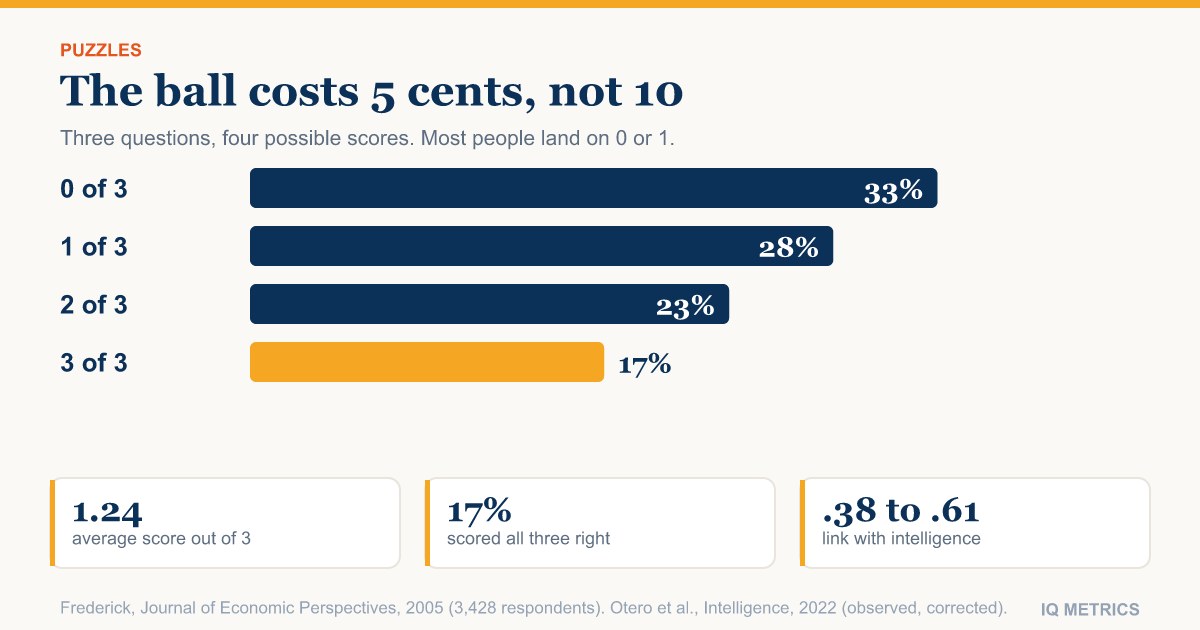
Cognitive Reflection Test: What the Bat-and-Ball Score Says About IQ
Across 3,428 people the three-question Cognitive Reflection Test averaged 1.24 correct, and only 17% got all three. Its link to IQ is moderate, not one-to-one, and the questions are now so well known that familiarity shifts scores.

Syllogism Questions on IQ Tests: Why the Right Answer Feels Wrong
A syllogism gives you two statements and asks what must follow. Decades of research show most people answer with what they already believe instead — and the fix is one simple substitution trick.

Does Rubik's Cube Increase IQ? What the Studies Show
No study we found shows that solving a Rubik's Cube raises IQ. In 79 trained novices, fluid reasoning explained 30% to 35% of cube skill, so the evidence runs from reasoning to the cube, not the other way.
Read the research.
Then find your own number.
Our IIF-certified assessment reports your score with its scale, percentile and confidence range — and a breakdown of the cognitive domains behind it.
Start IQ Test →