





Prenatal Smoking and IQ: A Story More Complicated Than the Headlines
Several studies link smoking during pregnancy to a lower child IQ score. Then a Danish cohort of 1,782 mothers adjusted for the one variable most of the earlier research had not: the mother's own IQ. What was left afterward is a genuinely more complicated story than the headline number suggests.

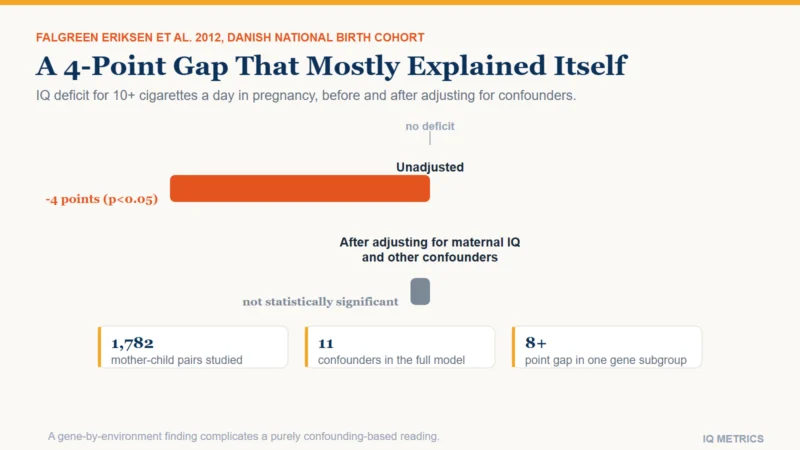
Probably a real effect, but a smaller and more contested one than the plainest version of this claim suggests — and a meaningful share of what early research measured as a smoking effect looks, in the best-controlled study available, like something else entirely. Nicotine is a well-established neuroteratogen with a real biological pathway into a developing brain. It is also true that mothers who smoke during pregnancy differ, on average, from mothers who do not in ways that independently affect a child's IQ score — and one of the more careful studies on this question found that once those differences are accounted for, the specific IQ-point effect mostly disappears.
Both of those things are true at once, and treating this as a simple "smoking lowers IQ by N points" claim, or dismissing it as pure confounding, both oversell the certainty the evidence actually supports.
The biological case, independent of any single study
Nicotine and its metabolite cotinine cross the placenta freely, reaching the fetus at concentrations equal to or higher than those in the mother's own bloodstream. Both are established to alter the developing brain's acetylcholine, serotonin and catecholamine neurotransmitter systems, and smoking also produces vasoconstriction and reduced oxygen delivery to the fetus through a separate pathway. None of that depends on any particular cohort study's numbers holding up; it is why researchers expected to find a cognitive effect in the first place, and it is also why prenatal smoking's other, non-cognitive harms — preterm delivery, fetal growth restriction, congenital malformation, stillbirth and Sudden Infant Death Syndrome — are not in dispute here at all. This article is about the narrower and genuinely contested IQ-point question only.
It is worth being precise about what "no known safe amount" means when public-health agencies say it, since the same phrase shows up in this site's companion piece on prenatal alcohol exposure and is easy to misread. It is a statement that no safe threshold has been established by research, not a claim that every level of exposure produces a measurable cognitive effect. Heavy, sustained smoking carries well-documented risk across multiple outcomes; the size of any effect from lighter or more occasional exposure specifically on IQ is one of the genuinely less settled questions this article covers, and treating the two as identical overstates what either literature actually shows.
What the early cohort studies found
A cohort of more than 1,800 Estonian schoolchildren, drawn from 45 schools across all fifteen of the country's counties, found a 3.3-point IQ deficit associated with prenatal smoking exposure, alongside separate effects from birth weight and maternal education. A 2012 study of the Danish National Birth Cohort, 1,782 mother-child pairs tested with a standard preschool IQ scale at age 5, found an unadjusted 4-point drop in Full-Scale IQ associated with smoking 10 or more cigarettes a day during pregnancy, compared with not smoking at all — a statistically solid, easily quotable number, and the kind of figure that tends to be the one repeated in summaries of this research. Both studies controlled for at least some confounding factors, which is standard practice in this field and is exactly why their headline numbers read as credible on their own. The open question was never whether these researchers adjusted for anything — it is whether they adjusted for the single confounder that turns out to matter most.
What happened when researchers controlled for the mother's own IQ
That same Danish study did something a large share of earlier research had not: its full statistical model adjusted not just for parental education but for maternal IQ directly, along with maternal alcohol use, the child's sex and age, paternal smoking, maternal age and body mass index, family environment, breastfeeding and sensory impairment. Once all of that was accounted for, the significant effect of prenatal smoking on Full-Scale IQ disappeared. The authors' own reading is specific and worth quoting in substance rather than softening: earlier studies that did not control for maternal IQ directly may carry substantial residual confounding, because smoking during pregnancy correlates with a mother's own cognitive score for reasons that have nothing to do with nicotine's effect on a fetus.
Where would your own score land?
Take the IIF-certified assessment and get your score with the scale it was measured on, the percentile it corresponds to and the confidence range around it — the three figures most online tests leave out.
Find your IQ score now! →The complication that keeps this from being a clean confounding story
If confounding fully explained the pattern, a well-designed genetic-interaction study should not find a smoking-specific effect tied to one particular gene variant. One does. Children carrying the Met allele of the BDNF gene showed a Full-Scale IQ deficit of more than 8 points specifically when their mother smoked during pregnancy, a pattern that held across multiple childhood ages in the same cohort. A socioeconomic or maternal-IQ confound would be expected to affect children regardless of which BDNF variant they inherited; a gene-by-exposure interaction this specific is harder to wave away as pure confounding, and it is the strongest piece of evidence that a real, biological, dose-sensitive effect exists underneath the more contested average finding. Taken together, the two results are less contradictory than they first look: the average effect across an entire cohort may genuinely wash out once maternal IQ is accounted for, while a real, biologically specific effect still concentrates inside a genetically identifiable subset of the same cohort. A population-level null result and a subgroup-level real effect can both be true about the same dataset at once, a nuance no single quoted number ever carries on its own.
Secondhand exposure and dose
The research on secondhand smoke exposure during pregnancy follows a similar dose-response shape to the direct-smoking literature: more frequent secondhand exposure is associated with worse outcomes than occasional exposure, in the same general direction as, though generally smaller than, active maternal smoking. The practical implication tracks the direct finding above: dose and frequency appear to matter more than exposure as a simple binary, which is also consistent with the biological picture — a fetus absorbing a smaller, less sustained dose of nicotine and cotinine would be expected, on the mechanism described earlier, to show a smaller effect than one absorbing a mother's own direct, daily exposure. It is also one more reason a single number attached to "smoking in pregnancy" as a yes-or-no category was always going to be an oversimplification of what is really a graded, dose-dependent exposure, closer in shape to a dial than to a simple binary light switch.
What this means, and does not mean
The honest summary sits between the two headline-ready versions of this story. Nicotine's biological pathway into a developing brain is real and well established. Some of the specific IQ-point numbers attached to that pathway, in studies that did not control for the mother's own cognitive ability, are very likely inflated by confounding — the same shape of caution this site applies to the Adverse Childhood Experiences score in the piece on toxic stress and IQ, where a real population-level signal turned out to predict very little about any individual person. And a specific gene-by-environment finding suggests the confounding explanation is not the whole story here either. Readers looking for a single settled number will not find one in this article, and that absence is itself the honest finding: unlike some of the other exposures covered on this site, the research here has not converged on one, and a responsible summary says so rather than repeating whichever figure sounds most citable. None of this touches prenatal smoking's separately well-established harms outside cognition, which are not in question and are not softened by anything above. This is one of three ways this site has now covered a substance or exposure reaching a fetus directly: alongside prenatal alcohol exposure and, through the lungs rather than the placenta, fine-particle air pollution. For the much broader question of how much of any IQ score is inherited in the first place, including from a mother's own cognitive ability, see is IQ genetic.
Keep reading
All articles →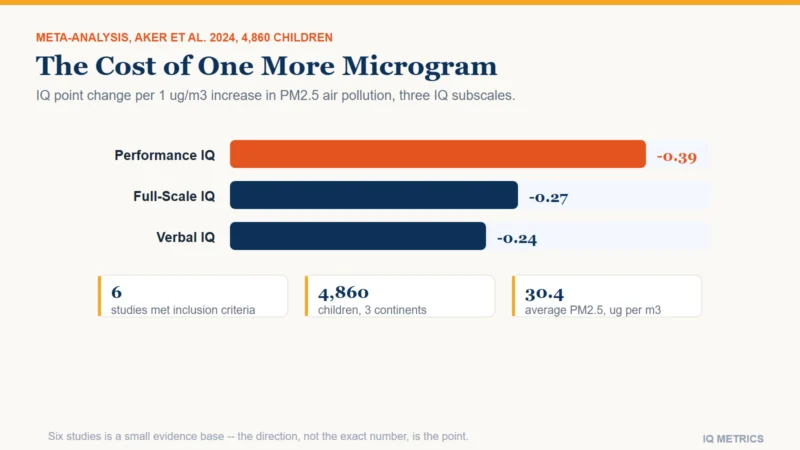 Research & Evidence
Air Pollution and IQ
A 2024 meta-analysis pooling six studies and 4,860 children found that every rise in fine-particle air pollution came with a small, statistically significant drop in IQ scores. The same pattern shows up in aging adults living near traffic, and in a household exposure route this conversation usually leaves out entirely.
 Research & Evidence
Fetal Alcohol Spectrum Disorder and IQ
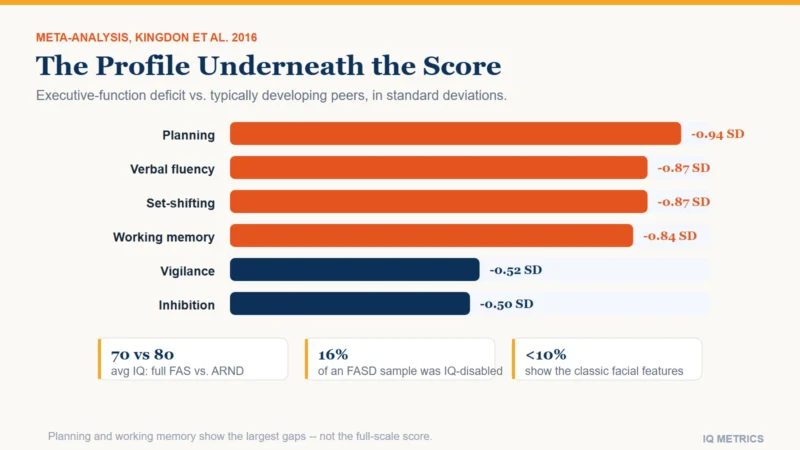
A clinical study of 473 people diagnosed with fetal alcohol syndrome or its milder forms found that only 16 percent had an IQ in the intellectually disabled range. That statistic is not the reassurance it sounds like -- it is the reason the condition is so often missed. Here is what a normal-looking score can still be hiding.
 Research & Evidence
Is IQ Genetic?
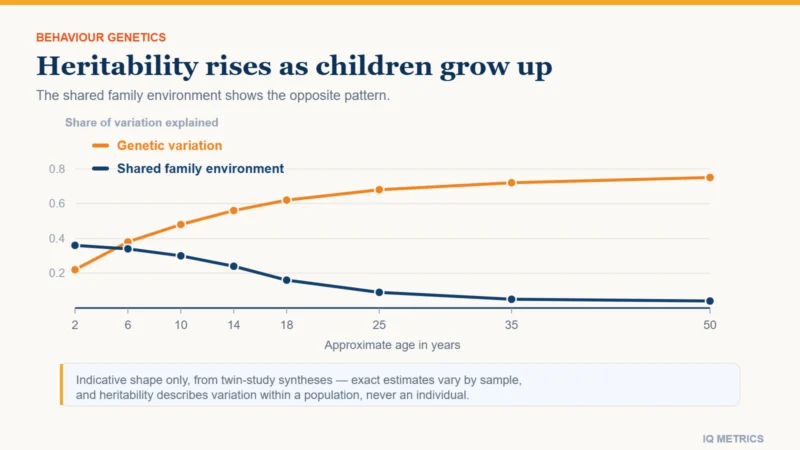
Heritability estimates for IQ rise from roughly 0.4 in childhood to 0.7 or higher in adulthood, which sounds decisive until you know what heritability measures. Here is what twin and adoption studies actually show, and the four conclusions people draw from them that the statistic does not support.