





Toxic Stress and IQ: What the Bucharest Orphanage Study Actually Found
Researchers in Romania did something that can never be done again for ethical reasons: they randomly assigned some institutionalized children to foster care and left others in the institution, then followed both groups for twenty years. The IQ gap that opened up has held at every check-in since. What has not held up as cleanly is the famous claim about exactly when the window closes.

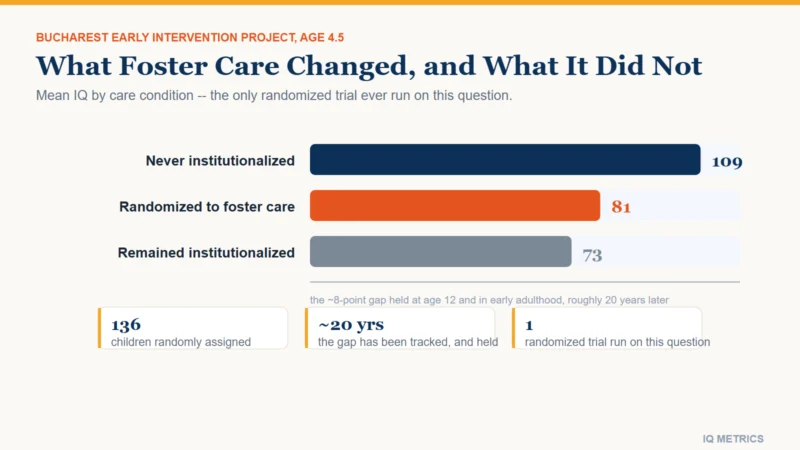
Yes, and the cleanest evidence available comes from the only randomized controlled trial ever conducted on the question — a study that could not be ethically repeated today and has followed the same children for two decades. Children living in Romanian institutions were randomly assigned either to remain in institutional care or to move into a newly created foster-care network. At the first major follow-up, the foster-care group averaged an IQ of 81, the group that remained institutionalized averaged 73, and a comparison group of children who had never been institutionalized averaged 109.
That eight-point gap between the two institutionalized groups — caused by nothing except which one got assigned to leave — is about as close to direct causal proof as developmental psychology gets. What is less solid, and worth being honest about, is the specific age-based claim that usually rides along with this study whenever it gets summarized.
The experiment nothing else in this field can match
The Bucharest Early Intervention Project enrolled 136 children, average age about 22 months, living in Romanian institutions in the early 2000s. Half were randomly assigned to continued "care as usual"; the other half were placed into foster families recruited and supported specifically for the study. A third group of Bucharest children who had never been institutionalized served as a community comparison. Because placement was randomized rather than chosen by caseworkers or families, any later difference between the foster-care and institutional groups can be attributed to the intervention itself rather than to whatever made some children more likely to be placed — the same logic, and the same rare strength, behind this site's piece on the Perry Preschool experiment.
What the gap looked like, and how long it lasted
At 54 months, the foster-care group's average IQ of 81 sat meaningfully above the institutional group's 73, both well below the never-institutionalized comparison group's 109. The gap did not fade the way some early-childhood effects do: at age 12, the same three groups scored 75.80, 68.76 and 98.61 respectively, and a 2022 follow-up in early adulthood found a foster-care group average of 73.49 against 64.65 for the group that remained institutionalized — a statistically real, roughly nine-point advantage that had held for close to twenty years. A synthesis of the full two-decade dataset, published in 2023, described the IQ effect of foster care versus institutional care as remarkably stable across the entire follow-up period.
The "24-month window" claim, and why it deserves a hedge
The original 2007 report, and most popular coverage of it since, highlighted a striking finding: children placed into foster care before 24 months of age recovered more fully than those placed later, suggesting a sensitive window for cognitive development. That finding is real, but the later follow-ups that tested it directly did not keep reproducing it cleanly. At age 8, the cutoff that mattered had shifted to around 26 months and applied to a narrower set of measures. At age 12, the researchers explicitly tested cutoffs at 20, 22, 24 and 26 months and found no significant effect of any of them on IQ. By early adulthood, age at placement was analyzed as a continuous variable with only a marginal association, and no discrete threshold was reported at all. The honest version: a real advantage to earlier placement shows up in this dataset, but a clean, fixed "24-month cutoff" is closer to the original headline than to what the full 20 years of follow-up data actually settled on.
Where would your own score land?
Take the IIF-certified assessment and get your score with the scale it was measured on, the percentile it corresponds to and the confidence range around it — the three figures most online tests leave out.
Find your IQ score now! →A second, independent study that points the same way
The English and Romanian Adoptees study, a separate research group following a different cohort of children adopted out of Romanian institutions into UK families, found a 15-point IQ deficit at age 11 for children institutionalized more than six months before adoption, compared with those adopted earlier — with no further worsening for longer stays between six and 42 months. Unlike the Bucharest trial, placement into adoption here was not randomized by researchers — families made their own decisions about which children to adopt and when — so this is a natural experiment rather than a controlled one. That its findings point the same direction as a true randomized trial is exactly what makes it a useful second check, not a substitute for one. A 2017 follow-up of the same cohort into young adulthood added a genuinely useful complication: the cognitive impairment measured at ages 6 to 11 had largely remitted by early adulthood, even though psychiatric and social difficulties in the same group had not. Early deprivation, in other words, did not damage every domain equally or permanently — cognition proved more recoverable over the long run than mental health did in this particular cohort.
Why toxic stress is different from an ordinary bad day
Researchers at Harvard's Center on the Developing Child draw a specific three-way distinction: positive stress is brief and normal, like a first day of childcare; tolerable stress is serious but time-limited and buffered by a supportive relationship; toxic stress is strong, frequent or prolonged activation of the body's stress-response systems without that buffering adult relationship in place. The proposed biological mechanism, laid out most influentially by the neuroscientist Bruce McEwen, is that repeated activation of stress hormones produces cumulative wear on brain regions, particularly the hippocampus and prefrontal cortex, that are central to memory and reasoning. That is a plausible, well-established mechanism for how chronic stress could affect cognition, not itself a specific measured effect size — the actual evidence for the size of the effect is the Bucharest and Romanian-adoptee data above.
What the ACE study does, and does not, actually show
The Adverse Childhood Experiences study, published in 1998 and often invoked in discussions like this one, is worth being precise about: it is a retrospective survey of more than 8,000 adult patients linking childhood adversity to later adult disease and risk behavior, and it never measured IQ, cognitive test performance or academic outcomes at all. Citing it as evidence that toxic stress lowers IQ specifically overstates what the study actually did. A separate, later body of work has since made that link directly: a 2024 meta-analysis pooling 32 studies and nearly 27,000 people found a real, small-to-medium association between a higher adversity score and worse cognitive control in adulthood. That is a genuine cognition finding — it is simply a different, more recent literature than the original 1998 study, which never tested cognition at all. But even one of the ACE study's own original co-authors has since published a caution against using the ACE score for individual-level clinical prediction, and a 2021 analysis found its accuracy at predicting any single person's outcome to be poor, even though the population-level pattern is real. Population-level evidence and individual-level prediction are different claims, and this literature is a clean example of why that distinction matters.
What this means, and does not mean
None of this says a difficult early environment determines a fixed outcome. It says something narrower and better supported: prolonged, unbuffered early adversity is one of the few environmental factors with genuine experimental, not just correlational, evidence behind its effect on cognitive development, alongside the kind of factors already covered on this site in the piece on socioeconomic status and IQ, lead exposure and IQ, and a very different prenatal exposure covered in this site's companion piece on fetal alcohol spectrum disorder. The size of the effect is real but moderate, it responds to intervention, as the foster-care comparison shows directly, and — per the Romanian adoptee follow-up above — even the cognitive piece of it is not necessarily permanent. The single clearest, most actionable finding across all of this research is also the simplest one: the single largest protective factor identified in both the Bucharest and Romanian cohorts was the presence of one stable, responsive caregiving relationship, which is precisely the buffer the Harvard framework above names as the difference between tolerable stress and toxic stress in the first place.
Keep reading
All articles →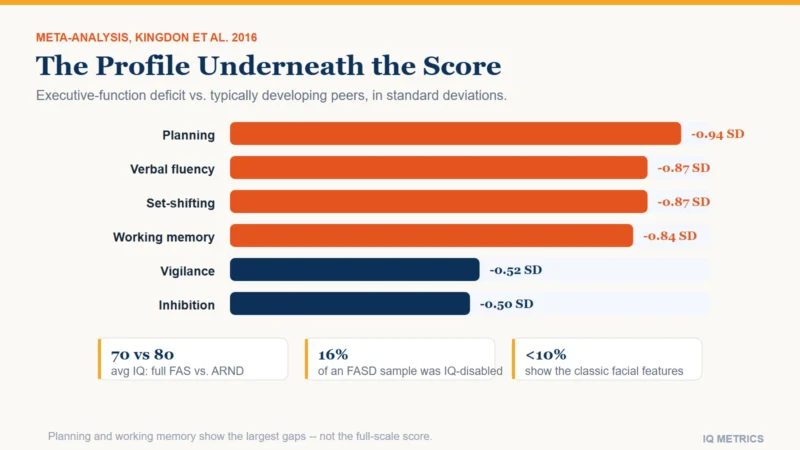 Research & Evidence
Fetal Alcohol Spectrum Disorder and IQ
A clinical study of 473 people diagnosed with fetal alcohol syndrome or its milder forms found that only 16 percent had an IQ in the intellectually disabled range. That statistic is not the reassurance it sounds like -- it is the reason the condition is so often missed. Here is what a normal-looking score can still be hiding.
 Research & Evidence
Socioeconomic Status and IQ
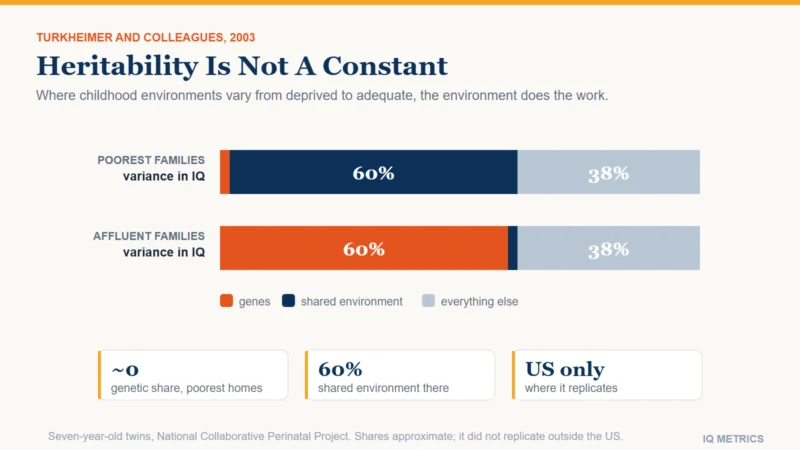
Family circumstances track IQ scores, and the relationship is stranger than a simple gap. In the poorest families studied, genes explained almost none of the variation in childhood scores and shared environment explained most of it. In affluent families the pattern reversed. Here is what that finding does and does not support.
 Research & Evidence
Preschool and IQ
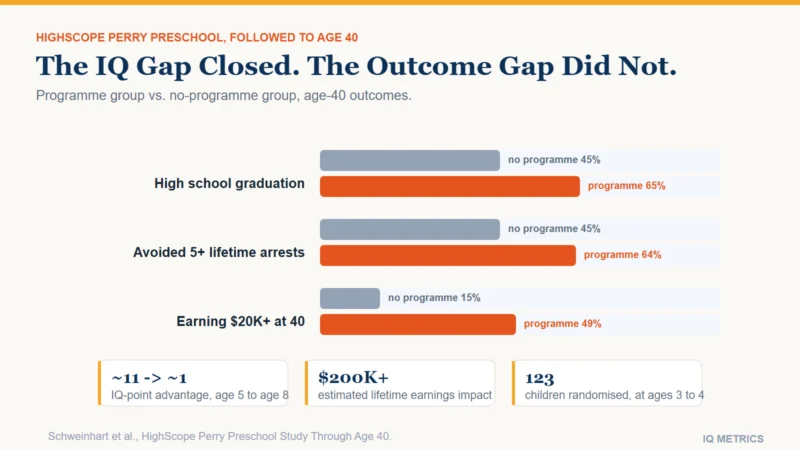
The most famous experiment in early-childhood education raised participants' IQ scores by as much as 13 points -- then watched that advantage shrink to almost nothing within a few years. Their income, education and arrest records stayed different for the rest of their lives. Why would outcomes outlast the score that supposedly predicts them?