Does Using AI Make You Dumber? What the Studies Measured
The claim that AI is making us stupider has real research behind it and is still routinely overstated. No study has measured a drop in intelligence. What has been measured is lower mental engagement during a delegated task and weaker memory for work you did not do yourself, which is a narrower finding and a more useful one.
Does using AI make you dumber? On the evidence available in 2026, no study has shown that AI use lowers intelligence, and none has measured an IQ score before and after. What researchers have measured is narrower and still worth taking seriously: people who delegate a thinking task to a language model engage less while doing it, remember less about it afterwards, and evaluate the output less critically the more they trust the tool.
Those are real findings about attention, memory and judgment. They are not findings about general intelligence, and the distance between the two is where most of the alarming coverage lives.
What the cognitive debt study actually measured
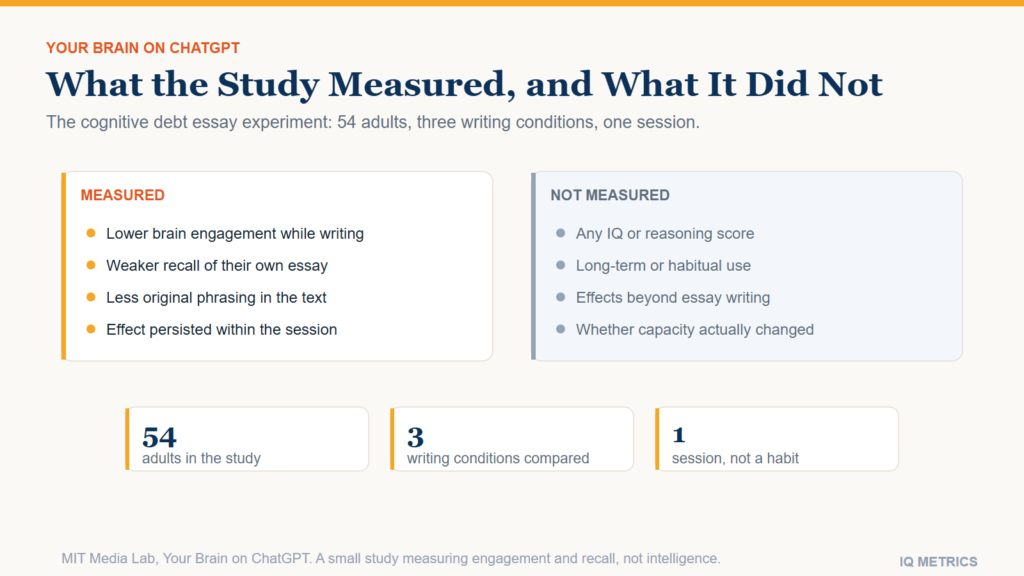
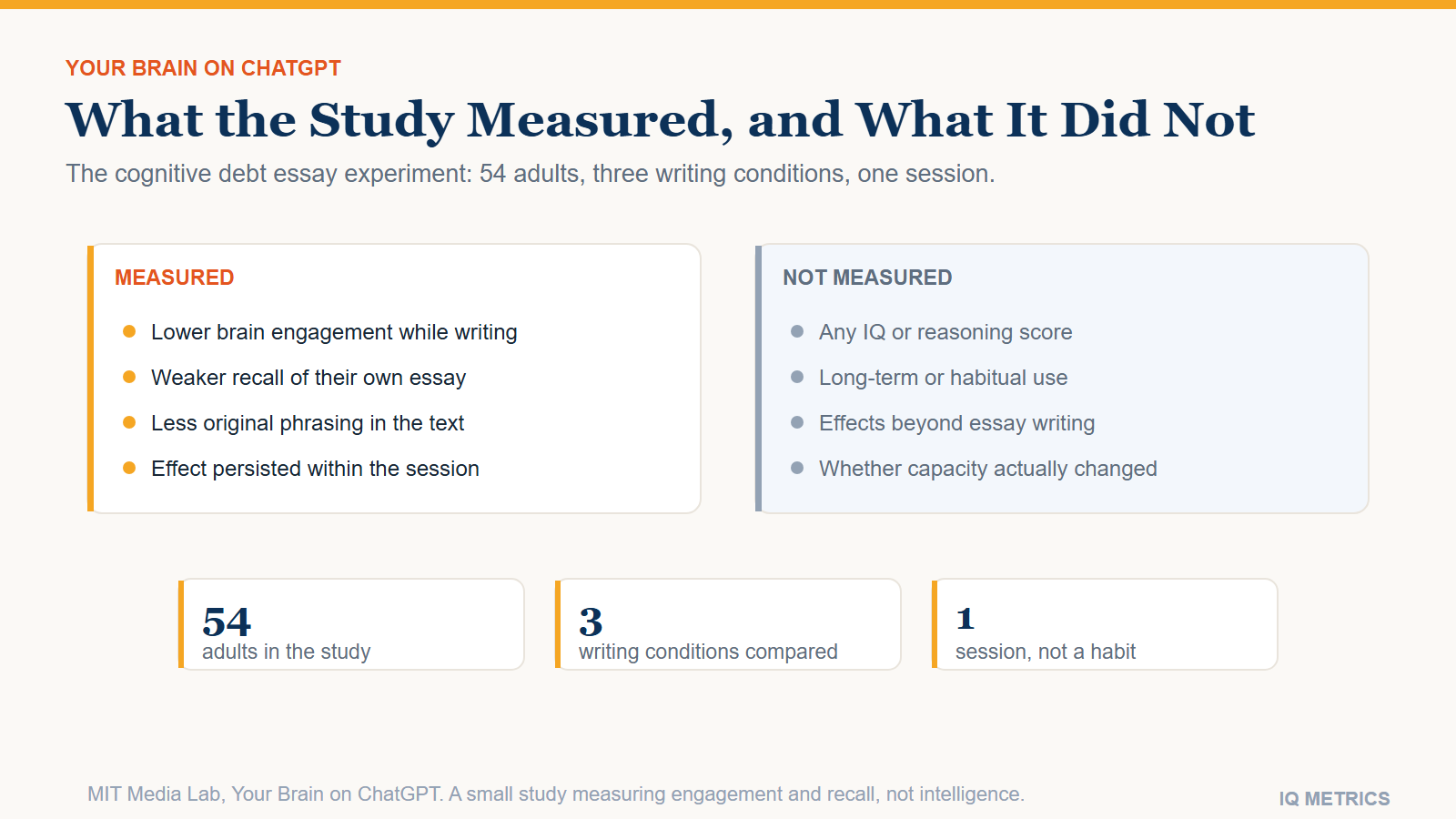
The study driving most of the headlines is work from the MIT Media Lab titled "Your Brain on ChatGPT: Accumulation of Cognitive Debt when Using an AI Assistant for Essay Writing Task". Fifty-four adults wrote essays under one of three conditions: with a language model, with a search engine, or with no tools at all. The researchers recorded brain electrical activity during the task and analysed the resulting text.
The model-assisted group showed measurably lower cognitive engagement while writing. They also showed weaker recall of their own essays afterwards — in several cases struggling to quote work they had submitted minutes earlier. The authors called the accumulated effect cognitive debt: a shortfall you take on by skipping the effortful part, which comes due later.
- The finding is about engagement during the task and memory for the output.
- It is not a finding about reasoning ability, problem solving, or any score on a cognitive test.
- Nobody in the study was given an intelligence test at any point.
What the study did not show
Being clear about the limits is not a way of dismissing the work. It is how the work should be read, and the authors are considerably more careful than the coverage.
- Fifty-four people is a small sample. Effects this size in samples this size routinely shrink when a study is repeated at scale.
- One task, one session. Essay writing under observation over a short window is not the same as habitual use over years, which is what the headline claim implies.
- Brain engagement is not intelligence. Lower measured activity during a task you delegated is close to what you would predict. It does not follow that capacity changed.
- Cognitive debt is a metaphor, coined by the authors and not a validated psychological construct with an established measure behind it.
The correct summary is that a well-designed small study found lower engagement and weaker recall under AI assistance, and that this is a reason to pay attention rather than a demonstration that anyone got less intelligent. The site applies the same standard to claims that things raise intelligence, which usually turn out to be weaker than advertised in exactly the same way.
The finding that should worry you more
A separate line of research points at something more specific than general dulling. A survey by researchers at Microsoft and Carnegie Mellon University found that the people who most trusted the accuracy of AI assistants thought least critically about what those assistants produced. Confidence in the tool, rather than time spent with it, predicted the drop in scrutiny.
Work tracking professional consultants found the same shape from the other direction: measurable short-term performance gains, reported in the range of 14 to 40 percent, alongside erosion of the independent judgment the assistance was supposed to support. The mechanism is not mysterious. Automation handles the routine cases and hands you the exceptions, which removes exactly the ordinary practice that keeps judgment sharp — so when the tool is wrong, the person checking it is out of practice.
Judgment behaves like a skill rather than a trait. It decays without use, and it does not show up on an intelligence test either way, which is part of why smart people can be reliably bad at particular kinds of decision. We look at that gap in why high scorers still make poor decisions.
Where would your own score land?
Take the IIF-certified assessment and get your score with the scale it was measured on, the percentile it corresponds to and the confidence range around it — the three figures most online tests leave out.
What would a study need to show to settle this?
It is worth being concrete about the gap between what exists and what would actually answer the question, because the gap is large and nothing currently published closes it.
- A normed cognitive measure, before and after. Not brain activity during a task, but a standard instrument administered at the start and again at the end.
- Random assignment and a real control group. People who choose to use AI heavily differ from people who do not, in ways that would produce this pattern on their own.
- Months or years, not one session. The claim is about habitual use, so the study has to run long enough for a habit to exist.
- A correction for practice effects. Sitting the same test twice raises the second score whatever happened in between, and that alone can manufacture or mask an effect.
No published study does all four. That is not a criticism of the researchers — a study like that is expensive and slow — but it does mean anyone claiming AI has measurably lowered human intelligence is going beyond the evidence. The same standard applies to the reverse claim: nobody has shown it is harmless either.
Does this apply to children and students?
The research discussed here was conducted on adults, and extending it to developing minds is exactly the kind of leap the evidence does not support. Children are not small adults for these purposes: the skills at issue are still being acquired rather than maintained, which could plausibly make delegation more costly or less, and neither has been demonstrated.
What is reasonably well established is narrower and older: learning that involves retrieval and effortful practice sticks better than learning that does not. A tool that removes the effort removes the thing that made it stick. That is an argument about how the tool is used in teaching, not about whether it lowers intelligence, and it long predates language models.
Is this the same as cognitive offloading?
Related but not identical, and the distinction is worth keeping. Cognitive offloading is the long-studied habit of storing information outside your head — a phone number in a contacts list, a route in a map app — and the research on what it does to memory predates language models by decades. We cover that literature separately in our report on AI and memory.
The cognitive debt work is about something narrower: not what happens to your memory when you store a fact elsewhere, but what happens to your engagement and recall when you delegate the thinking itself. Offloading a phone number costs you the number. Offloading the reasoning may cost you the practice.
How to use AI without losing the practice
Nothing in this research supports avoiding these tools, and the productivity findings are as real as the engagement ones. What the evidence does support is being deliberate about which part of the work you hand over.
- Attempt first, then delegate. Producing your own answer before asking for one preserves the effortful step the studies found missing, and gives you something to compare against.
- Use it to critique rather than to produce. Asking a model to find the weakness in your reasoning keeps you doing the reasoning.
- Distrust fluent output on purpose. The Microsoft and Carnegie Mellon result says confidence in the tool is the risk factor, so the correction is to check most carefully when the answer reads best.
- Keep some work unassisted. Not for virtue: for the same reason anyone practices anything they intend to stay good at.
If the underlying worry is about your own thinking rather than the technology, the useful move is to measure rather than speculate. A properly normed reasoning test gives you a baseline you can compare against later, reported as a position in a reference population rather than a bare number. And if the deeper question is whether machines are overtaking us, the domain-by-domain comparison is a better guide than any single study.
Keep reading
 Understanding IQ
Is AI Smarter Than Humans?
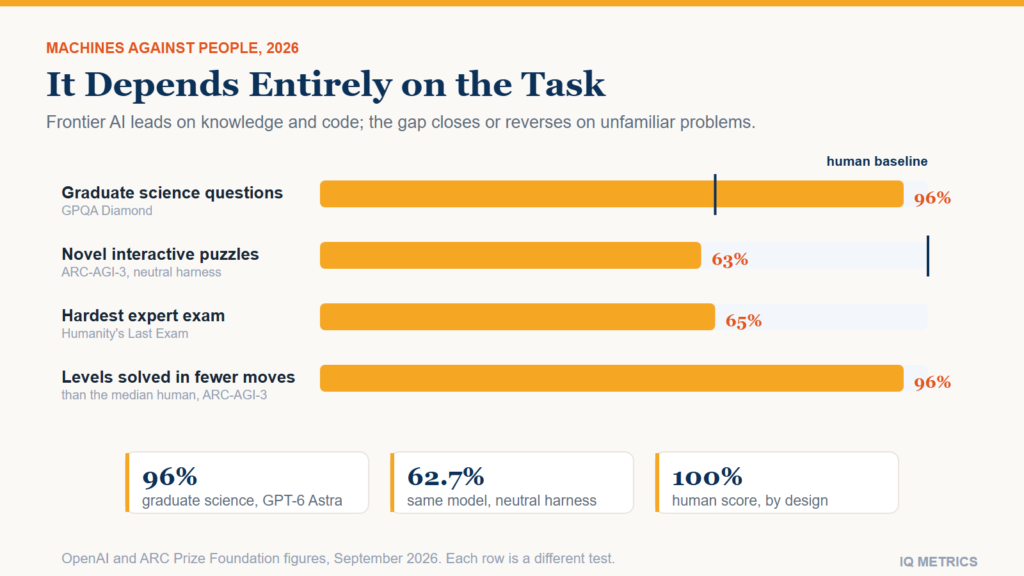
Ask whether AI is smarter than humans and the honest answer depends entirely on the task. Frontier systems now beat expert humans on graduate-level science questions and lose to ordinary people on puzzles built to be unfamiliar. Here is what the 2026 benchmarks actually measure, and why one score never settles it.
 Scores & Scales
What Is ChatGPT’s IQ Score?
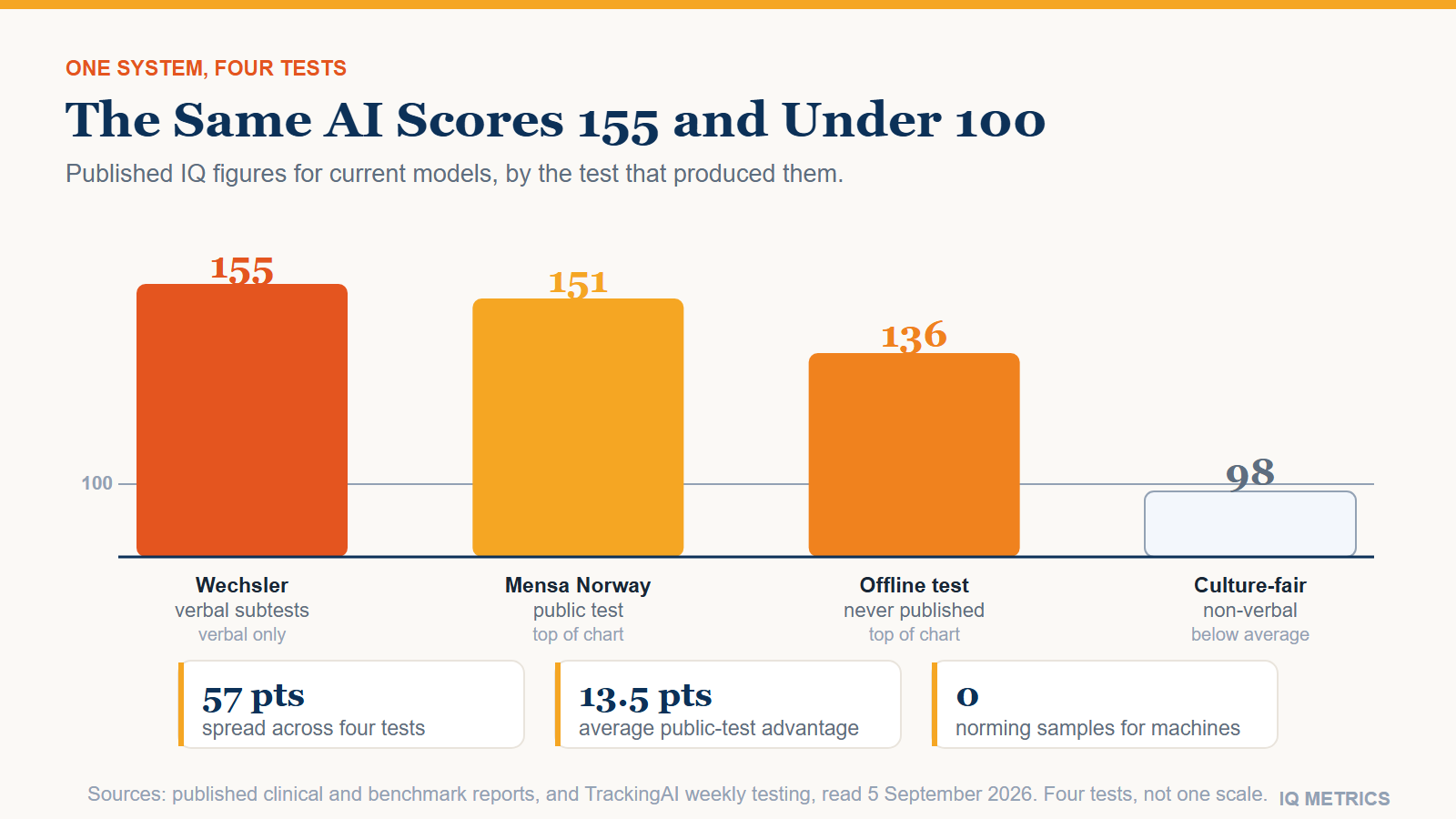
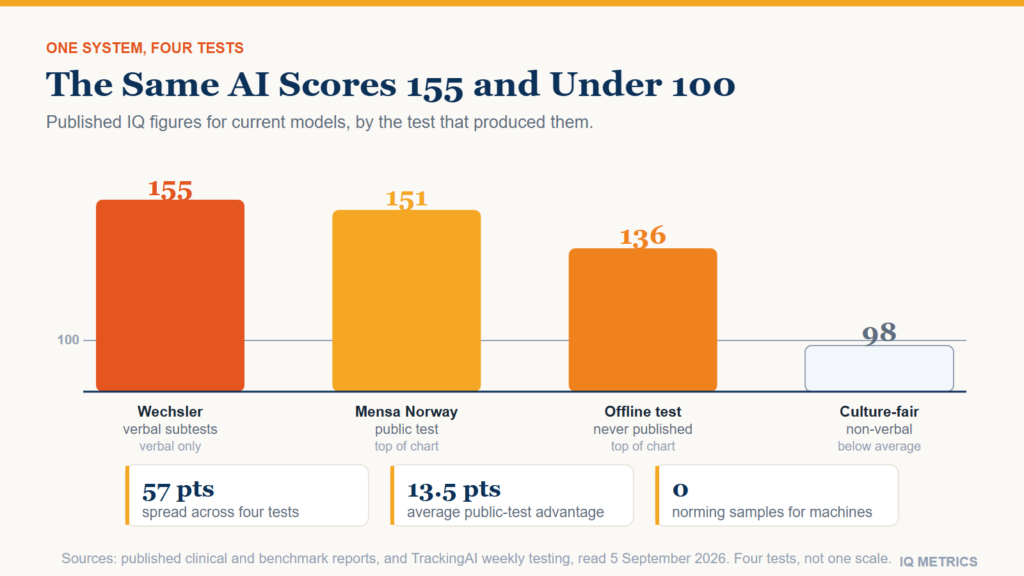
Search for ChatGPT’s IQ score and you will find 155, 136, 116 and under 100, all reported seriously, sometimes for the same model. They are not contradictions to be resolved. They are different tests, scored different ways, and the spread between them is the most informative thing about the whole exercise.
 Understanding IQ
Processing Speed and IQ
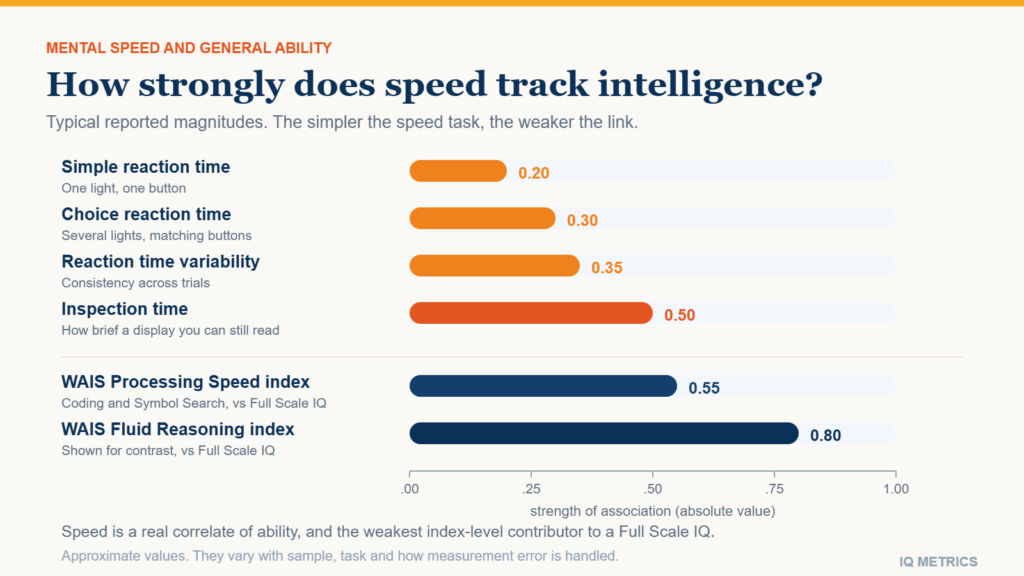
Fast thinkers are assumed to be smart thinkers, and there is a real finding underneath the stereotype: people who score higher on IQ tests do respond faster on tasks with no reasoning content at all. But the link is weaker than the folklore, and on a professional battery the speed index is the least g-loaded.