





What Is the ChatGPT IQ Score? Results by Model, Test and Date
Search for ChatGPT's IQ score and you will find 155, 136, 116 and under 100, all reported seriously, sometimes for the same model. They are not contradictions to be resolved. They are different tests, scored different ways, and the spread between them is the most informative thing about the whole exercise.

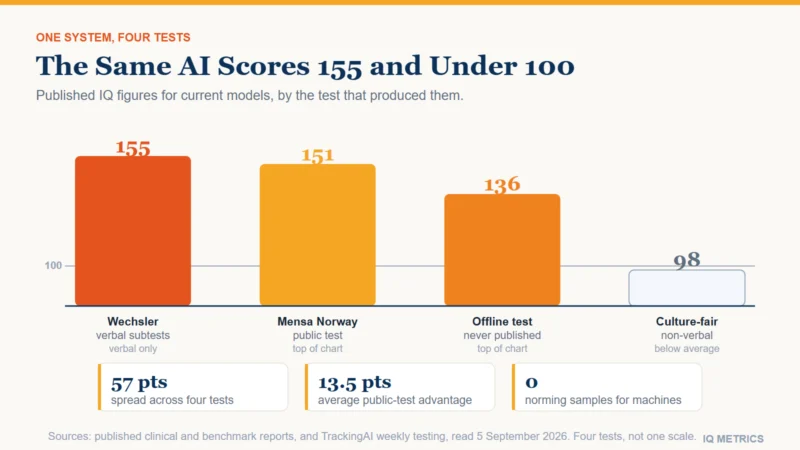
There is no official ChatGPT IQ score. Every ChatGPT IQ figure online comes from a named test on a named date, and none is an IQ in the clinical sense. On the Mensa Norway test as run by TrackingAI, GPT-Astra-Ultra averaged 32.5 of 35 puzzles by 5 October 2026, an IQ of 144 on TrackingAI’s line. ChatGPT-4 averaged 12.3, or 83, by March 2025. A 2023 estimate of 155 covered the verbal half of one Wechsler test only.
Below: the figure for each OpenAI model, why the IQ of ChatGPT depends on the test, and what that means for your own score. The table comes from TrackingAI’s public log, read on 9 November 2026. New here: the same model can score 73 or 145 on one test, depending on whether it reads the puzzles or sees them.
Key takeaways
- There is no official ChatGPT IQ. An IQ ranks a person against a norm group, and no norm group of chatbots exists.
- On TrackingAI’s Mensa Norway line, OpenAI models rose from IQ 83 (ChatGPT-4, 2025) to 144 or 147 (GPT-Astra-Ultra, 2026). That line is not the human IQ scale.
- The same model can differ by up to 72 points between a text form and an image form of the test: GPT-5-Pro scored 73 and 145.
- The 155 figure is a Verbal IQ estimated from five of six Wechsler subtests in 2023 (Roivainen, Scientific American). It is not a full-scale IQ.
- The public Mensa Norway test ran 13.9 points higher than an unpublished test for 23 models, in our October analysis of TrackingAI’s log.
What is ChatGPT's IQ?
ChatGPT has no single IQ. The best-known figure is a Verbal IQ of 155. Eka Roivainen estimated it in 2023 from five of the six verbal subtests of the Wechsler Adult Intelligence Scale, third edition (Scientific American).
On that scale the chatbot scored above 99.9% of the 2,450-person US standardisation sample. It could not take the non-verbal subtests, because it lacks eyes, ears and hands, and it could not take Digit Span, the short-term memory subtest. So no full-scale IQ came out of it.
Every other figure is a benchmark run, not a clinical test. ChatGPT is the product, so benchmarks report the OpenAI models behind it by name.
What is the IQ of ChatGPT-5 compared with older models?
On TrackingAI’s Mensa Norway chart, GPT-5 scores 125 in its text form and 109 in its vision form. That is well above ChatGPT-4 at 83 and below the 2026 models, which sit at 139 to 147.
TrackingAI gives each model the Mensa Norway test every week and shows an average of the last seven sittings. We took that average from its public log, read on 9 November 2026 (data to 4 November). We converted it with TrackingAI’s own line, which adds 3 points for every extra correct answer.
| Model (TrackingAI name) | Released | Text version | Vision version |
|---|---|---|---|
| ChatGPT-4 | March 2023 | 12.3 (IQ 83) | no vision entry |
| GPT-4o (GPT4 Omni) | May 2024 | 11.0 (IQ 79) | 4.7 (IQ 60) |
| o1 | September 2024 | 25.3 (IQ 122) | no vision entry |
| o3 | April 2025 | 29.7 (IQ 135) | 14.9 (IQ 91) |
| GPT-5 | August 2025 | 26.3 (IQ 125) | 21.0 (IQ 109) |
| GPT-5-Pro | August 2025 | 9.0 (IQ 73) | 33.0 (IQ 145) |
| GPT-Sol-Ultra | July 2026 | 33.0 (IQ 145) | 31.0 (IQ 139) |
| GPT-Astra-Ultra (GPT-6 Astra) | September 2026 | 32.5 (IQ 144) | 33.5 (IQ 147) |
Read the table as a ladder of test performance, not of intelligence. ChatGPT-4 sat near 83, o3 reached 135 in text form in 2025, and the newest models sit near the top of what the formula can show. The newest entries have only 4 to 10 sittings, so their averages can still move, and GPT-5-Pro’s text form logged 9 correct in each of its last seven sittings.
The ceiling matters. TrackingAI’s line gives 100 for 18 of 35 correct and 151 for 35 of 35, so 151 is a formula limit, not a measured maximum. Our analysis of the Mensa Norway scores explains how that line works and why a one-sitting average can mislead.
Can AI take an IQ test?
Not a full one, the way a person does. A chatbot can answer written questions, but a clinical test also needs eyes, ears and hands, as Roivainen noted.
The test behind most AI figures is the Mensa Norway test: 35 visual-pattern puzzles with a 25-minute limit for people. A model that cannot see is given the puzzles described in words, and a model that can see is given the images. TrackingAI runs both forms.
Mensa Norway reports human results between 85 and 145 and says the test is no substitute for a professional one. TrackingAI’s line goes past 145, so its numbers are not human IQs.
A different kind of test is ARC-AGI-3, a set of interactive games. ARC Prize says a 100% score means an AI agent beats every game as efficiently as humans do. See our ARC-AGI-3 results for how AI agents score and why that is not an IQ.
Why do ChatGPT IQ scores disagree?
Each figure answers a different question: a different test, a different form of that test and a different date. That is why AI IQ test results never line up.
- Different tests. The Wechsler verbal subtests reward stored knowledge such as vocabulary and general information, which is a language model’s home ground. A pattern test strips out language on purpose.
- Different forms. GPT-5-Pro scored 73 as text and 145 as images. o3 scored 135 as text and 91 as images. GPT-4o scored 79 and 60.
- No fixed direction. GPT-Astra-Ultra scored higher with images (147) than with text (144), the opposite of GPT-4o, o3 and GPT-5.
- Different dates. ChatGPT-4’s 83 and GPT-Sol-Ultra’s 145 are over three years of model releases apart.
In a person, abilities correlate: a top vocabulary usually comes with strong matrices. In a machine there is no such tie, so the choice of test decides the answer. Human testing also treats standard administration as part of the instrument, and almost none of the AI figures in circulation were produced that way.
What happens when the test has never been published?
Models score higher on the public test than on one that has never been online. In our October analysis of TrackingAI’s log, read on 7 October 2026, the public Mensa Norway test ran 13.9 points higher on average than its unpublished offline test. That covers 23 models active since August with at least three sittings on each. In the project’s own words, the offline test has never been on the public internet and is in no AI training data.
An honest caveat: two different tests are not directly comparable. They have different norming samples, different difficulty and different item formats, and the offline test’s construction has not been released. The gap is consistent with the public test having leaked into the training data, but it does not prove it. People show the same pattern: the practice effect means a test taken a second time scores higher.
Where would your own score land?
Take the IIF-certified assessment and get your score with the scale it was measured on, the percentile it corresponds to and the confidence range around it — the three figures most online tests leave out.
Find your IQ score now! →Is a ChatGPT IQ score a real IQ?
No. An IQ is not a mark out of anything. It is a position within a reference population, expressed on a scale with a stated mean, almost always 100, and a stated standard deviation, usually 15. Producing one requires a norming study in which the test is given to a representative sample under standard conditions.
A machine belongs to no such population and has no norming sample, so the last step cannot be taken. What a model produces on an IQ test is a count of correct answers. Calling that count an IQ borrows the authority of a scale it was never placed on. Our piece on why an AI score on an IQ-style test is not an IQ makes the full argument.
Am I smarter than ChatGPT?
That comparison is not clean, because a chatbot’s score is not on the human scale. A model can answer 33 of 35 puzzles on one test and still struggle with tasks people find easy.
To see where you stand, take a properly normed reasoning test once, cold, and read the result as a range rather than a point. You can take the IQ test for a score on the human scale, or practise pattern puzzles first with our logical reasoning test.
Other yardsticks compare AI with people in other ways. METR’s time horizon is the length of task, set by how long a skilled human takes, that an agent completes about half the time: see our METR time horizon explainer. For a ranking of models, see the most intelligent AI model according to the indexes. None of these is an IQ.
Does using a chatbot lower your IQ? Our AI and memory research review found that assistants change what you remember from work you hand over, and no study linking AI use to lower IQ. For the wider human-versus-machine question, read is AI smarter than humans.
Quick answers
- What is Chat GPT’s IQ? There is no official one. A 2023 Verbal IQ of 155 came from five Wechsler verbal subtests only.
- What is the ChatGPT IQ level now? On the Mensa Norway test as run by TrackingAI, GPT-Astra-Ultra averaged 32.5 of 35 correct (IQ 144 on TrackingAI’s line) by 5 October 2026.
- What is the IQ of ChatGPT-5? GPT-5 scores 125 in text form and 109 in vision form on the same line, against 83 for ChatGPT-4.
- Can AI take an IQ test? It can take written tests such as Mensa Norway’s puzzles, but not a full clinical test. Its figure is a count of correct answers, not an IQ.
- Why do AI IQ test results differ? Different tests, different forms (text or images) and different dates: GPT-5-Pro scored 73 and 145.
- Am I smarter than ChatGPT? The scales differ, so the comparison is not clean. Take a normed test once and read the result as a range.
The bottom line
ChatGPT has no IQ, only test results with a name and a date. The newest OpenAI models score 139 to 147 on one puzzle test’s formula. The same model can score 73 or 145 depending on the form, and none of it is on the human IQ scale. To see a score that is, take the IQ test.
Sources
- Roivainen E (2023). I gave ChatGPT an IQ test. Here’s what I discovered. Scientific American.
- TrackingAI. Public score log (daily_logs.csv) and model list (ai_models_info.csv), read 9 November 2026, data to 4 November 2026.
- ARC Prize. ARC-AGI-3.
- IQ Metrics. AI scores on the Mensa Norway test: what 151 means and what it does not (analysis of TrackingAI’s log read 7 October 2026).
Keep reading
All articles →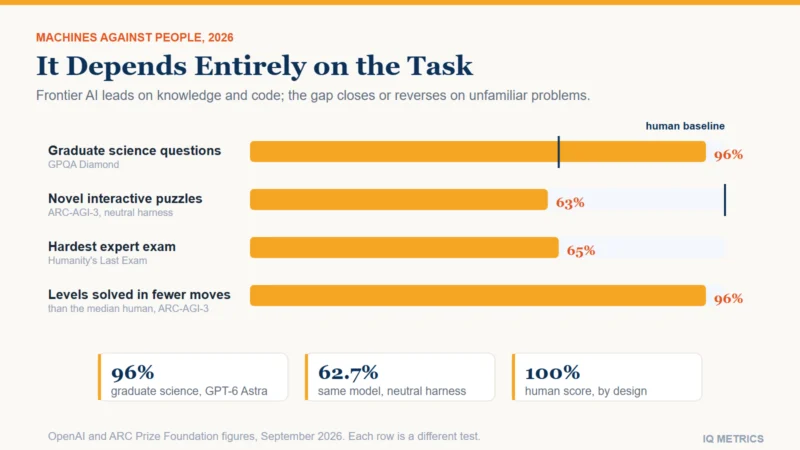 Understanding IQ
Is AI Smarter Than Humans?
Ask whether AI is smarter than humans and the honest answer depends entirely on the task. Frontier systems now beat expert humans on graduate-level science questions and lose to ordinary people on puzzles built to be unfamiliar. Here is what the 2026 benchmarks actually measure, and why one score never settles it.
 Understanding IQ
What Is AGI?
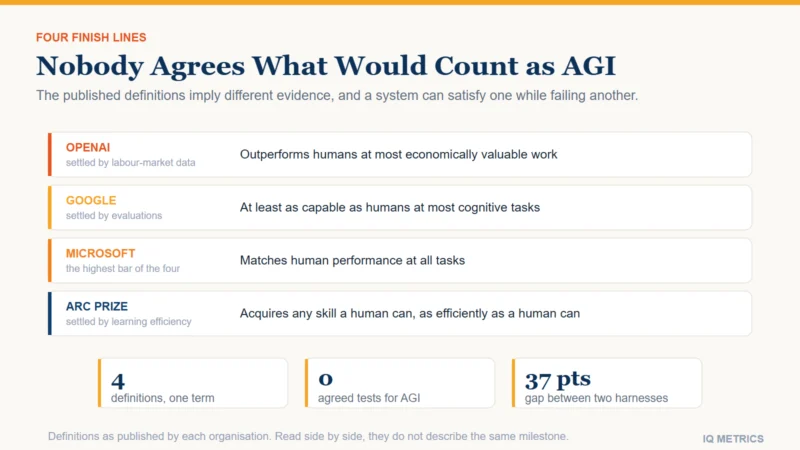
Artificial general intelligence means a system that can learn and apply knowledge across the full range of tasks a person can, rather than excelling at a narrow set. The trouble is that the major labs each publish a different definition, none of them converts into a test, and so claims that AGI has arrived cannot be checked either way.
 Research & Evidence
Cultural Bias in IQ Tests
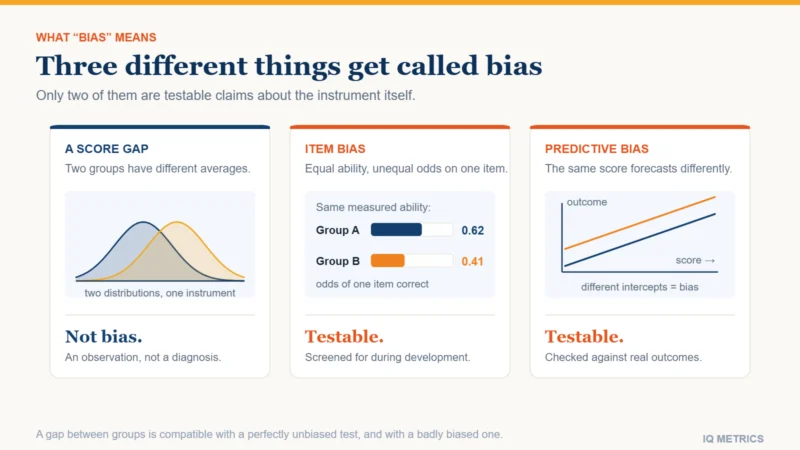
Ask whether IQ tests are culturally biased and you get two confident, opposite answers. Both are partly right, because the word means something far narrower to a psychometrician than it does in ordinary use. Here is what the item-level evidence shows, and where culture really does get into a score.