
Does School Raise IQ? What Natural Experiments Show
Education is the environmental factor with the strongest evidence for actually raising IQ scores, and the effect is bigger than most people expect. Three independent study designs, pooled across more than 600,000 participants, point the same way. Here is the size of it, and the caveat that gets dropped.
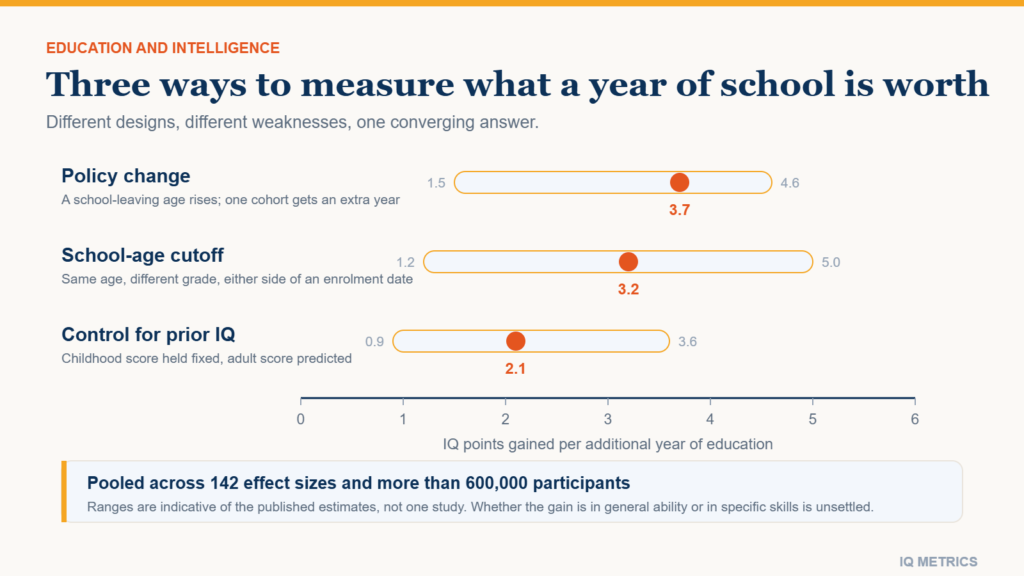
Yes — school raises IQ scores, and the effect is one of the largest and best-identified in the whole environmental literature. The best current estimate comes from a 2018 meta-analysis by Stuart Ritchie and Elliot Tucker-Drob, which pooled 142 effect sizes from over 600,000 participants and found that each additional year of education is associated with a gain of roughly one to five IQ points, with a central estimate of a little over three.
That is a serious number. It is comparable to the gap between the middle of the average band and its upper edge, and it appears to persist rather than fading out in the years after schooling ends. But there is a real caveat about what is being raised, and it does not get repeated nearly often enough. Both halves are below.
Why this question is hard to answer
The obvious problem is that people who stay in education longer were already scoring higher before they got there. Any raw correlation between years of schooling and adult IQ is therefore uninterpretable on its own: it could be schooling raising ability, ability raising schooling, or a third factor driving both. This is the mirror image of the question we cover in whether IQ predicts school success, and the two run in opposite directions.
What makes the modern evidence credible is that researchers stopped relying on correlations and started using natural experiments — situations where something other than the student decided how much schooling they got. Ritchie and Tucker-Drob organised the literature around three such designs:
- Policy change. A country raises its school-leaving age, so one birth cohort gets an extra compulsory year and the cohort just before it does not. Nothing about the students themselves differs systematically.
- School-age cutoff. Children born days either side of an enrolment cutoff are the same age when tested but have had a full extra year of school. Age is held constant while schooling varies.
- Control for earlier intelligence. Take a measured IQ in childhood, then predict adult IQ from years of education while holding the earlier score fixed.
The three designs have completely different weaknesses. That they converge on a similar answer is the reason the finding is taken seriously.
What the natural experiments found
The compulsory schooling studies are the cleanest. A well-known analysis of a Norwegian reform, which added two years to compulsory education and rolled out across municipalities at different times, estimated a gain of roughly 3.7 IQ points per additional year on the military conscription test taken at around age 19. Because the reform arrived at different times in different places, the comparison is close to a clean experiment.
The cutoff studies attack the problem from the other end. A classic Israeli study by Cahan and Cohen compared children within the same grade who differed in age with children of the same age who differed in grade, and found that a year of schooling contributed substantially more to test performance than a year of simply getting older. Later work using the same logic in other countries reached compatible conclusions.
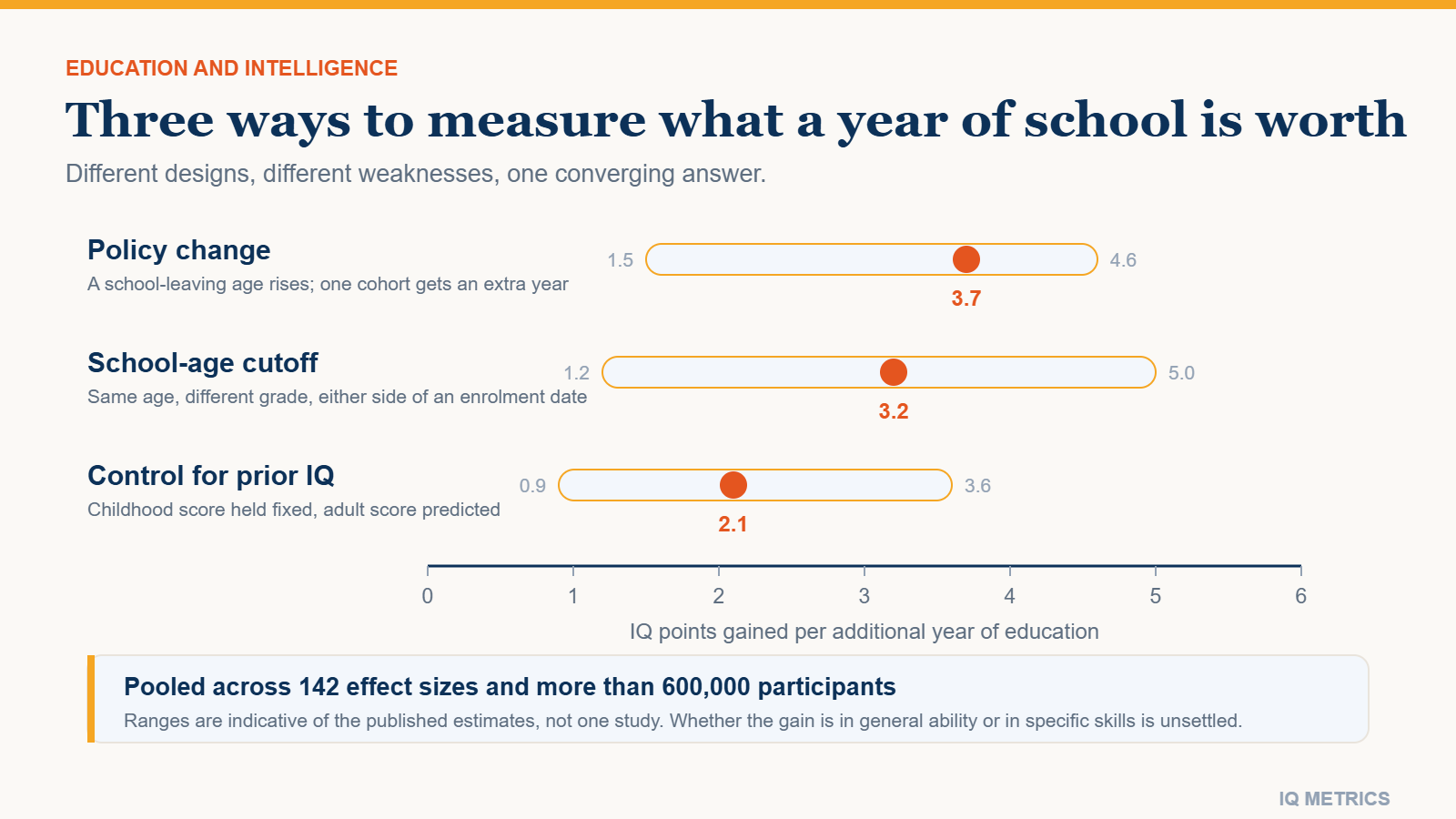
The third design is the weakest of the three but the easiest to run at scale: measure intelligence in childhood, measure it again in adulthood, and ask whether years of education in between predict the adult score once the childhood one is held fixed. It cannot rule out every confound — motivation and family circumstances still differ — but it removes the largest one, and it produced estimates in the same broad range as the other two.
Perhaps the most striking part of the meta-analysis is that the gains did not appear to fade with age. Educational interventions in early childhood have a well-documented fadeout problem — initial score gains shrink over the following years. The schooling effect on adult IQ did not show that pattern in this analysis, which is what makes it unusual.
The caveat: raising scores is not the same as raising g
Here is the part that gets dropped in most summaries. There is good evidence that education raises performance on specific cognitive tests without raising the general factor those tests share. Ritchie, Bates and Deary examined this directly using a Scottish sample with childhood and later-life testing, and found education’s effect concentrated on individual test scores rather than on the underlying general ability that all the tests load on.
In practice that means the honest claim is narrower than the headline. More schooling reliably makes you better at the kinds of tasks tests use — vocabulary, arithmetic, structured reasoning, sustained attention under instruction. Whether it increases some deeper general capacity is genuinely unsettled, and anyone who tells you it is settled in either direction is ahead of the data. Our page on how IQ tests work explains why the distinction between a test score and the general factor matters so much here.
It is worth adding that this is not a debunking. For nearly every practical purpose — qualifications, employment, the day-to-day cognitive demands of adult life — being better at the tasks is what people actually want. The distinction matters for the theory, not usually for the decision.
Where would your own score land?
Take the IIF-certified assessment and get your score with the scale it was measured on, the percentile it corresponds to and the confidence range around it — the three figures most online tests leave out.
Why early-years gains fade but schooling gains do not
There is an apparent contradiction here worth resolving, because it is the most common objection to the whole finding. Intensive early-childhood programmes — the Perry Preschool and Abecedarian projects are the famous examples — reliably produce large IQ gains that then shrink substantially within a few years of school entry. Fadeout of that kind is one of the most replicated results in the education literature. So why would schooling itself behave differently?
The most persuasive reading, argued in John Protzko’s work on fadeout, is that cognitive gains persist roughly as long as the environmental input producing them persists, and decay once it stops. On that account a two-year preschool programme followed by nothing in particular is expected to fade. A decade of compulsory schooling is not a brief intervention at all — it is a sustained one, and the measurement usually happens while it is still running or shortly after it ends.
- Short and intense tends to produce a large gain that shrinks — the classic fadeout curve.
- Long and sustained tends to produce a smaller annual gain that accumulates and holds.
- The outcome measured matters. Several programmes whose IQ advantage faded still showed durable effects on attainment, employment and earnings decades later.
This is an explanation that fits the data rather than a demonstrated mechanism, and it should be held loosely. But it does mean the two literatures are not in conflict, and it points at something useful: continuity of cognitive demand looks more valuable than intensity in a short burst.
How this fits with the heritability evidence
People often read a large schooling effect as evidence against a genetic contribution to intelligence, or the reverse. Neither follows. Heritability is a statistic about the sources of variation in a particular population at a particular time; it places no ceiling on how much an environmental change can move the average. Our article on whether IQ is genetic works through why a high heritability estimate and a large schooling effect are entirely compatible.
The clearest illustration is historical. Average scores rose substantially across the twentieth century in dozens of countries — far too fast for genetic change to be involved — over exactly the period in which mass secondary education spread. Schooling is not the only candidate explanation for that rise, but it is among the strongest.
What this means for you
- If you are still studying: the effect is real and the evidence is unusually good. Staying in education longer is one of very few things with credible causal support behind it.
- If you are past school age: the same logic suggests sustained, structured cognitive demand matters more than brief training. The evidence for short puzzle-app regimes is much weaker, which is what our page on improving your IQ covers.
- If you are interpreting a score: a test measures you as you are now, education included. That is a feature. See how to read an IQ test report for what each number on a report actually represents.
If you want a current benchmark before drawing any conclusions, our free online IQ test scores against age-adjusted norms and takes about twenty minutes. The result will reflect everything that got you here — genetics, health, and quite a lot of schooling.
Keep reading
 Mind & Everyday Life
Why Smart People Make Bad Decisions
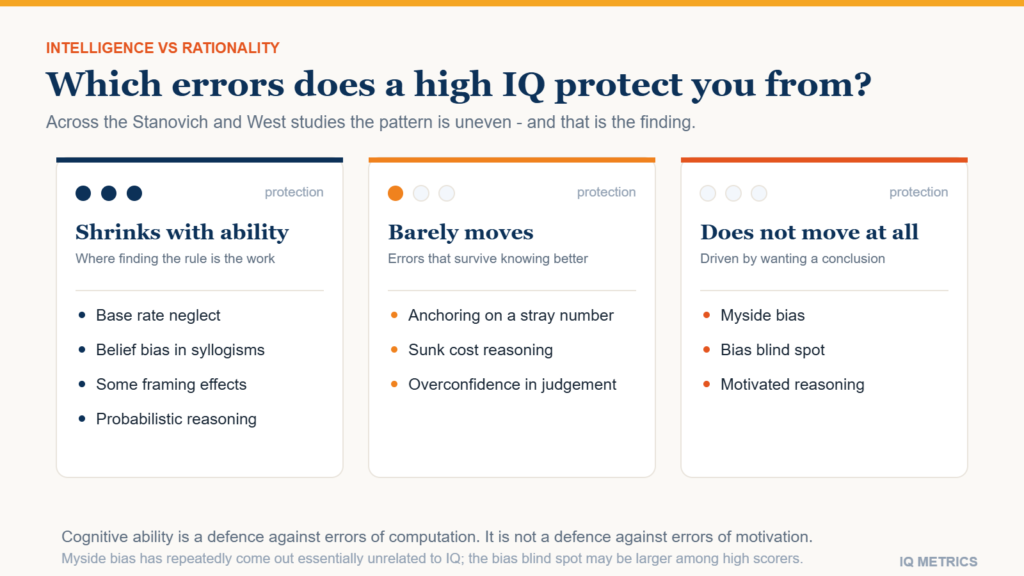
Everyone knows someone brilliant who keeps making terrible calls. That is not a paradox; it is a measurement gap. Intelligence tests and rationality tests load on different things, and several of the best-studied thinking errors turn out to be almost completely independent of how high you score.
 Research & Evidence
Is IQ Genetic?
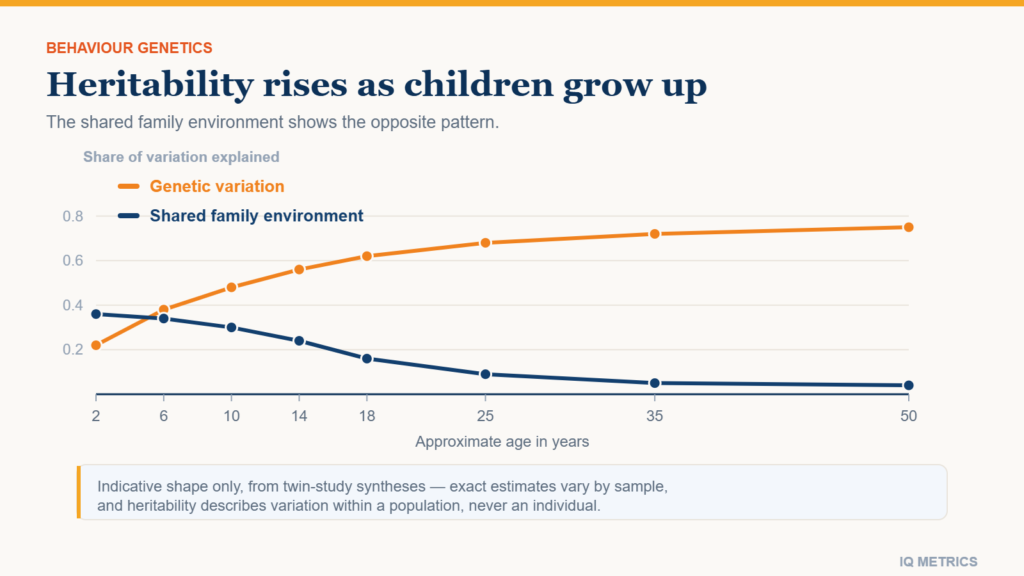
Heritability estimates for IQ rise from roughly 0.4 in childhood to 0.7 or higher in adulthood, which sounds decisive until you know what heritability measures. Here is what twin and adoption studies actually show, and the four conclusions people draw from them that the statistic does not support.
 Research & Evidence
Does IQ Predict School Success?
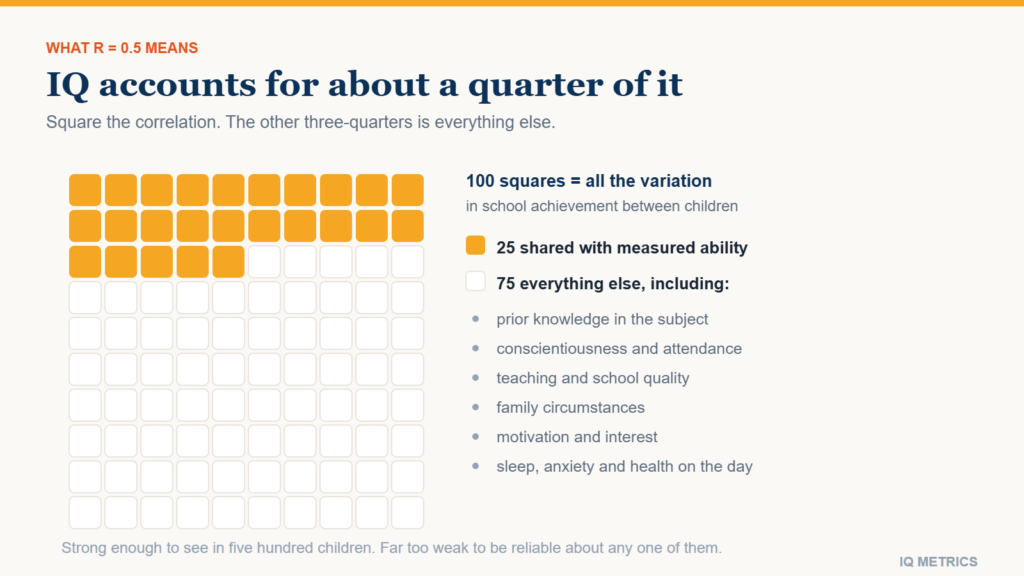
IQ predicts school achievement better than any other single measure psychologists have found, and still leaves roughly three-quarters of the variation unexplained. Both halves of that sentence get ignored by somebody. Here are the actual correlations, what they mean for one child, and what accounts for the rest.