Stereotype Threat: Does It Really Change Test Scores?
Few findings in psychology have been cited as widely, or held up as poorly, as stereotype threat. The original experiments were elegant and the idea is intuitive. Two decades of replication attempts have left a much smaller and more uncertain effect than the textbook version suggests.
Stereotype threat is the proposal that being reminded of a negative stereotype about a group you belong to, immediately before a test that the stereotype concerns, lowers your performance on it. It is one of the most cited ideas in social psychology, it appears in most undergraduate textbooks, and it has had a rougher time in the replication literature than almost any other finding of comparable fame.
Both halves of that sentence deserve equal weight. This article sets out what the original studies found, why the effect is a different thing from test bias, what happened when large pre-registered replications were run, and what a person about to sit a test should reasonably conclude.
What the original experiments showed
The founding studies, published by Claude Steele and Joshua Aronson in 1995, gave university students a set of difficult verbal questions taken from a graduate admissions test. The manipulation was purely in the framing: one group was told the task was diagnostic of verbal ability, another that it was a laboratory exercise in problem solving. The questions themselves were identical.
The reported result was that performance differed by condition in a way that tracked the stereotype the framing made salient. It was a striking demonstration because nothing about the test had changed. If a sentence of instructions could move scores, then a score was partly a product of the situation in which it was collected, not only of the person producing it.
One methodological detail matters for what came later. The headline analyses adjusted for participants prior admissions-test scores. Whether that adjustment is appropriate has been argued about ever since, because it changes the quantity being estimated from “how did the groups score” to “how did they score relative to expectation”. Reasonable people disagree, and the unadjusted contrasts are weaker.
It is not the same thing as a biased test
These two ideas are constantly merged and they make different claims about different objects.
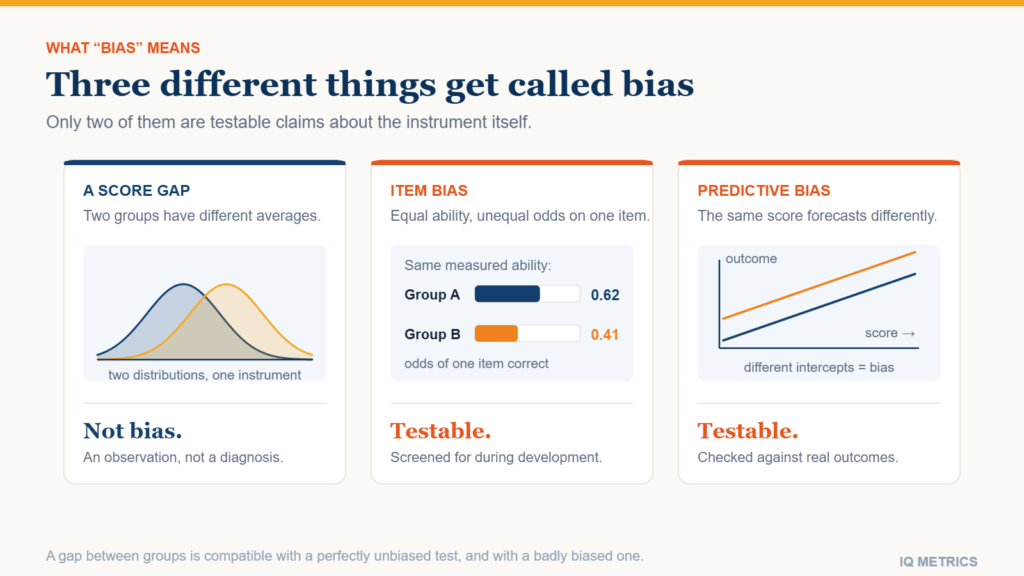
- Test bias is a property of the questions. An item is biased when it draws on knowledge or conventions unevenly distributed across the groups taking it, so the item measures something other than the ability it is supposed to measure. It is detectable by statistical analysis of item functioning, and it is fixed by rewriting or removing items.
- Stereotype threat is a property of the situation. The claim is that identical items yield different scores depending on what is said beforehand. Nothing about the instrument is faulty; the context surrounding its administration is doing the work.
The practical consequence is that they call for different remedies and produce different evidence. The item-level question is covered in cultural bias in IQ tests, which is about content. This article is about framing. Conflating them lets a weak result in one area be used as support in the other.
What replication did to the effect
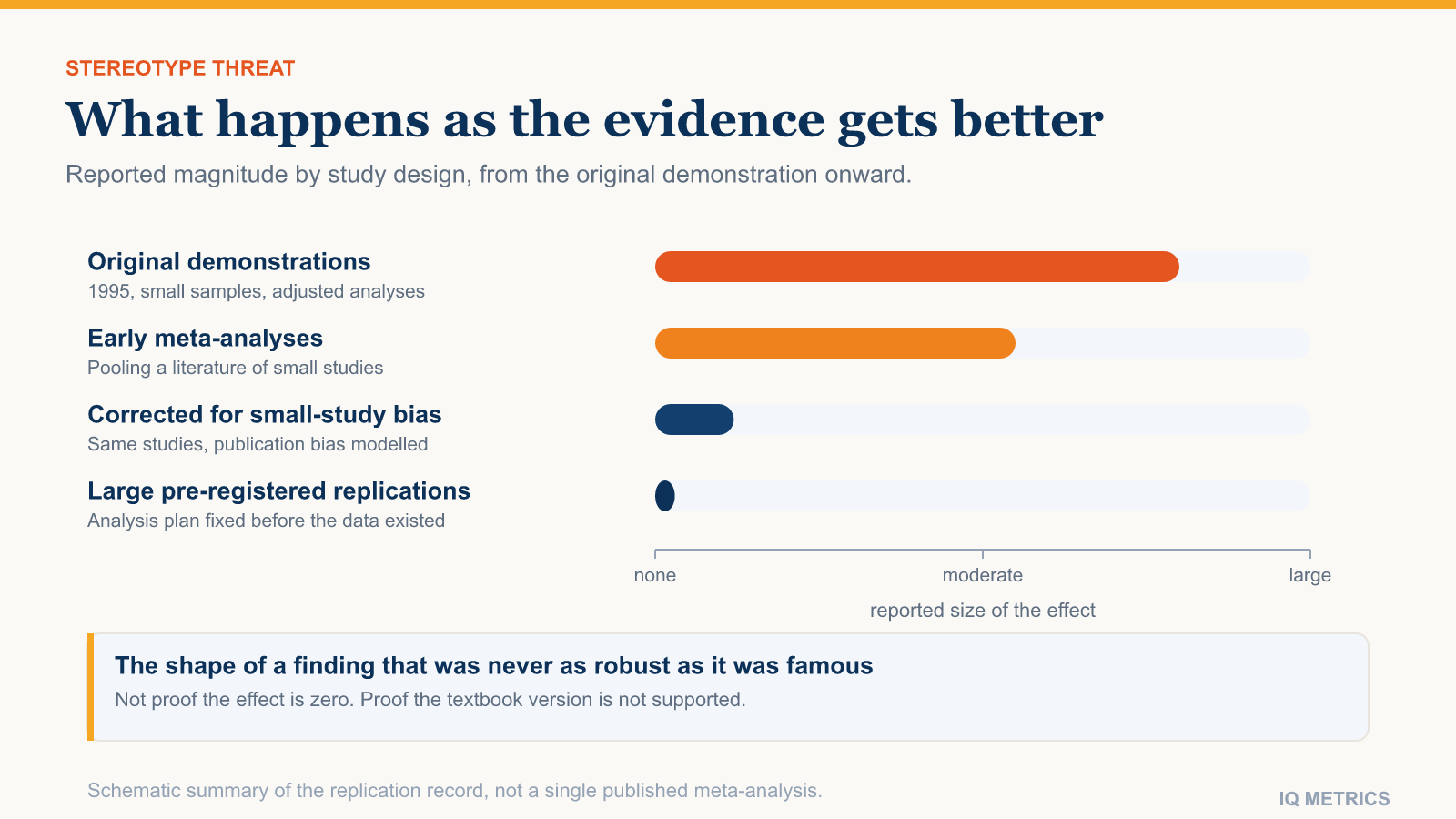
The original result was followed by hundreds of studies, most of them small, and for some years the meta-analytic average looked solid. Then the same scrutiny that reshaped much of social psychology arrived, and it found the usual problems.
- Small-study effects. Meta-analyses of the stereotype-threat literature on mathematics performance in girls found the classic signature of publication bias: small studies reporting large effects, large studies reporting small ones. Correcting for it moved the adjusted estimate close to zero.
- Pre-registered replications came back null. Large studies that fixed the analysis plan in advance, across multiple schools and sizeable samples, have repeatedly failed to find the effect.
- Analytic flexibility was substantial. Whether to covary out prior ability, which subgroups to analyse, and which outcome to treat as primary were all choices made after the data existed in much of the early work.
None of this establishes that the effect is zero. Absence of evidence in a set of replications is not the same as evidence of absence, and it remains possible that the phenomenon is real but requires conditions the replications did not reproduce. What it does establish is that the confident textbook version — a large, robust, easily triggered effect — is not supported.
It is worth noticing what this does and does not change about the underlying questions. Stereotype threat was often invoked to explain observed differences between groups on tests. If the effect is much smaller than claimed, that explanation weakens — but the differences themselves were always a separate empirical matter, with their own large literature and their own unresolved arguments, and nothing about the replication failures settles those. IQ tests and gender differences takes that question on directly. A weak mechanism is not evidence for any particular alternative mechanism.
Where would your own score land?
Take the IIF-certified assessment and get your score with the scale it was measured on, the percentile it corresponds to and the confidence range around it — the three figures most online tests leave out.
The laboratory and the examination hall
Almost all of this evidence comes from short experiments on volunteers, usually students, working through a subset of test items in a room they will leave in half an hour. Whether the effect transfers to a real assessment that matters to the person taking it is a separate empirical question, and it has been studied much less.
There are arguments in both directions and it is worth seeing them set against each other rather than picking one. On one side, a real assessment carries far more consequence, and if evaluative pressure is the mechanism then more consequence should mean more pressure. On the other, a real assessment is usually taken by someone who has prepared for it, in a familiar format, without an experimenter saying anything about groups at all — and the manipulation is precisely what the laboratory studies were adding.
The few attempts to test for the effect in operational admissions and certification data have generally not found it. That is not decisive either, because a field setting cannot control what each candidate is thinking. But it does mean the confident extrapolation from a thirty-minute laboratory task to national examination results was never supported by direct evidence.
The mechanism that still looks plausible
The most credible proposed mechanism is that evaluative pressure consumes working memory. Monitoring your own performance, suppressing an intrusive worry and continuing to reason all compete for the same limited resource, so anything that adds to the monitoring load has less capacity left for the task.
That account is attractive because it does not depend on stereotypes at all. It predicts that any source of evaluative pressure should cost performance, which is a much better-supported claim — and one with a substantial independent literature behind it, covered in test anxiety and IQ scores. On this reading, stereotype threat is a specific and hard-to-reproduce instance of a general effect that is easy to reproduce.
It also explains why the demonstrations were fragile. If the active ingredient is the pressure rather than the stereotype, then the stereotype manipulation only works when it happens to generate enough pressure — which will depend on the sample, the setting, the era and how plausible the framing sounds to the people hearing it.
What this means if you are about to take a test
The practical advice is unchanged by the controversy, because it follows from the well-supported half rather than the contested one.
- Evaluative pressure costs performance. Whatever reduces it — familiarity with the format, an unhurried setting, treating a practice attempt as practice — is worth having.
- Test conditions are part of the measurement. A score collected under pressure and one collected calmly are not interchangeable, which is one reason a single administration deserves less weight than people give it.
- Be sceptical of a single dramatic study, including one you like. The reason this finding was believed for so long is that it was elegant and widely repeated, not that it was robust.
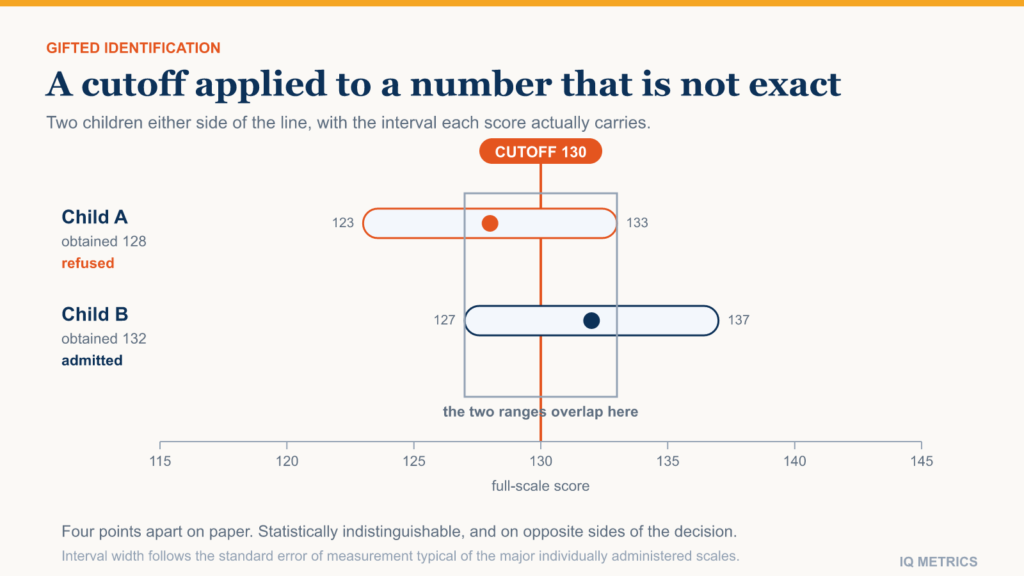
The broader lesson generalises past this one result. A test score is a measurement taken under conditions, and conditions vary. That is also why a threshold applied to a single number does more damage than most people realise, which is the subject of gifted cutoff scores. Where a finding in this field is genuinely contested, this site says so rather than picking the version that reads better.
Keep reading
 Mind & Everyday Life
Test Anxiety and IQ Scores
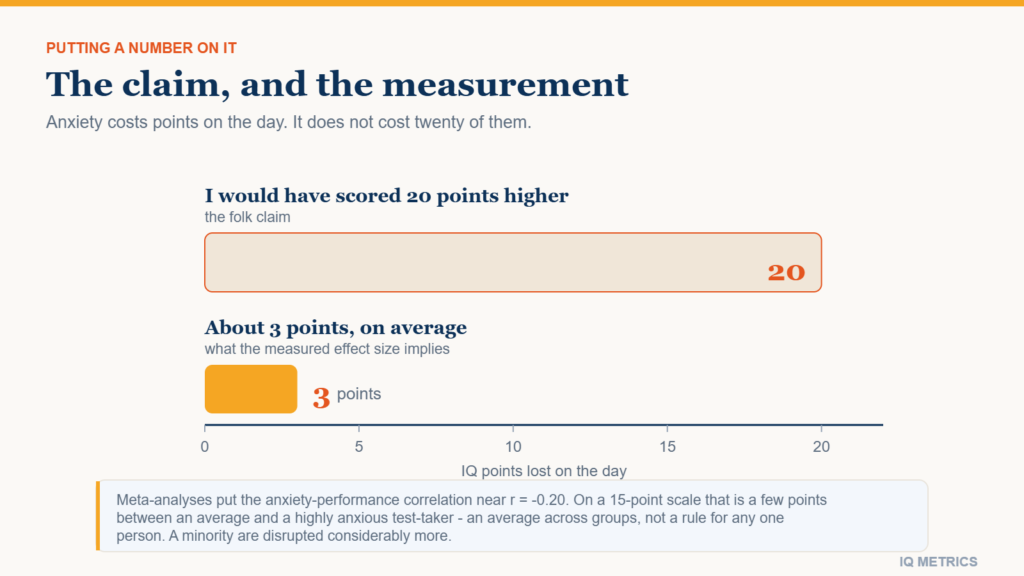
Almost everyone who has had a disappointing result has wondered whether nerves cost them fifteen or twenty points. The evidence says no. Test anxiety and cognitive performance correlate at roughly r = -0.20, which works out to a few points on a 15-point scale. Here is the number, and what it changes.
 Research & Evidence
Cultural Bias in IQ Tests
Ask whether IQ tests are culturally biased and you get two confident, opposite answers. Both are partly right, because the word means something far narrower to a psychometrician than it does in ordinary use. Here is what the item-level evidence shows, and where culture really does get into a score.
 Scores & Scales
Gifted Cutoff Scores
Most gifted programmes draw their line at an IQ of 130. The number is a statistical convention rather than a boundary in nature, and three well-documented features of how the score is produced and used mean a strict cutoff reliably excludes children who belong on the other side of it.