Multiple Intelligences: Why the Theory Never Entered Testing
Gardner’s multiple intelligences theory is one of the most influential ideas in education and almost entirely absent from the tests psychologists use. That gap is not stubbornness. It comes down to one stubborn statistical finding, one missing instrument, and a real insight the theory carries.
Multiple intelligences theory occupies an unusual position: it is one of the best-known ideas in education and one of the least used in psychometrics. Howard Gardner proposed it in Frames of Mind in 1983, it reshaped how a generation of teachers talked about ability, and forty years later no standard cognitive battery measures the eight intelligences. That is not professional stubbornness. There are three specific reasons, and one of them is a finding the theory has to explain and has not.
What Gardner actually proposed
The claim was not that people have different strengths — nobody disputes that. It was that human intelligence is not one capacity but several biologically distinct and largely independent ones, each with its own developmental path and neural substrate. The original seven became eight, with a ninth debated.
- Linguistic — language, rhetoric, writing
- Logical-mathematical — abstraction, proof, quantity
- Spatial — mental rotation, navigation, visual design
- Musical — pitch, rhythm, timbre
- Bodily-kinaesthetic — skilled movement, physical craft
- Interpersonal — reading and influencing other people
- Intrapersonal — accurate self-knowledge
- Naturalistic — recognising and classifying living things
Gardner did not pick these arbitrarily. He set out eight criteria a candidate had to satisfy, including isolation by brain damage, the existence of prodigies and savants in the domain, an identifiable core set of operations, a distinct developmental history and evolutionary plausibility. Two of the eight criteria were psychometric. Those two are where the trouble starts.
The criteria themselves are a genuine methodological contribution, and they are more demanding than most popular summaries suggest. The neuropsychological criterion in particular does real work: amusia, prosopagnosia and specific language impairment are established dissociations, and they are the strongest evidence Gardner has. The difficulty is that a candidate could satisfy six criteria comfortably while failing both psychometric ones, and the theory offers no rule for what to do when that happens. In practice, admission has been decided by argument rather than by a threshold, which is why the count has moved from seven to eight with a ninth perpetually under discussion.
The positive manifold, and why it is the whole argument
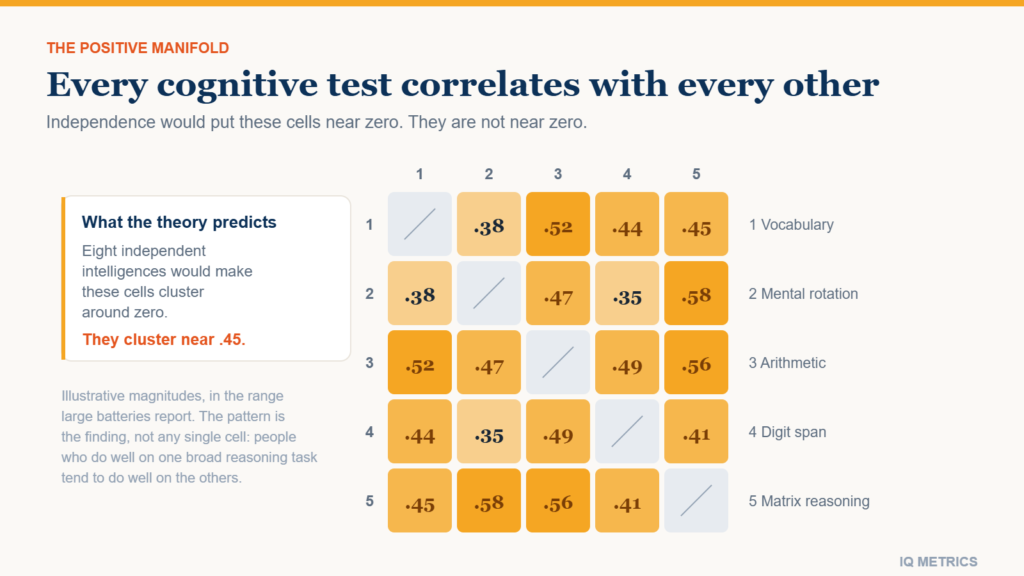
Take any broad set of cognitive tests — vocabulary, mental rotation, arithmetic, digit span, pattern completion — and give them to a large unselected sample. Almost without exception every test correlates positively with every other. People who do well on one tend to do well on the rest. This is the positive manifold, first described by Spearman in 1904, and it is one of the most replicated results in psychology. It is what our note on the g factor describes, and what the hierarchical models behind how modern IQ tests work are built to represent.
Multiple intelligences theory predicts something different. If the intelligences are genuinely independent, then measures of them should be substantially uncorrelated. When researchers have constructed ability-based measures of Gardner’s domains, the correlations keep turning up — and the domains that submit most readily to objective measurement, linguistic, logical-mathematical and spatial, are precisely the ones that load most heavily on the general factor the theory sets out to replace.
The magnitudes matter here. Correlations between broad cognitive domains in large samples typically sit somewhere between 0.3 and 0.7, and a general factor commonly accounts for something in the region of 40 to 50 per cent of the variance in a broad battery. Independence would predict something close to zero. What the data show is neither one intelligence nor eight separate ones, but distinguishable abilities that travel together.
This is not a knockout blow. Gardner’s reply has been that the correlations reflect the narrow, schooled tasks psychometricians choose, and that the domains furthest from the classroom have never been measured properly. That is a coherent objection. It has just not yet produced the data that would settle it.
The measurement gap
Which is the second problem. Gardner has consistently declined to build a battery, on the stated grounds that reducing the intelligences to test scores would repeat the error he was diagnosing. That is a defensible philosophical position with a severe practical cost: a theory that resists operationalisation cannot easily be confirmed either.
The instruments that circulate under the multiple intelligences banner are almost all self-report inventories — a person rates how musical or interpersonal they feel. Self-rated ability correlates only modestly with measured ability across most domains. These questionnaires capture self-concept, which is a real and interesting variable, and not the thing the theory is about. The contrast with the clinical batteries psychologists use, each with published reliability figures and standardisation samples, is stark.
It is worth stating what would settle the argument, because it is not out of reach. Build performance tasks for each of the eight domains — judged musical production, tested spatial navigation, scored social inference, measured motor learning. Administer all of them to one large sample. Factor the results. If eight roughly independent factors appear, the theory is vindicated against the strongest objection to it. If a general factor absorbs most of the shared variance again, it is not. Nobody has run that study at scale, and until somebody does, the disagreement stays where it has been since 1983.
Where would your own score land?
Take the IIF-certified assessment and get your score with the scale it was measured on, the percentile it corresponds to and the confidence range around it — the three figures most online tests leave out.
What the theory gets right
None of the above makes the idea worthless, and the dismissive version of this argument is as sloppy as the credulous one.
Gardner was right that standard batteries sample a narrow slice of human competence. A test that predicts school achievement well is not thereby a measure of everything valuable about a mind. Musical skill, athletic judgment, social perception and craft ability are genuine, developable and largely unmeasured — and the fact that they may correlate with g does not mean they reduce to it. He was also right that the label attached to a child changes what is expected of that child, which is a real cost of testing set out in the case for and against IQ testing.
There is a second thing it gets right, less often credited. A general factor is a statistical abstraction extracted from a correlation matrix, not an organ or a substance. It is easy to slide from “a general factor explains much of the shared variance” to “there is a single quantity of intelligence that people possess in amounts”, and the second claim does not follow from the first. Gardner pushed hard against that slide, and he was right to.
That insight has an established home in the literature. It is the subject of whether intelligence is limited to IQ, it drives the research on IQ and creativity, and it is why the site treats a score as one input rather than a verdict.
Multiple intelligences, EQ and the triarchic theory
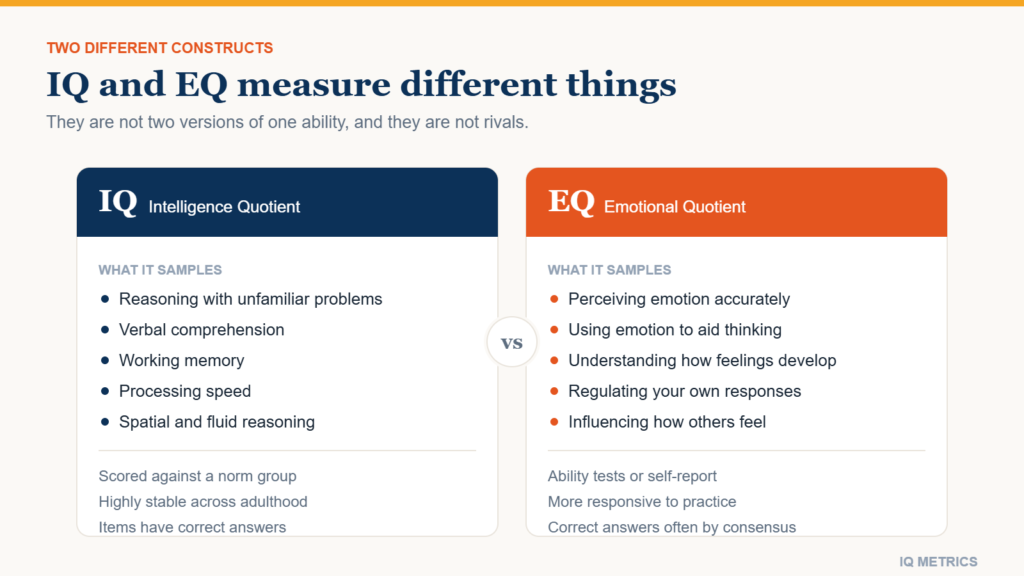
Gardner’s is not the only rival. Sternberg’s triarchic theory proposed analytical, creative and practical intelligence, and made more effort to measure its constructs; its practical intelligence component remains contested on whether it adds predictive power beyond g. Emotional intelligence covers similar ground to Gardner’s interpersonal and intrapersonal domains, with the same recurring split between ability-based tests and self-report questionnaires that the comparison of IQ and EQ sets out.
What psychometrics adopted instead was the Cattell-Horn-Carroll model, which resolves the tension a third way: many distinct broad abilities, arranged in a hierarchy, with a general factor above them. It gets the plurality Gardner wanted and keeps the correlations the data insist on.
Why it conquered classrooms anyway
The theory spread for reasons largely independent of its evidential status. It arrived when single-number labelling of children was under sustained criticism. It is egalitarian in a way a single ranking cannot be: every child is intelligent in some way. And it is easy to convert into activities.
That last quality is also how it went wrong. Multiple intelligences is routinely conflated with learning styles — the idea that a kinaesthetic learner should be taught kinaesthetically — and Gardner has publicly and repeatedly rejected the conflation. His intelligences are content domains, not delivery channels. The meshing claim is one of the brain myths that failed when tested directly.
How to use the idea honestly
- Treat it as a corrective, not a measurement system. It is a good argument about what tests leave out and a poor basis for profiling anyone.
- Distrust any multiple intelligences profile you were given. If it came from a questionnaire about preferences, it measured preferences.
- Keep the two claims separate. That people have uneven strengths is certain; that those strengths are independent intelligences is the contested part.
If you want a number that is defined, normed and reported with its error band rather than a profile of eight, that is what a properly constructed IQ test is for — and knowing exactly what it does not cover is the most useful thing Gardner leaves you with.
Keep reading
 Understanding IQ
Brain Myths About Intelligence
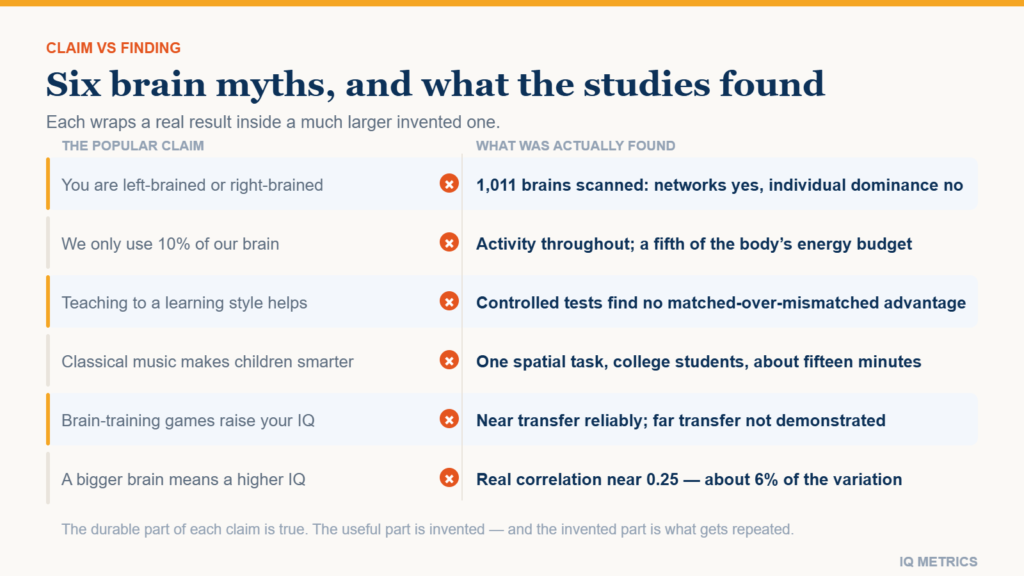
You are not left-brained or right-brained, you do not use ten per cent of your brain, and matching a lesson to your learning style does not help you learn. Six claims about intelligence that almost everyone repeats, what the studies that tested them found, and the smaller true fact hiding inside each one.
 Understanding IQ
Is Intelligence limited to IQ?
As we explore the fascinating world of intelligence, we will uncover the truth about IQ and the limitations of the human intellect. Beyond traditional measures of intellect, this article explores a wider range of aptitudes that impact our perception and engagement with the natural world.
 Mind & Everyday Life
IQ vs EQ
IQ measures reasoning; EQ measures how well you read and manage emotion. They are different constructs, measured in different ways, with different amounts of evidence behind them. Here is what each one actually predicts, which is easier to change, and where the popular claim that EQ matters more comes from.