





Does Intelligence Stop Predicting Creativity Above IQ 120?
The threshold hypothesis says IQ and creativity move together up to about 120 and barely at all above it. It is a real claim with a real number, and modern re-analyses have weakened it. Here is what the segmented-regression work found, why the two kinds of task differ, and why measurement noise matters.

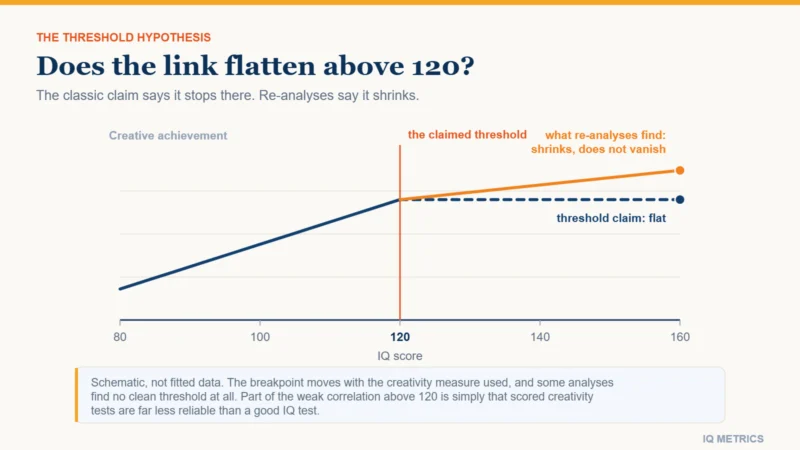
It fades, but it does not stop. IQ and creativity correlate positively but modestly across ordinary score ranges, and the relationship may well weaken somewhere in the 110 to 130 band. What it does not appear to do, on the best modern evidence, is switch off: the correlation shrinks rather than vanishing, and where it starts shrinking moves with the creativity measure you use.
Two things make the question stubborn. Creative tasks ask the mind for a different operation than a reasoning item does, and the instruments that score them are far noisier than an IQ test.
The threshold hypothesis, stated as a number
The claim is most often associated with Ellis Paul Torrance, though J. P. Guilford and others in the same 1960s literature advanced versions of it too. Stated plainly: intelligence is necessary but not sufficient for creative performance, so below roughly IQ 120 more measured ability tends to mean more creative output, and above that point extra points buy little or nothing.
There is nothing magical about 120 itself. On a scale with a mean of 100 and a standard deviation of 15, a score of 120 sits just above the 90th percentile, so about nine people in a hundred score higher. Where it falls on the IQ bell curve makes the point better than a sentence can, and the percentile calculator will place any other score beside it.
So the threshold, if it exists, sits at the edge of the top decile, not out among the rare scores. That matters: a claim about the top ten percent is testable in ordinary samples; a claim about the top tenth of one percent is not. Our piece on what a score of 120 actually means covers the everyday side.
- Below the line: a clearly positive correlation between measured intelligence and scored creativity, steep enough to see in a scatter plot. For reference, meta-analytic summaries put the correlation across the whole score range at roughly 0.2, with individual estimates scattered widely on either side of it.
- Above the line: a correlation close to zero, so that two people scoring 125 and 145 ought to be indistinguishable on creative measures.
- A visible kink: a scatter plot whose slope changes at a particular score, not a straight line that merely drifts.
What happened when the claim was re-tested
The threshold hypothesis is unusually easy to test, because it makes a geometric prediction. Fit one line to the data and it should fit badly. Fit two lines joined at a breakpoint estimated from the data itself — segmented, or piecewise, regression — and the second line should come out flat. Several groups have done exactly that, on Torrance-style divergent-thinking batteries and on fresh community samples.
The results have been mixed. Some analyses do recover a breakpoint, but its location moves with the scoring rule rather than sitting at 120: estimates have landed in the mid-80s for simple idea fluency, near 100 for originality scored across all responses, and close to 120 only when originality was judged on a person's best ideas alone. The confidence intervals around those estimates are usually wide.
Other analyses find that a single straight line describes the data about as well as two do, which is precisely what the hypothesis says should not happen. A bend only some analysts can find, at a score that moves with the marking scheme, is a weak bend.
Longitudinal work on people far above the threshold cuts against it too. In samples selected in adolescence for very high mathematical or verbal ability, differences within that already-elite group still predicted patents, publications and creative accomplishment decades later. If ability stopped mattering above 120, those differences should have washed out. They did not.
Something does visibly change in the upper range, though, and the competing explanations are unglamorous.
- Range restriction. Correlations shrink automatically when you slice the bottom off a distribution, whether or not the underlying relationship changed.
- Ceiling effects. Many creativity tasks are short and easily maxed out, so strong performers pile up at the top and the spread a correlation feeds on disappears.
- Sampling. Gifted-programme and selective-university cohorts supply most above-threshold data, and they are selected on close to the very variable under study.
Two operations: divergent and convergent thinking
The argument also refuses to settle because creativity tests do not all ask for the same thing. Two families of task dominate the literature, they behave differently against IQ, and the quickest way to see why is to imagine sitting them.
The alternate uses task
You are handed a common object — a brick, a paperclip, a newspaper — and asked to list as many uses for it as you can in a few minutes. Responses are scored on fluency (how many), flexibility (how many categories), originality (how rare the answer is against a reference sample) and elaboration. A doorstop counts. So does grinding the brick down for pigment. There is no key at the back of the book.
The remote associates task
Here you get three words — cottage, Swiss, cake — and have to find the fourth that links all three. The answer is cheese, and once you see it, it is plainly right. That single defensible answer makes the task behave much more like a reasoning item, and its correlations with general intelligence tend to run higher than those of alternate-uses scores. The word creativity is covering two rather different measurements.
Where would your own score land?
Take the IIF-certified assessment and get your score with the scale it was measured on, the percentile it corresponds to and the confidence range around it — the three figures most online tests leave out.
Find your IQ score now! →How that compares with what an IQ test asks
A matrix-reasoning item shows a three-by-three grid of shapes with the bottom right cell missing and six or eight candidates underneath; exactly one completes the rule governing the rows and columns. A number-series item gives 2, 6, 12, 20 and wants 30, because the gaps grow by two each time. In both cases the correct response can be argued from the stimulus alone, which is what makes it scorable; the mechanics are covered in how IQ tests work.
Set that beside the brick. Two competent scorers marking matrix items agree on essentially every response; two scorers marking originality will not, unless both consult the same frequency table from the same reference population. That disagreement is not sloppiness. It is built into what is being measured.
Ability, output, and the ingredients that are not cognitive
A test measures what somebody can produce in a few minutes under instruction. A creative career measures what they finished, showed to other people, defended against criticism and kept doing after the first rejection. Related quantities, certainly — but nobody should expect them to track each other tightly.
Among the non-cognitive ingredients, openness to experience is the trait most consistently linked with creative achievement, in many studies at least as strongly as measured ability is. Persistence and sheer accumulated hours inside a domain do comparable work. Our comparison of IQ and personality sets them side by side.
The broader question — what else has a claim on the word intelligence — is treated in is intelligence limited to IQ. This page is narrower and more checkable: whether one number stops tracking another above a particular value.
The reliability problem, which is the strongest argument here
Any correlation between two measures is capped by how reliably each is measured. A well-constructed supervised IQ test typically reports test-retest reliability at or above 0.90, so somebody who sits it twice lands in close to the same place. Scored creativity batteries do considerably worse, and much less consistently: depending on the task, the scoring scheme and the interval between sittings, reported retest figures run from roughly 0.5 to roughly 0.8, and no single value describes them.
The consequence is arithmetic rather than philosophical. When one of your two variables is noisy, the observed correlation is dragged toward zero even where the true relationship is strong. Part of the modest link reported between intelligence and creativity is therefore a fact about instruments rather than about minds. Statisticians call the adjustment correcting for attenuation; applying it raises the estimates, though it produces a projection of what a perfect instrument would have found rather than a fresh measurement.
This cuts in more than one direction. Noise on its own would blur the relationship everywhere rather than bend it at one particular score, so unreliability alone is not the whole story. It is not a defence of the threshold either: a ceiling on the creativity measure, of the kind described above, produces something that looks very like a kink.
What poor reliability does guarantee is that no relationship above 120 and a real relationship too faint for a blunt instrument to detect look identical in a scatter plot. Our page on IQ test accuracy sets out the error bars a single score carries.
So what does a score above 120 say about creative potential?
Less than the number's precision implies, and more than nothing. The defensible reading is that intelligence behaves like a resource with diminishing returns for creative work: useful throughout, most decisive at the lower end of the range, and progressively outweighed further up by interest, temperament, opportunity and hours on task.
The threshold hypothesis survives as a rough description rather than a law with a fixed value. Estimates vary, breakpoints move with the measure, and several careful analyses find no clean elbow anywhere in the data. Treat 120 as a landmark in a conversation, not as a gate.
If a result put you near that band, the useful next step is unhurried: sit a properly timed IQ test under decent conditions and read the score with its error bar attached. It will tell you something real about reasoning and pattern work. What it cannot tell you is where you land relative to its own slope once temperament, interest and hours in a domain have had their say.
Keep reading
All articles → Understanding IQ
Is Intelligence limited to IQ?
As we explore the fascinating world of intelligence, we will uncover the truth about IQ and the limitations of the human intellect. Beyond traditional measures of intellect, this article explores a wider range of aptitudes that impact our perception and engagement with the natural world.
 Mind & Everyday Life
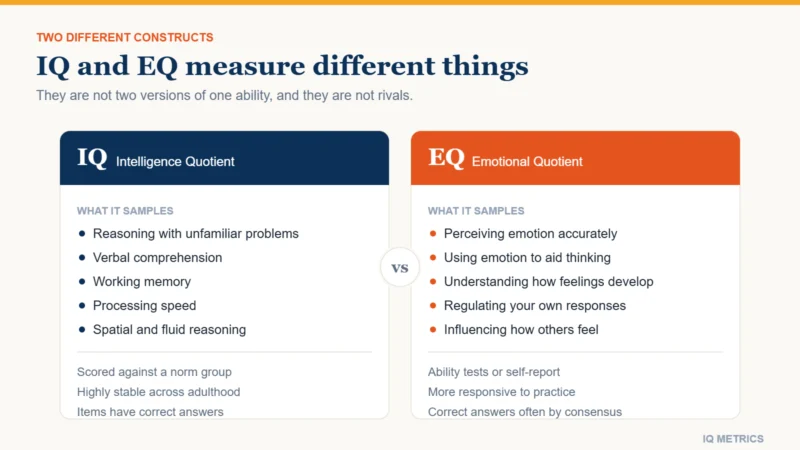
IQ vs EQ
IQ measures reasoning; EQ measures how well you read and manage emotion. They are different constructs, measured in different ways, with different amounts of evidence behind them. Here is what each one actually predicts, which is easier to change, and where the popular claim that EQ matters more comes from.
 Mind & Everyday Life
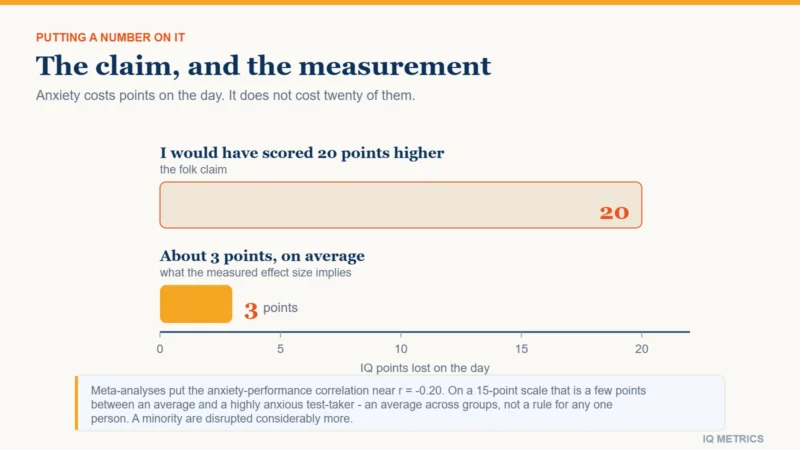
Test Anxiety and IQ Scores
Almost everyone who has had a disappointing result has wondered whether nerves cost them fifteen or twenty points. The evidence says no. Test anxiety and cognitive performance correlate at roughly r = -0.20, which works out to a few points on a 15-point scale. Here is the number, and what it changes.