
How ADHD, Autism and Dyslexia Change What an IQ Test Measures
A test score is a measurement, and a measurement can be biased by the conditions under which it is taken. ADHD, autism and dyslexia each depress performance on particular kinds of item without lowering the reasoning underneath. Here is what actually interferes, condition by condition, and what to do next.
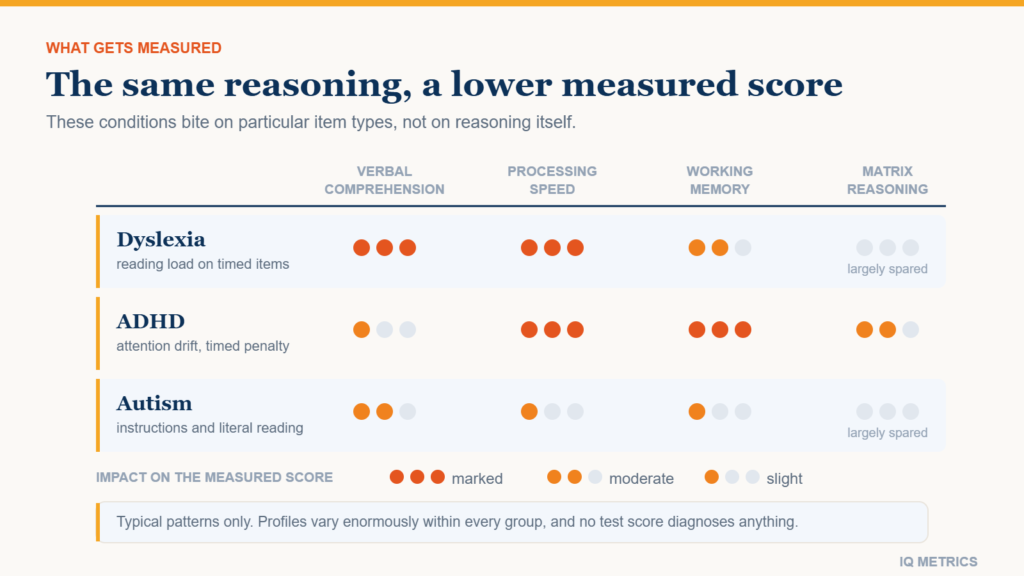
If you have ADHD, autism or dyslexia, a score from a timed online test is not meaningless, but for many people it reads lower than their reasoning does. ADHD and IQ test scores interact through the format rather than through intelligence: attention, reading load and the clock all sit between your thinking and the number at the end. What follows names the mechanism for each condition, and what to do about it.
This site publishes tests and explains scores; it has no clinical standing, and nothing here is diagnosis or medical advice. No IQ score, and least of all an unproctored online one, can indicate or rule out ADHD, autism or dyslexia. A qualified assessor is the only route to that answer.
A Depressed Score Is Not a Lower Ability
Much of what is written about neurodevelopmental conditions and testing quietly folds two different claims into one. The first is that measured composites in these groups often come out lower than in comparison samples. For ADHD and dyslexia that is a reasonably consistent finding; for autism it depends heavily on which test was used and how the sample was recruited.
The second claim is that these groups reason less well. That does not follow from the first. A test score is a measurement, and any measurement can be distorted by the conditions under which it is taken. It is more precise to say the score is depressed than that the ability is lower.
A bathroom scale on a thick carpet reads wrong; the reading changed, the weight did not. Much of what these three conditions do to a test result is carpet.
Ordinary test-day variables work the same way; the same person can land several points apart across a fortnight. Our longer piece on the factors that affect IQ test results covers sleep, anxiety, caffeine and practice. The difference is that these three conditions are stable features of how you process information, not the state you turned up in.
Where the Interference Actually Lands
A modern battery is not one thing. It samples several fairly distinct abilities and averages them into a single composite, and interference rarely hits all of them equally. It lands hard on one or two, and the composite carries the damage without saying so.
- Verbal comprehension – vocabulary, similarities, general knowledge; all of it delivered in written language.
- Fluid reasoning – matrices and number series, the part closest to raw pattern-finding.
- Working memory – holding material in mind and manipulating it while you use it.
- Processing speed – how quickly you get through easy items, not how hard the items are.
This is exactly why a profile beats a composite, and why the index-by-index breakdown produced by professionally administered tests is worth far more to a reader in this position than the headline figure.
Dyslexia: The Reading Load Hidden Inside the Test
Dyslexia is a difficulty with accurate or fluent word recognition, decoding and spelling, neurobiological in origin and not explained by a lack of instruction. On a test it lands in two predictable places. Verbal comprehension items have to be read, and so do the instructions and the answer options.
Processing-speed items are trivially easy in content and hard to finish. On a professional battery they use symbols rather than words, and are still often lower in dyslexic profiles because naming things quickly is part of what they measure. On an online test the speeded items are usually words and sentences, which puts the reading load back on top of the clock.
Fluid reasoning typically holds. A dyslexic reader who grinds through a vocabulary section will often complete matrix items at roughly the level the rest of their profile predicts, because a matrix does not have to be read. The composite then averages one fair estimate with one depressed estimate and understates the reasoning.
How large that gap gets varies from person to person, and a gap is not automatically meaningful on its own. The companion piece on verbal and non-verbal score splits covers when a difference between two indexes is big enough to interpret at all.
ADHD and IQ Test Scores: Inconsistency, Not a Lower Ceiling
The characteristic pattern for ADHD on a test is not uniformly weaker performance. It is variability. The same person can solve a hard matrix item in seconds and then miss three easy ones in the block that follows, and where in the session an item fell can matter more than how hard it was.
Three separate things cost points here, and they are worth keeping apart because they respond to different fixes.
- Time pressure. A per-item or whole-test clock converts a slow start into lost items, even when the reasoning would have arrived a few seconds later.
- Sustained-attention drift. Dozens of near-identical matrix puzzles in a row is close to a worst case: low novelty, no feedback, and wrong answers that feel exactly like right ones.
- Working-memory load. Items that require holding several constraints at once are harder to finish when the holding itself takes effort.
That last one is worth holding apart from reasoning itself: the two are related but not interchangeable, and someone can have a genuinely low working-memory index and strong fluid reasoning at the same time. An item that loads both is limited by the weaker of the two.
Sleep and time of day move ADHD test performance, and so can where someone is in their usual routine on the day. That is another reason to treat one sitting as a single sample rather than a verdict, and to be sceptical of any score taken at the end of a long day.
Where would your own score land?
Take the IIF-certified assessment and get your score with the scale it was measured on, the percentile it corresponds to and the confidence range around it — the three figures most online tests leave out.
Autism: Uneven Profiles and Confounded Instructions
There is no autistic IQ profile. Autistic people cover the entire measured range, and the variation inside the group is far larger than any average difference between it and everyone else. Anything that describes one shape of profile as typical is describing a subset and calling it a population.
One pattern does show up often enough to be worth naming: a split between verbal and perceptual performance, running in either direction. Some autistic people score markedly higher on matrix reasoning than on verbal subtests, particularly where verbal items reward conventional usage; others show the reverse.
The larger measurement problem is often the wrapper rather than the item. Instructions written loosely can be read literally and answered correctly by their own logic. Asking which one does not belong has several defensible answers, and an item lost that way costs the same as an item nobody could solve. The score cannot tell the two apart.
Conditions matter too. An unfamiliar room, harsh lighting, the social weight of being watched while you think: none of that is reasoning, and all of it can move a number.
What an Online Screener Does to These Profiles
An unproctored online test has no way to accommodate anyone. It cannot verify a diagnosis, grant extra time, offer a quiet room, read an item aloud, or notice that you stopped concentrating twenty minutes ago. It records what happened and scores it.
Format still changes the size of the problem. A timed IQ test stacks the effects above into their worst configuration: a speed penalty, no way back from a slow opening, and a hard stop that arrives whether or not you were nearly there.
If the clock is your main obstacle, the untimed classical format is a fairer instrument for you. If reading load is the obstacle, a culture-fair test built from figures rather than sentences takes most of the language out from between you and the item. Neither is a formal accommodation; each just removes one confound.
Accommodations, and Who Can Authorise Them
Formal assessment does have answers to all of this, and they are unglamorous rather than clever.
- Extended time, commonly one and a half times the standard limit, sometimes double.
- Scheduled breaks between subtests, or the session split across more than one day.
- A separate quiet room, with the examiner present and nobody else.
- Untimed administration of subtests where speed is not the ability being measured, reported alongside the standard scoring rather than in place of it.
- Items read aloud, or answers given orally rather than written.
None of that is self-service, which is the practical point most articles skip. Accommodations are authorised by whoever owns the assessment: a qualified psychologist for a clinical evaluation, a school’s special educational needs process for a child being tested, a university disability service, or an employer’s occupational-health route at work. Each normally wants documentation first, which is one more reason a screener result cannot start the process.
If You Think Your Score Is an Underestimate
Start by treating the number as information about a sitting rather than about you. Which sections felt bad, and why? Running out of clock, losing the thread halfway through a block, and reading the same sentence four times are three different failures, each pointing at a different index dragging the composite down.
Then take the test again in a format that removes the thing you identified, and compare. Two scores with a known difference between the conditions that produced them tell you more than one score of any size, and that comparison is the closest thing to self-accommodation a free screener can offer.
If a defensible number actually matters — for a school placement, an accommodation request, an assessment — an online result will not do that job. What a free online IQ test gives you is a rough bearing and, taken twice under deliberately different conditions, a sense of how much of your score is about the format rather than your reasoning.
Keep reading
 Scores & Scales
Verbal vs Non-Verbal IQ Scores
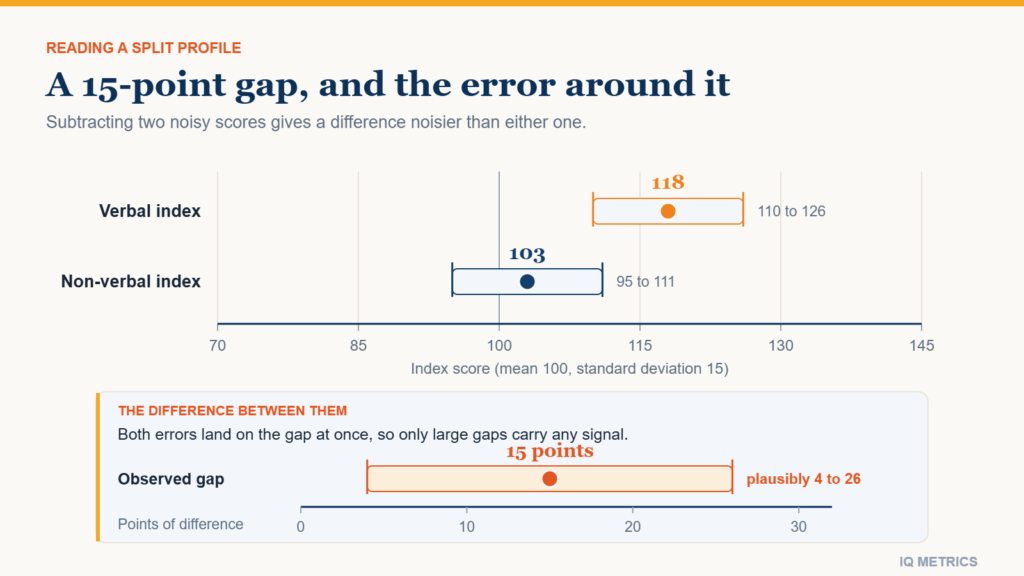
Two people can hold the same IQ number and have completely different profiles, and a split between the verbal and non-verbal indexes is far commoner than most test-takers expect. Here is what base-rate tables and compounding measurement error say about how large a gap has to be before it means anything.
 Research & Evidence
What are the Factors that Affect the Results of an IQ Test?
When you take an IQ test, do you ever find yourself wondering why certain people do better than others? It turns out that your IQ can be affected by a lot of different things. Discover the hidden meaning of these characteristics and how they affect your intelligence in this essay
 Taking a Test
Professional IQ Tests
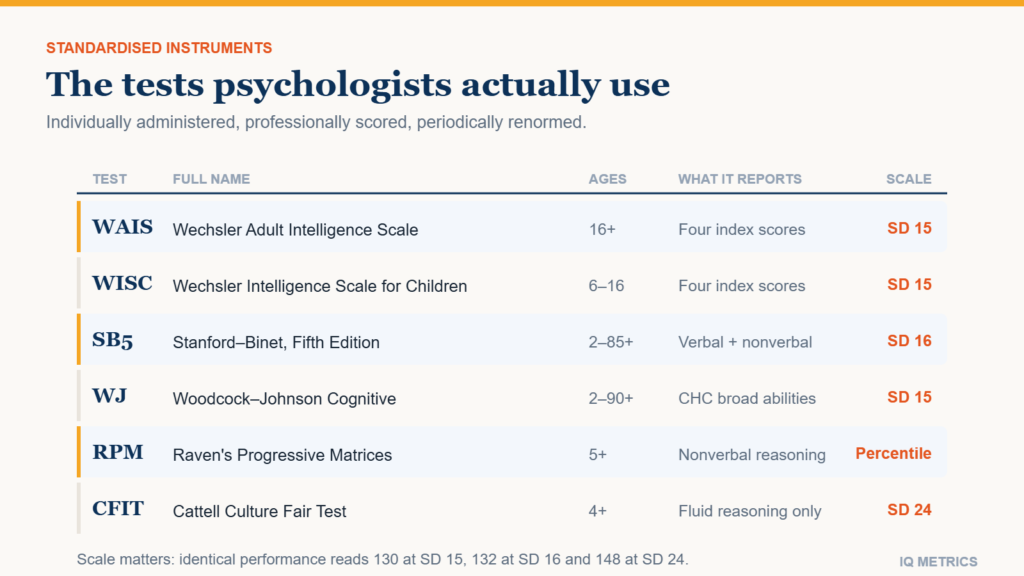
When a psychologist measures intelligence, they reach for one of a small number of standardised instruments. This guide covers what the Wechsler scales, Stanford-Binet, Woodcock-Johnson and Raven’s Progressive Matrices each measure, who each one is for, and where an online test genuinely fits.