



Education & Testing
Admissions exams, gifted programs, national score reports and school testing policy, explained without the spin from either side.

SSAT Percentile Chart 2026-27: Scores by Grade and the IQ Question
The SSAT percentile is a rank among first-time takers in the same grade, not a mark out of 100. In the 2026-27 guide a grade 8 student needs a total of about 2013 of 2400 for the 50th percentile and 2343 for the 99th. The test does not claim to measure IQ.

i-Ready Scores by Grade Level: The Official 2026-27 Chart and What It Means
The score runs from 100 to 800 and means something only against a child's grade: Grade 4 math is on grade at 465 to 526. The publisher prints its table as pictures, which is why online charts disagree, and the same score is a different percentile in fall and spring.

Iowa Assessment Scores Explained: Percentiles, Standard Scores, 2024 Norms
There is no single good Iowa score. Riverside Insights made its 2024 norms the default in 2025, the standard score has no mean of 100, and the two gifted rules we could check, a Wisconsin district's and the Davidson Institute's, are not 99th percentiles.

What Is a Good MAP Growth Score? 2025 Norms and the IQ Question
There is no single good MAP score: NWEA's 2025 norms put the fifth-grade fall median at RIT 206 in math and 204 in reading. Its tables show the median fell about 2.6 points since 2020, while the 95th-percentile bar barely moved.

What Is a Good TARA Score? Percentiles, Conversion and Results Date
UAT-UK sets no pass mark and publishes no raw-to-scaled calculator. Its technical report gives the 25th, 50th, 75th and 90th percentiles for 2,626 candidates, medians of 4.0 and 4.7 on a 1 to 9 scale and a standard error of about one point; October 2026 results arrive on 16 November.

National Merit 2027 Cutoffs: What 208 to 223 Mean in Percentiles and IQ
NMSC named more than 16,000 Semifinalists on 9 September 2026, under 1% of U.S. seniors. A prep firm puts state cutoffs between 208 and 223 on the Selection Index, which maps to totals near 1380 to 1490 and, as an expected IQ, to roughly 129 give or take 11.
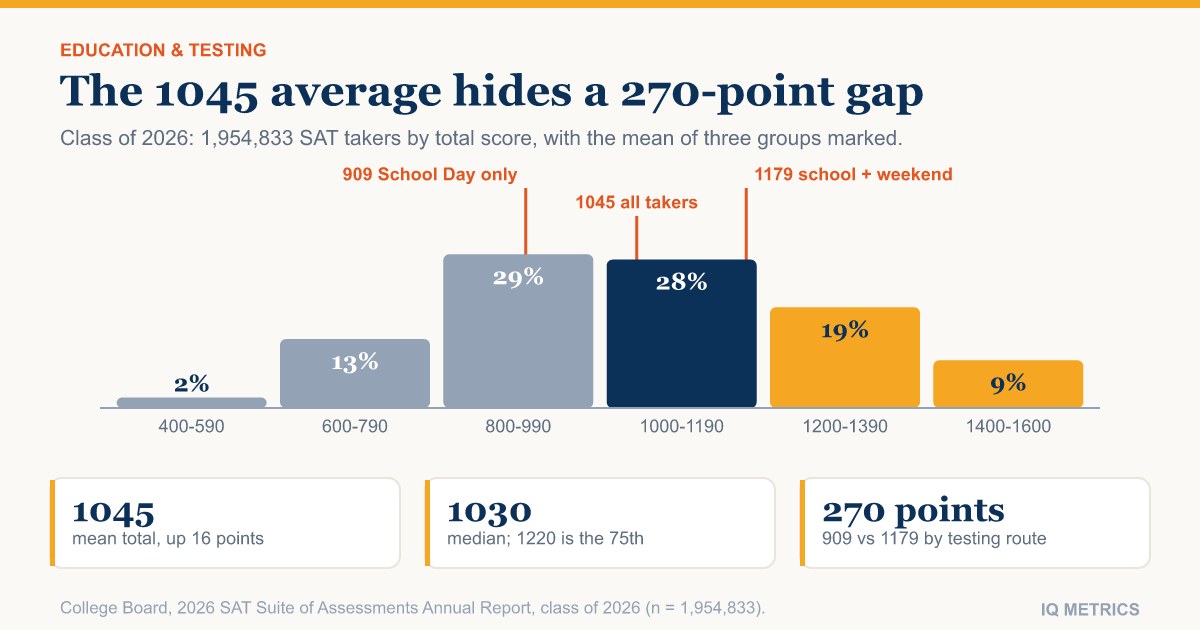
SAT Scores for the Class of 2026: What the 1045 Average Means
The College Board reports a mean of 1045 for 1,954,833 test takers, 16 points up on last year. The median is 1030, and two groups of takers sit 270 points apart, so the headline average reflects who sits the test as well as how well they do.
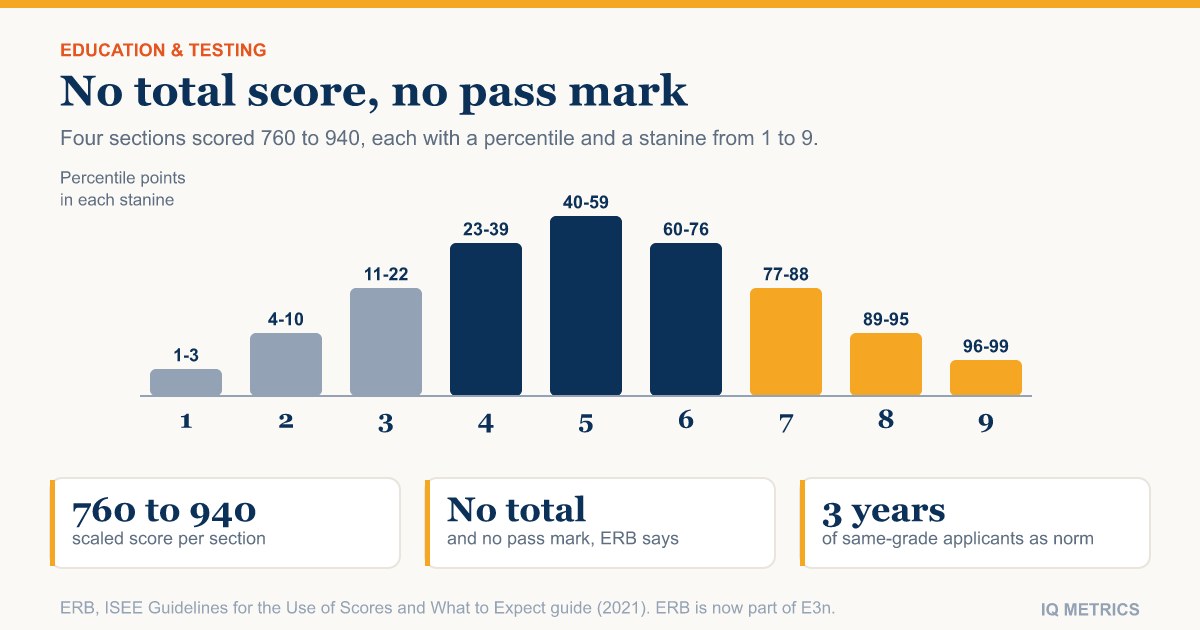
ISEE Scores Explained: Scaled Scores, Stanines and the IQ Question
The ISEE reports four section scores of 760 to 940, a percentile and a stanine for each, and no total or pass mark. Its maker never calls it an IQ test, and its percentiles compare a child with other private-school applicants.

UCAT Scores Explained: Deciles, Bands and the IQ Question
The 2025 mean total was 1891 out of 2,700 and the 2026 preliminary mean is 1970, but no source converts a UCAT score to IQ. The Consortium's own table puts a total of 2100 at the 80th percentile of applicants.
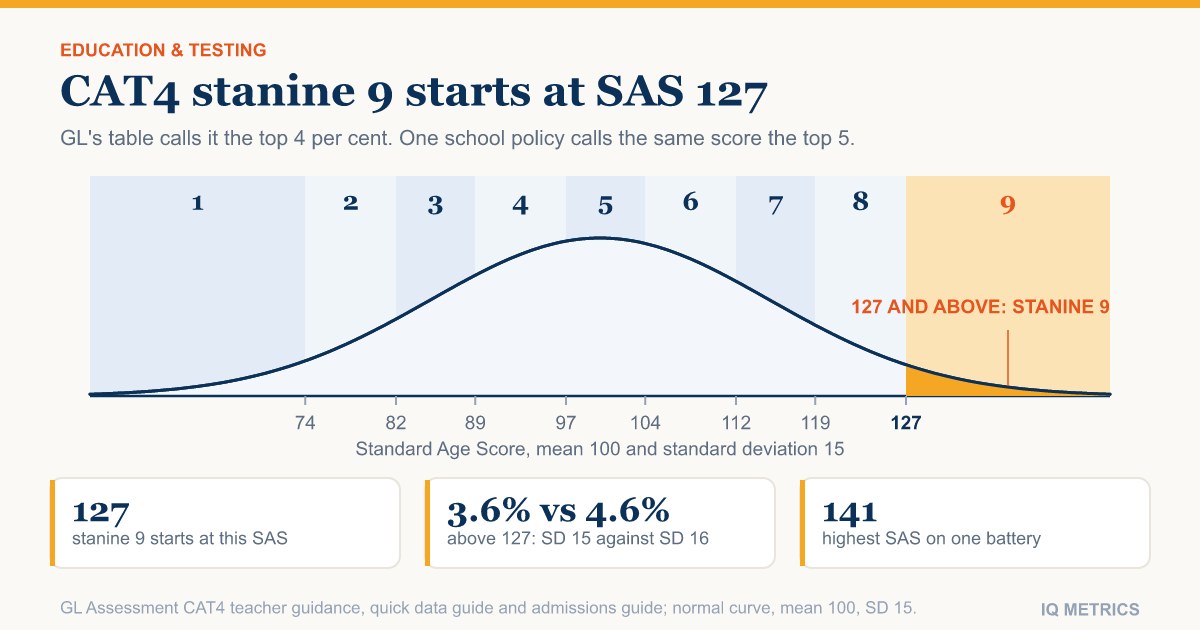
CAT4 Scores Explained: SAS, Stanines, Good Scores and the 141 Cap
GL Assessment prints CAT4 results as a Standard Age Score with an average of 100 and a standard deviation of 15, from 59 to 141, then folds them into stanines. Its own table starts the top 4 per cent at 127, and schools use their own gifted and talented lines, from stanine 8 to a SAS of 130.

11+ Standardised Scores vs IQ: Why a 121 Is Not an IQ of 121
Buckinghamshire says a standardised score of 121 qualifies a child and expects about 37% of children to reach it. On an IQ-style curve, 121 is the top 8%.

Average IQ of MIT, Oxford, Cambridge, Yale and Stanford Students
None of these schools publishes an IQ figure. MIT, Stanford and Yale publish SAT scores, which support an estimate of about 130 for the middle student; Oxford and Cambridge select on other tests and publish neither.

Working Memory and Maths Underachievement: The Data
A 2022 meta-analysis of 46 studies and more than 11,000 children finds a real but moderate link between working memory and arithmetic, and the two kinds of working memory matter differently as children get older.

Does IQ Matter for JEE? What the Evidence Actually Shows
JEE candidates never take a standardized IQ test, so no study has directly measured the correlation. Here is what decades of research on ability and exam performance say instead — and what a 2026 analysis of JEE's own questions found about how reasoning-heavy the exam really is.

Average IQ of Harvard Students: About 130, Not 145
Harvard publishes SAT scores, not IQs, and one study gave 184 Harvard students a Wechsler IQ test. Both routes land close to 130, not the 145 or higher that circulates online. We also set Harvard beside Yale, Stanford, MIT and Cornell, and look at Harvard Law School.

WISC-V Index Scores Explained: Ranges, Descriptors and GAI
A WISC-V report gives a Full Scale IQ and five index scores on a mean-100, SD-15 scale: 40 to 160 for the FSIQ and 45 to 155 for the indexes. Here is what each index contains, what the descriptors mean, how the GAI and CPI differ, and why the FSIQ is not an average.

Universal Screening Finds the Gifted Students Teacher Referral Misses
When a large Florida district began testing every second grader instead of waiting for a teacher's nomination, the population it identified as gifted changed sharply — not because more students became capable, but because fewer of them had ever been tested at all.
Why a CogAT 132 and an NNAT 132 Are Not the Same Score
The two tests American schools use most to screen for gifted programmes print their results on scales that differ by one point of standard deviation. At the level where cutoffs are set, that moves the same printed number by most of a percentile.
Taking an IQ Test in a Second Language: Does It Lower Your Score?
Verbal subtests measure ability through vocabulary and cultural knowledge acquired in one language, so a test taken in a second language can understate ability on those subtests specifically — not on the test as a whole.
Falling Reading Scores Are Not Falling IQ. Here Is the Difference
National reading results have dropped again, and around forty per cent of American fourth-graders are now below the NAEP Basic level. That is a fact about an achievement test, and achievement tests are built to show exactly the movement an IQ score is built to hide.
Does Screen Time Lower Cognitive Test Scores? Eight Years of Data Say No
A Finnish cohort followed 260 children from primary school into adolescence and measured cognition at the end. The children who had spent more time on screens did not do worse. On the processing measures they did slightly better.
Online IQ Scores Vary Widely. The Norm Sample Explains Why
Two people can perform identically on two different online tests and walk away with scores twenty points apart. The scale, the comparison group and the margin of error are what separate an assessment from a quiz.
The SAT Is Digital and Adaptive Now. Here Is What That Changes for a Score
The exam is shorter, taken on a screen, and the second half of each section changes difficulty based on how you did in the first. Raw right-answer counts stopped mapping onto scores the way they used to.
Written to be checked, not just clicked
Every number carries its scale
An IQ figure is meaningless without the scale it was measured on and the range around it. Every story here reports all three, or says plainly that the source did not.
Sources are listed, not implied
Each story ends with the studies, datasets and documents it draws on, named and attributed, so you can go and read them yourself.
We correct in public
Spotted an error? Write to corrections@iqmetrics.org. Corrections are made on the story and noted at the bottom of it — never quietly.
Read the research.
Then find your own number.
Our IIF-certified assessment reports your score with its scale, percentile and confidence range — and a breakdown of the cognitive domains behind it.
Start IQ Test →