



UCAT Scores Explained: Deciles, Bands and the IQ Question
The 2025 mean total was 1891 out of 2,700 and the 2026 preliminary mean is 1970, but no source converts a UCAT score to IQ. The Consortium's own table puts a total of 2100 at the 80th percentile of applicants.


What you need to know
- The 2026 UCAT total runs 900 to 2700 (three cognitive subtests scored 300 to 900) plus a Situational Judgement band of 1 to 4. The 2025 final mean was 1891 (SD 244.84, 41,354 tests). The 2026 preliminary mean, to 13 September with about 22,000 more candidates expected, is 1970; in 2025 the preliminary mean was 1939 and the final 1891.
- Deciles are percentiles: the Consortium says the 1st decile is the 10th percentile, and so on. In 2025 the 5th decile was 1880, the 8th 2100 and the 9th 2220. On a normal curve with mean 1891 and SD 244.84, 2100 is the 80th percentile, matching the Consortium's table.
- No source we found calls the UCAT an IQ test or converts a score to IQ. The authors of a large validity study say it aims to assess fluid intelligence, and the Consortium says it contains no curriculum content. Percentiles are among self-selected applicants, not the population.
- Prediction is modest: a correlation of .148 between UKCAT total and first-year marks in 4,811 students, against .362 for prior attainment, about 2 per cent versus 13 per cent of variation. A 2022 review of 24 studies found no significant predictive validity in over 70 per cent of univariate data points.
A good UCAT score depends on the university. The UCAT Consortium says no single score guarantees selection and not every university sets a minimum. For scale, the 2025 mean total was 1891 out of a possible 2,700 across 41,354 tests, the 5th decile was 1880, and a total of 2100 was the 80th percentile. The 2026 figures are still preliminary. No source we found calls the UCAT an IQ test or converts a UCAT score into an IQ, and this guide explains why such a conversion would mislead.
How is the UCAT scored in the 2026 cycle?
The 2026 test has four subtests, according to the Consortium's test-format page. Verbal Reasoning has 44 questions in 22 minutes, Decision Making 35 in 37 minutes, Quantitative Reasoning 36 in 26 minutes and Situational Judgement 69 in 26 minutes. Each of the three cognitive subtests is scored from 300 to 900, giving a total of 900 to 2700, and Situational Judgement is reported as a band from 1, the highest, to 4. There is no negative marking. Abstract Reasoning was removed in 2025, and the Consortium says scores from 2025 onward are not directly comparable with earlier years, when the total ran from 1,200 to 3,600 across four cognitive subtests.
Not every question counts. The 2025 technical report, which the Consortium links publicly, shows that each subtest carries unscored trial items: Verbal Reasoning has 10 scored testlets of four items plus one unscored testlet, Decision Making has 31 scored items plus four unscored, and Quantitative Reasoning has eight scored testlets of four items plus one unscored. That is 40, 31 and 32 scored items out of the 44, 35 and 36 a candidate sees. The Situational Judgement bands are set by score ranges: in 2025 Band 1 covered scaled scores of 658 to 900, Band 2 596 to 657, Band 3 502 to 595 and Band 4 300 to 501, with intended shares of 22, 38, 30 and 10 per cent.
What do the latest UCAT statistics show?
The Consortium publishes a mean and a decile table for each test year, and defines a decile simply: the 1st decile is a score at the 10th percentile, the 2nd decile a score at the 20th percentile, and so on. Here are the total-score deciles for 2025, final, based on 41,354 tests up to 26 September 2025.
- 1st decile: 1580
- 2nd: 1680
- 3rd: 1760
- 4th: 1820
- 5th: 1880
- 6th: 1950
- 7th: 2010
- 8th: 2100
- 9th: 2220
And the preliminary deciles for 2026, based on 20,794 tests up to 13 September 2026, with the Consortium expecting about 22,000 more candidates.
- 1st decile: 1630
- 2nd: 1750
- 3rd: 1840
- 4th: 1910
- 5th: 1980
- 6th: 2040
- 7th: 2110
- 8th: 2190
- 9th: 2300
The 2025 final mean total was 1891, with a standard deviation of 244.84 in the technical report, and subtest means of 602 for Verbal Reasoning, 628 for Decision Making and 661 for Quantitative Reasoning. The 2026 preliminary means are 1970 for the total and 614, 657 and 699 for the subtests. Do not read that as a rise. The Consortium says the 2026 scores should be treated with significant caution and gives its own example: the 2025 preliminary mean was 1939 and the final mean 1891. Situational Judgement shifted too. In 2025, 21 per cent of candidates were in Band 1, 39 per cent in Band 2, 29 per cent in Band 3 and 10 per cent in Band 4; the 2026 preliminary shares are 16, 42, 32 and 10. The technical report says Verbal and Quantitative Reasoning scores were downscaled by 10 points in 2025 and the band cut-offs revised, so bands are not like-for-like with 2024, when Band 1 held 13 per cent.
What is a good UCAT score?
The Consortium says universities use UCAT results in different ways: some set a threshold score, some weight it alongside academic results, and some use a cut-off for a subtest or for the Situational Judgement band. Its FAQ says there is no single score that guarantees selection and not all universities have a minimum. One published rule: the University of Edinburgh says its minimum UCAT total cut-off for 2027 entry is 1850, that it then ranks scores and divides the cohort into deciles, and that applicants in Situational Judgement Band 4 will not be considered. It adds a 5 per cent uplift to the UCAT total for Flag applicants and 10 per cent for Plus Flag and Scottish SIMD40 applicants. Newcastle says it cannot predict its threshold because it depends on the number of applicants and their average score.
Set Edinburgh's 1850 against the national table and it is not a high bar. On a normal curve with the 2025 final mean of 1891 and standard deviation of 244.84, 1850 is about the 43rd percentile, between the 4th and 5th deciles; against the 2026 preliminary table it falls between the 3rd and 4th. A minimum is a floor for consideration, and the ranking that follows is what counts. That is our comparison, and a floor at one university says nothing about the others.
Is the UCAT an IQ test?
No source we found says so. The Consortium describes the test as assessing a range of mental abilities identified by medical and dental schools as important, and its technical report says it is not an exam of student achievement and holds no curriculum or science content. The authors of a large validity study, McManus and colleagues (BMC Medicine, 2013), write that the UKCAT aims to assess fluid intelligence and other attributes thought to be important in decision making, while specifically trying not to measure science knowledge. The subtests are related: in 2025 scaled scores correlated .66 between Decision Making and Verbal Reasoning, .59 between Quantitative and Verbal Reasoning and .75 between Quantitative Reasoning and Decision Making, which the report reads as a set of common qualities measured across the subtests. It does not call that IQ. We found no published correlation between UCAT scores and an IQ test, and no conversion.
The usual way of putting a score on the IQ scale would mislead here anyway. The decile table is very close to a normal curve: 2100 is 0.85 standard deviations above the 2025 mean, the 80th percentile on a normal curve and exactly the Consortium's 8th decile, so the arithmetic in our z-score guide works. But the reference group is 41,354 people who chose to sit a test for medical and dental school entry, a self-selected group that will not resemble the population. A 90th percentile among them is not a 90th percentile in the population, so calling it an IQ of about 119, on the scale with a mean of 100 and a standard deviation of 15, would be wrong by an amount nobody can state. Our percentile calculator is for scores whose norm group is the population.
A UCAT decile is a rank among medical applicants, not an IQ, and no published source converts one into the other.
How well does the UCAT predict success in medical school?
Modestly. McManus and colleagues followed 4,811 students at 12 UK medical schools who took the UKCAT in 2006 to 2008 and found a correlation of .148 between the UKCAT total and first-year overall marks. Prior educational attainment correlated .362 with the same marks in 3,432 students. Squared, .148 is about 2 per cent of the variation in first-year marks and .362 about 13 per cent, our arithmetic. The authors describe the added value of the UKCAT over educational attainment as significant but small. Another admissions test with its own score scale is the TARA used by Oxford and UCL; see what is a good TARA score.
A later study of 6,812 entrants (Tiffin and colleagues, BMC Medicine, 2016) reached a similar verdict of statistically significant but modest incremental predictive validity, and a 2022 systematic review of 24 studies (Bala and colleagues, Medical Teacher) found that for over 70 per cent of univariate data points the UCAT had no statistically significant predictive validity and that for the rest its power was weak. Those studies cover the earlier test, with Abstract Reasoning, which the Consortium dropped after its own analysis found lower predictive validity than the other sections. Our guides to achievement tests versus IQ tests and to whether IQ predicts school success set this in context.
Does coaching help, and who gets it?
The Consortium calls commercial preparation unnecessary and unregulated, says it does not automatically equate to better performance, and advises scepticism about coaching claims. It gave coachability as a reason for removing Abstract Reasoning, and its technical report says scores on that subtest rose over a decade while response times fell. Observational evidence points to a gap in who prepares. Kulkarni, Parry and Sitch (BMC Medical Education, 2022) questioned UK school-leavers who sat the 2017 test: 5,439 of 14,332 replied, 38 per cent. Using the official timed practice tests was associated with the largest gain, 67.77 points (95 per cent interval 52.01 to 83.53) on the older 1,200 to 3,600 scale, and paid commercial materials with 37.65 points. On that scale 80 points was the step from the 5th to the 6th decile. Candidates from less deprived backgrounds and from independent or grammar schools were significantly more likely to use paid materials and to prepare for longer. The data are self-reported and observational, so they show association, not cause.
Any timed reasoning test rewards practice, as our guide to the practice effect shows. Other entrance tests raise the same questions about what a score means: see our guides to JEE and IQ and to the digital adaptive SAT, and the way scores describe a candidate relative to a cohort in our guides to 11-plus scores and CAT4 scores.
Where would your own score land?
Want a score with a norm group that is the general population? Take the IQ Metrics test and see your IQ with its percentile.
Find your IQ score now! →A UCAT score tells a medical school where you stand among that year's applicants. The IQ Metrics test reports a score on the standard IQ scale with its percentile, and our score converter translates between published scales when a test has the norms to allow it. You can try the underlying reasoning skills in our verbal and numerical IQ tests. For the US medical school exam, see MCAT score to IQ.
Common questions
What is a good UCAT score?
It depends on the university. The Consortium says there is no single score that guarantees selection and not all universities have a minimum. For scale, the 2025 final mean total was 1891 out of 2,700, the 5th decile was 1880 and the 8th decile, the 80th percentile, was 2100.
What is the average UCAT score?
For 2025 the final mean total was 1891 out of 2,700 across 41,354 tests, with a standard deviation of 244.84. The 2026 preliminary mean is 1970 to 13 September, but the 2025 preliminary mean was 1939 and the final 1891, so the 2026 figure will move.
Is the UCAT an IQ test?
No source we found calls it one. The Consortium says it assesses mental abilities and holds no curriculum content, and a large validity study says it aims to assess fluid intelligence. No published source converts a UCAT score into an IQ.
What does a UCAT decile mean?
The Consortium defines the 1st decile as the score at the 10th percentile, the 2nd at the 20th percentile, and so on. In 2025 the 5th decile was 1880 and the 9th 2220, so a total of 2220 was better than about 90 per cent of that year's candidates.
Sources for this story
- Test Statistics 2025 — UCAT Consortium
- Test Statistics: 2026 preliminary scores and deciles — UCAT Consortium
- UCAT Test Format and Scoring — UCAT Consortium
- UCAT 2025 Technical Report — UCAT Consortium
- The UKCAT-12 study of first-year outcomes in 12 UK medical schools (McManus et al., BMC Medicine, 2013) — BMC Medicine
- UCAT requirements for 2027 entry — University of Edinburgh
Corrections: spotted an error? Email corrections@iqmetrics.org and we will update this story and note the change here.
Related stories
All news →
11+ Standardised Scores vs IQ: Why a 121 Is Not an IQ of 121
Buckinghamshire says a standardised score of 121 qualifies a child and expects about 37% of children to reach it. On an IQ-style curve, 121 is the top 8%.
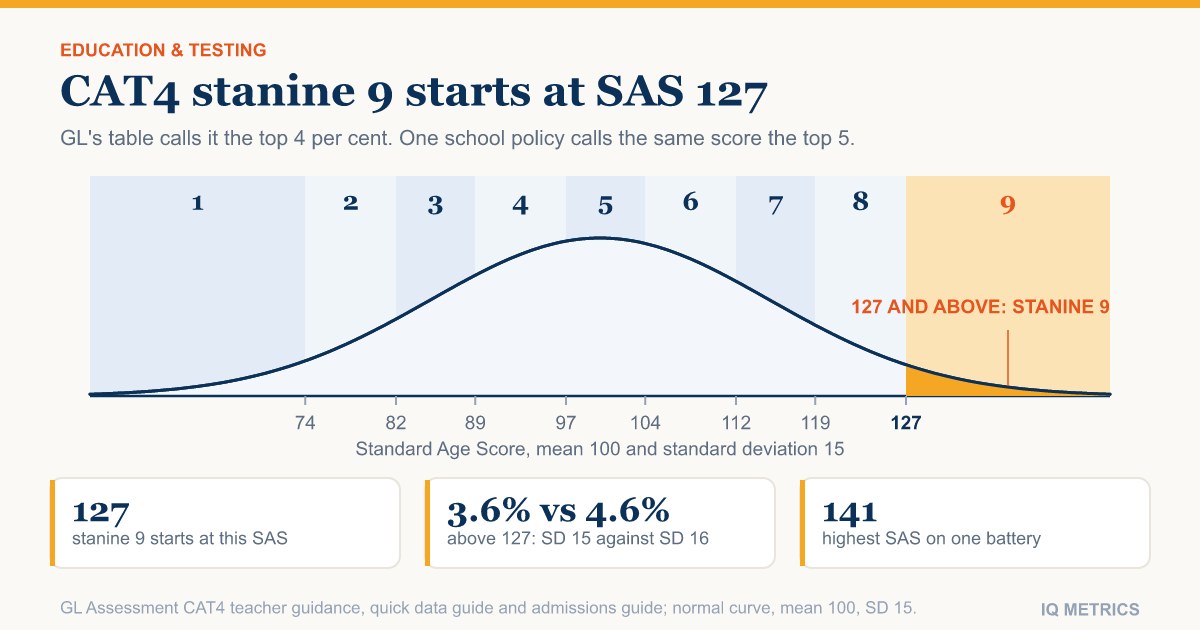
CAT4 Scores Explained: SAS, Stanines, Good Scores and the 141 Cap
GL Assessment prints CAT4 results as a Standard Age Score with an average of 100 and a standard deviation of 15, from 59 to 141, then folds them into stanines. Its own table starts the top 4 per cent at 127, and schools use their own gifted and talented lines, from stanine 8 to a SAS of 130.

SSAT Percentile Chart 2026-27: Scores by Grade and the IQ Question
The SSAT percentile is a rank among first-time takers in the same grade, not a mark out of 100. In the 2026-27 guide a grade 8 student needs a total of about 2013 of 2400 for the 50th percentile and 2343 for the 99th. The test does not claim to measure IQ.
Read the research.
Then find your own number.
Our IIF-certified assessment reports your score with its scale, percentile and confidence range — and a breakdown of the cognitive domains behind it.
Start IQ Test →