





Does Multitasking Lower Your IQ? What the Research Shows
No study has measured a person's IQ before and after a bout of multitasking. What researchers at Stanford measured instead is narrower and more surprising: heavy multitaskers, tested against the exact skill they practice constantly, turned out to be worse at it, not better.

No study has measured a person's IQ before and after a bout of multitasking and found it dropped, and none has followed people over years to see whether heavy multitasking causes a lasting change in general intelligence. What researchers have measured is narrower and, in its own way, more interesting: chronic heavy multitaskers perform measurably worse on the exact cognitive skills an IQ test leans on most — filtering out irrelevant information, holding items in working memory, and switching cleanly between tasks. The researchers who first tested this in the lab expected the opposite result, which is a large part of why the finding is worth taking seriously.
The study that expected the opposite result
A 2009 Stanford study published in the Proceedings of the National Academy of Sciences set out to answer a specific question: do people who chronically juggle several media streams at once develop better cognitive control as a result of all that practice? The researchers built a media multitasking index from a questionnaire covering twelve forms of media, then compared "heavy" multitaskers (one or more standard deviations above the average number of simultaneous streams) against "light" multitaskers (one or more below) on a battery of established cognitive-control tests. The working hypothesis, reasonable on its face, was that heavy multitaskers should show an advantage at managing multiple streams of information, since that is exactly what they do all day.
What they actually found
In a filter task requiring participants to track two target shapes while ignoring a variable number of distractor shapes, heavy multitaskers' accuracy fell steadily as distractors were added; light multitaskers' accuracy did not move at all, meaning they filtered out the irrelevant shapes completely while heavy multitaskers let more and more of them in. A related test asked participants to hold a letter cue in mind and respond only when a specific follow-up letter appeared, sometimes with an unrelated distractor letter shown in between. With no distractor present, the two groups performed identically. Adding the distractor changed that: heavy multitaskers slowed down noticeably while accuracy stayed the same for both groups, meaning the extra letter was genuinely pulling their attention rather than confusing either group about the rules of the task. A separate test of raw impulse control, a stop-signal task requiring participants to withhold an already-triggered response, found no difference between the groups at all — heavy multitaskers were not simply more impulsive across the board, only more susceptible to letting irrelevant information in. A third test, a memory-updating task requiring participants to ignore letters that had appeared earlier but were no longer relevant, found the same pattern: heavy multitaskers' false-alarm rate — mistaking an old, irrelevant item for a current target — climbed faster as the task went on. Across three independently designed tests, the direction of the effect was consistent: heavy multitaskers let more irrelevant information into working memory, not less, while showing no general deficit in impulse control on its own.
The task-switching result specifically
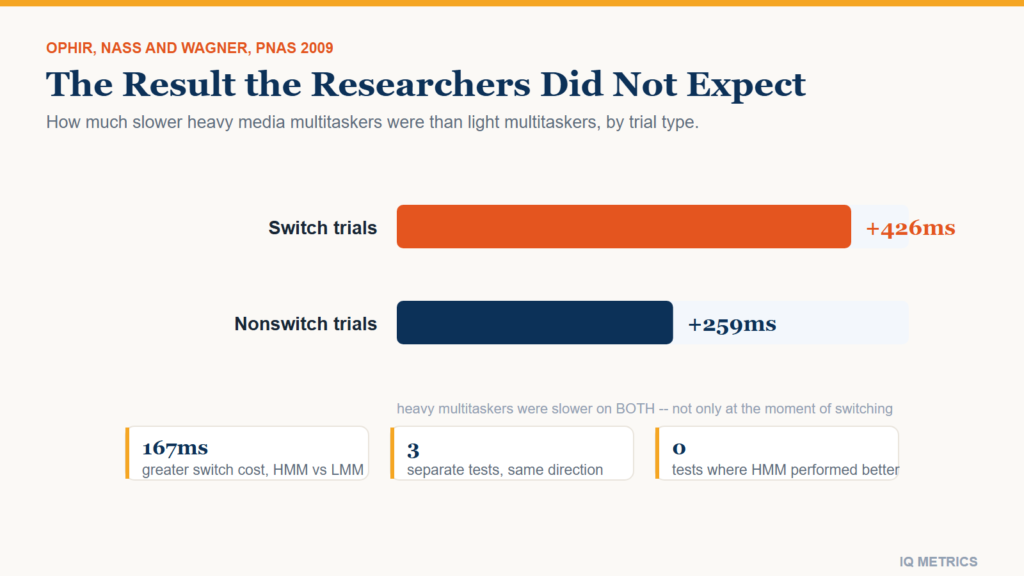
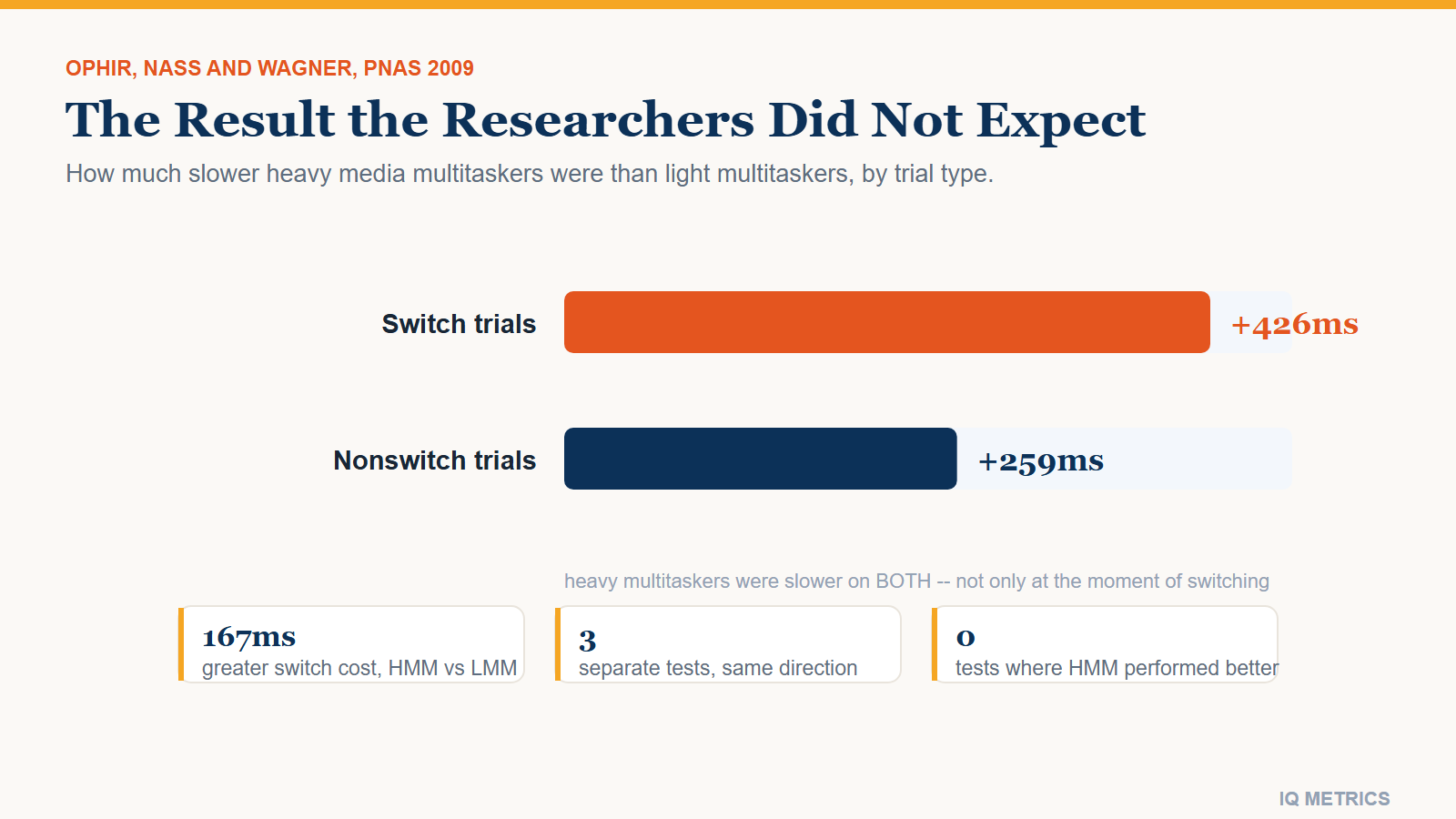
The most direct test compared how much slower each group got when a trial required switching from one type of task to a different one, versus repeating the same task type. If heavy multitasking practice built genuine switching skill, heavy multitaskers should have shown a smaller penalty. They showed a larger one: 167 milliseconds greater than light multitaskers', a statistically solid difference. The detail that matters most is that heavy multitaskers were slower even on trials that did not require switching at all — 259 milliseconds slower on repeat trials, on top of 426 milliseconds slower on switch trials. That rules out an explanation limited to "switching itself is the problem"; something about sustained, single-task focus was affected too, not only the transition between tasks.
Where would your own score land?
Take the IIF-certified assessment and get your score with the scale it was measured on, the percentile it corresponds to and the confidence range around it — the three figures most online tests leave out.
Find your IQ score now! →What this does not show
The study's own authors were explicit that the direction of cause and effect is unresolved, and this article carries that caveat forward rather than smoothing it over: chronic multitasking could cause weaker filtering and switching ability, or people who are already less able to filter distraction could simply be drawn toward multitasking behavior more than people who filter well. A follow-up summary of a decade of subsequent research, published by Stanford in 2018, described a consistent memory-performance gap between heavy and light multitaskers across many later studies — and reported the same causal-direction question still unresolved a decade later. The sample in the original study was also a group of university students tested once, not a general population followed over time, which limits how far any single number here should be generalized. The researchers themselves floated a specific version of the reverse-causation possibility worth stating directly: someone who already struggles to sustain focus on one thing might find single-tasking uncomfortable and gravitate toward switching between several activities precisely because it suits a mind that already has trouble filtering, rather than multitasking behavior creating that difficulty from scratch. Either story is consistent with the same data, and only a study that follows the same people over years, watching multitasking habits and cognitive-control ability change together or apart, could tell them apart. That study has not been done yet.
What the switching cost looks like outside the lab
A separate line of research, distinct from the Stanford trait-based comparison above, has measured the practical cost of interrupting one task to handle another. The American Psychological Association, summarizing task-switching research, estimates that switching between tasks can consume up to 40 percent of someone's otherwise-productive time. A 2009 study on what researchers call "attention residue" found that a portion of attention stays with an unfinished task even after switching away from it, measurably impairing performance on whatever comes next. Neither of these findings is about IQ or general intelligence either — they describe a real, practical cost to interrupting focused work, on top of, and separate from, the cognitive-control differences described above. A widely cited 2005 field study of office workers found that more than half of observed work tasks were interrupted before completion, with an average delay of roughly 25 minutes before the original task resumed. That number describes a single workplace observational study, not a laboratory measure of cognitive ability, and it varies enormously by job and by how the interruption is defined; it is included here as context for how large the practical cost of switching can look outside a controlled experiment, not as a second data point for the cognitive-control findings above.
So, does multitasking lower your IQ
Not in any sense a test can measure directly, and nobody has run the study that would settle it either way. What the evidence does support is narrower and arguably more useful: treating multitasking as a skill that improves with practice, the way learning an instrument or a language does, is not what the data shows. The Stanford research points toward the opposite pattern — constant practice at dividing attention correlating with getting worse, not better, at the specific mental skills, filtering distraction and holding focus, that an IQ test also draws on. Whether that is cause, effect or a bit of both for any one person is a question this research has not answered yet.
Where this fits next to the site's other coverage
This is a different mechanism from this site's piece on AI and cognitive offloading, which covers what happens when someone delegates a single thinking task to a tool rather than doing it themselves; multitasking is about dividing attention across several tasks at once, a distinct question with its own separate research base. It sits more naturally next to processing speed and IQ and memory and IQ as another way a specific, trainable-feeling mental skill turns out to have a more complicated relationship to general cognitive performance than intuition suggests. The same underlying theme — a limited cognitive resource, spent well or poorly — shows up from a completely different angle in this site's piece on sleep and IQ, which is about losing hours of consolidation time rather than splitting attention during the day.
Keep reading
All articles →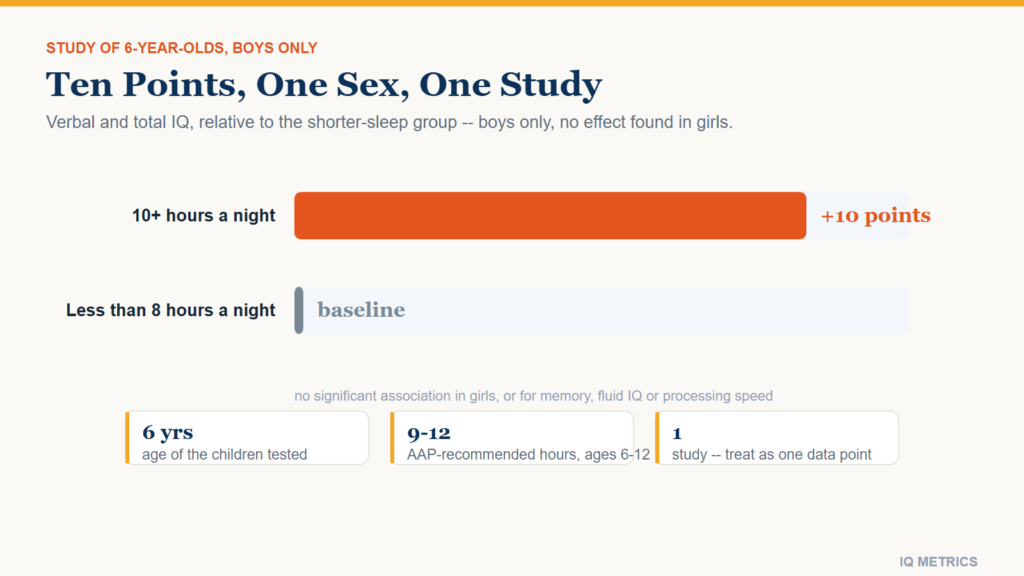 Research & Evidence
Sleep and IQ
This site's news desk has already covered what one bad night does to a test score on the day it is taken. This is a different and, for children especially, more consequential question: what years of too little sleep do to the cognitive systems an IQ test measures in the first place.
 Mind & Everyday Life
Does Using AI Make You Dumber?
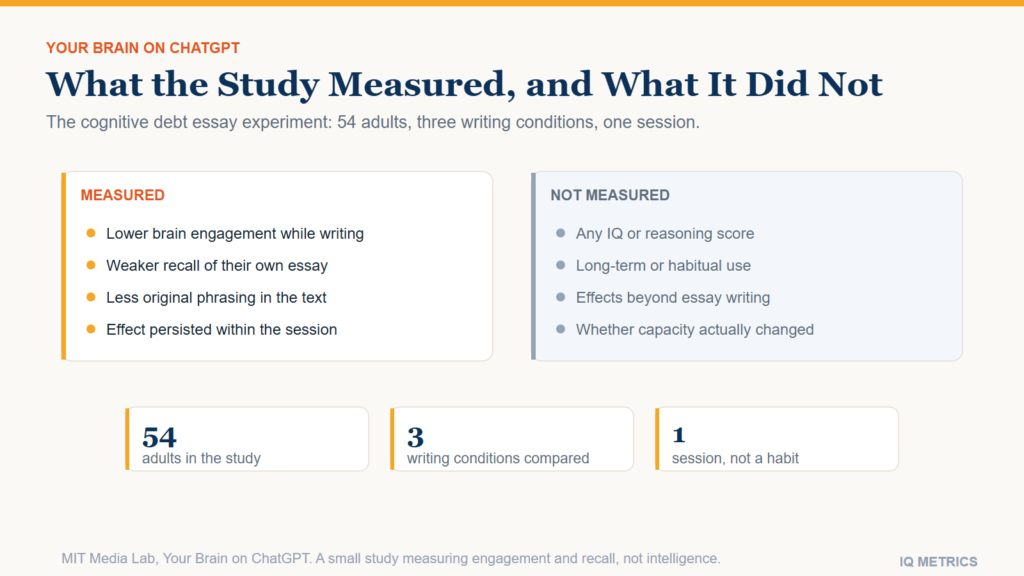
The claim that AI is making us stupider has real research behind it and is still routinely overstated. No study has measured a drop in intelligence. What has been measured is lower mental engagement during a delegated task and weaker memory for work you did not do yourself, which is a narrower finding and a more useful one.
 Understanding IQ
Processing Speed and IQ
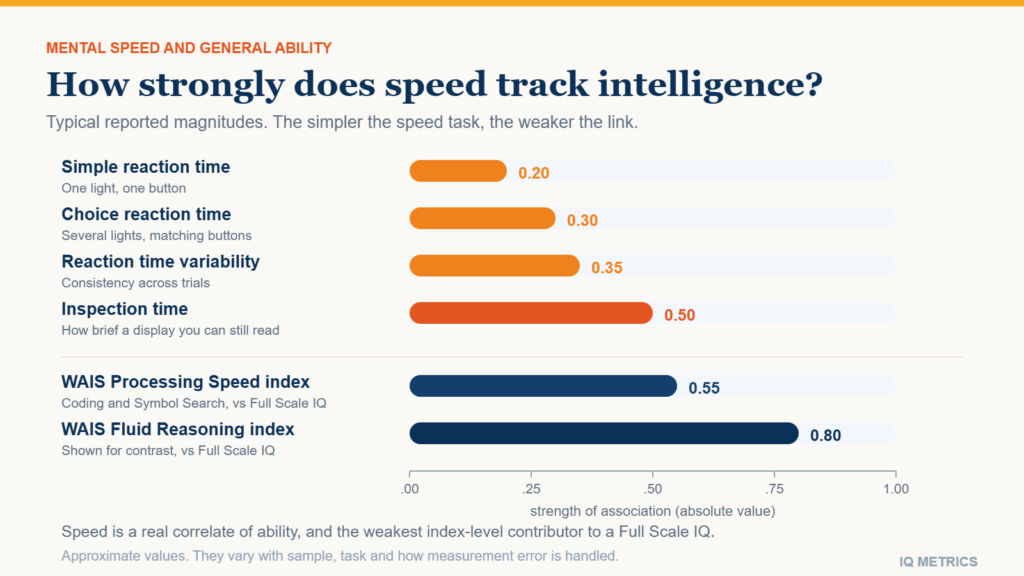
Fast thinkers are assumed to be smart thinkers, and there is a real finding underneath the stereotype: people who score higher on IQ tests do respond faster on tasks with no reasoning content at all. But the link is weaker than the folklore, and on a professional battery the speed index is the least g-loaded.