





Sleep and IQ: What Chronic Sleep Loss Does to a Developing Brain
This site's news desk has already covered what one bad night does to a test score on the day it is taken. This is a different and, for children especially, more consequential question: what years of too little sleep do to the cognitive systems an IQ test measures in the first place.

A single bad night blunts attention, working memory and processing speed for that one sitting, without touching a person's underlying ability — that acute, test-day question is covered in full on this site's news desk. This article is about something slower, and for children in particular, potentially more consequential: what chronic sleep duration, sustained across months and years of development, does to the cognitive systems an IQ score is built to measure in the first place, and how sleep's role in memory itself may explain part of the connection.
A study built to test exactly that question
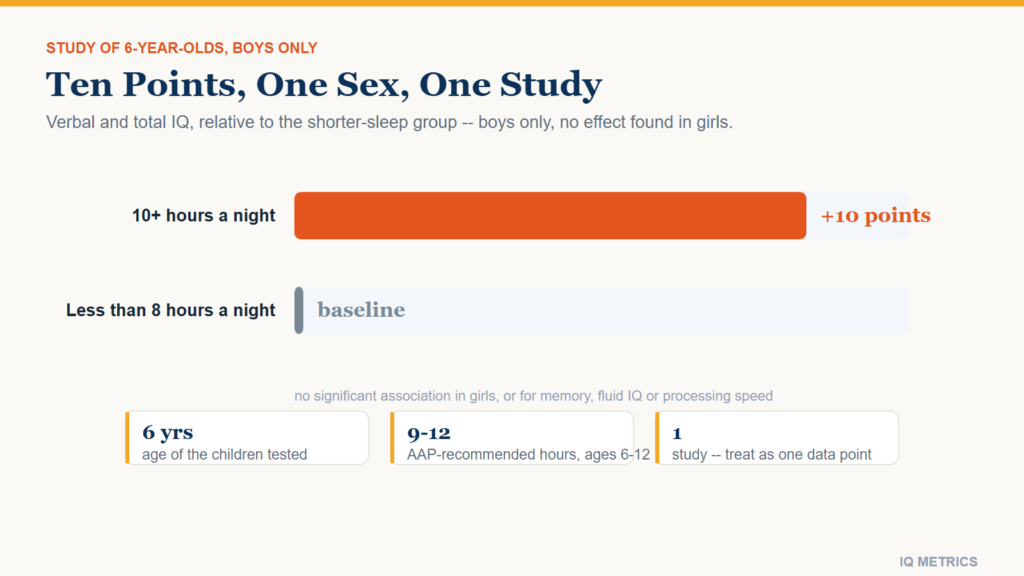
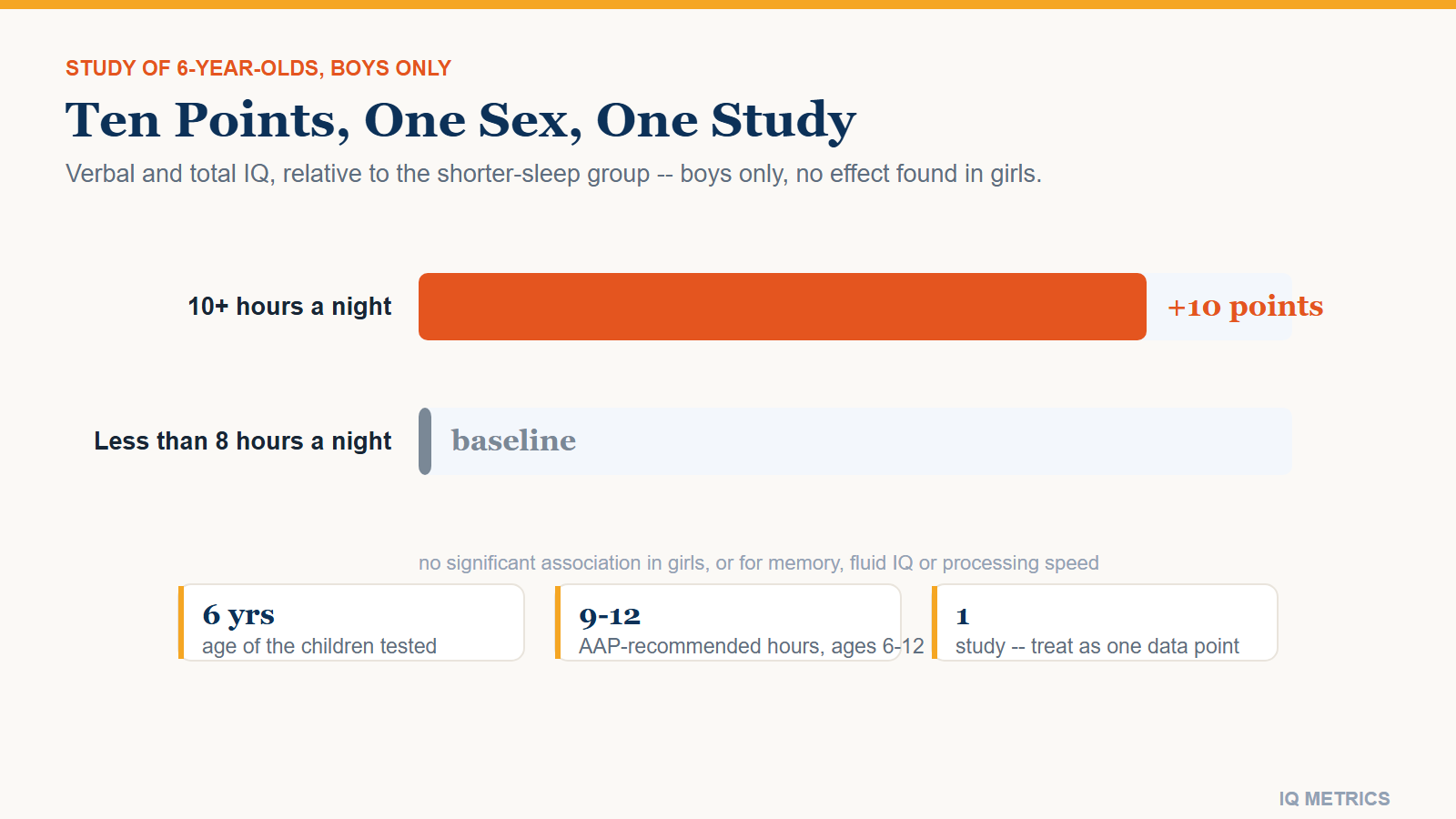
A study out of Seoul National University's Environmental Health Center, working with Hanyang University Medical Center, measured habitual sleep duration in a group of six-year-old children and tested their IQ directly. Boys who slept 10 or more hours a night scored roughly 10 points higher on verbal and total IQ than boys sleeping less than 8 hours. That is a large gap for a single study to carry, and the honest reading requires the details that come with it: the association held for boys but not for girls, and it held specifically for verbal and total IQ, not for memory, fluid IQ, processing speed or attention measured separately in the same children. Treat this as one well-designed but sex-specific and domain-specific data point, not a settled general finding that more sleep raises IQ across the board.
Why an effect this size would show up in boys and not girls is not settled by the study itself, and this article will not pretend otherwise. Sex differences in the timing of early brain development are a documented, general phenomenon in child developmental research, which makes a sex-specific result plausible rather than suspicious on its face — but plausible is not the same as explained, and a single study finding an effect in one sex and not the other is exactly the kind of result that most needs an independent replication before it hardens into a general claim about boys and sleep.
The mechanism: what sleep is actually doing
The leading explanation is systems memory consolidation: during sleep, especially slow-wave sleep, newly formed memories held in the hippocampus are gradually transferred into longer-term storage distributed across the neocortex. Cut that process short night after night, the theory goes, and a child accumulates a deficit in exactly the kind of durable knowledge and skill consolidation that both school performance and IQ testing draw on. Several studies suggest this consolidation process may run faster, or more efficiently, in children than in adults — which would help explain why sleep's cognitive stakes look especially high during the exact developmental window most of this research focuses on. A separate strand of research on napping specifically has found that even a short daytime nap can improve retention of material learned just beforehand in young children, which is consistent with the same underlying mechanism operating on a shorter timescale than a full night's sleep, not only across it.
Longer-run evidence, not just one snapshot
A 2023 prospective cohort study, tracking sleep-duration trajectories from early childhood forward rather than measuring sleep once, found that children on a persistently short-sleep trajectory showed poorer visual-spatial performance later on and a higher risk of scoring in the low range on Full-Scale IQ. Separate research on toddlers, ages 1 to 3, found that shorter naptimes and a lower ratio of sleep to wake time were linked to cognitive outcomes measured at age 4, which in turn connected indirectly to Full-Scale IQ measured at age 6 — a longer causal chain than the single cross-sectional study above, but pointing the same direction across a different age range and a different research design. What makes a trajectory study more persuasive than a single snapshot is exactly that it can separate a child who is a naturally short sleeper on the night of testing from a child whose sleep has been short consistently for years; the two are easy to confuse in a one-time measurement and considerably harder to confuse once sleep has been tracked over time.
Where would your own score land?
Take the IIF-certified assessment and get your score with the scale it was measured on, the percentile it corresponds to and the confidence range around it — the three figures most online tests leave out.
Find your IQ score now! →When sleep is disrupted by more than a late bedtime
Pediatric obstructive sleep apnea, a physical airway obstruction that fragments sleep independent of how early a child goes to bed, offers a genuinely useful natural check on the pattern above. Children and teens with moderate to severe sleep-disordered breathing average about half a letter grade lower in school than children without it — a consistent finding across multiple studies. Office-based IQ testing specifically is less consistent: the clearest IQ deficits show up in preschool and early grade-school years, with results in older children more mixed. Worth being precise about that distinction rather than collapsing it: the academic-performance effect of disrupted sleep is well established across ages, while the direct IQ-score effect is better supported at younger ages specifically than at older ones. The value of the OSA evidence here is not the size of any one number; it is that airway obstruction fragments sleep for reasons that have nothing to do with a family's bedtime habits, income or parenting choices, which makes it a cleaner natural test of "does fragmented sleep itself affect cognition" than a survey asking parents to report how many hours a child usually sleeps. That the pattern points the same direction as the habitual-duration research above, using a completely different mechanism of sleep loss, is what makes it a useful cross-check rather than a repeat of the same finding.
How much sleep is actually recommended
- Infants, 4 to 12 months: 12 to 16 hours per 24, naps included
- Ages 1 to 2: 11 to 14 hours per 24, naps included
- Ages 3 to 5: 10 to 13 hours per 24, naps included
- Ages 6 to 12: 9 to 12 hours a night
- Teens: 8 to 10 hours a night
Those figures come from the joint American Academy of Pediatrics and American Academy of Sleep Medicine consensus guidance, and regularly sleeping below them is independently associated with attention, behavior and learning problems, separate from the IQ-specific findings described above.
What this means, and does not mean
None of this says that a single late bedtime, one missed hour on one particular night, costs a child real IQ points, any more than one single skipped meal by itself causes real malnutrition. It says something narrower and better supported: sustained sleep duration across months and years of development is consistently linked to cognitive outcomes across several independent lines of evidence — a cross-sectional study in six-year-olds, a longitudinal cohort tracking trajectories rather than single measurements, toddler research on napping specifically, and a physically distinct disruption pathway in sleep apnea — even though no single one of those studies is airtight on its own, and even though the sex-specific result in the headline study deserves the caution given to it above. That kind of convergence across different designs and different ages is a genuinely stronger form of evidence than any one striking number, and it is why sleep belongs on the same short list as the other directly modifiable factors connected to cognitive outcomes on this site, alongside the mechanics of memory covered in this site's piece on memory and IQ and the developmental window discussed in testing IQ in children. A related, physical and frequently under-diagnosed cause of fragmented childhood sleep is worth ruling out where it applies, since some of its attention and behavior effects overlap with what is separately discussed in this site's piece on ADHD, autism and dyslexia. And the same underlying idea — a limited daily cognitive resource, protected or spent down by how someone lives — is covered from an entirely different angle in this site's companion piece on multitasking and IQ, which is about dividing attention during the day rather than losing consolidation time at night.
Keep reading
All articles →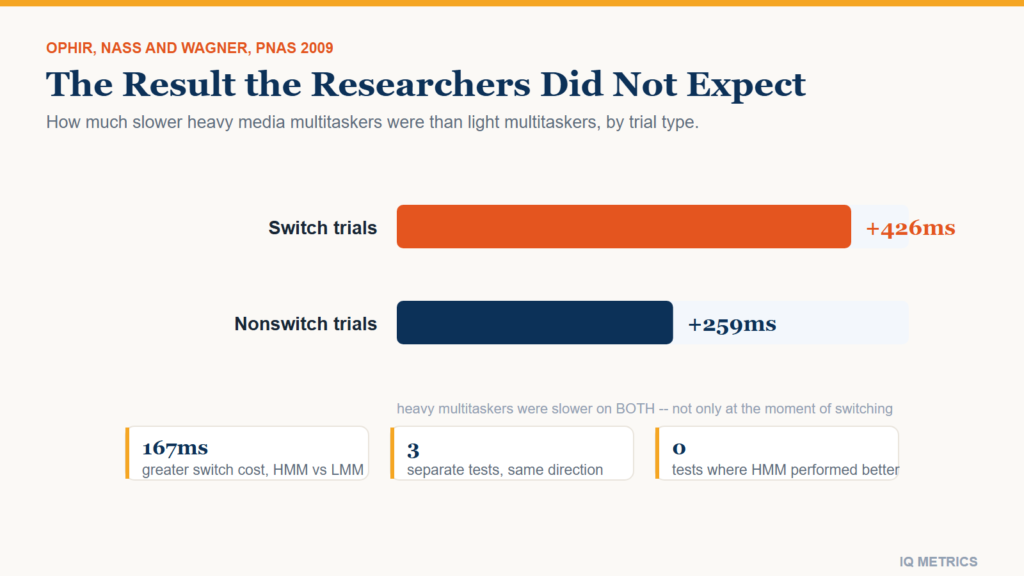 Research & Evidence
Multitasking and IQ
No study has measured a person's IQ before and after a bout of multitasking. What researchers at Stanford measured instead is narrower and more surprising: heavy multitaskers, tested against the exact skill they practice constantly, turned out to be worse at it, not better.
 Understanding IQ
Memory and IQ
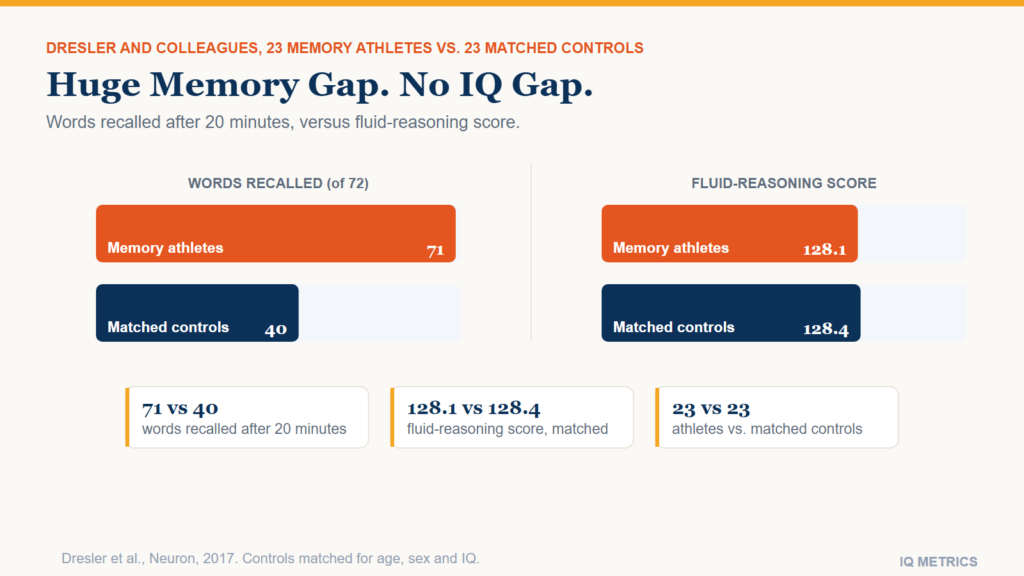
The world's best memory athletes can memorize 71 shuffled words in twenty minutes. Their IQ scores are not measurably different from a matched control group who could only manage 40. If a spectacular memory is not the same thing as a high IQ, what actually is the difference?
 Taking a Test
IQ Testing for Children
Children are not tested on the same instrument as adults, and the test itself changes twice before age eighteen. Here is which one applies when, how reliable an early score really is, and what a parent should and should not conclude from a single number.