





Premature Birth and IQ: What Gestational Age Actually Predicts
Children born very preterm score, on average, about 0.8 of a standard deviation lower on IQ tests than children carried to term. Here is what a 2018 meta-analysis and the studies since actually found: the gestational-age gradient, what is really driving the gap, and what it does not tell you about one specific child.

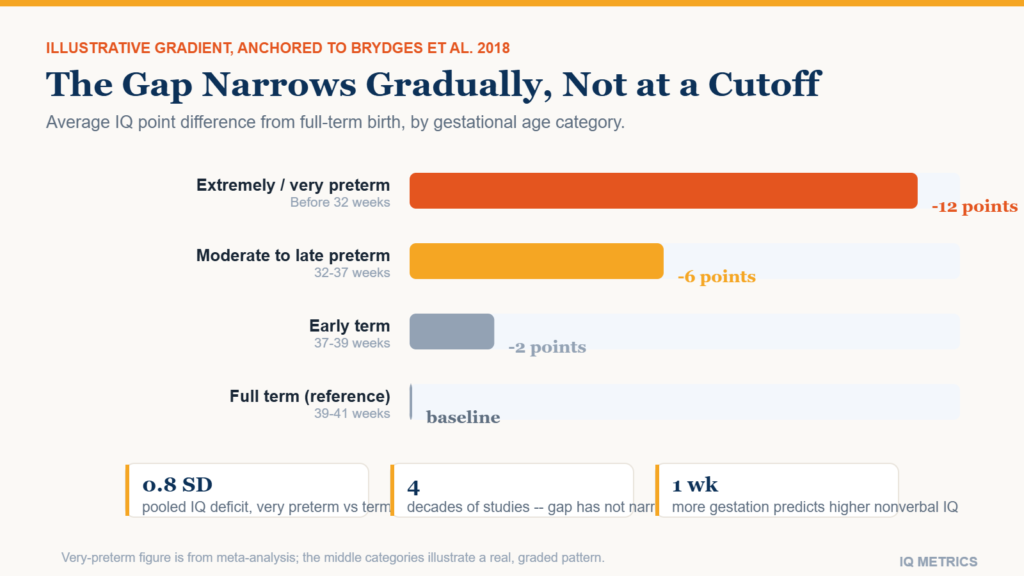
Children born very preterm — before 32 weeks of a typical 40-week pregnancy — score, on average, about 0.8 of a standard deviation lower on IQ tests than children carried to term. On the familiar 100-point scale, that works out to roughly 12 points, and it is one of the more consistently replicated findings in developmental research: a 2018 meta-analysis and a broader review of trends across four decades of neonatal medicine land on almost the same number. What the average obscures matters more than the average itself — the effect is graded by exactly how early a birth was, it is driven disproportionately by specific complications rather than prematurity as a single cause, and it says very little about what any one child will do.
The headline number, and what it is built from
A 2018 meta-analysis published in Developmental Medicine & Child Neurology pooled cognitive outcomes across studies of children and adolescents born very preterm and found a deficit of roughly 0.8 to 0.86 standard deviations in full-scale IQ compared with term-born controls, alongside smaller but still substantial gaps of about 0.5 standard deviations each in executive function and processing speed. A later systematic review, tracking studies published across roughly four decades, found this gap has not meaningfully narrowed over that period — worth sitting with, since intuition says survival rates and neonatal care have improved enormously over the same stretch. Better survival for the most fragile births and an unchanged average cognitive gap are not actually in tension; they describe two different things.
Preterm is a gradient, not a category
Clinicians split preterm birth into bands: extremely preterm (before 28 weeks), very preterm (28 to 32 weeks), moderate to late preterm (32 to 37 weeks), and early term (37 to 39 weeks) before reaching a full-term birth. The research does not describe a cliff at any one of those boundaries. Across studies, each additional week of gestation is associated with a higher average nonverbal IQ score — a continuous, dose-response relationship rather than a threshold effect. A separate systematic review looking specifically at early-term and late-preterm birth — children born just a few weeks early, well outside what a neonatal intensive care unit would flag as high-risk — still found small but measurable shifts in average cognitive scores relative to full term.
| Category | Typical gestational age | General pattern in the research |
|---|---|---|
| Extremely / very preterm | Before 32 weeks | The largest average gap versus full term, and the widest spread between individual children. |
| Moderate to late preterm | 32–37 weeks | A smaller but still measurable average gap; more support commonly needed early on. |
| Early term | 37–39 weeks | Small, subtle shifts on average, detectable mainly at the group level. |
| Full term | 39–41 weeks | The reference point every comparison above is measured against. |
Where would your own score land?
Take the IIF-certified assessment and get your score with the scale it was measured on, the percentile it corresponds to and the confidence range around it — the three figures most online tests leave out.
Find your IQ score now! →What is actually driving the gap
Gestational age and birth weight travel together but are not the same thing, and neither is preterm birth itself the whole story. Within the preterm-born population, specific complications of early birth predict much worse outcomes than gestational age alone would suggest. Bronchopulmonary dysplasia — a chronic lung condition that can follow the ventilator and oxygen support extremely preterm infants often need in their first weeks — is among the strongest known predictors of a lower cognitive score within this group, over and above how early the birth was. Intraventricular hemorrhage — bleeding into the fluid-filled spaces of an immature brain, graded by severity from mild (grade 1) to severe (grade 3 or 4) — is another well-documented driver, and the more severe grades carry a substantially higher risk of later cognitive and motor impairment than mild bleeds, which often resolve without a detectable long-term difference at all. Both complications become more common the earlier a birth happens, which is part of why gestational age and outcome track each other as closely as they do without gestational age itself being the entire mechanism. The gap is not identical across sexes, either — boys born preterm tend to show a somewhat larger average cognitive deficit than girls born at the same gestational age, a pattern that recurs across enough cohorts to be treated as a real, if not fully explained, sex difference rather than noise in a handful of studies.
The deficit is not spread evenly across academic skills, either. Follow-up studies through school age consistently find mathematics hit harder, on average, than reading — a pattern that recurs often enough in the preterm literature that some researchers treat early numeracy as a specific skill worth monitoring, rather than assuming a general reading-focused intervention will cover it.
Preterm birth is also not randomly distributed through the population: it is associated with lower socioeconomic status, maternal health conditions during pregnancy, and multiple pregnancies — twins and triplets are born preterm far more often than single births, which is one reason researchers studying twins for unrelated questions, such as the heritability work behind is IQ genetic, have to treat gestational age as a confound in its own right. Studies that statistically adjust for these factors find the cognitive gap shrinks — but, unlike some other early-life exposures this site has covered, it does not disappear the way it does. Prenatal smoking and IQ found that adjusting for the mother’s own cognitive ability erased most of a raw 4-point gap; for gestational age, adjustment narrows the gap but a real residual remains, which is part of why researchers treat gestational age itself, not only its social correlates, as doing genuine work.
Does the gap close as children grow up?
The effect is strongest at the earliest gestational ages and the lowest birth weights. Some domains show relative narrowing during adolescence, but studies that follow very preterm-born people into adulthood still detect measurable differences, so "catching up" turns out to be real but partial rather than complete. There is a genuinely constructive thread in this research, too: postnatal catch-up growth and nutrition in the months after NICU discharge is an active area of study, and better early growth after birth is associated with better later cognitive outcomes — one of the few pieces of this picture a family and a pediatric team can actually act on. Breastfeeding and IQ covers a related piece of the nutritional puzzle in the general population; the preterm-specific literature on post-discharge feeding finds a similar direction of effect, though the infants and the stakes involved are different.
Follow-up windows matter here, too. Several long-running cohorts have now followed people born very preterm into their twenties and thirties, and the group-level cognitive difference remains detectable that far out, even as most individuals in the cohort go on to finish school, hold jobs and live independently. Persistent does not mean disabling for most people in the group; it means the average stays measurably different, a distinction that is easy to lose in either direction — toward false reassurance, or toward false alarm.
What this means for one specific child
A population average describes a distribution, not a prediction for any individual. The spread of outcomes within the preterm-born population is wide, and a great many children born very preterm score in the average range or above. Early cognitive development does not move in only one direction, either: researchers who study early biological risk factors like gestational age and researchers who study giftedness are often looking at the same developmental window from opposite tails of the same distribution — see signs of a gifted child for what the other tail looks like. When testing is actually wanted — for a school placement decision or a developmental concern — using a child’s corrected age rather than their birth age matters for interpreting the result correctly, a point IQ testing for children covers in more detail. Early intervention services — structured developmental support offered from the first year or two after a preterm birth, rather than a wait-and-see approach — are associated with better outcomes in follow-up studies, and most neonatal follow-up clinics build a referral to these programs into routine care for infants born very preterm. That is a genuinely actionable piece of this research, in contrast to a population average that a family cannot do anything about directly.
Keep reading
All articles →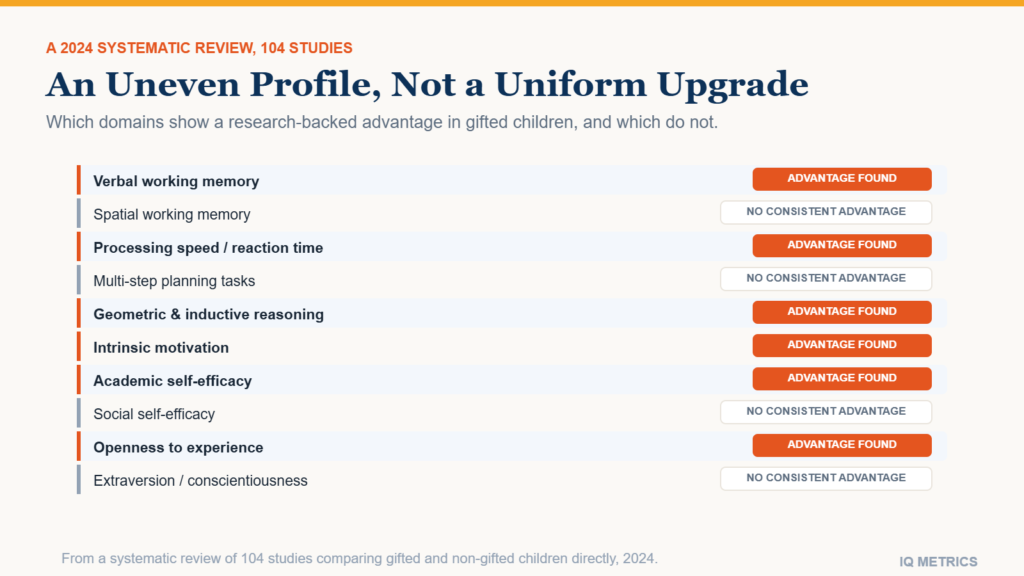 Understanding IQ
Signs of a Gifted Child
The "reads early, has a big vocabulary" checklist misses what a 2024 systematic review actually found: an uneven cognitive profile, a documented speed-accuracy tradeoff, asynchronous development, and real gaps in who gets identified. What the research says, and what to do with a hunch.
 Research & Evidence
Prenatal Smoking and IQ
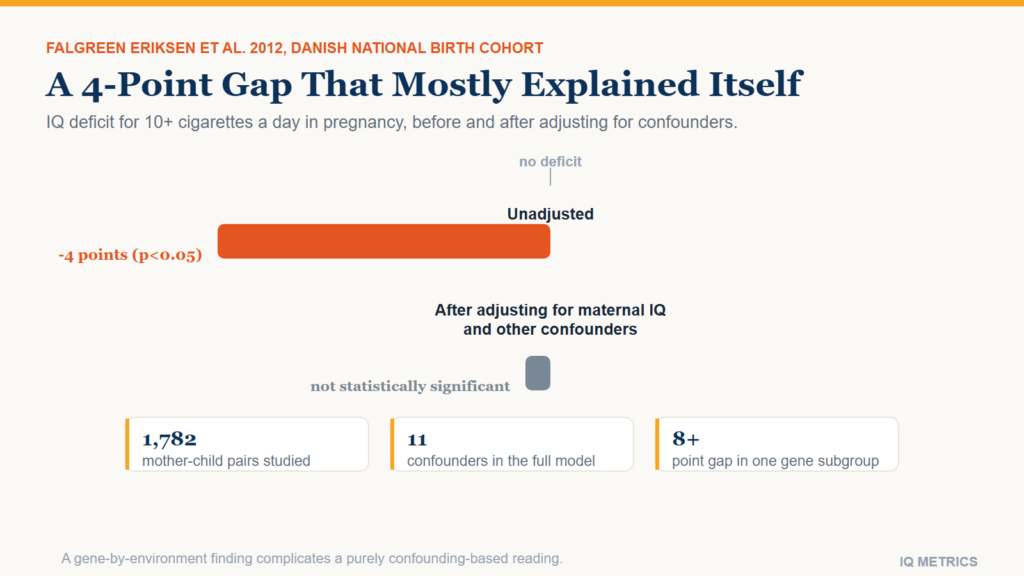
Several studies link smoking during pregnancy to a lower child IQ score. Then a Danish cohort of 1,782 mothers adjusted for the one variable most of the earlier research had not: the mother's own IQ. What was left afterward is a genuinely more complicated story than the headline number suggests.
 Research & Evidence
Fetal Alcohol Spectrum Disorder and IQ
A clinical study of 473 people diagnosed with fetal alcohol syndrome or its milder forms found that only 16 percent had an IQ in the intellectually disabled range. That statistic is not the reassurance it sounds like -- it is the reason the condition is so often missed. Here is what a normal-looking score can still be hiding.