IIF Certified Assessment
Start IQ Test
IIF Certified Assessment
A 2024 US government review linked fluoride above 1.5 mg/L to lower IQ in children. An April 2026 study of 10,317 people found no sign of harm from community fluoridation. The two findings are about different doses, and the dose is the whole argument.
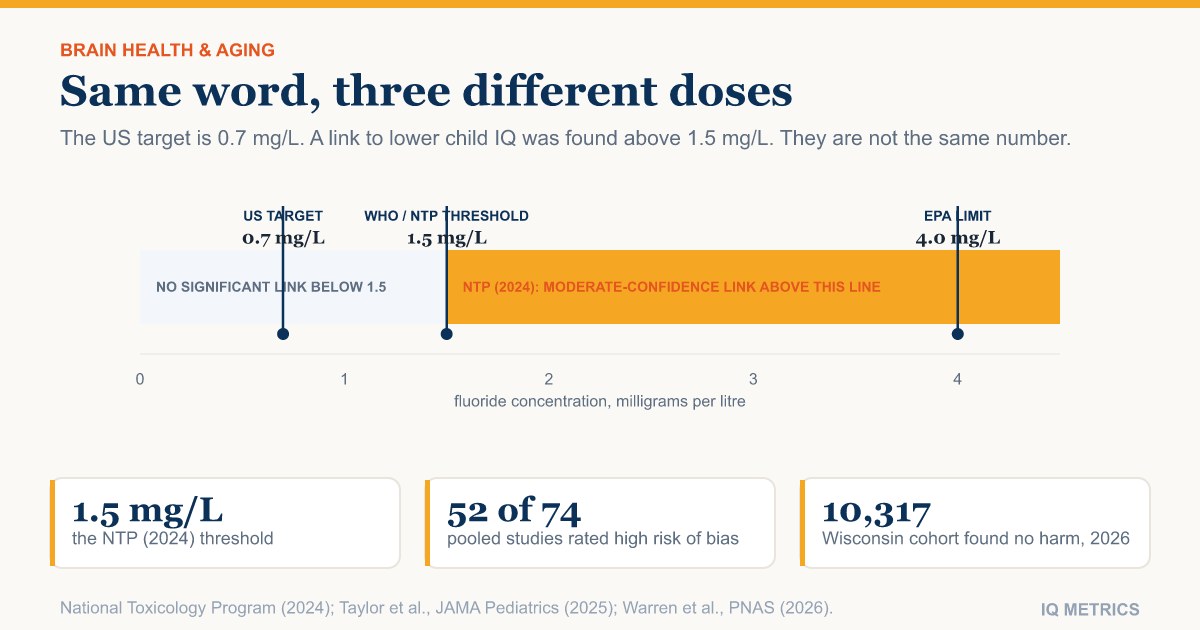
Few questions about intelligence have become as political as this one. Fluoride is added to public water supplies in many places to prevent tooth decay, and a series of studies over the past decade has linked higher fluoride exposure to lower IQ scores in children. In 2025 two US states stopped adding it to water altogether. Yet in April 2026 one of the longest-running studies of American cognition found no sign of harm. Both findings can be accurate at once, because they are not describing the same amount of fluoride.
In August 2024 the National Toxicology Program, part of the US Department of Health and Human Services, published a systematic review of fluoride exposure and children's neurodevelopment. Its central conclusion was stated with moderate confidence: fluoride exposures higher than 1.5 milligrams per litre of drinking water are associated with lower IQ in children. That threshold matches the World Health Organization's guideline value for fluoride in drinking water, first set in 1984.
The review was just as explicit about what it did not find. It said there were insufficient data to determine whether 0.7 mg/L, the level the US recommends for community water fluoridation, has a negative effect on children's IQ, and it was not designed to assess fluoridated water on its own. The 0.7 figure has been the US Public Health Service recommendation since 2015, when it replaced an older range of 0.7 to 1.2 mg/L. It is a recommendation, not a legal ceiling: the enforceable federal limit, set by the Environmental Protection Agency in 1986, is 4.0 mg/L.
The numbers behind most headlines come from a meta-analysis by the same government team, published in JAMA Pediatrics in January 2025. It combined 74 studies: 64 cross-sectional snapshots and 10 cohort studies that followed children over time. Forty-five came from China and 12 from India, and the WHO names parts of both countries among the regions with high natural fluoride in groundwater. The reviewers rated 52 of the 74 studies at high risk of bias, meaning weaknesses in design or measurement could have distorted their results.
Pooling 59 studies of 20,932 children, the analysis found lower IQ scores in higher-exposure groups, with a standardised mean difference of −0.45. A standardised mean difference expresses the gap between two groups in standard deviations. Each study compared its own higher- and lower-exposure groups, whatever the levels were, so the figure is not the effect of any particular dose. Multiplied naively by the 15 points of an IQ standard deviation it would be about 7 points, a number that circulates in coverage but does not appear in the paper. Among the studies rated at low risk of bias, the difference shrank to −0.19, under 3 points by the same arithmetic. Our IQ bell curve shows how little a shift of that size moves a distribution.
The dose-response estimate is the figure most often misquoted. Across 13 studies of 4,475 children, each additional 1 mg/L of fluoride measured in urine was associated with IQ scores 1.63 points lower, and 1.14 points lower in the low-risk studies. Urinary fluoride is a biomarker of fluoride from all sources, not only drinking water, so this is not an estimate of what 1 mg/L in tap water does.
The meta-analysis also split its studies by exposure level, and this is where the dose becomes decisive. For drinking water below 1.5 mg/L, the pooled estimate across all studies was essentially zero, 0.05 from 7 studies. The estimate from the 3 low-risk studies in that range, covering 879 children, pointed toward lower IQ but was not statistically significant. Urinary fluoride below 1.5 mg/L did show a small but statistically significant association, −0.08. The authors described the drinking-water evidence below 1.5 mg/L as limited and uncertain.
The live question is not whether fluoride can lower IQ. It is whether it does at 0.7 milligrams per litre, which is exactly where the data run thinnest.
On 13 April 2026, PNAS published a study led by Warren and colleagues at the University of Minnesota using the Wisconsin Longitudinal Study, which has followed a one-third random sample of the state's high-school class of 1957. The researchers reconstructed each of 10,317 participants' exposure up to age 14 from community fluoridation records and natural fluoride in wells: 3,614 were never exposed, 2,595 were exposed from birth, 2,087 from age 8 and 2,021 from age 14.
The participants took the Henmon-Nelson IQ test in 9th and 11th grade and cognitive tests again at ages 53, 64, 72 and 80. The study found no evidence that childhood fluoridation exposure lowered adolescent IQ or later cognition: only 2 of 45 key estimates reached statistical significance, about what chance alone would produce. A companion study by the same lead author in Science Advances in November 2025, using the national High School and Beyond cohort, found exposure at the recommended level was associated with slightly better cognition in school, a difference that had narrowed and was no longer significant by about age 60.
The Wisconsin study has limits of its own. Exposure was inferred from where people lived rather than measured in their bodies, the cohort is one state's class of 1957, and the paper does not report the concentrations the children received. It is strong evidence of no detectable harm in that population, not proof that no effect exists anywhere. Its result echoes a 2021 Swedish register study in the Journal of Political Economy, which used natural differences in fluoride from bedrock among people born between 1985 and 1992 and found no effect on cognitive ability, alongside better dental health and higher incomes.
Policy has not waited for the science to settle. In September 2024 a federal judge in California, Edward Chen, ruled in Food & Water Watch v. EPA that fluoridation at 0.7 mg/L posed an "unreasonable risk" to children's IQ under the Toxic Substances Control Act and ordered the EPA to address it, while noting that the finding was not made with certainty. The EPA appealed, and on 21 May 2026 the Ninth Circuit vacated the decision on procedural grounds and sent the case back, without ruling on whether fluoride at 0.7 mg/L is risky.
Even the contested estimates are small for an individual. A standard deviation on an IQ scale is 15 points, and a single full-scale score carries a margin of error of a few points either way, as our note on why an IQ score is a range, not a number explains, so a difference of one or two points could never be seen in one child's result. Across a population the arithmetic is different. If a whole distribution moved down by 1.63 points, the share scoring 130 or higher would fall from 2.28% to about 1.75%, and the share below 70 would rise from 2.28% to about 2.93%. That is our own illustration of the size of the dose-response figure, not a measured effect of tap water, and whether any such shift happens at 0.7 mg/L is the unresolved question. You can check the percentages with our IQ percentile calculator.
A population average cannot tell you about one person. If you want to know where your own reasoning ability stands, take a properly normed assessment and read the result with its range.
Find your IQ score now! →The honest summary is less satisfying than either side's slogan. High fluoride exposure, of the kind found in some natural groundwater, is associated with lower childhood IQ with moderate confidence. At the levels used in community water programmes, the best recent studies find no detectable harm, and the evidence is too thin to rule a small effect firmly in or out. Related environmental questions are covered in our article on lead, pollution and IQ, and if you want a measured score rather than a population estimate, our IQ test reports one with its percentile attached.
At high exposures, probably: the US National Toxicology Program concluded with moderate confidence in 2024 that fluoride above 1.5 mg/L in drinking water is associated with lower IQ in children. For the 0.7 mg/L used in US community water fluoridation, it found the data insufficient, and a large 2026 study found no evidence of harm.
There is no tap-water figure. The 2025 JAMA Pediatrics meta-analysis estimated 1.63 IQ points lower per 1 mg/L of fluoride in urine, a biomarker of fluoride from all sources, and 1.14 points in studies at low risk of bias. For drinking water below 1.5 mg/L it found no statistically significant association.
Published in PNAS in April 2026, it followed 10,317 people from Wisconsin's high-school class of 1957 and found no evidence that childhood exposure to community water fluoridation lowered teenage IQ or cognition later in life. Exposure was inferred from where people lived rather than measured in each person.
Utah and Florida were the first two, both in 2025. Utah's law took effect on 7 May 2025 and Florida's on 1 July 2025; Florida's law bars additives that do not meet its definition of a water quality additive rather than naming fluoride.
Corrections: spotted an error? Email corrections@iqmetrics.org and we will update this story and note the change here.
Almost every eleven-year-old in Scotland sat the same test on the same day in 1932. Decades later those scores turned out to track survival — and the argument about what that means has run ever since.
A Finnish cohort followed 260 children from primary school into adolescence and measured cognition at the end. The children who had spent more time on screens did not do worse. On the processing measures they did slightly better.
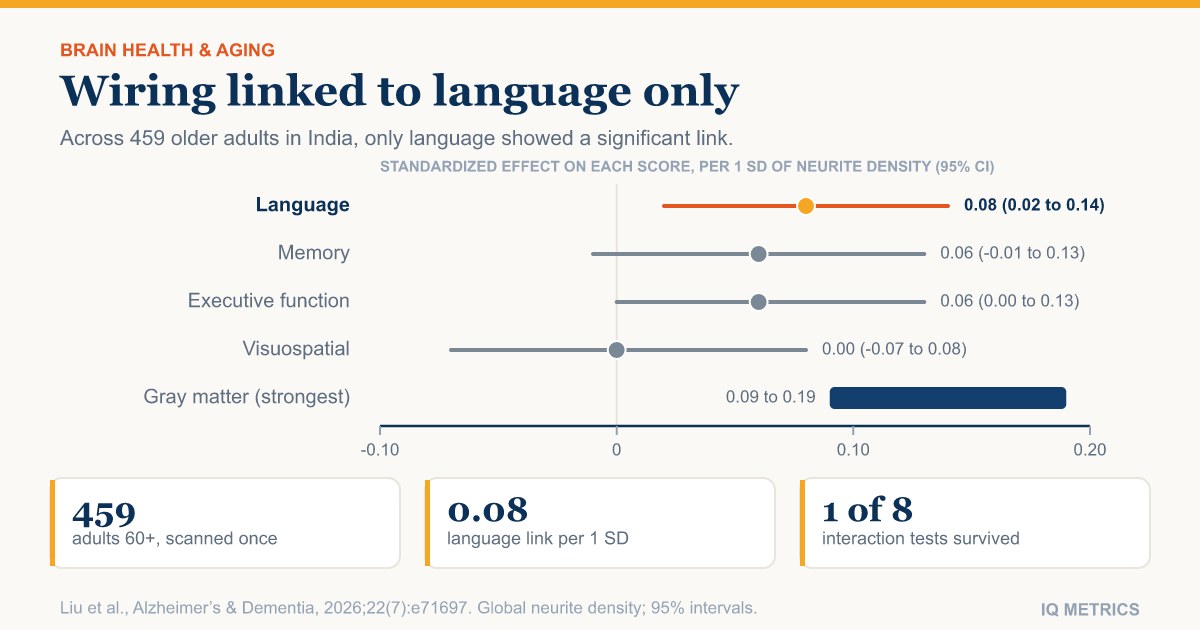
Headlines say healthy “wiring” shields the aging mind from gray-matter loss. The study behind them, 459 older adults in India scanned once, found a small link to language only, and it does not claim to have measured cognitive reserve.
Our IIF-certified assessment reports your score with its scale, percentile and confidence range — and a breakdown of the cognitive domains behind it.
Start IQ Test →