IIF Certified Assessment
Start IQ Test
IIF Certified Assessment
One peer-reviewed study estimated the IQ of every president from George Washington to George W. Bush. It put John Quincy Adams first at 168.8 and Ulysses S. Grant last at 120. No president was ever given an IQ test for it, and the ranges overlap far more than a ranked list suggests.
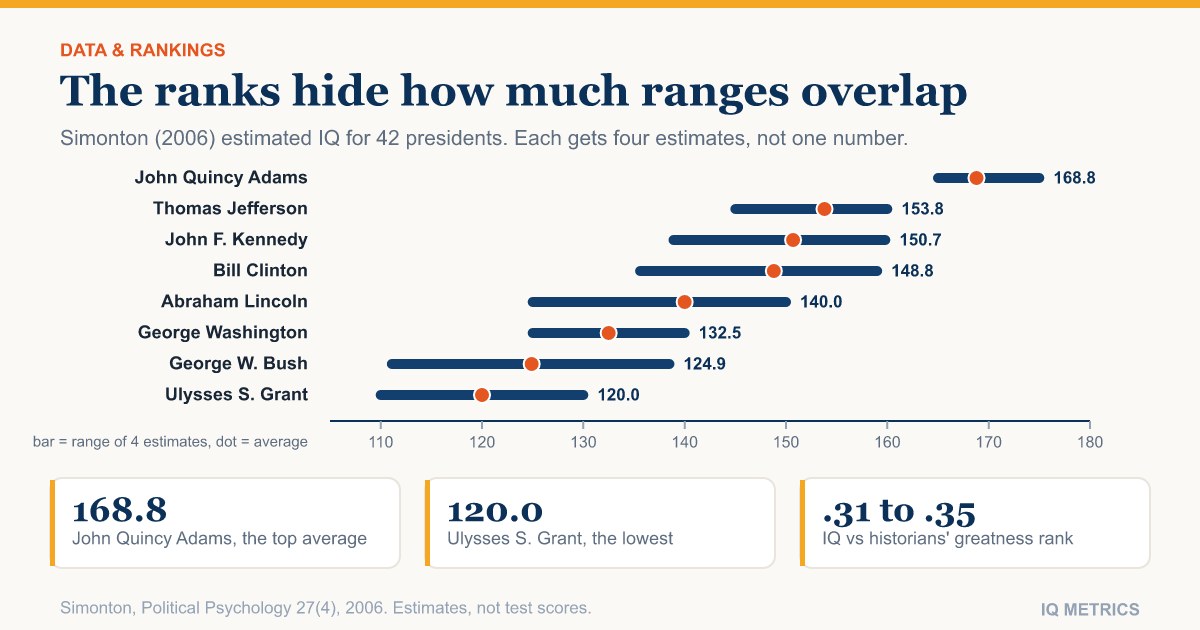
Search for the IQ of US presidents and you will find confident lists, ranked from first to last, with a number beside every name. Nearly all of the defensible numbers come from a single academic paper, and the paper says something rather different from the lists built on it. No president took an IQ test for it. Each figure is a statistical estimate, built from biographies and expert ratings, and each comes as a spread of four numbers rather than one.
This article gives the full ranking, all 42 presidents, and explains where each number comes from, how much it can be trusted, and which of the other figures in circulation are simply invented.
In 2006 the psychologist Dean Keith Simonton of the University of California, Davis, published "Presidential IQ, Openness, Intellectual Brilliance, and Leadership" in the journal Political Psychology. It covered 42 chief executives, George Washington to George W. Bush, with Grover Cleveland counted once although he served two separate terms. It remains the only peer-reviewed attempt to put an IQ-style number on every president.
Simonton built the estimates from three published sources:
The three measures correlate strongly with one another, so Simonton used a standard statistical method to fill in each president's missing values from the ones that existed. That is the crucial detail. Only the eight presidents in Cox's study have IQ figures rooted in an IQ-style rating. For the other 34, every IQ number was estimated from personality and intellect ratings, and the IQ scale itself is anchored on those eight.
Cox rated her subjects twice, once on the record from birth to age 17 and once on the record from 18 to 26, and she also corrected each rating for how reliable the surviving biographical material was. Simonton kept that structure, so every president has four estimates: early and later, uncorrected and corrected. The paper prints no single figure and no margin of error.
The single numbers that circulate come from one of two choices. Most lists use the average of the four, which is what we use below. Some use only the highest column, the corrected estimate for ages 18 to 26, which is why you will also see John Quincy Adams at 175, Jefferson at 160 and Kennedy at 159.8. Neither is wrong, but a list that does not say which it used cannot be compared with one that does. A figure you may see for Clinton, 149.4, matches no combination of his four estimates. His average is 148.8.
Each line gives the average of Simonton's four estimates, then the lowest and highest of the four. Presidents with identical averages share a rank, and the order follows the unrounded averages.
Two things stand out. The whole table is compressed: the average across all 42 presidents is 134.5, and 36 of the 42 averages fall between 124 and 146. And the ranges overlap heavily. George W. Bush, 39th, has a range of 111.1 to 138.5; George Washington, 20th, has 125 to 140. On these numbers the study cannot tell most neighbouring presidents apart, and in places it cannot separate the 20th from the 39th.
Only eight presidents have IQ estimates rooted in an IQ-style rating. For the other 34, every number was inferred from personality and intellect scores.
Simonton was explicit that the IQ columns were the most heavily estimated part of the dataset, writing that the IQ scores "must therefore be considered more tentative and approximate". Cox had attached error margins to her own ratings, from about 4 points where the records were rich to about 10 where they were thin, and those margins do not appear in the presidential table at all.
The estimates also depend on how much biography survives, and on how experts writing much later chose to describe a president. George W. Bush's figures, for example, rest on a single input: an Openness score that his biographers did not supply, which the 2004 authors rated themselves. Simonton put his estimate at about 125, which he described as more than one standard deviation above the population average and in the top 10%. Read as a modern score with a standard deviation of 15, 125 would sit near the 95th percentile on our IQ percentile calculator, but the historical scale has no fixed spread, which is why Simonton put it more cautiously.
Did higher IQ make a better president? The study compared the estimates with an average of 12 historians' rankings of presidential greatness, from 1948 to 2000. The four IQ columns correlated with greatness at between .31 and .35, meaning IQ accounts for roughly a tenth of the differences in how historians rate presidents. Intellectual Brilliance, the adjective-based rating, did better at .56, and once all three measures were considered together it was the only one that still predicted greatness.
John F. Kennedy is third in Simonton's ranking at 150.7. He is also the only president in the table with a documented IQ test result. Several major biographies, including Herbert Parmet's Jack (1980) and Robert Dallek's An Unfinished Life (2003), report that he scored 119 on an Otis intelligence test taken in 1930, before he entered Choate School. The historian Thomas Reeves pointed to that score in 2006 when questioning the study's estimates.
The two numbers measure different things. One is a group test taken by a 12-year-old with a long record of illness; the other is an inference from adult achievement and historians' descriptions. Neither settles the other, and our John F. Kennedy IQ profile sets out both. What the gap shows is how far an estimate can sit from the only measurement available.
The study ends with George W. Bush, so there is no Simonton figure for any later president, and we found no comparable peer-reviewed estimate for Barack Obama, Donald Trump or Joe Biden. In a 2018 follow-up paper in the Journal of Intelligence, Simonton wrote that his method could be extended to Obama once enough biographical material existed, and he gave no number. Sites that attribute a specific Simonton figure to Obama contradict Simonton himself.
The figures you will see for recent presidents come from elsewhere. The 156 attached to Trump was calculated from an assumed SAT score that has never been released, as our Donald Trump IQ profile explains. The 130 to 150 attached to Obama has no test or published method behind it; see our Barack Obama IQ profile. For the most recent presidents in the study, the estimates are Jimmy Carter 145.1, Ronald Reagan 130.0, George H. W. Bush 130.1, Bill Clinton 148.8 and George W. Bush 124.9.
Many "presidential IQ" lists online are not from Simonton at all. In July 2001 an email circulated claiming that a "Lovenstein Institute" in Scranton, Pennsylvania, had ranked the IQs of 12 presidents. It gave Bill Clinton 182, Jimmy Carter 175, John F. Kennedy 174 and George W. Bush 91. The institute did not exist. The Guardian printed the list in its Diary column on 19 July 2001 and retracted it on 14 August.
Every presidential IQ figure is an estimate with a wide margin. If you want a number that is actually measured, take a timed test that reports a percentile and a range.
Find your IQ score now! →The honest version of the presidents-by-IQ list is less tidy than the popular one. John Quincy Adams and Thomas Jefferson do lead a real, peer-reviewed table, and most presidents sit well above the population average. But the table is an estimate built mainly from later ratings of personality and intellect, it covers no one after 2009, and the ranges are too wide to rank most presidents against their neighbours. A measured score works differently: our IQ test reports a percentile, and our note on why a score is a range explains how to read it.
John Quincy Adams, on the only peer-reviewed estimate. Dean Keith Simonton's 2006 study put his average estimated IQ at 168.8, with a range of 165 to 175, ahead of Thomas Jefferson at 153.8 and John F. Kennedy at 150.7. No president was given an IQ test for the study.
Ulysses S. Grant, at an average of 120.0 in Simonton's 2006 study, followed by James Monroe at 124.1, Warren G. Harding at 124.3 and George W. Bush at 124.9. Every one of those estimates is still above the population average of 100.
No peer-reviewed estimate exists for any of them. Simonton's study ends with George W. Bush, and the figures circulating for later presidents come from assumptions or unsourced lists, not from a test or a published method.
No. It was a hoax that circulated by email in July 2001, crediting a non-existent institute in Scranton, Pennsylvania, with ranking 12 presidents. It gave Bill Clinton 182 and George W. Bush 91. The Guardian printed it on 19 July 2001 and retracted it on 14 August.
Corrections: spotted an error? Email corrections@iqmetrics.org and we will update this story and note the change here.
The numbers attached to famous names travel for decades without ever acquiring a test record, a date or a scale. Where the trail can be followed at all, it usually ends at a magazine paragraph.
On a mean-100, standard-deviation-15 scale, 130 sits at the 97.72nd percentile, which leaves about one person in 44 above it. Here is the rarity at every threshold — and why the figures stop describing real people long before they stop being calculable.
No state has a measured average IQ. The popular tables convert school test scores from 2005 into IQ points, the spread between typical states is about two points on that scale, and the poverty gap inside one state is bigger than the whole map.
Our IIF-certified assessment reports your score with its scale, percentile and confidence range — and a breakdown of the cognitive domains behind it.
Start IQ Test →