IIF Certified Assessment
Start IQ Test
IIF Certified Assessment
A study of more than 5,000 older Germans found people schooled in the socialist East kept sharper memory and processing speed after 50 than West Germans the same age — despite worse heart health and shorter life expectancy.
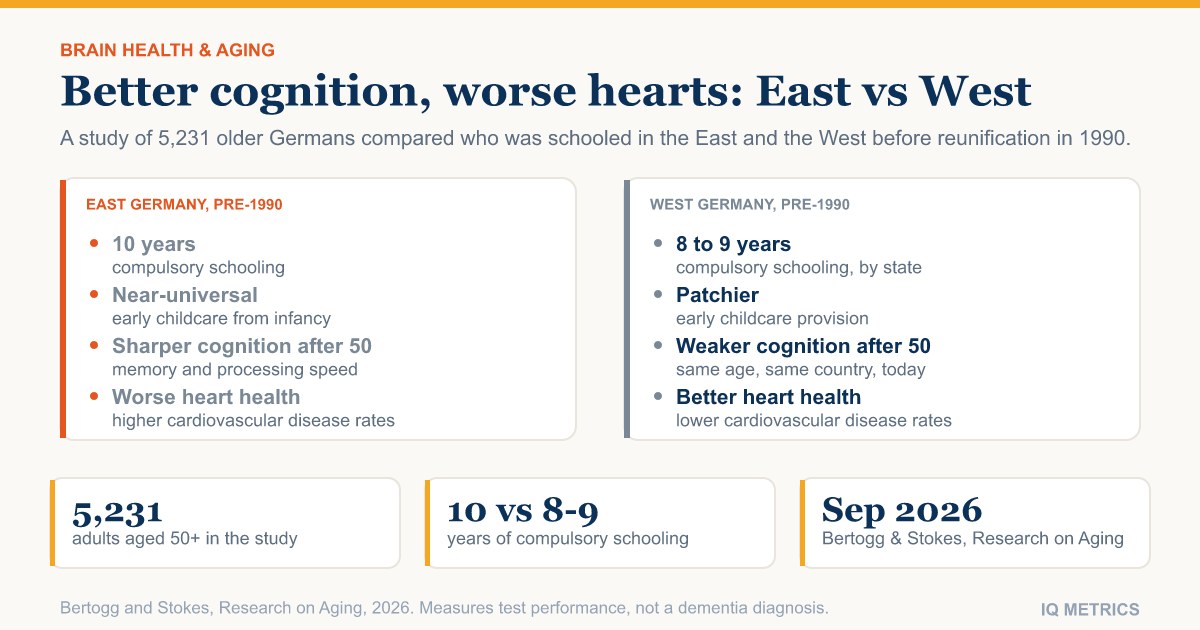
East Germany spent four decades as a byword for what a planned economy gets wrong: chronic shortages, a secret police file on nearly everyone, a health system that left its population with more heart disease and shorter lives than its western neighbour. A study published on 16 September 2026 adds an uncomfortable footnote to that record. On cognitive tests taken decades after reunification, the East German-educated half of the comparison came out ahead.
Ariane Bertogg at the University of Konstanz and Jeffrey E. Stokes at the University of Massachusetts Boston drew on 5,231 German adults aged 50 and over, comparing those who had spent their childhood and schooling in the East against those raised in the West before the two systems merged in 1990. Across the cognitive domains tested — including orientation and numerical ability — the East German-raised group showed better performance and a slower rate of decline as the sample aged, with the advantage "especially pronounced in men," according to the published findings. The work appeared in the journal Research on Aging.
The comparison is unusual for how cleanly it isolates a specific window. Everyone in the study is a citizen of the same reunified country, has lived under the same government for over three decades, and is drawn from the same national surveys. What differs is which school system and which childhood institutions they passed through before 1990 — a natural experiment that a randomised trial could never ethically run.
The easy explanation would be that East Germans in this sample are simply healthier across the board, and cognition is riding along with everything else. The data rules that out directly. East Germany has carried higher cardiovascular disease rates and shorter life expectancy than the West for the entire post-reunification period, and that gap shows up in this sample too. The cognitive advantage runs the opposite way from the cardiovascular one. Whatever is producing sharper memory and processing speed in this group, it is not general good health.
That divergence is what makes the finding worth taking seriously rather than filing away as a curiosity. Physical and cognitive aging usually move together in population data, because so many of the same risk factors — diet, smoking, exercise, access to care — affect both. Finding a group that does worse on one axis and better on the other points at something specific rather than something general.
The explanation the researchers point to is policy rather than ideology. East Germany mandated ten years of compulsory schooling, compared with eight or nine years across West Germany's regional systems. It also ran early childcare as a near-universal service, built in large part to support the state's policy of near-full female employment, at a time when West German provision was far patchier and childrearing was more likely to happen at home.
The mechanism researchers reach for here is what aging science calls cognitive reserve: the idea that more schooling and more cognitively demanding early environments build a buffer of neural connections that takes longer to run down as a person ages, even if the underlying decline itself is unaffected. It is the same logic behind the advice to stay mentally active in later life, applied retrospectively to a childhood that happened to be more standardised and more institutionally supported in the East.
East Germans in the study had worse hearts and shorter lives than West Germans the same age — and sharper minds.
A single observational study comparing two populations inside one reunified country cannot rule out everything else that differed between East and West beyond schooling: family structure, diet, workplace conditions and a different healthcare model all varied too, and the paper cannot cleanly separate schooling's contribution from all of it. The comparison also only works looking backward — everyone young enough to have been fully educated after reunification falls outside it, so the finding is necessarily about a specific, aging cohort rather than a standing feature of either system today.
There is also a migration question sitting underneath the comparison. Roughly 3.5 million people left East Germany for the West before the border closed in 1961, and movement in both directions resumed after 1989. Whoever stayed in the East long enough to be schooled there and is still alive and traceable in Germany at 50 or older today is not a random sample of everyone born there — people who leave a country are rarely identical, on average, to people who stay, on any trait you might care to measure. The study cannot fully rule out that this kind of selection, rather than the classroom itself, shaped part of who ended up in each group.
The finding fits a broader pattern this site has covered before: measurements taken early in life keep showing up in outcomes recorded fifty and sixty years later. Scotland's national school testing programme, discussed in our piece on what childhood test scores predict about later-life health, found something structurally similar — a score fixed at age eleven still carrying information about survival decades on. The East German comparison works from the opposite direction: instead of an individual score predicting an individual outcome, a population-level policy predicts a population-level cognitive pattern. Both point at the same underlying fact, which our overview of what twin studies say about the balance of genetics and environment in test scores covers from the genetics side: environment early in life is not a minor input, and its effects do not fade on any short timescale.
None of this tells you what your own IQ test results say about your risk of cognitive decline decades from now — that is a population-level association, not an individual forecast, and the study was not designed to answer it. What it does support is the more modest, well-established point behind most of the cognitive reserve literature: schooling and early stimulation are not just inputs to a score. If you want to see how the tools on this site define and calculate cognitive scores in the first place, our IQ tools page is the place to start.
Curious what your own cognitive profile looks like right now, independent of which school system you grew up under? A properly administered test gives you a percentile against a current reference sample — a snapshot, not a life-long prediction.
Find your IQ score now! →The East German data will not settle the argument about which parts of a childhood matter most for a mind sixty years later. What it adds is a clean natural experiment with a genuinely surprising shape: the population with the worse hearts had the sharper minds, and the researchers' best explanation points squarely at a classroom and a childcare place, not at anything more ideological.
A 2026 study of 5,231 German adults aged 50 and over found people who were schooled in East Germany before 1990 scored better on cognitive tests and declined more slowly than West Germans of the same age. The researchers link this to East Germany's longer compulsory schooling and near-universal early childcare, not to socialism as an ideology, and describe it as one study that needs to be checked against clinical diagnoses and other countries.
No. East Germany has had higher cardiovascular disease rates and shorter life expectancy than West Germany for the entire post-reunification period, and that pattern shows up in this study's sample too. The cognitive advantage runs in the opposite direction from the physical-health gap, which is what makes the finding notable rather than a simple story about one group being healthier across the board.
Cognitive reserve is the idea that more schooling and more mentally demanding early environments build a buffer of neural connections that takes longer to erode as a person ages. It does not stop underlying age-related change, but it can delay when that change shows up on a test. Researchers point to it as the likely mechanism behind the East German finding.
It is consistent with a large existing body of research linking additional schooling to higher cognitive test scores, but this particular study cannot isolate schooling from every other difference between East and West Germany, including childcare access, family structure and healthcare. The authors describe education and childcare policy as their leading explanation, not a proven cause.
Corrections: spotted an error? Email corrections@iqmetrics.org and we will update this story and note the change here.
Almost every eleven-year-old in Scotland sat the same test on the same day in 1932. Decades later those scores turned out to track survival — and the argument about what that means has run ever since.

Identical twins raised in separate homes end up more alike on IQ than fraternal twins raised in the same one. That single, replicated pattern is the whole logic behind how heritability gets estimated — and behind why the number is so often misread.
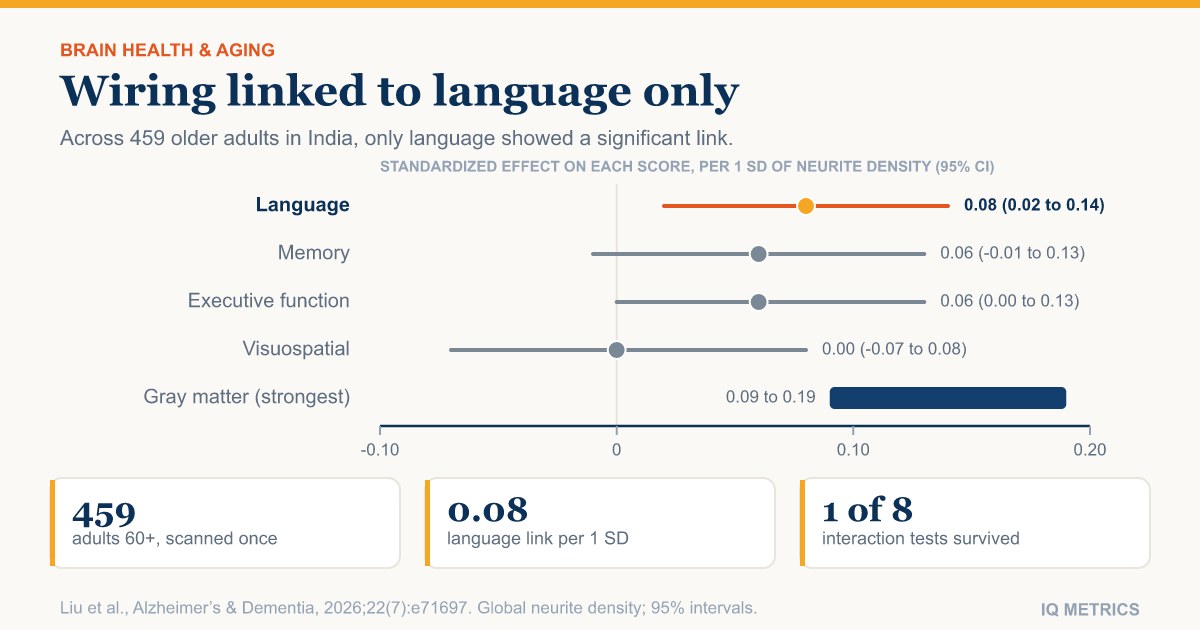
Headlines say healthy “wiring” shields the aging mind from gray-matter loss. The study behind them, 459 older adults in India scanned once, found a small link to language only, and it does not claim to have measured cognitive reserve.
Our IIF-certified assessment reports your score with its scale, percentile and confidence range — and a breakdown of the cognitive domains behind it.
Start IQ Test →