




IQ Tests in Job Interviews: What Employers Actually Use and Why
An IQ test for a job interview is usually branded a cognitive ability assessment, like the Wonderlic. What it actually measures, why a 1998 meta-analysis made employers take it seriously, whether it is legal, and how to prepare.

Yes, an IQ test for a job interview is a real thing at some employers — it just rarely goes by that name. What shows up in an application process is usually branded a “cognitive ability assessment,” an “aptitude test,” or a specific product name like the Wonderlic, and it measures largely the same general reasoning ability an IQ test does, scored and validated for a different purpose. This article covers what these tests actually are, why employers use them despite the controversy, which ones you are likely to see, whether they are legal, and how to prepare without wasting your time.
Is a hiring test really an "IQ test"?
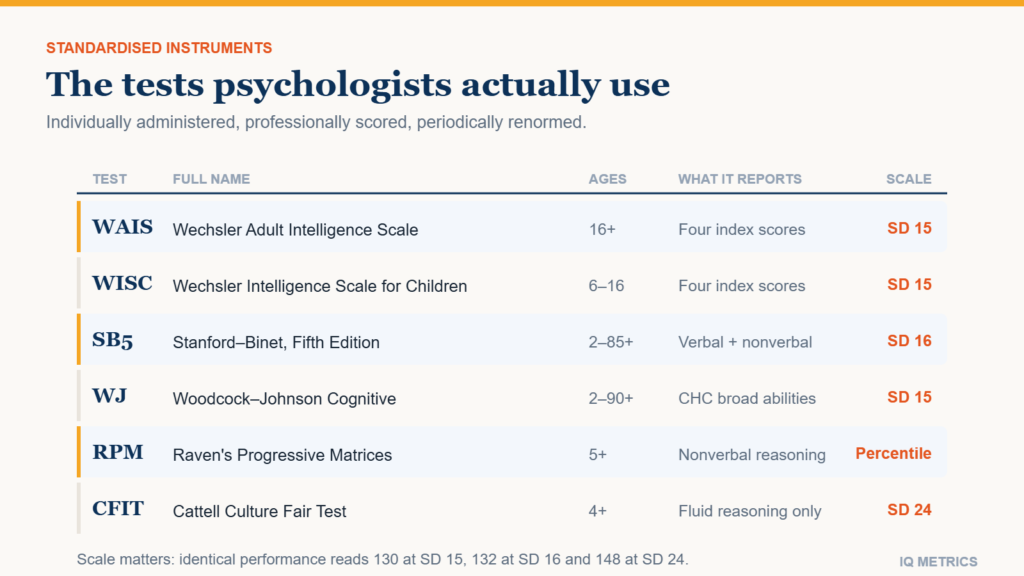
Not officially, and the distinction matters. A clinical IQ test like the WAIS is administered one-on-one by a trained psychologist, takes an hour or more, and is normed for diagnostic use. Professional IQ tests covers those instruments in detail. A pre-employment cognitive ability test is usually a short, timed, group- or online-administered instrument, validated specifically for predicting job performance rather than for clinical use — and employers avoid the term “IQ test” partly for the legal reasons covered further down.
Under the hood, both are measuring overlapping ground. Verbal reasoning, numerical reasoning and pattern recognition are common to nearly every test in the family built around the general factor of intelligence. That overlap is why a hiring test correlates with an IQ score even though it is scored and marketed as something else entirely.
Scoring also works differently in practice. A clinical IQ report compares one number against the general population. A hiring test more often reports a percentile against a role-specific norm group — other applicants for similar jobs — and many employers set a minimum threshold rather than ranking candidates by raw score past that point, specifically to avoid over-weighting small differences between two qualified people.
Why employers use them at all
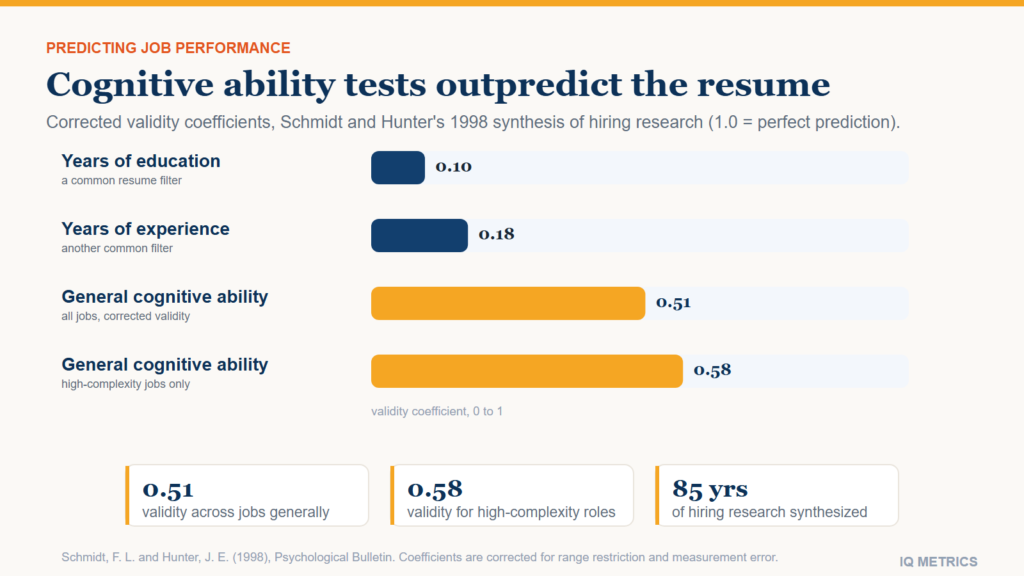
The case for cognitive testing in hiring rests on one of the more replicated findings in industrial psychology. In a 1998 synthesis of 85 years of selection research, Frank Schmidt and John Hunter found that general mental ability tests predicted job performance with a corrected validity of about 0.51 across jobs generally, rising to roughly 0.58 for high-complexity roles — the strongest single predictor they examined, ahead of work samples and structured interviews, and well ahead of the resume staples: years of education came in around 0.10 and years of experience around 0.18.
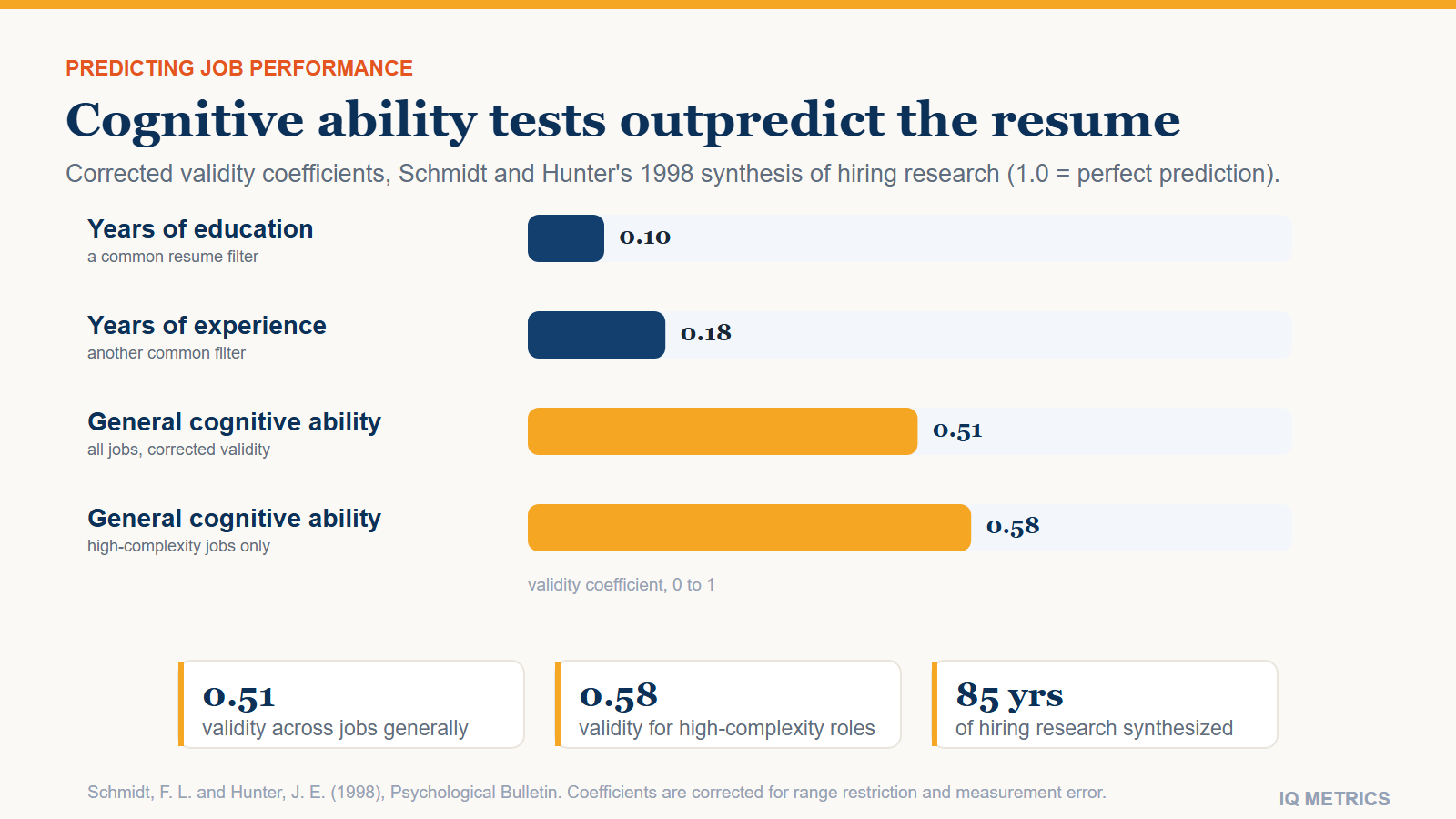
Put plainly, a candidate’s general cognitive ability score predicts how well they go on to perform in a role better than how many years they spent in school, or in a similar job, does. That is the finding employers who use these tests are leaning on. It is also the finding critics push back against, since a single, decades-old meta-analysis has limits: job performance ratings are themselves imperfect, and validity varies by role, by test, and by how the score actually gets used in the final decision.
Not every industrial psychologist agrees a single general-ability score is the best approach even where those numbers hold up. A competing view favors narrower, job-specific aptitude tests — a coding test for a software role, a numerical-reasoning test for an analyst role — on the theory that a task-matched measure adds useful signal on top of general ability without necessarily replacing it. In practice, many of the assessments candidates actually sit blend both approaches.
Which industries lean on these tests hardest
Cognitive ability testing shows up most visibly in a handful of settings. The NFL has administered the Wonderlic to draft prospects since the 1970s, less to predict who will play well than as one data point among many in an already expensive evaluation process. Quantitative trading firms and parts of finance use numerical-reasoning-heavy assessments as an early screen, on the theory that raw quantitative reasoning speed matters directly to the job. Large consulting firms and some technology employers use shorter, broader assessments earlier in the pipeline, often before a human reviews the resume at all, because the tests scale to thousands of applicants far more cheaply than early-round interviews do.
Where would your own score land?
Take the IIF-certified assessment and get your score with the scale it was measured on, the percentile it corresponds to and the confidence range around it — the three figures most online tests leave out.
Find your IQ score now! →Which tests you are likely to see
- Wonderlic Personnel Test — 50 questions in 12 minutes, widely used across industries and well known for its use in NFL prospect evaluation.
- Criteria Cognitive Aptitude Test (CCAT) — a similarly short, timed test common in corporate and tech hiring pipelines.
- Predictive Index Cognitive Assessment — another timed reasoning test, often paired with a separate personality or behavioral survey.
- In-house or platform-specific assessments — some large employers and hiring platforms build their own, but nearly all borrow the same verbal, numerical and abstract-reasoning item types.
Average IQ by occupation shows how scores have historically clustered by field, even though the underlying data there is decades old and scored on a different scale than any test in current use.
Is it legal to test candidates this way?
In the United States, yes, with real constraints. Cognitive ability tests can produce group score differences that draw legal scrutiny under adverse-impact rules; the four-fifths rule explains the specific ratio regulators use to flag a test result for a closer look, and whether IQ tests are legal for hiring covers the broader legal history, including Griggs v. Duke Power, the 1971 Supreme Court case that first required an employment test to be job-related rather than simply convenient. A test that is properly validated for a specific role can still be used lawfully even where it produces a group difference; one that is not validated is the version that draws legal trouble.
What a cognitive ability score actually predicts at work goes further into how employers are supposed to justify using one of these tests in the first place, which is worth reading before assuming a test you were asked to take is either clearly fair or clearly not.
A newer wrinkle is AI-scored and AI-proctored assessments, which raise similar adverse-impact questions in a new form; how AI agents and proctored hiring tests interact covers what is different about auditing an algorithmic scorer versus a fixed answer key.
How to prepare without wasting your prep time
Practice effects on cognitive ability tests are real but modest, and tend to plateau after a couple of exposures — enough to knock off first-time jitters and unfamiliarity with the item types, not enough to meaningfully raise the ceiling on a fixed reasoning ability. How to prepare for an IQ test covers the same territory in more depth. The highest-value prep for a timed hiring test specifically is usually: run through one full timed practice set of the actual item types — verbal analogies, number series, spatial pattern completion — so the format itself is not a surprise, get a full night’s sleep beforehand, and budget your time per question rather than getting stuck defending one answer. If a disability affects testing, most employers using a validated assessment are required to offer reasonable accommodations, such as extended time, on request — worth raising with a recruiter before the test date rather than after a low score.
It is also worth remembering what these scores do and do not mean for you personally. The importance of IQ tests in education and employment covers the wider picture; a single timed test is one input into one hiring decision, not a verdict on your intelligence, and even the strongest predictors in the Schmidt-and-Hunter numbers above leave roughly three-quarters of the variation in job performance unexplained by cognitive ability alone.
The bottom line
If a job posting mentions an assessment, an aptitude test, or a “cognitive” screening step, there is a good chance it is functionally a cognitive ability test even if the words “IQ test” never appear. The research case for using one is genuinely strong, the legal rules around using one responsibly are specific, and the most useful thing a candidate can do is show up rested, familiar with the format, and not over-invested in what one timed score says about them.
Keep reading
All articles →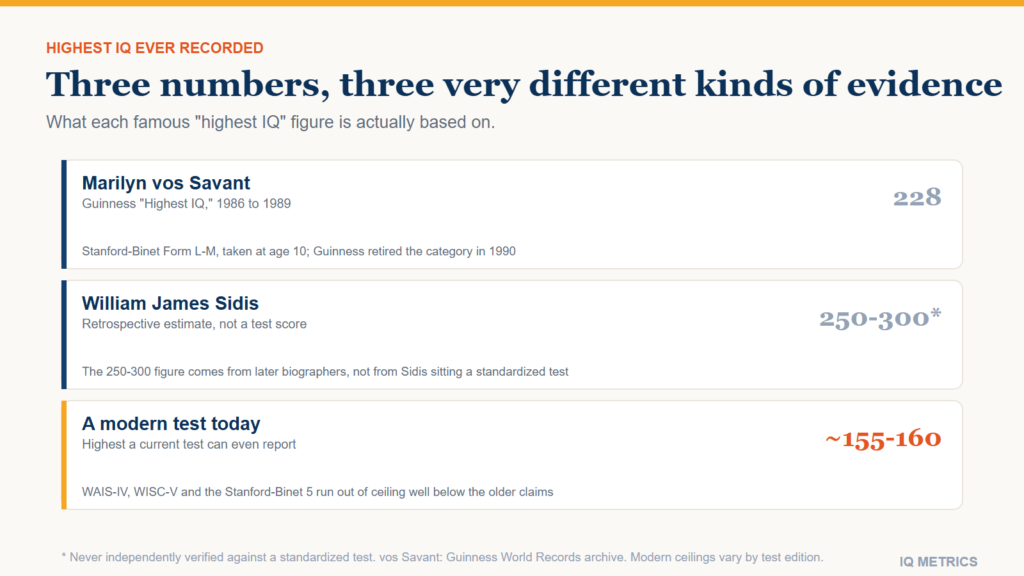 Scores & Scales
Highest IQ Ever Recorded
The highest IQ ever recorded is usually given as Marilyn vos Savant's 228 or William James Sidis's claimed 250 to 300 - neither from a test in use today. Where the famous numbers actually come from, and what a modern test can really report.
 Taking a Test
Professional IQ Tests
When a psychologist measures intelligence, they reach for one of a small number of standardised instruments. This guide covers what the Wechsler scales, Stanford-Binet, Woodcock-Johnson and Raven's Progressive Matrices each measure, who each one is for, and where an online test genuinely fits.
 Taking a Test
How to Prepare for an IQ Test?
Is your mind ready to be unleashed by mastering IQ tests? Our all-inclusive guide to IQ test success and mind mastery is your one-stop shop. To help you stand out and increase your IQ, this post contains expert advice, methods, and insights.