IIF Certified Assessment
Start IQ Test
IIF Certified Assessment
OnlineJobs.ph’s own test pages could not be opened for this article, so this piece covers what can be checked: how the cognitive tests employers use are built and scored, why a score is not an IQ, and what research says a score predicts.
If you searched for the OnlineJobs.ph IQ test, you probably want to know what it asks and what a good score is. OnlineJobs.ph, the Philippines-based job board where employers hire remote workers, appears in search listings with pages titled “IQ Test” and “Do I Need To Take Tests To Get Hired?”. Its pages returned a bot-check to our tools, so we could not read them, and this article does not state the site’s test provider, number of questions, time limit or scoring. What we can do is explain what the cognitive tests employers use in hiring measure, how their scores are reported, and what research says a score predicts. Before relying on any figure quoted elsewhere for the OnlineJobs.ph test, look for it on the site’s own page.
Publishers document their formats, so two well-known examples can be checked. The Criteria Cognitive Aptitude Test (CCAT) gives candidates up to 50 questions in a 15-minute limit, and most do not finish all 50. It measures three abilities: spatial reasoning, verbal ability, and maths and logic. The report shows a raw score out of 50 plus a percentile, with a percentile for each of the three areas; in Criteria’s sample report a raw score of 24 sits at the 50th percentile. Criteria describes the test as cognitive aptitude, often referred to as general intelligence or g. It draws on a large item bank, so candidates get different question sets, and it can be taken unsupervised on any device.
Wonderlic’s cognitive test is described on the publisher’s page as 50 questions with 12 minutes to answer, covering simple maths, basic logic, language comprehension, spatial reasoning and pattern identification. The page we read does not state a score scale or call the result an IQ; figures such as an average score of about 20 circulate on third-party sites, which we could not verify. Both tests reward speed as well as accuracy, which is why most people cannot finish. Our piece on Wonderlic scores and IQ shows how far a raw score can be stretched into an IQ.
Not by itself. A raw score out of 50 is a count of correct answers within a time limit. A percentile ranks you against a comparison group chosen by the publisher or the employer. An IQ is a standard score with a stated mean and standard deviation, usually 100 and 15, taken from a norm sample. A percentile can be turned into an IQ-scale equivalent through its z-score (see our guide to IQ z-scores), but only if the comparison group is the general population:
A percentile against a pool of job applicants, or against people in one occupation, sits at a different place on the IQ scale, so the same percentile can mean a different IQ. The percentile calculator shows the conversion for any score on the standard scale.
We also found no published norm data for Filipino test takers on either the CCAT or Wonderlic. A percentile from one of them therefore says nothing certain about how you compare with other applicants in the Philippines, so ask the employer which group the percentile refers to.
A percentile only means something against the group it was measured in.
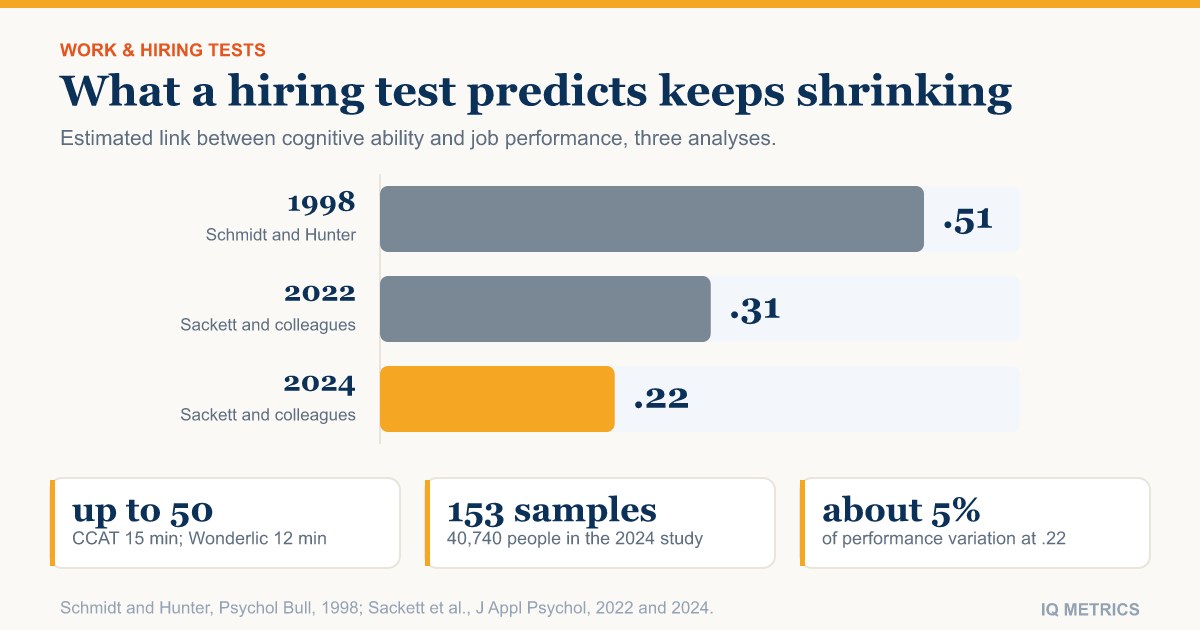
The classic figure comes from Schmidt and Hunter (Psychological Bulletin, 1998), who reported an operational validity of .51 for general mental ability, corrected for measurement error in performance ratings and for range restriction, and .28 before the corrections. Range restriction is the statistical problem that people who were hired scored higher than typical applicants, so a study sees only part of the range. Sackett, Zhang, Berry and Lievens (Journal of Applied Psychology, 2022) argued that the validity of many selection procedures had been substantially overestimated, with mean validity estimates reduced by .10 to .20 points, and that structured interviews, not cognitive tests, ranked first. They traced much of the gap to over-correction for range restriction.
A 2024 paper by Sackett, Demeke, Bazian, Griebie, Priest and Kuncel (Journal of Applied Psychology 109(5), 687-713) looked at 21st-century studies only: 153 samples and 40,740 people, a mean observed validity of .16 and a corrected validity of .22. The authors put the 2022 estimate for general cognitive ability at .31 and concluded that cognitive ability relates to job performance but by less than earlier estimates suggested. Our own summary of the 2022 debate is in what a cognitive ability test at work predicts.
Want a proper IQ-scale score to compare against? Take the IQ Metrics test and read your result as a percentile.
Find your IQ score now! →The safest reading of any hiring test is narrow. It samples a few reasoning skills under time pressure and ranks you against a group. To see how a percentile lands on the IQ scale for yourself, take the IQ test, then use the score converter to see it on other scales.
Search listings show pages titled “IQ Test” and “Do I Need To Take Tests To Get Hired?” on OnlineJobs.ph, but the site blocked our tools from reading them, so we cannot confirm the provider, length, scoring or whether any employer requires it. Check the page itself.
Up to 50 questions in 15 minutes, and most candidates do not finish. It covers spatial reasoning, verbal ability, and maths and logic, and reports a raw score out of 50 with a percentile.
No. A raw score counts correct answers in a time limit and a percentile ranks you against a comparison group. An IQ is a standard score with a stated mean and standard deviation from a norm sample.
Modestly. Estimates of the correlation fell from .51 (Schmidt and Hunter, 1998) to about .31 (Sackett and colleagues, 2022) and .22 in a 2024 study of 21st-century samples, which is roughly 5% of the variation in performance.
There is no universal cut-off. A good score is relative to the comparison group and the job, and employers set their own thresholds, if any. In Criteria’s sample report a raw score of 24 out of 50 marks the 50th percentile.
Corrections: spotted an error? Email corrections@iqmetrics.org and we will update this story and note the change here.
Aptitude tests are among the better-studied hiring tools, and for decades the headline validity figures were quoted with more confidence than the corrections behind them deserved. A 2022 reanalysis pulled those numbers down.
The formula circulating online multiplies a Wonderlic score by two and adds sixty. It comes from no published conversion table, and the number it produces is not an IQ in the sense any test manual uses the word.
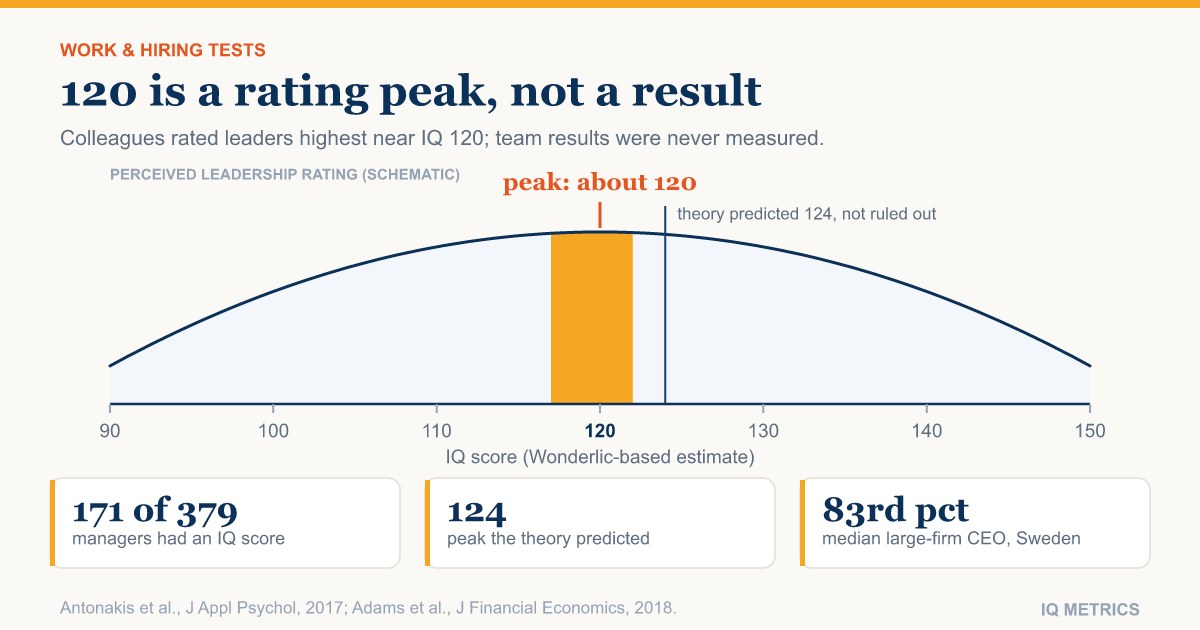
A 2017 study found that colleagues' ratings of leaders peak near IQ 120 and then dip. It measured how others rated mid-level managers, not how their teams performed, and larger datasets on real outcomes show no such ceiling.
Our IIF-certified assessment reports your score with its scale, percentile and confidence range — and a breakdown of the cognitive domains behind it.
Start IQ Test →