





What Does an IQ of 125 Mean? Percentile and Accuracy
An IQ of 125 is about 1 person in 21 on a standard deviation 15 scale, the 95th percentile and one band below most gifted cutoffs. See how rare it is, what “Superior” means, how accurate a single score is, and what it predicts.

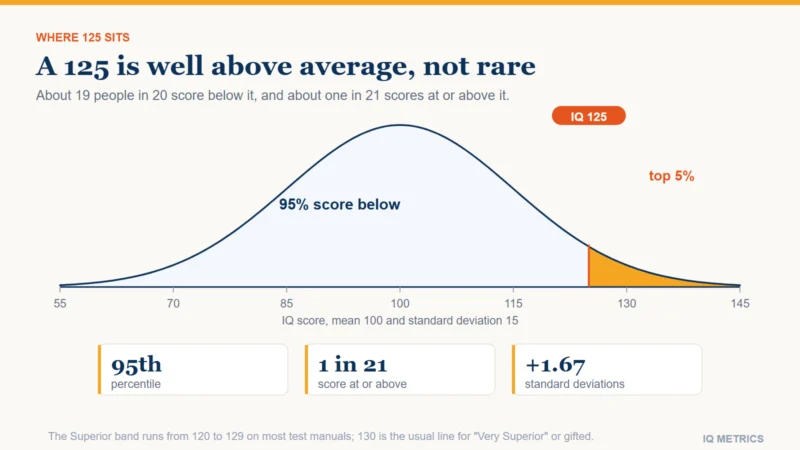
An IQ of 125 is well above average but not rare enough to count as gifted. On a test scaled to a mean of 100 and a standard deviation of 15 — the scale used by the Wechsler tests and the current Stanford–Binet — a 125 sits 1.67 standard deviations above the mean, at about the 95th percentile. Roughly one person in 21 scores 125 or higher. That places it inside the band most test manuals call “Superior”, one full band below the “Very Superior” line at 130 that most sources use for “gifted”. This article covers how rare 125 really is, what the classification bands mean, how much a single 125 can be trusted, and what it does and does not predict.
- Rarity: about 1 in 21 people score 125 or higher on a standard deviation 15 scale, the 95th percentile.
- Classification: most Wechsler-family manuals label 120 to 129 “Superior”, one band below the 130-and-up line commonly used for “gifted”.
- Accuracy: a reported 125 on a reliable test has an expected true score around 124, with a 95% range of roughly 117 to 131.
- Prediction: this range links to somewhat better odds of finishing a demanding degree or entering a skilled profession, on average across large groups — not a guarantee for any one person.
How rare is an IQ of 125?
On a normal curve with a mean of 100 and a standard deviation of 15, a score of 125 sits at z = +1.67. About 4.75% of people score that high or higher, which works out to about 1 in 21. Applied to a world population of roughly 8.2 billion, that implies somewhere near 390 million people, though almost none of them have ever taken a test that could confirm it. The IQ percentile calculator places any score on the same curve, and the IQ scale by age page covers how the same raw ability compares across ages.
| IQ score | Percentile | About 1 person in |
|---|---|---|
| 110 | 74.75 | 4 |
| 115 | 84.13 | 6 |
| 120 | 90.82 | 11 |
| 125 | 95.22 | 21 |
| 130 | 97.72 | 44 |
| 135 | 99.02 | 102 |
| 140 | 99.62 | 261 |
Equal steps in score are not equal steps in rarity. Moving from 100 to 110 passes about a quarter of the population; moving from 115 to 125 passes only about another 11%. The IQ of 120, IQ of 135 and IQ of 140 articles cover the neighbouring bands in the same way.
What is a 125 on other IQ scales?
A bare number means little without its scale. The Wechsler tests and the current Stanford–Binet use a standard deviation of 15, but older and alternative scales spread scores further, so the same underlying rarity prints a different number on each one. A result with the same 1-in-21 rarity as a Wechsler 125 would print as roughly 127 on the older Stanford–Binet Form L-M scale (standard deviation 16), and roughly 140 on one of Cattell’s scales (standard deviation 24). This is one reason two people who sat different tests should never compare raw numbers directly; the standard deviation 15 versus 16 explainer covers the mechanics, and the IQ scale by age page shows how the same ability can also read differently depending on the age norms used.
| Scale | Standard deviation | Score with the same 1-in-21 rarity |
|---|---|---|
| Wechsler tests, Stanford–Binet 5 | 15 | 125 |
| Stanford–Binet Form L-M | 16 | ~127 |
| Cattell scales | 24 | ~140 |
Is an IQ of 125 the same as being “gifted”?
Not on most definitions, though the line moves depending on who is drawing it. Test manuals typically reserve “Very Superior” or “Extremely High” for 130 and above, and many gifted-education programmes set their cutoff there too. Others set it lower, sometimes 120, so a 125 qualifies for admission in some school systems and not in others. Gifted cutoff scores covers how much these lines vary, and is 130 genius and what counts as a genius-level IQ go further up the scale. A 125 sits in the “Superior” band on most Wechsler-based tables: clearly above average, one notch below the line most people mean by “gifted”.
How accurate is a single score of 125?
Every score carries measurement error, and psychologists correct for it with Kelley’s formula: the expected true score is 100 plus the test’s reliability times the distance of the observed score from 100. For a good test with a reliability of 0.95, an observed 125 implies an expected true score of about 124, with a 95% range of roughly 117 to 131. A less reliable test, such as a short online quiz, widens that range considerably. The pattern is regression to the mean: a person who scores 125 is, on average, a little less exceptional than the raw number suggests, and a retest on a different instrument tends to land a little closer to 100. See regression to the mean and how to read an IQ test report for the same arithmetic applied elsewhere.
Where would your own score land?
Take the IIF-certified assessment and get your score with the scale it was measured on, the percentile it corresponds to and the confidence range around it — the three figures most online tests leave out.
Find your IQ score now! →What does an IQ of 125 predict?
At the population level, scores in this range associate with somewhat better odds of completing a demanding degree and entering a skilled profession, but the relationship is a group average, not a rule for any one person. Effort, opportunity, personality and plain circumstance carry much of the rest, which is why some people with lower scores outperform people who scored 125, and why the correlation between IQ and later outcomes, while real, is far from perfect. Does IQ predict school success? and talent versus practice cover how much of the rest depends on factors a test cannot see.
Where a score around 125 tends to show up
Scores in the low-to-mid 120s are unremarkable in settings that already select for academic or professional achievement, which is part of why the number feels more common in some contexts than the population-wide 1-in-21 rarity suggests. Selective university programmes, graduate study and many licensed professions draw disproportionately from people who score above average on cognitive measures, simply because admissions and training filter on related skills such as verbal and quantitative reasoning. That selection effect is also why a 125 can feel ordinary inside a specific workplace or classroom while still sitting in the top 5% of the general population. Mensa’s IQ requirements sit well above this range, at the top 2%, which is one reason a 125 does not qualify on its own.
Quick answers
- Is 125 a good IQ? Yes. It is about 25 points above average, in the top 5% of scores on a standard deviation 15 scale.
- Is an IQ of 125 gifted? Usually not by the most common cutoff of 130, though some programmes set the line at 120.
- What percentile is an IQ of 125? About the 95th, roughly 1 person in 21.
- Is 125 higher than average? Yes, 25 points above the mean of 100.
- Can an online test accurately report a 125? A short unsupervised test can print a number, but with wider error than an individually administered test; see IQ test accuracy.
- Does an IQ of 125 qualify for Mensa? No. Mensa requires scoring in the top 2%, roughly 132 on a standard deviation 15 scale, well above 125.
- Will an IQ of 125 change if retested? A little, usually. Retesting on the same instrument tends to nudge scores up through familiarity, and testing on a different instrument can move a score a few points in either direction; treat any single number as an estimate, not a fixed trait.
The bottom line
An IQ of 125 means about 1.67 standard deviations above average on a standard deviation 15 scale: the 95th percentile, roughly 1 person in 21, and squarely inside the “Superior” band just below most gifted cutoffs. Treat it as a range in the high 110s to low 130s rather than an exact point, and as one input among many for judging ability, not the whole picture.
Sources
- Wechsler test manuals (WAIS–IV, WISC–V): standard qualitative classification table, “Superior” for 120 to 129 and “Very Superior” for 130 and above.
- National Association for Gifted Children: published guidance noting that gifted identification criteria, including IQ cutoffs, vary by school district and state.
Keep reading
All articles →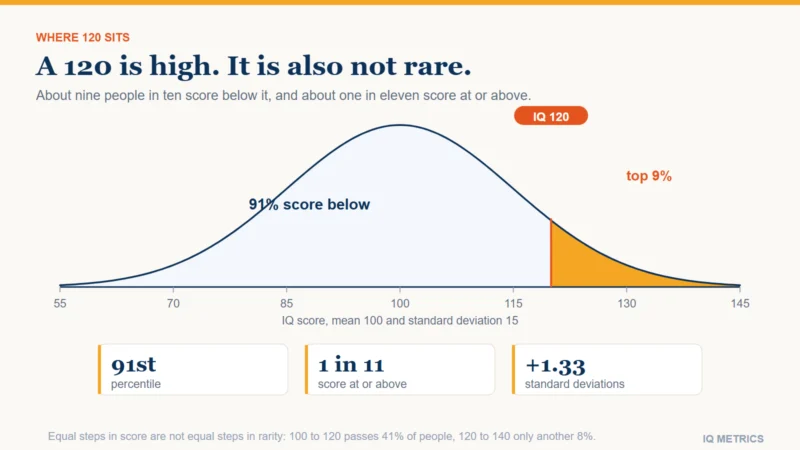 Scores & Scales
Is a 120 IQ High?
A score of 120 sits comfortably above average, and roughly nine people in ten score below it. But "high" is a comparison, not a property, and the honest answer depends on which scale produced the number, how much error is wrapped around it, and what you were hoping the score would tell you.
 Scores & Scales
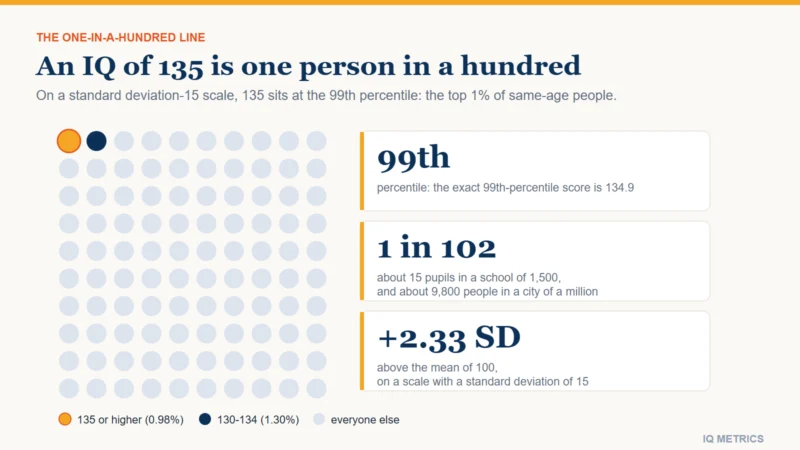
What an IQ of 135 Means
An IQ of 135 is the 99th percentile: one person in 102 on the Wechsler scale, but only 1 in 14 on the Cattell scale. Rarity of every score from 130 to 139, the cut-off Terman really used, how precise a 135 is, and what it predicts.
 Scores & Scales
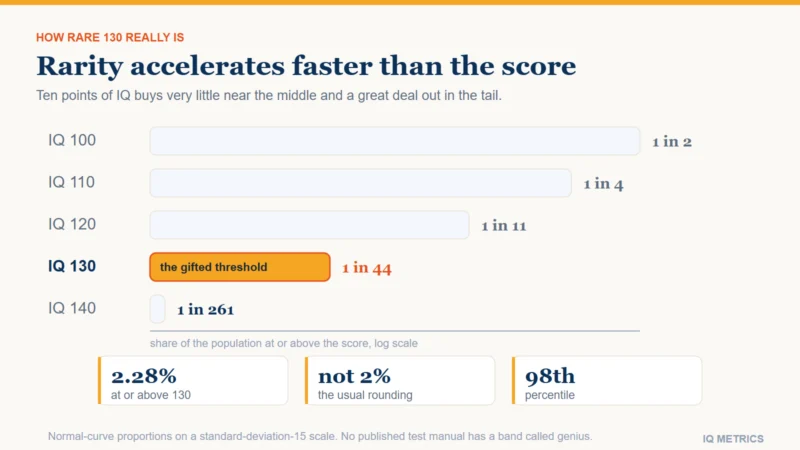
Is 130 IQ a Genius Score?
A score of 130 is the conventional threshold for gifted identification and for high-IQ society membership, and it is reached by about one person in 44. It is not, however, a "genius" score, because no published test defines such a band. The word is a popular import, and the difference is worth understanding.