





Is Intelligence Inherited From Mother or Father? What the Evidence Shows
Is intelligence inherited from mother or father? From both. A review of 111 family studies found mothers and fathers resemble their children in IQ equally (.41 each). See where the X-chromosome claim came from, why it fails, and how much IQ parents pass on.

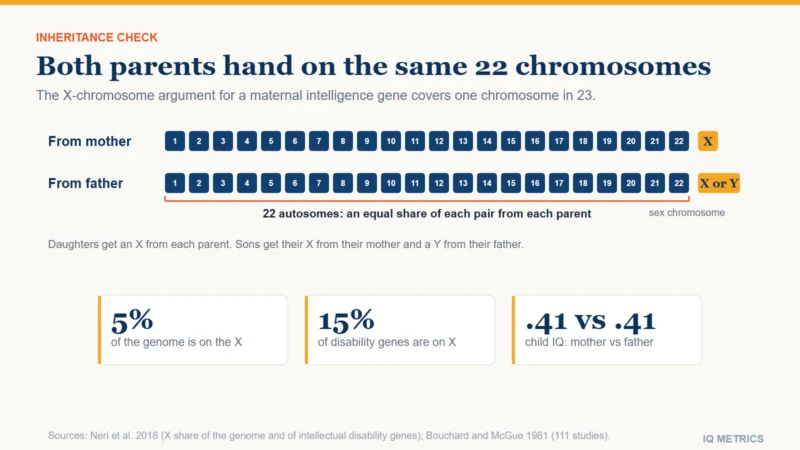
Is intelligence inherited from mother or father? From both. A review of 111 family studies found that mothers’ IQ scores resembled their children’s about as closely as fathers’ did (a correlation of .41 for each), and that sons resembled their fathers as much as their mothers. The claim that intelligence comes mainly from the mother traces to a 1972 X-chromosome hypothesis, a mouse experiment and a misread breastfeeding study, and none of them shows that a normal IQ comes from one parent. This guide covers where the idea started, what the X chromosome really does, what family and DNA studies find, and how much of a child’s IQ you can predict from the parents’ scores.
- Family data: children reared with their parents resemble mothers and fathers equally, .41 each, across 111 studies (Bouchard and McGue, 1981).
- The X chromosome: about 5% of the genome but about 15% of the genes known to be associated with intellectual disability, which is where the myth gets its foothold.
- DNA studies: two large analyses found 205 and 148 genome-wide loci for intelligence, many small effects; the X chromosome is often left out of such scans.
- Real parent-of-origin effects exist (Prader-Willi and Angelman syndromes) but concern specific disorders, not everyday differences in IQ.
Where the claim that intelligence comes from the mother started
The idea has three separate roots, and most retellings blend them together.
- An X-linkage hypothesis (1972). Lehrke’s paper “A theory of X-linkage of major intellectual traits”, in the American Journal of Mental Deficiency, argued that genes on the X chromosome shape intelligence. A son receives his only X from his mother, so an X-linked trait looks maternal in sons.
- A mouse experiment (1996). Keverne and colleagues built chimeric embryos from cells carrying either a duplicated maternal genome or a duplicated paternal genome. The maternal-genome cells contributed to the cortex, striatum and hippocampus; the paternal-genome cells contributed to the hypothalamus and not the cortex. It is animal work on brain structure, and it measured no intelligence.
- A breastfeeding study (2006), misread in 2016. In September 2016 a viral post claimed that a Glasgow study showed children’s IQs track their mothers’ within 15 points. Snopes rated the claim “Unproven”. KQED reported that Geoff Der, a co-author of the Glasgow group’s paper on breastfeeding and intelligence, said the 15-point figure could not have come from that study, which had no data on fathers’ intelligence.
The Glasgow paper (Der, Batty and Deary, BMJ, 2006) used 5,475 children of 3,161 mothers in a US national survey and asked something different: does breastfeeding raise a child’s IQ? It concluded that breastfeeding has little or no effect on intelligence once the mother’s IQ is accounted for. That is a finding about a confounder, not about mothers being the source of intelligence.
What the X chromosome really does
The X-linkage idea is not invented from nothing. The X chromosome makes up only about 5% of the human genome, yet it accounts for about 15% of the genes currently known to be associated with intellectual disability; the number of X-linked intellectual disability genes rose from 72 to 141 in the ten years to 2017 (Neri and colleagues, 2018). X-linked causes account for roughly 5 to 10% of intellectual disability in males (Lubs and colleagues, 2012). Males have a single X, so a harmful variant on it has no second copy to cover for it; Zechner and colleagues (2001) report that the incidence of mental disability is about 30% higher in males than in females. From their count of disability genes by chromosome they proposed that X-linked genes exert a large effect on general intelligence.
Two things stop that from becoming “intelligence comes from your mother”. First, a gene that causes disability when it is broken is not the same as a gene that explains differences in the normal range; those involve very many small effects, covered below. Second, X-linkage makes a testable prediction. A father passes his only X to every daughter and none to his sons, and daughters also receive an X from their mother. If normal differences in intelligence lived on the X, fathers and daughters should resemble each other more than fathers and sons do. Family data can check that.
What family studies show: mothers and fathers resemble their children equally
The largest review of IQ resemblance between relatives pooled 111 studies (Bouchard and McGue, 1981). For children reared with their parents, the weighted mean correlation between a mother’s IQ and her child’s was .41 (25 correlations, 5,660 pairs). For fathers it was also .41 (22 correlations, 5,497 pairs). The reviewers noted that same-sex and opposite-sex pairings gave equivalent averages and that the average mother-offspring correlation matched the father-offspring one.
| Pairing | Correlations (pairs) | Median r | Weighted mean r |
|---|---|---|---|
| Mother and daughter | 10 (1,804) | .44 | .43 |
| Mother and son | 12 (2,802) | .37 | .39 |
| Father and daughter | 10 (1,658) | .46 | .39 |
| Father and son | 14 (2,843) | .40 | .38 |
| All mother-child pairs | 25 (5,660) | .38 | .41 |
| All father-child pairs | 22 (5,497) | .43 | .41 |
If intelligence sat on the X, the father-son correlation would be the lowest by a wide margin, because sons get no X from their father. It is .38, against .39 for mother and son. The reviewers concluded that the absence of any demonstrable sex effect fits a polygenic account of inheritance, with no sex linkage. One caution: these children grew up with their parents, so the figures mix the genes parents pass on with the home they provide. Twin studies, which separate the two better, are covered in our news piece on twin studies and IQ heritability and our guide Is IQ genetic?.
What DNA studies show: hundreds of small effects
Genome-wide association studies scan the DNA of very large groups for variants linked to test scores. A 2018 analysis of 269,867 people found 205 genomic loci and 1,016 genes associated with intelligence (Savage and colleagues). Another, of 300,486 people, found 148 independent loci and 709 genes, and polygenic scores built from it predicted up to 4.3% of the variance in general cognitive function in independent samples (Davies and colleagues, 2018). The picture is many small effects spread across the genome, not a handful of genes on one chromosome. Our news piece on embryo screening for low IQ shows how limited such scores are for predicting one person.
The X chromosome is the caveat. It is commonly left out of these scans: a review of GWAS papers published in 2010 and 2011 found that only 33% (242 of 743) reported including it (Wise and colleagues, 2013). So what the scans can say about the X is limited. Studies that do analyse it point to a modest share: across 48 traits in 343,695 UK Biobank participants the X chromosome contributed about 3% of the autosomal heritability (Fu and colleagues, 2025), and across 20 traits its SNP-based heritability averaged 0.63% in men and 0.30% in women (Sidorenko and colleagues, 2019). Those are averages over many traits, not intelligence-specific estimates, so read them as a sense of scale: a real but small role, and nothing that makes intelligence maternal.
Genetic nurture: what parents pass on without passing on DNA
Parents shape a child through the DNA they transmit and through the environment their own genes help create. A study of 21,637 people with at least one genotyped parent found that alleles the parents did not transmit still affected the child’s educational attainment, with an effect 29.9% as large as that of the transmitted alleles (Kong and colleagues, 2018). The authors call it genetic nurture. Paternal and maternal polygenic scores had similar effects on educational attainment, while mothers contributed more than fathers to nutrition- and health-related traits.
That last point is where the mother genuinely stands out, and it is environmental, not a gene for intelligence. She carries the pregnancy: our guides to prenatal smoking and IQ, breastfeeding and IQ and premature birth and IQ cover what that does and does not change. The breastfeeding example is instructive: before adjustment it was associated with about 4 points of mental ability, and after adjusting for the mother’s IQ and other confounders the effect fell to 0.52 points and was not statistically significant (Der and colleagues, 2006). Maternal IQ, not breastfeeding, carried most of the association. See also socioeconomic status and IQ.
Where would your own score land?
Take the IIF-certified assessment and get your score with the scale it was measured on, the percentile it corresponds to and the confidence range around it — the three figures most online tests leave out.
Find your IQ score now! →Real parent-of-origin effects: genomic imprinting
A few genes really are switched on from only one parent’s copy, a process called genomic imprinting, and losing that copy has large effects. In Prader-Willi syndrome, most cases (about 70%) arise when a segment of the paternal chromosome 15 is deleted. In Angelman syndrome the maternal copy of the UBE3A gene is lost, leaving no active copy in most parts of the brain (MedlinePlus). Both are specific syndromes, not the ordinary variation that IQ tests measure.
The one human finding that connects imprinting to the X chromosome points the other way. In Turner syndrome a girl has a single X. A 1997 study of 80 females (55 with a maternally derived X, 25 with a paternal one) found the paternal-X group better adjusted, with superior verbal and higher-order executive-function skills, although intelligence is usually normal in Turner syndrome; the proposed locus, for social cognition, was not expressed from the maternal X (Skuse and colleagues, 1997). If anything, that favours the father’s X, and it concerns a social-cognitive trait, not IQ.
How much of a child's IQ can you predict from the parents'?
Regression to the mean does most of the work. In the same 111-study review, a single parent’s IQ correlated .42 with a child’s and the average of both parents correlated .50; spouses correlated about .33 in that review and about .40 in a later summary (Plomin and Deary, 2015). Combining those numbers in a simple straight-line, bell-curve model gives the expectations below. The table is our arithmetic, not a study result: expected child IQ = 100 + slope × (parents’ IQ − 100), with a slope of .42 for one parent and about .61 for the average of two (the .50 correlation divided by the narrower spread of two-person averages), and a spread of 13 to 14 points around the expectation.
| Parents' IQ | Expected child IQ | Range for about two children in three |
|---|---|---|
| One parent at 130 | 113 | 99 to 126 |
| Both parents at 130 | 118 | 105 to 131 |
| Both parents at 115 | 109 | 96 to 122 |
| Both parents at 100 | 100 | 87 to 113 |
| Both parents at 85 | 91 | 78 to 104 |
| Both parents at 70 | 82 | 69 to 95 |
The last column is the point. Even two parents at 130 have children who range from about 105 to about 131, and children of the same parents differ. It also explains why very high or very low scores in one generation are followed by scores nearer 100 in the next: see regression to the mean for the mechanics and assortative mating and IQ for why couples tend to match. Family studies of this kind rely on individually administered tests such as the Stanford-Binet and the Wechsler scales; our guide to the WPPSI-IV covers the preschool version.
Quick answers
- Is intelligence inherited from the mother or the father? From both. Family studies find equal mother-child and father-child resemblance (.41 each), and most of the DNA involved sits on chromosomes both parents pass on.
- Do sons inherit intelligence from their mothers? Not more than from their fathers: in the 111-study review the weighted mother-son and father-son correlations were .39 and .38.
- Do children inherit intelligence from the mother only? No. Snopes rated the claim Unproven, and the X-linkage and mouse-imprinting arguments do not extend to normal IQ.
- How much of IQ is inherited? Heritability estimates rise from about 20% in infancy to perhaps 80% in later adulthood (Plomin and Deary, 2015). It describes differences across a population, not the share of one person’s IQ that is genetic.
- Can two bright parents guarantee a bright child? No. Expect a child somewhat closer to average, with a wide range around that expectation.
- Does the mother matter more? Through pregnancy and the early environment she can, but not through a special intelligence gene.
The bottom line
Intelligence is inherited from both parents. The mother-only story rests on an X-chromosome hypothesis that family data do not support, a mouse study of brain structure, and a breastfeeding paper that was misquoted. The X does carry many disability genes, imprinting does exist, and mothers do shape the prenatal and early environment, but none of that makes a typical IQ maternal. For a child, the practical reading is modest: parents’ scores predict a child’s only partly, and the result regresses toward the average.
Sources
- Bouchard, T.J. and McGue, M. (1981): familial studies of intelligence, a review of 111 studies (Science).
- Neri, G. et al. (2018): X-linked intellectual disability update 2017.
- Lubs, H.A. et al. (2012): fragile X and X-linked intellectual disability.
- Zechner, U. et al. (2001): a high density of X-linked genes for general cognitive ability?
- Savage, J.E. et al. (2018): genome-wide association meta-analysis of intelligence in 269,867 individuals.
- Davies, G. et al. (2018): 148 independent loci for general cognitive function in 300,486 individuals.
- Wise, A.L., Gyi, L. and Manolio, T.A. (2013): eXclusion, integrating the X chromosome in GWAS.
- Fu, Y. et al. (2025): role of the X chromosome in complex trait genetics.
- Sidorenko, J. et al. (2019): X-linked dosage compensation and complex trait variation.
- Kong, A. et al. (2018): the nature of nurture.
- Der, G., Batty, G.D. and Deary, I.J. (2006): breastfeeding and intelligence in children (BMJ).
- Keverne, E.B. et al. (1996): genomic imprinting and parental genomes in brain development.
- Skuse, D.H. et al. (1997): an imprinted X-linked locus affecting cognitive function in Turner syndrome.
- Lehrke, R. (1972): a theory of X-linkage of major intellectual traits.
- Plomin, R. and Deary, I.J. (2015): genetics and intelligence differences, five special findings.
- Snopes fact check and KQED, September 2016: how the viral claim spread.
- MedlinePlus, Prader-Willi syndrome and Angelman syndrome.
Keep reading
All articles →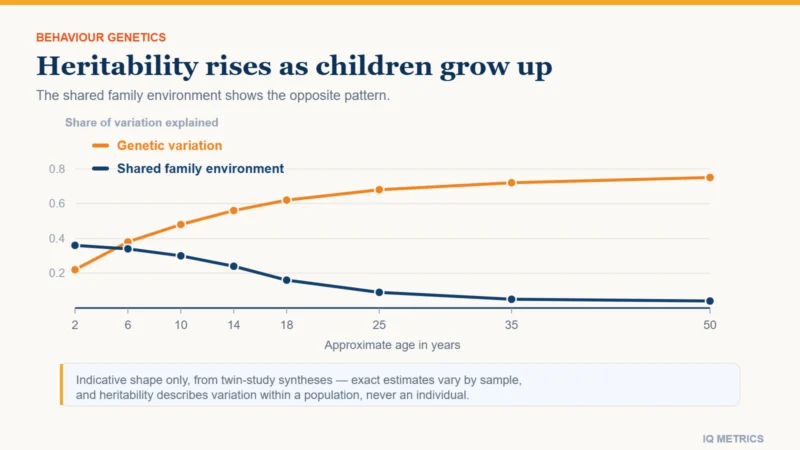 Research & Evidence
Is IQ Genetic?
Heritability estimates for IQ rise from roughly 0.4 in childhood to 0.7 or higher in adulthood, which sounds decisive until you know what heritability measures. Here is what twin and adoption studies actually show, and the four conclusions people draw from them that the statistic does not support.
 Research & Evidence
Assortative Mating and IQ
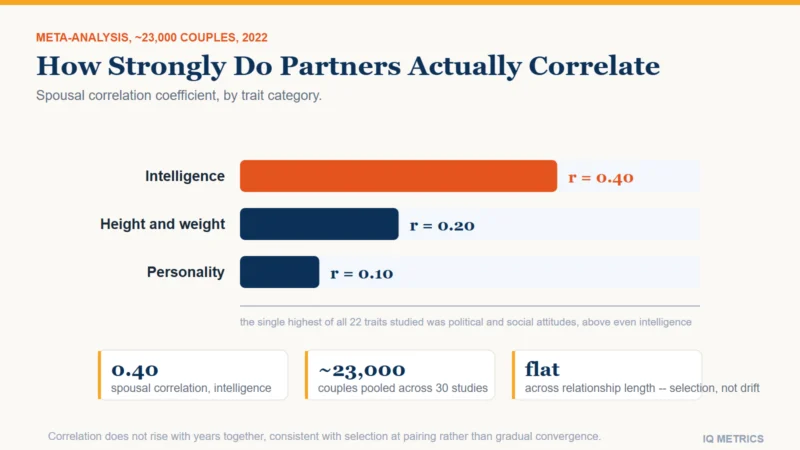
Married and long-term partners score more alike on IQ than on almost any other trait psychologists measure, personality included. The correlation is about 0.40, it shows up before the relationship starts, and it has real downstream effects on how heritability studies get interpreted.
 Research & Evidence
Breastfeeding and IQ
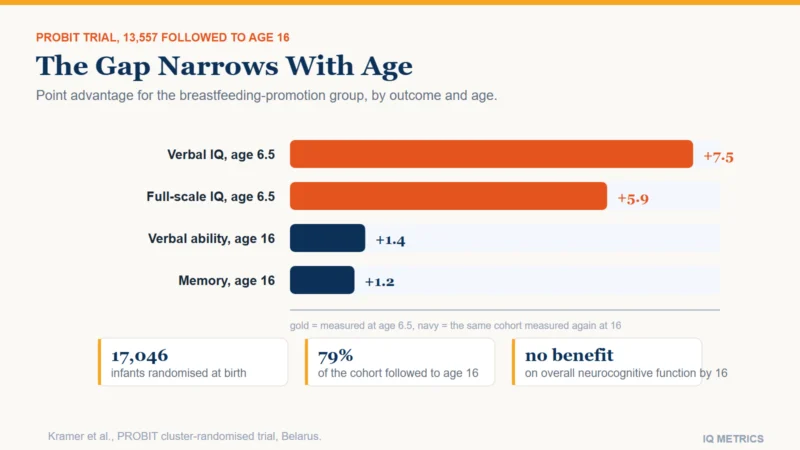
The largest randomized trial ever run on breastfeeding found a genuine IQ advantage at age six -- about six points on full-scale IQ. By age sixteen, the gap on most measures had shrunk close to zero. Here is what the trial actually measured, and why it still beats every observational study that came before it.