





Stanford-Binet IQ Test (SB5): Scores, Subtests and Age Range
The Stanford-Binet IQ test (SB5) covers ages 2 to 85+ with ten subtests, a mean of 100 and SD 15. See its history, how scores and labels work, why older forms used SD 16, how it differs from the Wechsler tests and which societies accept it.

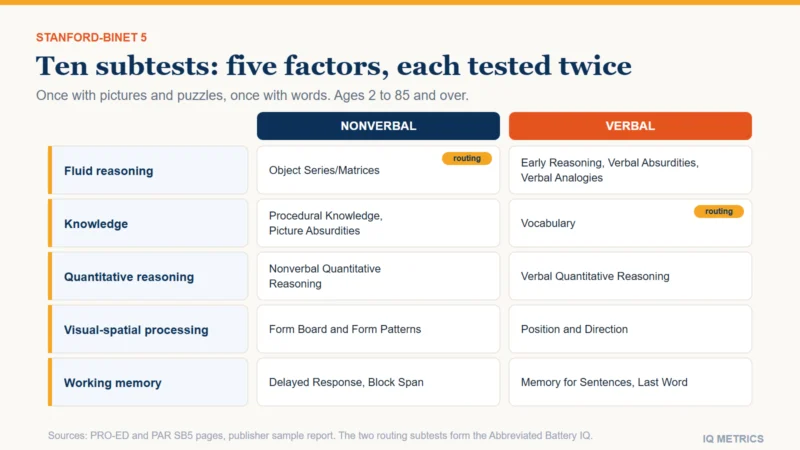
The Stanford-Binet IQ test, formally the Stanford-Binet Intelligence Scales, Fifth Edition (SB5), is an individually administered intelligence test for ages 2 to 85 and over, written by Gale Roid and published in 2003. It has ten subtests: a verbal and a nonverbal test for each of five factors (fluid reasoning, knowledge, quantitative reasoning, visual-spatial processing and working memory). Scores use a mean of 100 and a standard deviation of 15, so an SB5 result reads on the same scale as a Wechsler score. This guide covers the history from Binet’s 1905 scale, the ten subtests, how scores and labels work, the older standard deviation of 16 and what it does to a printed number, how the SB5 compares with the Wechsler tests, which high-IQ societies accept it, and its limits.
- Ages: 2 to 85+ in a single battery.
- Structure: ten subtests; Full Scale, Nonverbal, Verbal and Abbreviated Battery IQs plus five factor indexes.
- Norms: 4,800 people, matched to US Census figures for 2000.
- Scale: IQ mean 100, standard deviation 15 (subtests: 10 and 3). Older forms used 16.
- Range: an Extended IQ scale supports scores below 40 and above 160, up to 225.
- Time: about 50 minutes for all ten subtests, one to one with a trained examiner.
What is the Stanford-Binet test?
The name joins two people. Alfred Binet, a French psychologist, built the first practical intelligence scale with Théodore Simon in 1905. Lewis Terman, at Stanford University, revised it for American children in 1916, and the Stanford-Binet has been revised several times since. The current edition is the SB5. It is sold by PRO-ED as an individually administered kit at test level C, which limits it to trained examiners, and it is used in clinical, school and gifted evaluations. Our overview of professional IQ tests places it beside the Wechsler and Woodcock-Johnson families; the Woodcock-Johnson guide and the news explainers on WAIS index scores and WISC-V index scores cover the other main batteries.
A short history: from Binet to the SB5
| Year | Milestone |
|---|---|
| 1905 | Binet and Simon publish the first practical intelligence scale in France, revised in 1908 and 1911. |
| 1912 | William Stern proposes expressing intelligence as a quotient of mental age and chronological age. |
| 1916 | Terman publishes the Stanford revision of the Binet-Simon scale: the first Stanford-Binet. |
| 1937 | Terman and Merrill publish a revision in two parallel forms, L and M. |
| 1960 | A combined Form L-M brings in deviation IQ scores. |
| 1986 | The fourth edition (SB-IV), by Thorndike, Hagen and Sattler. |
| 2003 | The fifth edition (SB5), by Gale Roid, published by Riverside and now sold by PRO-ED. |
| Now | PRO-ED’s norming-studies page lists a Sixth Edition (SB-6) for ages 3 to 90 in a normative study; that page gives no release date. |
Two threads run through the table. The scoring moved from Stern’s ratio to a deviation score, a change explained in our news piece on deviation IQ versus ratio IQ and in IQ and mental age. And Terman used the test to select the children for his long-running study of the gifted: by 1928 he had 1,528 participants, found through the Stanford-Binet and school recommendations, as Stanford magazine has described. How that study is remembered, and its cut-off, is covered in our guides to an IQ of 135 and the eugenics era of IQ testing; the wider story is in the history of intelligence testing.
The ten SB5 subtests
Every one of the five factors is measured twice, once with little or no spoken response and once with language. Two routing subtests, Object Series/Matrices and Vocabulary, come first; together they form the Abbreviated Battery IQ, a quick estimate of fluid reasoning and crystallised knowledge. The tasks inside a subtest change with the examinee’s level, which is why several rows below list more than one name.
| Factor | Nonverbal subtest | Verbal subtest |
|---|---|---|
| Fluid reasoning | Object Series/Matrices | Early Reasoning, Verbal Absurdities, Verbal Analogies |
| Knowledge | Procedural Knowledge, Picture Absurdities | Vocabulary |
| Quantitative reasoning | Nonverbal Quantitative Reasoning | Verbal Quantitative Reasoning |
| Visual-spatial processing | Form Board and Form Patterns | Position and Direction |
| Working memory | Delayed Response, Block Span | Memory for Sentences, Last Word |
The five factors map onto the model that most modern batteries share; see our news piece on CHC theory. The nonverbal half is not an add-on: the Nonverbal IQ is built from the five nonverbal subtests and can be used with deaf or hard-of-hearing examinees and with people who have communication disorders, autism or a limited English-language background, according to the publisher’s scoring guide.
How SB5 scores work
| Score | Built from | Scale |
|---|---|---|
| Full Scale IQ | All ten subtests | Mean 100, SD 15 |
| Nonverbal IQ | The five nonverbal subtests | Mean 100, SD 15 |
| Verbal IQ | The five verbal subtests | Mean 100, SD 15 |
| Abbreviated Battery IQ | The two routing subtests | Mean 100, SD 15 |
| Five factor indexes | Verbal and nonverbal subtests for one factor | Mean 100, SD 15 |
| Subtest scaled scores | One subtest | Mean 10, SD 3 |
| Extended IQ (EXIQ) | Extended norms for very low and very high performance | Below 40 down to 10; above 160 up to 225 |
The scoring software also produces change-sensitive scores and age equivalents, which help track progress over time. Scores above 160 come from the extended scale, and our news piece on why scores stop near 160 explains why any test loses precision that high.
Publishers print descriptive labels next to the numbers. The bands below are those reported for the SB5 in Kaufman (2009) and Sattler (2008); check the chart printed with your own report, because other tests draw the bands differently. The percentiles are ours, read from a normal curve with a mean of 100 and standard deviation of 15, and you can check any score with the IQ percentile calculator.
| IQ range | Label | Percentile at the lower edge |
|---|---|---|
| 145 to 160 | Very gifted or highly advanced | 99.9th |
| 130 to 144 | Gifted or very advanced | 97.7th |
| 120 to 129 | Superior | 90.9th |
| 110 to 119 | High average | 74.8th |
| 90 to 109 | Average | 25.3rd |
| 80 to 89 | Low average | 9.1st |
| 70 to 79 | Borderline impaired or delayed | 2.3rd |
| 55 to 69 | Mildly impaired or delayed | 0.1st |
| 40 to 54 | Moderately impaired or delayed | 0.003rd |
Standard deviation 16 versus 15: what changed
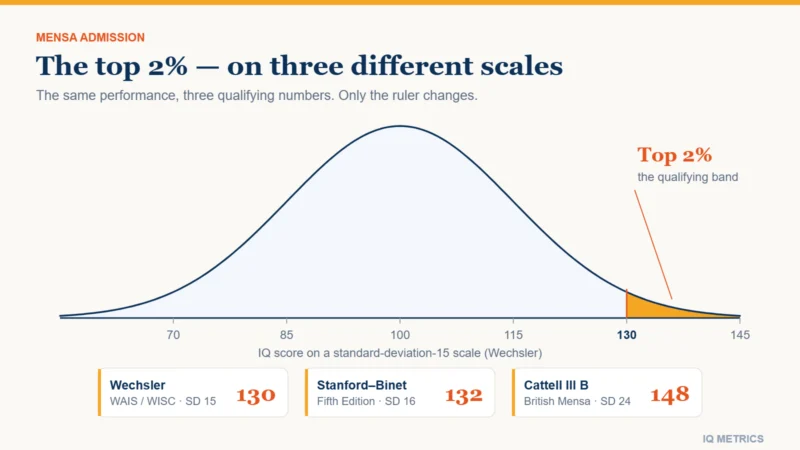
The SB5 reports IQ on a scale with a standard deviation of 15, the same as the Wechsler tests. Form L-M and the fourth edition used 16. The difference does not change where a person stands, but it changes the printed number: the same performance that earns 130 on an SB5 earns 132 on the older forms. That is why American Mensa lists a qualifying score of 132 for the Stanford-Binet and 130 for the Stanford-Binet 5. A score printed under the old scale converts by z-score: subtract 100, multiply by 15 and divide by 16, then add 100.
| Score on the old SD 16 scale | Same standing on SD 15 | Percentile |
|---|---|---|
| 84 | 85 | 15.9th |
| 100 | 100 | 50th |
| 116 | 115 | 84.1st |
| 132 | 130 | 97.7th |
| 148 | 145 | 99.9th |
| 164 | 160 | 99.997th |
Our news piece on standard deviation 15 versus 16 explains why one percentile carries several numbers, and the IQ score converter does the conversion for you.
How reliable and valid is the Stanford-Binet?
The publisher reports average internal-consistency reliabilities of .95 to .98 for the Full Scale, Nonverbal and Verbal IQs, .90 to .92 for the five factor indexes and .84 to .89 for the ten subtests. Validity data were gathered against the SB-IV, Form L-M, the Woodcock-Johnson III, the UNIT, the Bender-Gestalt II, the WPPSI-R, the WAIS-III, the WIAT-II and the WISC-III. High reliability still leaves a margin of error of a few points; see the margin of error in an IQ score.
An independent comparison shows what agreement between batteries looks like in practice. In 40 young people aged 10 to 16 with autism, corresponding SB5 and WISC-IV scores correlated .78 to .88, yet the Full Scale IQs still differed: most participants scored higher on the SB5, with 14% scoring more than one standard deviation higher, and verbal-nonverbal discrepancy classifications matched for only 60% (Baum and colleagues, 2015). Two good tests can agree on the broad picture and still disagree by several points.
Where would your own score land?
Take the IIF-certified assessment and get your score with the scale it was measured on, the percentile it corresponds to and the confidence range around it — the three figures most online tests leave out.
Find your IQ score now! →Stanford-Binet versus the Wechsler scales
| Feature | Stanford-Binet 5 | Wechsler batteries |
|---|---|---|
| Ages | 2 to 85+ in one instrument | Separate batteries: WPPSI-IV (2:6 to 7:7), WISC-V (6 to 16), WAIS (16 to 90) |
| Design | Five factors, each measured verbally and nonverbally | Index scores by domain; a separate Nonverbal index is ancillary |
| Norms | 4,800 people, 2000 US Census | WPPSI-IV: 1,700 children, 2010 US Census |
| Scale | SD 15 (older forms 16) | SD 15 |
| Top of the range | Extended IQ scale up to 225 | Composites reported to 160 (see the ceiling article) |
The practical draw of the SB5 is a single instrument across the lifespan and a Nonverbal IQ that is a full scale in its own right; the practical draw of the Wechsler batteries is familiarity and, for the preschool version, newer norms. Our guide to the WPPSI-IV covers the Wechsler preschool scale in detail.
Who uses the Stanford-Binet, and for what?
The publisher describes the SB5 as useful for assessing English-language learners, deaf and hard-of-hearing examinees and autistic people, with extensive high-end items for gifted performance and improved low-end items for low functioning. Under the US disability law, the publisher notes, it provides a profile of strengths and weaknesses for children and adults with learning difficulties. Its high ceiling is why it appears in gifted testing (see gifted cutoff scores) and why several high-IQ societies accept it.
| Society and test | Qualifying score |
|---|---|
| American Mensa, Stanford-Binet 5 | 130 |
| American Mensa, older Stanford-Binet | 132 |
| Triple Nine Society, SB-5 | 146 |
| Triple Nine Society, SB-IV | 149 |
| Triple Nine Society, Form LM (taken 1986 or earlier) | 149 |
| Triple Nine Society, Form L or M | 151 |
Triple Nine requires a minimum age of 16 at the test date. The Mensa figures are a 98th-percentile requirement expressed on each scale, as our guides to Mensa score requirements, why the requirement is a percentile and high-IQ societies explain.
Limits worth knowing
- Dated norms. The SB5 was normed to match the 2000 US Census, so in 2026 its norms are about 26 years old. A meta-analysis of 285 studies found the Flynn effect at about 2.9 IQ points per decade for modern Stanford-Binet and Wechsler tests (95% CI 2.3 to 3.5; Trahan and colleagues, 2014). If that drift held unchanged, a score on 2000 norms could read several points high by now, up to roughly 8 by our arithmetic. The drift has slowed in some wealthy countries (see why IQ norms expire), so treat that as an upper bound.
- A successor is coming. PRO-ED’s norming page lists an SB-6 for ages 3 to 90, so this edition is unlikely to be the last.
- Time and access. About 50 minutes one to one with a trained examiner; a report from a qualified professional is the only source of an SB5 score.
- Scores are ranges. A result is best read with its margin of error and, for children, alongside the story in IQ testing for children.
Can you take the Stanford-Binet IQ test online?
No. The publisher sells the SB5 as an individually administered kit for trained examiners, and the one-to-one format, with an examiner who routes the examinee and records spoken responses, cannot be reproduced by a website. Pages that offer an “online Stanford-Binet” are not the publisher’s test, and their numbers are not SB5 scores. For a self-serve estimate use one of our IQ tests, which are screeners on the same standard-deviation-15 scale, not the SB5, and read what to check before trusting an online score.
Quick answers
- What does the Stanford-Binet measure? Five factors: fluid reasoning, knowledge, quantitative reasoning, visual-spatial processing and working memory, each verbally and nonverbally.
- What age range does the Stanford-Binet cover? Ages 2 to 85 and over.
- What is a good Stanford-Binet score? 90 to 109 is the average band; 130 on the SB5 is the American Mensa requirement (132 on the older forms).
- Is the Stanford-Binet the same as the Wechsler? No. Both use a mean of 100 and, for the SB5, a standard deviation of 15, but the batteries, subtests and norms differ.
- Who invented the Stanford-Binet? Alfred Binet and Théodore Simon built the 1905 scale; Lewis Terman at Stanford published the American revision in 1916.
- Is the Stanford-Binet still used? Yes. The fifth edition, published in 2003, is in current use, and a sixth edition is listed in norming.
The bottom line
The Stanford-Binet is the oldest name in intelligence testing and the SB5 remains a distinctive instrument: one battery from age 2, five factors each tested verbally and nonverbally, a Nonverbal IQ that stands on its own and an extended scale that reaches 225. Read its numbers with the scale in mind (15 on the SB5, 16 on older forms), remember that its norms date from 2000, and treat any single result as a range interpreted by a qualified examiner.
Sources
- PRO-ED, SB5 complete test kit: age range, norm sample, Extended IQ scale, test level and timing.
- PAR, Stanford-Binet Intelligence Scales, Fifth Edition: reliability, validity data and intended uses.
- PRO-ED, SB5 Online Scoring and Report System user’s guide: structure of the composites and score metrics.
- PRO-ED norming studies: the SB-6 normative study.
- American Mensa, qualifying test scores.
- Triple Nine Society, test scores.
- Wikipedia, Stanford-Binet Intelligence Scales: timeline, subtest table and the classification bands reported from Kaufman (2009) and Sattler (2008).
- Baum, K.T. et al. (2015): WISC-IV and SB-5 scores in adolescents with autism spectrum disorder.
- Trahan, L.H. et al. (2014): the Flynn effect, a meta-analysis.
- Stanford magazine, The Vexing Legacy of Lewis Terman: the size of the Terman study.
Keep reading
All articles →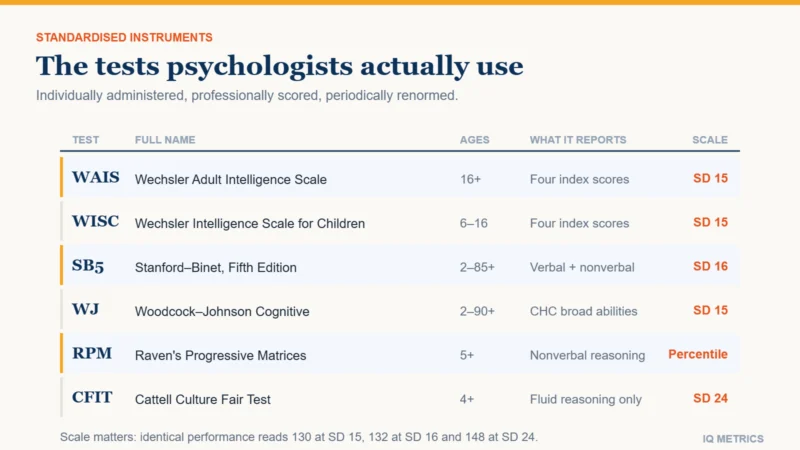 Taking a Test
Professional IQ Tests
When a psychologist measures intelligence, they reach for one of a small number of standardised instruments. This guide covers what the Wechsler scales, Stanford-Binet, Woodcock-Johnson and Raven's Progressive Matrices each measure, who each one is for, and where an online test genuinely fits.
 Research & Evidence
History of IQ Testing: Origins to Significance
Discover the strange history of IQ testing to assess its significance. Intelligence testing has impacted our knowledge of cognition and human potential since its inception. Expect a fascinating history of this statistic and its social effects.
 Scores & Scales
Mensa IQ Score Requirements
Mensa admits the top 2% of scorers, but "the top 2%" is a rank, not a number, and the number it maps to changes with the test you sat. Here is what qualifies on the Wechsler, Stanford-Binet and Cattell scales, the two routes to membership, and what the supervised admission test is actually like.