





Beyond Mensa: How Triple Nine, Prometheus and Other High-IQ Societies Work
Mensa is the famous one, but it is nowhere near the most exclusive. The Triple Nine Society admits one person in a thousand; the Prometheus Society, one in thirty thousand. Here is how each threshold is actually set, what test you would need, and why the further out you go, the less any single number can be trusted.

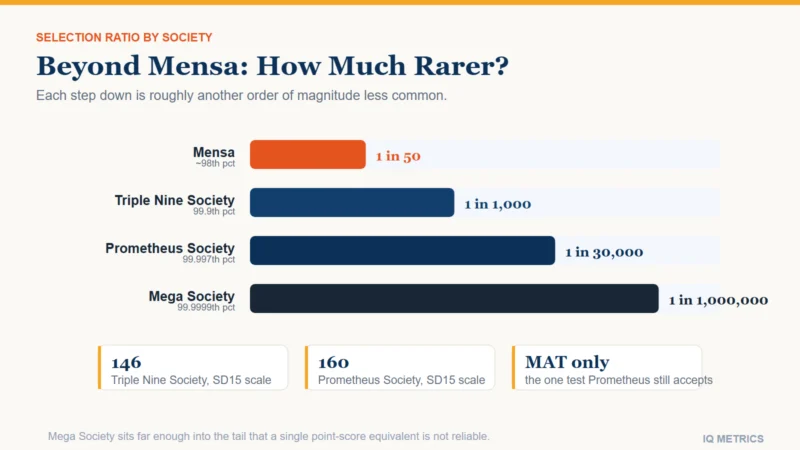
Several societies do, and by a wide margin. Mensa’s well-known threshold is the 98th percentile — the top 2 percent of the population. The Triple Nine Society sets its bar at the 99.9th percentile, roughly one person in a thousand. The Prometheus Society goes further still, to the 99.997th percentile, about one in 30,000, and the Mega Society further still beyond that. Each step down this list is a real, order-of-magnitude jump in rarity rather than a marginal increment, and each society comes with its own quirks about which tests actually qualify a candidate for membership.
The further out this list goes, though, the shakier the underlying numbers get — not because anyone is being dishonest, but because of a limit this site has covered before: no test can reliably measure a score that rare. Every society here uses the exact same 98th-percentile logic Mensa does; what changes from one to the next is simply how far right on the curve the cut-off sits, and how much less trustworthy that cut-off becomes the further right you go.
Mensa's threshold, as a baseline
Mensa requires the 98th percentile on an approved, supervised test of intelligence — nothing else about age, education or background counts. On the SD15 scale most modern tests use, that works out to just under 130; this site's full breakdown of that number, and why different publishers report it as 130 or 132 covers the derivation in detail and is not repeated here. What matters for the rest of this article is the baseline: everything that follows is progressively rarer than the one high-IQ society most people have actually heard of.
Triple Nine Society: one in a thousand
The Triple Nine Society takes its name from its threshold: "999" for the 99.9th percentile, about one person in a thousand. On the SD15 scale that is 146; on SD16, 149. It accepts scores from a wide range of standardized intelligence and academic-aptitude tests — over twenty of them — which makes it considerably more accessible than either of the two societies further down this list. Not easy: a 1-in-1,000 score is still rare enough that the overwhelming majority of people who sit a standard test will never see one on their own report, no matter how well they happen to do. But it is reachable through an ordinary supervised assessment, the same kind of test a school, clinic or employer might administer, rather than a specialist instrument built specifically to chase a rarer tail of the distribution.
Prometheus Society: one in thirty thousand
The Prometheus Society sets its bar at the 99.997th percentile — 160 on the SD15 scale, 164 on SD16, and roughly one person in 30,000. Here the practical requirements change in a way that is worth understanding rather than just noting: as of today, the society accepts essentially only the Miller Analogies Test (MAT) for qualification. That is not an arbitrary rule. Most standardized IQ tests simply are not built with enough discriminating power that far out in the distribution to certify a score that rare in the first place — which is the same ceiling problem covered in detail in why no IQ test can reliably score you above about 160.
Where would your own score land?
Take the IIF-certified assessment and get your score with the scale it was measured on, the percentile it corresponds to and the confidence range around it — the three figures most online tests leave out.
Find your IQ score now! →Mega Society: one in a million, and a cautionary history
The Mega Society sits past Prometheus again, at the 99.9999th percentile — about one person in a million. Founded in 1982 by Ronald K. Hoeflin, it is a useful case study in what goes wrong at this level of rarity, and it is not merely a matter of statistics. Hoeflin’s own qualifying instrument, the Mega Test, ran unsupervised and untimed in Omni magazine in 1985 — anyone could take it at home, on paper, at their own pace. That design made sense for reaching a geographically scattered population of extremely rare scorers, and it was also its downfall: once enough people had discussed the questions and shared answers, later scores stopped meaning what earlier ones had. The society stopped accepting Mega Test scores from after 1994, and a successor instrument, the Titan Test, was eventually retired for the same reason in 2020.
That history matters beyond one society’s administrative footnote: it is a second, independent reason — alongside the statistical extrapolation problem below — that scores this far into the tail are hard to trust at face value. A test rare and specialised enough to target one-in-a-million scorers is also, almost by construction, too small and too specialised in its niche to be administered under the same tightly controlled, regularly re-normed conditions as a mainstream instrument like the WAIS.
Why the numbers get shakier as the club gets more exclusive
This is the important part, and it follows directly from that ceiling-effect article: a standardisation sample for a major test typically runs into the low thousands of people. That is plenty to characterise the middle of the distribution precisely, and it is nowhere near enough to empirically verify what a 1-in-30,000 or 1-in-a-million score should actually look like. Past a certain point, a test manual is extrapolating the shape of a curve outward from data it does not really have, not reading a measurement off a ruler. That is exactly why the Mega Society, at the 99.9999th percentile — one person in a million — is not given a specific point-score equivalent here. Past a certain rarity, a single number claims a precision the underlying test data cannot support.
What these societies actually do
Beyond the admission threshold, the day-to-day reality of Triple Nine, Prometheus and similar societies looks a lot like Mensa’s: member newsletters, online discussion groups, occasional in-person meetups, and special-interest groups built around members’ other hobbies. The exclusivity is entirely in the door, not in what happens after you are through it — joining one of these does not unlock anything functionally different from what Mensa already offers, just a smaller and more specifically selected room.
That is worth sitting with for a moment, because it cuts against the mystique these societies sometimes attract online. There is no secret curriculum, no exclusive research programme and no functional advantage to membership beyond the social one of meeting other people who cleared the same unusually high bar. For most people genuinely curious about their own score, an ordinary supervised test and a clear explanation of where the result sits on a standard scale will answer the actual question far more usefully than pursuing admission to any of these.
Should you try to qualify
If you are curious, the realistic first step is the same one either way: sit a properly normed, supervised test and see where you land, rather than assuming an online quiz score tells you anything about eligibility for any of these. A casual, ungraded online test is not accepted by any of these societies, and for the same reason it should not be treated as a real estimate of where you would land on one that is — the ceiling and norming problems described above apply just as much to an unverified quiz as they do to a specialist admission test, only with far less rigor behind the number it reports. And if you do not clear one of the higher bars, that is at least as likely to reflect the ceiling problem described above as it is to reflect anything meaningful about you — the tests that can distinguish the 98th percentile reliably were mostly never built to distinguish the 99.997th. Worth remembering, too: none of this measures the kind of skill covered in this site's piece on memory versus IQ — these thresholds are about reasoning under test conditions, not how much you can memorize. For your own number, on a test that reports the scale, percentile and confidence range together rather than a bare figure, start here.
Keep reading
All articles →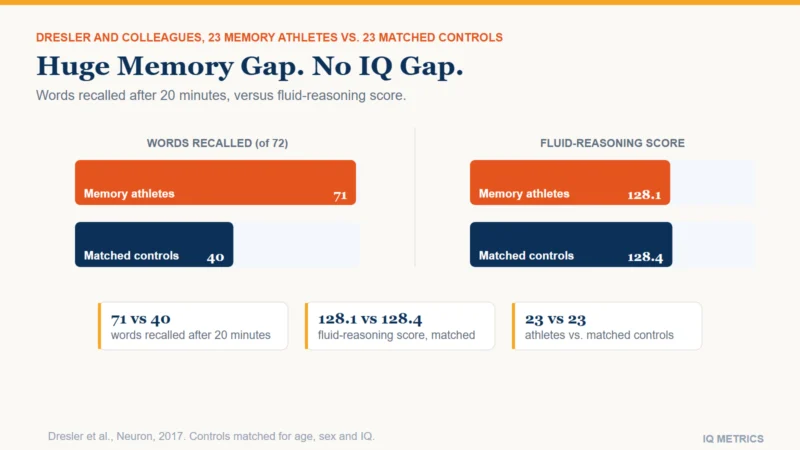 Understanding IQ
Memory and IQ
The world's best memory athletes can memorize 71 shuffled words in twenty minutes. Their IQ scores are not measurably different from a matched control group who could only manage 40. If a spectacular memory is not the same thing as a high IQ, what actually is the difference?
 Scores & Scales
Mensa IQ Score Requirements
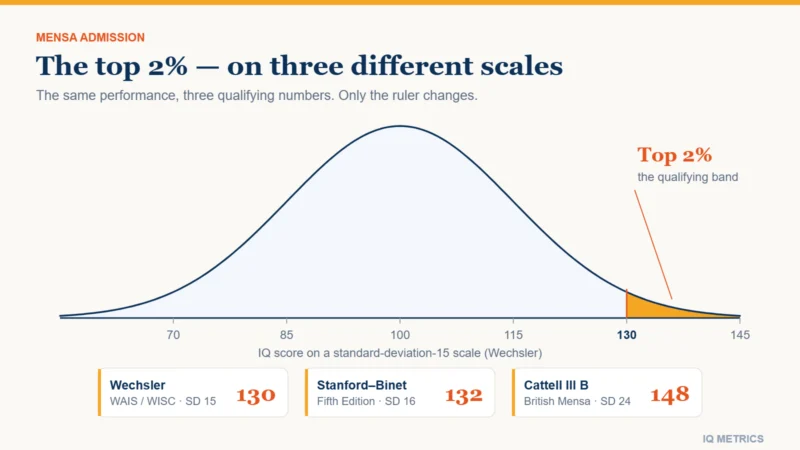
Mensa admits the top 2% of scorers, but "the top 2%" is a rank, not a number, and the number it maps to changes with the test you sat. Here is what qualifies on the Wechsler, Stanford-Binet and Cattell scales, the two routes to membership, and what the supervised admission test is actually like.
 Scores & Scales
IQ Score Ceiling Effects
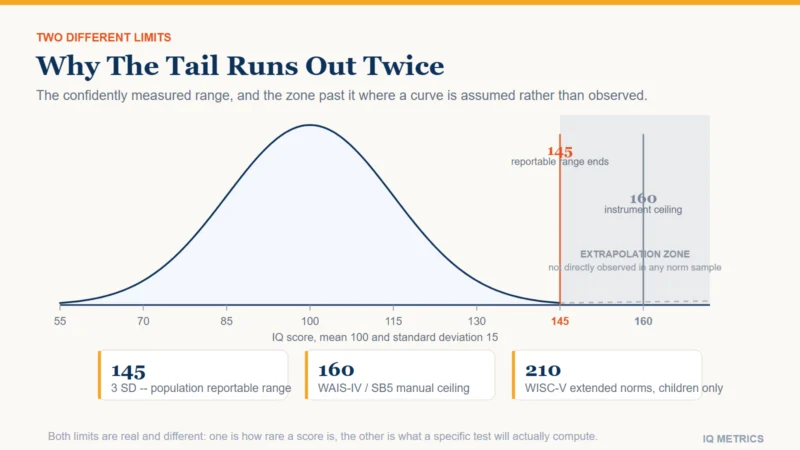
Two different numbers get used as "the top of the scale," 145 and 160, and they come from two different kinds of limit. One is a statement about population statistics; the other is about what a specific test manual will actually compute.