



What was Martin Luther King Jr.’s IQ?
In 1950 he wrote that his “I.Q. stands somewhat above the average.” A Morehouse professor had written in 1948 that his ability exceeded his record.
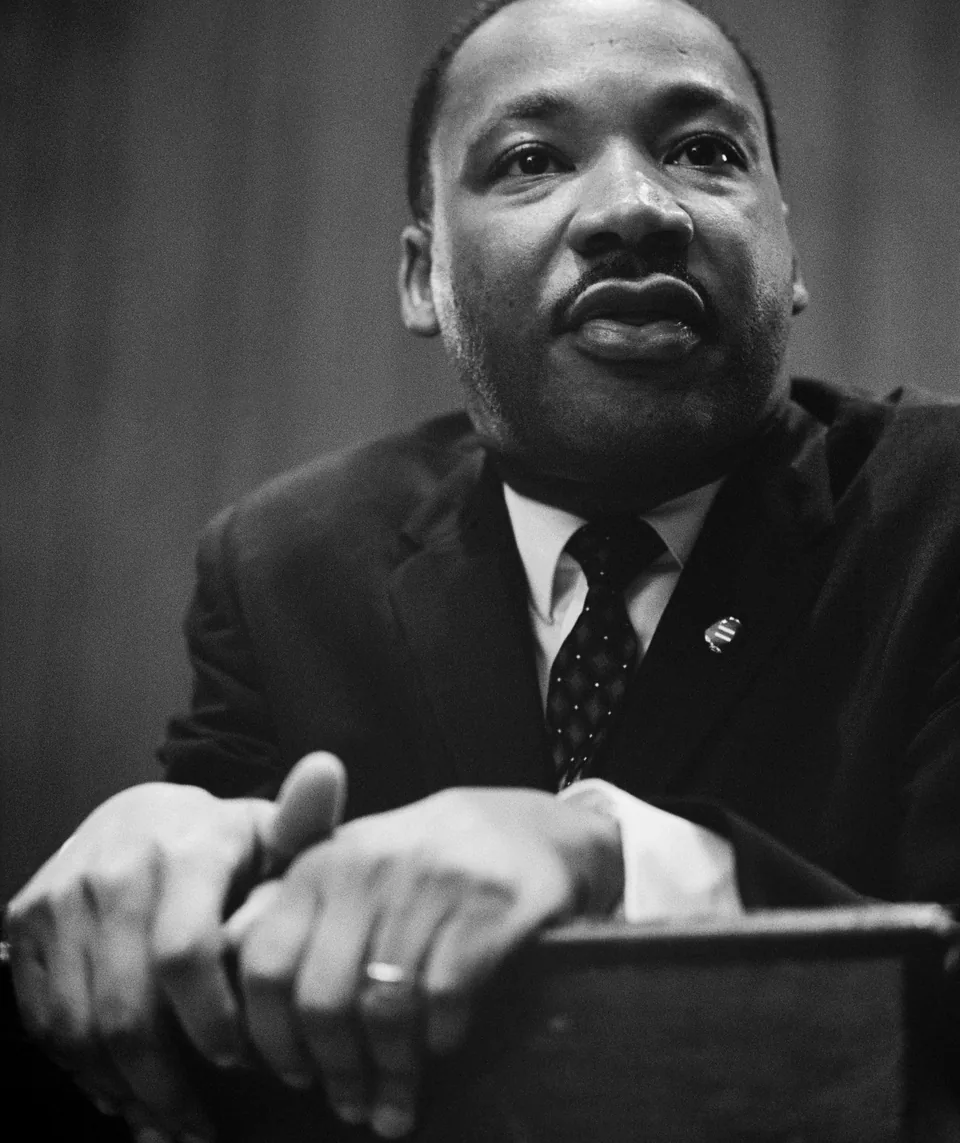
Martin Luther King Jr. entered college at 15, graduated as Crozer’s valedictorian in 1951 and earned a Ph.D. at 26, but no IQ score has been published for him, and the 130+ and 140 that circulate for his IQ level cite no test. This page’s estimated IQ for him, inferred from that record, is 125–145.
Martin Luther King Jr.’s estimated IQ
- Skipped the ninth grade and entered Morehouse College in September 1944, aged 15 and a year early, after a special admissions test.
- B.A. in sociology from Morehouse on June 8, 1948. Crozer’s dean noted his Morehouse average as 2.48 in March 1948, between a C and a B, but President Benjamin Mays wrote that he and another applicant were not brilliant students yet had good minds, and Professor George Kelsey that King’s ability exceeded his record.
- Crozer Theological Seminary valedictorian in May 1951, with the Pearl Plafker Memorial Award and a $1,200 fellowship; in 1950–51 George Davis rated him of exceptional intellectual ability, Raymond Bean the outstanding student in his class and Dean Charles Batten one of the most brilliant students Crozer had had.
- Ph.D. in systematic theology from Boston University in 1955, less than four years after enrolling in September 1951, with an A– from Edgar S. Brightman and an A and an A– from L. Harold DeWolf in the courses the King Papers editors report; the dissertation was defended on April 21, 1955.
- A public record of sustained argument and organizing: president of the Montgomery Improvement Association during the bus boycott of December 1955 to December 1956, elected president of the Southern Christian Leadership Conference in 1957, the “Letter from Birmingham Jail” (April 16, 1963), the March on Washington address (August 28, 1963) and the Nobel Peace Prize in 1964, at 35 the youngest man to have received it.
This is a judgment, not a score. The range is wide because the record is uneven: a 2.48 Morehouse average and no class rank for Morehouse or Boston University leave the low end open, while degrees, honors and faculty praise measure sustained work in one field, and the leadership record depended on many other people.
- Born
- January 15, 1929, Atlanta, Georgia
- Died
- April 4, 1968, Memphis, Tennessee, aged 39
- Early schooling
- Skipped the ninth grade; entered Morehouse in September 1944, aged 15, after the eleventh grade and a special admissions test
- Morehouse College
- B.A. in sociology, June 8, 1948; academic average 2.48 in March 1948 per Crozer’s dean, between a C and a B
- Crozer Theological Seminary
- B.D., May 1951; valedictorian; Pearl Plafker Memorial Award; $1,200 J. Lewis Crozer Fellowship
- Boston University
- Ph.D. in systematic theology, 1955, less than four years after enrolling in September 1951
- Nobel Peace Prize
- 1964, awarded at 35; then the youngest man to have received it
- His own estimate
- 1950 seminary essay: his IQ stood somewhat above the average, with no test or number named
What an IQ of 125–145 actually means
Set the claim aside for a moment. If someone genuinely scored in this range, here is what that would represent.
Average is 100 by construction, and about two-thirds of people fall between 85 and 115. Take the test to place your own score on this scale.
| Score range | Classification | Share of people | What it indicates |
|---|---|---|---|
| 85 – 114 | Average | ~68% | The range most people fall into. |
| 115 – 129 | Above average | ~13.6% | Roughly one person in seven. |
| 130 – 144 | Gifted | ~2% | The threshold most high-IQ societies use. |
| Above 144 | Highly gifted | ~0.1% | Figures above this range are extrapolated from the curve rather than measured. |
Percentages are approximate and describe a normal distribution. The same number means different things on tests with different standard deviations.
Thirty questions gives you a measured position on this exact scale — your score, your percentile and the ability breakdown behind it.
Find out in 30 minutes →Who Martin Luther King Jr. was
Martin Luther King Jr. was born in Atlanta on January 15, 1929, into a family of Baptist pastors at Ebenezer Baptist Church. His schooling officially began in January 1935 at Yonge Street Elementary School, a year after an attempt to start early was foiled; he moved to the Atlanta University Laboratory School in 1940. When that school closed in 1942 he skipped the ninth grade and, at 13, began the tenth at Booker T. Washington High School, where in April 1944 he won the school’s place in the state Elks oratorical contest. That year, after the eleventh grade, he entered Morehouse College: enrollment had fallen with the wartime draft, President Benjamin E. Mays let promising high school juniors join the entering class of 1944, and King was admitted after a special admissions test. He began classes on September 20, 1944, aged 15.
At Morehouse King majored in sociology under Walter Richard Chivers and took George D. Kelsey’s two-semester Introduction to the Bible in his junior year, where, the King Papers editors say, he earned his only undergraduate A. He won second prize in the John L. Webb oratorical contest in 1946 and 1948, received the B.A. on June 8, 1948 and entered Crozer Theological Seminary in Chester, Pennsylvania that September. He was elected student body president in May 1950, was accepted for postgraduate study at Edinburgh University on December 15, 1950 and was admitted to Boston University on January 11, 1951. He graduated in May 1951 with the Bachelor of Divinity, as valedictorian, holding the Pearl Plafker Memorial Award and the J. Lewis Crozer Fellowship of $1,200.
At Boston University King studied with the personalist theologians Edgar S. Brightman and L. Harold DeWolf, enrolling on September 13, 1951. By February 1953 he had completed thirty-seven hours toward the degree. He passed the French examination on February 15, 1952, failed the German examination on October 10, 1952 and passed it on his second attempt on February 18, 1953; his transcript records the qualifying examinations as passed by April 1954. His dissertation, “A Comparison of the Conceptions of God in the Thinking of Paul Tillich and Henry Nelson Wieman,” went to the university on April 15, 1955 and was defended on April 21; the faculty voted to confer the doctorate on May 31, and Boston University dates his Ph.D. in systematic theology to 1955, when he was 26.
King accepted the call to Dexter Avenue Baptist Church in Montgomery, Alabama, on April 14, 1954. After the arrest of Rosa Parks on December 1, 1955 he became president of the Montgomery Improvement Association, which coordinated the bus boycott from December 5, 1955 to December 20, 1956, and in 1957 he was elected president of the Southern Christian Leadership Conference. He wrote the “Letter from Birmingham Jail” on April 16, 1963 and delivered the “I Have a Dream” address at the Lincoln Memorial on August 28, 1963, at the March on Washington; his books included Stride Toward Freedom (1958) and Why We Can’t Wait (1964). He received the Nobel Peace Prize in 1964, at 35 the youngest man to have received it, and was assassinated in Memphis on April 4, 1968. In 1950 he heard Mordecai Johnson of Howard University preach on Gandhi, and the Nobel Foundation notes that his organization took its operational techniques from Gandhi.
 By Elora Mercer, Celebrity Research WriterFigures checked by Leon Falkner, Data & Research Analyst
Reviewed by Aarav Vardhan, Editor-in-Chief · Last reviewed August 2026

Martin Luther King Jr.: the documented record
The estimate above rests on this record. Every entry here is a matter of public fact, which is more than can be said for the number itself.
- 1929Born January 15 in Atlanta.
- 1942Skips the ninth grade after the Atlanta University Laboratory School closes; starts the tenth at Booker T. Washington High School at 13.
- 1944Admitted to Morehouse College after the eleventh grade, following a special admissions test; begins classes on September 20, aged 15.
- 1948Receives the B.A. in sociology on June 8 (Crozer’s dean had noted a 2.48 average in March); enters Crozer in September.
- 1950Elected student body president at Crozer in May; writes in a course essay that his IQ stands somewhat above the average.
- 1951Graduates from Crozer in May as valedictorian; enrolls at Boston University in September.
- 1952–53Passes the French examination on February 15, 1952; fails the German examination on October 10 and passes it on February 18, 1953.
- 1955Defends his dissertation on April 21; Boston University’s faculty votes the doctorate on May 31; he is 26.
- 1955–63Leads the Montgomery bus boycott (December 1955 to December 1956); elected president of the Southern Christian Leadership Conference in 1957; writes the Birmingham letter on April 16 and gives the March on Washington address on August 28, 1963.
- 1964–68Awarded the Nobel Peace Prize in 1964, aged 35; assassinated in Memphis on April 4, 1968.
Where the 130–140 figure came from
Following a claim back to its first appearance is the part almost nobody does — and it is what most people are actually asking.
The MLK IQ score that circulates online is an estimate, not a test result. geniuses.club lists an IQ of 140 for Martin Luther King Jr. and says figures of this kind are published estimates, not a measured, verified test score; its readable text gives no method or source. lifescoretest.com prints 130+, with a working range of 120–140, marks its evidence low confidence and lists Catharine Cox’s 1926 study among its references, although a book published in 1926 cannot contain a man born in 1929. Neither page ties its number to a test: the pattern this site traces across celebrity IQ numbers, a round figure with a disclaimer where the citation should be.
So what was Martin Luther King’s IQ, as far as the documents show? The only statement of his own about it that turned up is in a Crozer course essay of fall 1950, where he said his IQ stood somewhat above the average, naming no test and no number; his professor marked the paper excellent. Everything else on the subject is judgment by others. Recommending him to Crozer in February and March 1948, Morehouse president Benjamin Mays wrote that King and another applicant were not brilliant students but had good minds, and Professor George Kelsey wrote that his ability exceeded his record; Crozer’s dean, Charles Batten, noted a Morehouse average of 2.48. In 1950–51 Batten called King one of the most brilliant students Crozer had had, Professor George Davis rated him of exceptional intellectual ability and Professor Raymond Bean called him the outstanding student in his class.
The record is uneven, which is why the range is wide. According to the King Papers editors, King had earned a single A at Morehouse by March 1948, and Kelsey wrote that he came to value scholarship late in his college career. At Crozer and Boston University the record turns: valedictorian, honors, A– and A grades from his professors, and a doctorate finished in less than four years (see average IQ by education level for how scores vary with degrees). No class rank for Morehouse or Boston University turned up, and degrees and honors measure sustained work in one field more than general reasoning, so this page treats the seminary and doctoral record as the anchor and the Morehouse years as the reason not to set the range higher.
On the usual scale (mean 100, standard deviation 15), 125–145 runs from about the top 5 percent (see what an IQ of 125 means) to about the top 0.1 percent of a bell curve. It matches Mahatma Gandhi’s 125–145, whose nonviolence, the King Institute says, gave King the method of social reform he had been seeking; it reaches five points higher than Charles Darwin’s 125–140 at the top and sits below Abraham Lincoln’s 140–160, at whose memorial King gave the 1963 March on Washington address. The circulating 130+ and 140 both fall inside the range, which is not confirmation: neither comes with a test or a document. Whether he was a genius depends on the definition (is 130 IQ genius?), and much of what made him famous, moral leadership, oratory and organizing, is not something one IQ score captures.
How we read a number →Essay for George W. Davis’s course The Religious Development of Personality: King says his I.Q. stands somewhat above the average, naming no test or number; Davis marked it excellent.
Morehouse average 2.48 (March 1948). Mays: not brilliant students but good minds. Kelsey: ability above his record; the editors add that his only undergraduate A was in Kelsey’s Bible course. Davis: exceptional intellectual ability. Bean: outstanding in his class. Batten: one of the most brilliant students Crozer had had. Petition: French passed, German failed once.
Volume I: skipping the ninth grade in 1942; early admission to Morehouse in 1944 after a special admissions test; the 1948 recommendations; the Crozer valedictorian record. Volume II: an A– from Brightman, an A and an A– from DeWolf.
Dates for the early admission (1944), B.A. (June 8, 1948), student body president (May 1950), Crozer awards, language examinations, dissertation (April 15 and 21, 1955) and doctorate vote (May 31, 1955); Boston University grades satisfactory; the March on Washington, boycott, Birmingham letter and Nobel pages.
Born January 15, 1929, Atlanta; died April 4, 1968, Memphis; degrees 1948, 1951, 1955; at 35 the youngest man to receive the Peace Prize; elected president of the Southern Christian Leadership Conference in 1957; its techniques from Gandhi. Boston University: Ph.D. in systematic theology, 1955.
Morehouse admitted high school juniors who passed its entrance examination during the war, and King enrolled at 15. Wikidata Q8027 is Martin Luther King Jr.
geniuses.club: an estimated IQ of 140, a published estimate, not a measured, verified test score. lifescoretest.com (reviewed August 2026): 130+, working range 120–140, low confidence, no verified full-scale IQ score available; lists Cox (1926) among its references.
The site’s own estimated ranges used for the comparisons: Gandhi 125–145, Darwin 125–140, Lincoln 140–160.
None found in the King Papers Project, the Nobel Foundation biography, Boston University’s School of Theology page or two IQ-estimate sites. King’s own 1950 remark, which names no test and no number, is the only first-person statement about his IQ found.
The sources behind our estimate
The figures that circulate for Martin Luther King Jr., what we were able to confirm, and where the two diverge.
Two pages give a number: geniuses.club lists an estimated IQ of 140 for Martin Luther King Jr., and lifescoretest.com lists 130+ with a working range of 120–140. Neither names a test.
No IQ score has been published for Martin Luther King Jr. geniuses.club calls figures of this kind published estimates, not a measured, verified test score, and its readable text gives no method or source. lifescoretest.com (reviewed August 2026) marks its 130+ low confidence and says no verified full-scale IQ score is available. The one statement of King’s own that turned up is a 1950 seminary essay in which he put his IQ somewhat above the average, naming no test and no number.
Both circulating figures fall inside this page’s 125–145, but that is not confirmation: neither page cites a test or a document, and a range built from degrees, honors and evaluations cannot verify a round number. The range runs 5 points below the 130 and 5 above the 140 because the 2.48 Morehouse average and the missing class ranks leave the low end open while the Crozer and doctoral honors support the high end.
Want a number that does hold up? Every figure on this page is somebody’s claim. Take the 30-question test and get a percentile you can check rather than a figure you have to trust.
Martin Luther King Jr. — frequently asked
What is Martin Luther King Jr.’s IQ?
IQ Metrics estimates Martin Luther King Jr.’s IQ at 125–145, inferred from his documented record, because no IQ score for him has been published. The 130+ and 140 that circulate online fall inside that range but cite no test, so they are not confirmation. The estimate rests on his degrees, honors and faculty evaluations.
Did Martin Luther King Jr. ever take an IQ test?
No IQ score for Martin Luther King Jr. has been published. In a 1950 seminary essay he wrote that his own IQ stood somewhat above the average, but he named no test and no number, so the figures that circulate for him are estimates from his record, not results.
How old was MLK when he started college?
Martin Luther King Jr. was 15 when he started at Morehouse College in September 1944. Born on January 15, 1929, he had skipped the ninth grade and entered a year early, after the eleventh grade, when Morehouse admitted promising high school juniors after a special admissions test. He earned his B.A. in sociology at 19, on June 8, 1948.
Was MLK a genius?
No IQ score settles it. Crozer’s dean called him one of the most brilliant students the seminary had had, and he earned a Ph.D. at 26, but his Morehouse average was 2.48 when he applied to Crozer. IQ Metrics’ estimated IQ for him is 125–145, so whether he was a genius depends on how genius is defined.
Was Martin Luther King Jr. smart?
By the record, yes. He skipped the ninth grade, entered college at 15, graduated as valedictorian of Crozer Theological Seminary in 1951 and earned a Ph.D. from Boston University in 1955 at 26. The record is uneven, though: his Morehouse average was 2.48 when he applied to Crozer, and a professor wrote that his ability exceeded his record.
Was Martin Luther King one of the smartest students at Boston University?
The sources checked give no ranking of his Boston University class, so it cannot be shown. The King Papers Project calls his grades satisfactory, its edition of his papers reports A– and A grades from his professors, and he finished the Ph.D. in less than four years after enrolling in September 1951.
How does Martin Luther King Jr.’s estimated IQ compare with Mahatma Gandhi’s?
IQ Metrics gives Martin Luther King Jr. and Mahatma Gandhi the same estimated range, 125–145, so it does not rank one above the other. The King Institute traces King’s method of nonviolent social reform to Gandhi, after a 1950 sermon on him. Both ranges are inferences from documented records, not measurements.
How does my IQ compare with Martin Luther King Jr.?
You can find out in about fifteen minutes. The IQ Metrics assessment is 30 questions, scored on the same 100-mean scale used throughout this page, so your result and the estimate above are at least expressed in the same units — one measured, one inferred. Once you have a number, the leaderboard shows where it would sit, and how we score and norm it explains the benchmarking.
Where does this estimate come from?
From the documented record rather than a test — the method is named above and set out in full under how we read a number. Compare it against the other historical profiles, starting with Isaac Newton.
- Take the 30-question IQ test — get a measured score and percentile of your own
- Average IQ by country — how the scale behaves across populations
- How IQ Metrics scores its assessment — the method behind our own number
- More on how IQ testing works — reliability, error and what a score can and cannot say
- More historical profiles — same field, same method
More historical
Portrait by Domenico Fetti (circa 1620), via Wikimedia Commons, public domain. · Photograph by an unknown photographer (1906), via Wikimedia Commons, public domain. Background removed for the portrait above. · Detail of the Alexander Mosaic from the House of the Faun, Pompeii (c. 100 BCE; now in the National Archaeological Museum of Naples), via Wikimedia Commons, public domain.


.jpg)
An estimate is an inference.
Yours can be measured.
Thirty questions, scored against general-population benchmarks. Your score, your percentile, your ability breakdown and a printable IIF certificate.
Find your IQ score now! →