



What is Archimedes’ IQ?
Online guesses put his IQ level at 165 to 190; what actually survives is a proof about a sphere and a cylinder that he asked to have carved on his own tomb.
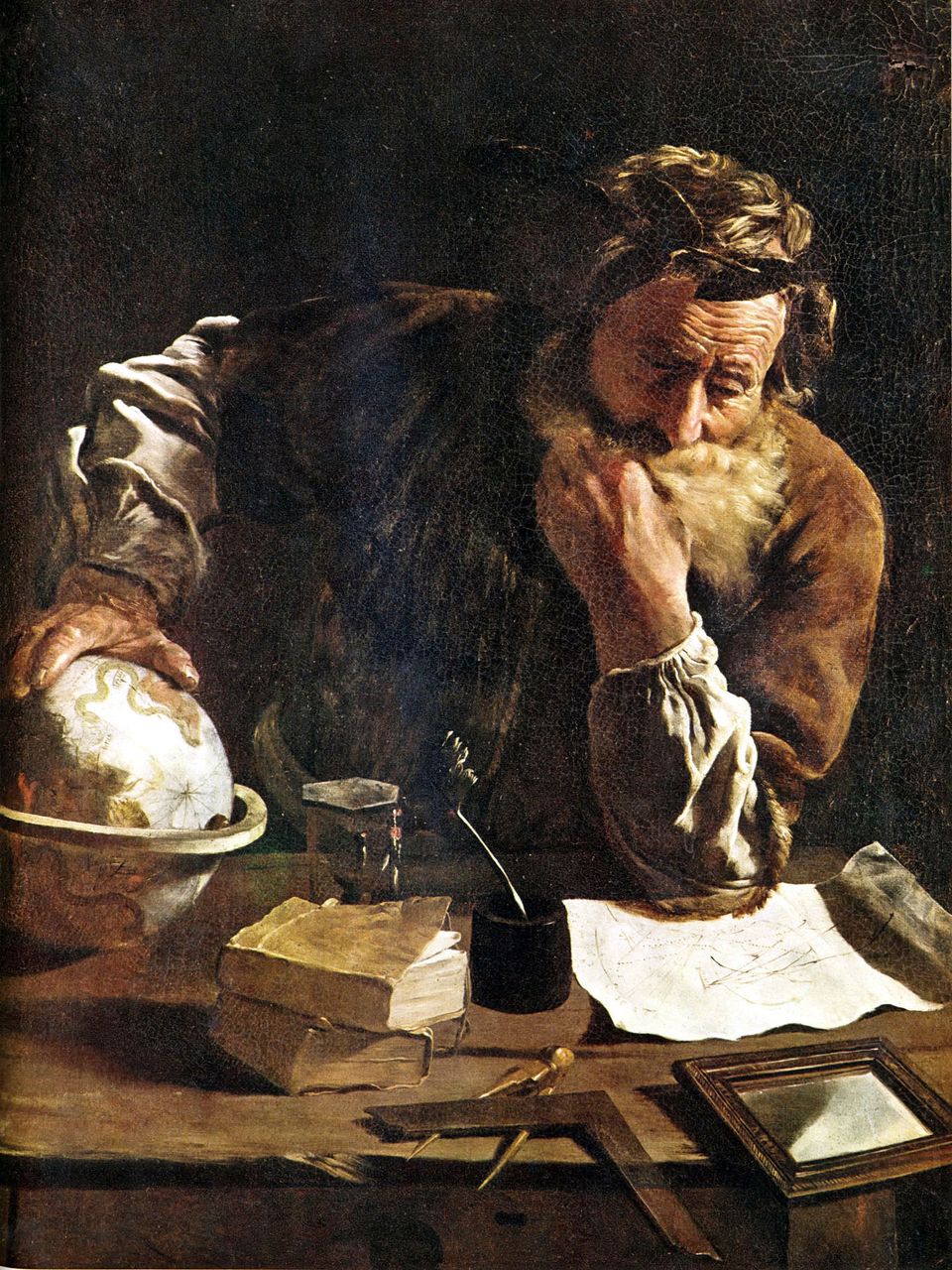
No IQ test result exists for Archimedes of Syracuse, who died in 212 BCE, more than 2,100 years before the Binet–Simon test of 1905; the estimated IQ figures that circulate for him, 165 and 190, cite none either. What is documented is a sphere-and-cylinder proof he ranked above his other work, a lever-and-indivisibles technique that anticipated calculus, and war machines that held off Rome. This page’s estimate of his IQ level is 160–185.
Archimedes’ estimated IQ
- On the Sphere and Cylinder proves that a sphere has exactly two-thirds the volume and surface area of the cylinder that exactly contains it — a result Archimedes valued enough to request as his tomb marker, which Cicero located and described in 75 BCE.
- Measurement of a Circle bounds π between 223/71 and 22/7 (about 3.1408 to 3.1429) using inscribed and circumscribed 96-sided polygons and the method of exhaustion, accurate to four significant figures with nothing more advanced than a straightedge and compass.
- The Method of Mechanical Theorems, recovered from the Archimedes Palimpsest in 1906, shows he used a lever-balancing technique with indivisible strips to find results before proving them rigorously — a technique the historian Michel Chasles credited with giving birth to the calculus of the infinite.
- Polybius, Livy and Plutarch — three independent ancient historians — all credit him with the catapults, cranes and iron “claw” that helped Syracuse hold off Marcellus’s Roman army for roughly two years during the Second Punic War.
- A ranking of history’s 100 greatest mathematicians (fabpedigree.com) places him second all-time behind only Isaac Newton, calling him “universally acknowledged to be the greatest of ancient mathematicians” — a reputational judgment echoed by Galileo, Huygens and Leibniz, though not a test score.
Archimedes died more than 2,100 years before modern intelligence testing began, so this is a judgment on a documented record, not a recovered score. That record is thinner than it looks: almost nothing about his life survives in his own words beyond naming his father in one line of The Sand-Reckoner, his friend Heracleides’ biography of him is entirely lost, and the two best-known personal stories — the naked dash from the bath and the Roman soldier’s sword — come from Vitruvius and Plutarch, writing centuries after his death, not from Archimedes himself. His mathematics is the opposite case: it survives in his own words and can be checked directly, which is more than can be said for most people this site estimates.
- Born
- c. 287 BCE, Syracuse, Sicily — the year is back-calculated from a 12th-century claim that he lived 75 years
- Died
- 212 BCE, Syracuse, killed by a Roman soldier as Marcellus’s army took the city in the Second Punic War
- Field
- Mathematics, physics (mechanics and hydrostatics), and military engineering
- Father
- Phidias, an astronomer — the only family detail Archimedes records himself, in The Sand-Reckoner
- Royal ties
- Friend and “near relation” of King Hieron II of Syracuse; dedicated The Sand-Reckoner to Hieron’s son, Gelo II
- Correspondents
- Conon of Samos and Eratosthenes of Cyrene, both linked to the Library of Alexandria
- Proudest result
- The 2:3 sphere-to-cylinder ratio (On the Sphere and Cylinder), requested for his tomb marker and located by Cicero in 75 BCE
- Portrait
- No likeness from life survives; the familiar 1620 painting by Domenico Fetti is a posthumous invention
What an IQ of 160–185 actually means
Set the claim aside for a moment. If someone genuinely scored in this range, here is what that would represent.
Average is 100 by construction, and about two-thirds of people fall between 85 and 115. Take the test to place your own score on this scale.
| Score range | Classification | Share of people | What it indicates |
|---|---|---|---|
| 85 – 114 | Average | ~68% | The range most people fall into. |
| 115 – 129 | Above average | ~13.6% | Roughly one person in seven. |
| 130 – 144 | Gifted | ~2% | The threshold most high-IQ societies use. |
| Above 144 | Highly gifted | ~0.1% | Figures above this range are extrapolated from the curve rather than measured. |
Percentages are approximate and describe a normal distribution. The same number means different things on tests with different standard deviations.
Thirty questions gives you a measured position on this exact scale — your score, your percentile and the ability breakdown behind it.
Find out in 30 minutes →Who Archimedes is
Archimedes of Syracuse was born around 287 BCE in the Greek city of Syracuse, on the island of Sicily; the year is back-calculated from a claim by the 12th-century Byzantine writer John Tzetzes that he lived 75 years. His father, Phidias, was an astronomer — a detail Archimedes supplies himself, in a single line of The Sand-Reckoner, and almost the only fact about his family that survives. A friend, Heracleides, is said to have written a biography of him; it is lost. MacTutor (University of St Andrews) judges that Archimedes likely studied as a young man with the successors of Euclid in Alexandria, though this rests on conjecture; firmer is his lifelong correspondence with two mathematicians tied to that city, Conon of Samos and later Eratosthenes of Cyrene. Back in Syracuse he was, in his own telling, friend and “near relation” of King Hieron II, and he addressed The Sand-Reckoner to Hieron’s son, Gelo II. No portrait made from life survives; the familiar 1620 painting Archimedes Thoughtful, by Domenico Fetti, is a later artist’s invention, not a likeness.
His surviving mathematics is dense with results usually credited to a much later era. On the Equilibrium of Planes works out the law of the lever from geometric first principles; On Floating Bodies gives the buoyancy principle that carries his name — that a body in fluid experiences an upward force equal to the weight of fluid it displaces. The bathtub version of that discovery, Archimedes leaping out shouting “Eureka,” Greek for “I have found it,” after Hieron II asked him to check whether a goldsmith had cheated on a votive crown, comes from the Roman architect Vitruvius, writing about two centuries later; historians flag the gap as long enough for the story to have been improved in the telling, whatever kernel of fact sits under it. Better attested is the achievement Archimedes ranked above the rest: On the Sphere and Cylinder proves that a sphere has exactly two-thirds the volume and surface area of the cylinder that exactly contains it, a result he asked to have carved on his own tomb as a sphere set inside a cylinder. Measurement of a Circle bounds π between 223/71 and 22/7 — about 3.1408 to 3.1429 — using 96-sided inscribed and circumscribed polygons and nothing more advanced than a straightedge and compass.
A technique Archimedes used to find those results before proving them rigorously survived only by accident. The Method of Mechanical Theorems, a letter to Eratosthenes, describes slicing shapes into many thin strips and balancing them on a lever to find areas and volumes — indivisibles, in effect, worked out some eighteen centuries before Newton and Leibniz formalized calculus. The 19th-century historian Michel Chasles credited the method with having, in his words, given birth to the calculus of the infinite. The text was thought lost until 1906, when the philologist Johan Ludvig Heiberg identified it, overwritten with prayers in a 13th-century book in Constantinople — the manuscript now known as the Archimedes Palimpsest. Later admirers took the surviving work at face value: Galileo Galilei called Archimedes “superhuman” and “my master,” and Christiaan Huygens wrote that he was “comparable to no one” — praise usually attached to what people mean by a genius IQ level, even without a score attached. In the one work that reads as autobiography, The Sand-Reckoner, Archimedes computed an upper bound for the number of grains of sand that would fill the universe — he arrived at 10⁶³ — and preserved one of the few surviving accounts of Aristarchus of Samos’s hypothesis that the earth revolves around the sun.
When Rome besieged Syracuse from 214 to 212 BCE during the Second Punic War, Archimedes designed the defenses: improved catapults, cranes that dropped weights onto ships, and — per Polybius, Livy and Plutarch, three independent ancient historians — an iron “claw” that hooked Roman ships by the bow and dropped them back into the sea. Plutarch records the Roman commander, Marcellus, joking that his engineers should stop “fighting against this geometrical Briareus,” after the hundred-handed giant of myth, since Archimedes alone directed the city’s defense. A separate, later tradition credits him with a mirror-based “heat ray”; the claim rests on writers centuries further removed than Polybius, Livy or Plutarch, and modern attempts to reproduce it have had mixed results at best. When Syracuse fell, Archimedes was killed by a Roman soldier; Plutarch gives three versions, but all agree he was working through a geometric problem in the sand when it happened. Marcellus, who had ordered him spared, was reportedly grieved and sought out Archimedes’ family to honor them.
 By Elora Mercer, Celebrity Research WriterFigures checked by Leon Falkner, Data & Research Analyst
Reviewed by Aarav Vardhan, Editor-in-Chief · Last reviewed August 2026

Archimedes: the documented record
The estimate above rests on this record. Every entry here is a matter of public fact, which is more than can be said for the number itself.
- c. 287 BCEBorn in Syracuse, Sicily; the year is back-calculated from the 12th-century Byzantine writer John Tzetzes’ claim that he lived 75 years.
- 3rd century BCEPossibly studies with the successors of Euclid in Alexandria as a young man; corresponds for life with Conon of Samos and later Eratosthenes of Cyrene.
- 3rd century BCEProves the law of the lever (On the Equilibrium of Planes) and the buoyancy principle (On Floating Bodies); friend and “near relation” of King Hieron II of Syracuse.
- 3rd century BCEOn the Sphere and Cylinder proves a sphere has two-thirds the volume and surface area of its circumscribing cylinder, the result he valued above the rest; Measurement of a Circle bounds π between 223/71 and 22/7.
- 3rd century BCEThe Sand-Reckoner, addressed to Hieron’s son Gelo II, computes an upper bound of 10⁶³ grains of sand to fill the universe and preserves a rare surviving account of Aristarchus of Samos’s heliocentric hypothesis.
- 214–212 BCEDesigns the catapults, cranes and iron “claw” that help the outnumbered defenders of Syracuse hold off Marcellus’s Roman army during the Second Punic War, per Polybius, Livy and Plutarch.
- 212 BCEKilled by a Roman soldier as Syracuse falls; Plutarch records three versions of the death and says Marcellus, who had ordered him spared, grieved and honored his kin.
- 75 BCECicero, as quaestor in Sicily, tracks down Archimedes’ overgrown tomb, marked with the sphere-and-cylinder monument he had requested (Tusculan Disputations).
- 1st century BCEThe Roman architect Vitruvius records the bathtub “Eureka” story about the golden crown, writing roughly two centuries after Archimedes’ death; historians flag the gap as long enough for embellishment.
- 1906 CEThe philologist Johan Ludvig Heiberg identifies The Method of Mechanical Theorems and other lost treatises in the Archimedes Palimpsest in Constantinople, recovering a technique read today as anticipating integral calculus.
- 1998 CEThe Archimedes Palimpsest sells at Christie’s for $2.2 million and is later imaged with ultraviolet and X-ray techniques at the Walters Art Museum, extending what Heiberg had been able to read.
Where the 165–190 figure came from
Following a claim back to its first appearance is the part almost nobody does — and it is what most people are actually asking.
Two IQ figures circulate for Archimedes, and neither cites a test. LifeScore’s history profile gives 165+, with a stated working range of 155–175, and labels its own evidence “very low confidence.” Geniuses.club’s comparison pages, “Archimedes vs Socrates” and “Albert Einstein vs Archimedes,” both give a clean 190 with no working shown; its own dedicated Archimedes profile had not loaded its text when checked in September 2026. Both sites describe themselves as reconstructions built on achievement, not recovered scores — the same kind of exercise this page runs, done more or less candidly. For how these numbers get made in general, see where celebrity IQ numbers come from.
A different, older kind of claim ranks Archimedes rather than scoring him. fabpedigree.com’s list of the 100 greatest mathematicians places him second all-time, behind only Isaac Newton, calling him “universally acknowledged to be the greatest of ancient mathematicians” and “the greatest genius who ever lived,” while ranking Newton higher for historical influence alone. The pairing is not new: historians of mathematics have long grouped Archimedes, Newton and Carl Friedrich Gauss together as the field’s three greatest figures — a judgment about standing among mathematicians, not an IQ claim, and none of the rankings behind it name a test.
Catharine Cox’s 1926 study, The Early Mental Traits of Three Hundred Geniuses, cannot supply a number either. Her 301 subjects were born between 1450 and 1850, drawn from J. McKeen Cattell’s 1903 eminence ranking; Archimedes, born around 287 BCE, is nowhere near that window, the same disqualification that rules out Aristotle. Formal intelligence testing itself starts with the Binet–Simon scale of 1905 (see the history of intelligence testing) and the term IQ was coined only in 1912 — more than 2,100 years after Archimedes died in 212 BCE. What is left, for a life this old, is reading an approximate level off the documented record, exactly as this site does for its other ancient figures.
The top of the circulating range strains the same way it does elsewhere on this site: a 190 sits six standard deviations above a mean of 100 (SD 15), rarer than one person in a billion on the textbook normal curve, a level the IQ ceiling effect page treats as effectively unmeasurable by any real test. What actually holds up under a source check is narrower and more concrete than either circulating number suggests: a handful of surviving proofs, a request carved on a tomb, and a siege three separate historians describe the same way. An Archimedes IQ claim met online can be checked the same way this page checks its own: which work, which historian, how many centuries after the fact.
How we read a number →Source for the birth/death framing, father Phidias as the only family detail (from The Sand-Reckoner), the lost Heracleides biography, the conjectural Alexandria period, correspondence with Conon of Samos, “friend and near relation” of Hieron II, the works list, Chasles’s verdict on the calculus of the infinite, the three Plutarch death accounts, the tomb request, and the note that his mathematics was little known until Eutocius’s 6th-century commentaries.
Cross-check for the Tzetzes birth-year calculation, the Vitruvius “Eureka” legend and its roughly two-century gap, Valerius Maximus’s recorded last words, the note that “do not disturb my circles” appears in no ancient source, the π bounds (223/71–22/7), the Marcellus “geometrical Briareus” line, Renaissance-era praise from Galileo, Huygens and Leibniz, the heat-ray dispute, and the note that no portrait from life survives.
Source for the 10⁶³ grains-of-sand upper bound, the dedication to Gelo II, and the passage preserving Aristarchus of Samos’s heliocentric hypothesis.
Ancient account, written roughly three centuries after the events, for the “geometrical Briareus” quote, the death scene, and Marcellus’s grief and honors to Archimedes’ kin.
Source for the 75 BCE tomb discovery, 137 years after Archimedes’ death, the overgrown column topped with a sphere and cylinder, and Plutarch’s report, cited on the same page, that Archimedes requested the marker.
Confirms Cox’s 1926 study drew its 301 subjects from people born 1450–1850; Archimedes, born around 287 BCE, falls outside that window by nearly two millennia.
Ranks Archimedes second all-time behind Isaac Newton, calling him “universally acknowledged to be the greatest of ancient mathematicians” and noting it is “widely accepted that Archimedes was the greatest genius who ever lived,” while ranking Newton higher for historical influence. A reputational ranking, not an IQ claim.
States a figure of 165+, a working range of 155–175, and labels the evidence “very low confidence,” checked September 2026.
Both comparison pages give 190 with no method shown; the dedicated profile page had not loaded its text when checked in September 2026.
Checked directly: intelligence testing dates from the 1905 Binet–Simon scale, and the term IQ from 1912, more than 2,100 years after Archimedes died in 212 BCE. Neither LifeScore nor Geniuses.club cites a test; both describe reconstructions from achievement.
The sources behind our estimate
The figures that circulate for Archimedes, what we were able to confirm, and where the two diverge.
Two IQ figures circulate for Archimedes, and neither cites a test: 165+ (working range 155–175) on LifeScore, labeled “very low confidence,” and a flat 190 on Geniuses.club’s comparison pages.
There is no published IQ test result for Archimedes, and there could not be one: he died in 212 BCE, more than 2,100 years before the Binet–Simon scale of 1905. Checked in September 2026: LifeScore’s history profile gives 165+, a working range of 155–175, and calls its own evidence “very low confidence”; Geniuses.club’s “Archimedes vs Socrates” and “Albert Einstein vs Archimedes” pages both give 190 with no working shown, while its own dedicated Archimedes profile had not loaded its text. fabpedigree.com ranks him second all-time among mathematicians, behind only Isaac Newton — a reputational judgment, not an IQ claim.
The circulating figures span only 165 to 190, a narrower and more sober spread than most ancient figures get online, and this page’s 160–185 range brackets both ends rather than sitting entirely under them. A 190 is six standard deviations above a mean of 100 (SD 15) on the textbook normal curve, rarer than one person in a billion; LifeScore’s own 165 carries a self-applied “very low confidence” label, which is the more candid of the two circulating figures.
Want a number that does hold up? Every figure on this page is somebody’s claim. Take the 30-question test and get a percentile you can check rather than a figure you have to trust.
Archimedes — frequently asked
What is Archimedes’ IQ?
Archimedes’ IQ was never measured and could not have been: he died in 212 BCE, more than 2,100 years before the Binet–Simon intelligence test of 1905. Estimated IQ figures circulating online run from 165 to 190, and neither cites a test. This page’s estimate of his IQ level, based on his documented mathematics, is 160–185.
Where do the Archimedes IQ estimates of 165 and 190 come from?
LifeScore gives 165+, with a working range of 155–175, and labels its own evidence “very low confidence.” Geniuses.club’s comparison pages give a flat 190 with no method shown, while its own dedicated Archimedes profile would not load its text when checked. Both are historiometric guesses built on achievement, not recovered test scores.
Was Archimedes a genius?
By reputation, yes: a ranking of history’s 100 greatest mathematicians places him second all-time, behind only Isaac Newton, and Galileo, Huygens and Leibniz all wrote of him with something close to awe. But reputation is not a score — no IQ test existed in the third century BCE, and none has ever been claimed for him.
Did Archimedes anticipate calculus?
In a technique historians call his method of mechanical theorems, yes: he sliced shapes into indivisibly thin strips and balanced them on a lever to find areas and volumes, roughly eighteen centuries before Newton and Leibniz formalized calculus. The mathematician Michel Chasles credited the method with giving birth to the calculus of the infinite.
How does Archimedes’ estimated IQ compare with Isaac Newton’s and Carl Friedrich Gauss’s?
This page estimates Archimedes at 160–185, against 170–190 for both Isaac Newton and Carl Friedrich Gauss. The three are commonly grouped as mathematics’ three greatest figures on reputation alone; Archimedes’ range sits slightly lower here mainly because so little reliable evidence survives about his life, not because his mathematics is judged weaker.
Did Archimedes really run naked through the streets shouting “Eureka”?
That detail comes from the Roman writer Vitruvius, recorded about two centuries after Archimedes lived. He describes Archimedes realizing, in the bath, that water displacement could expose a fraudulent goldsmith, then rushing home overjoyed. Historians treat the story as broadly plausible but likely embellished in the telling, not as a firsthand record.
What did Archimedes consider his greatest achievement?
The proof, in On the Sphere and Cylinder, that a sphere has exactly two-thirds the volume and surface area of the cylinder that exactly contains it. Archimedes valued the result enough to request a sphere set inside a cylinder as his tomb marker; Cicero located the overgrown tomb in 75 BCE and confirmed it was there.
How does my IQ compare with Archimedes?
You can find out in about fifteen minutes. The IQ Metrics assessment is 30 questions, scored on the same 100-mean scale used throughout this page, so your result and the estimate above are at least expressed in the same units — one measured, one inferred. Once you have a number, the leaderboard shows where it would sit, and how we score and norm it explains the benchmarking.
Where does this estimate come from?
From the documented record rather than a test — the method is named above and set out in full under how we read a number. Compare it against the other historical profiles, starting with Isaac Newton.
- Take the 30-question IQ test — get a measured score and percentile of your own
- Average IQ by country — how the scale behaves across populations
- How IQ Metrics scores its assessment — the method behind our own number
- More on how IQ testing works — reliability, error and what a score can and cannot say
- More historical profiles — same field, same method
More historical
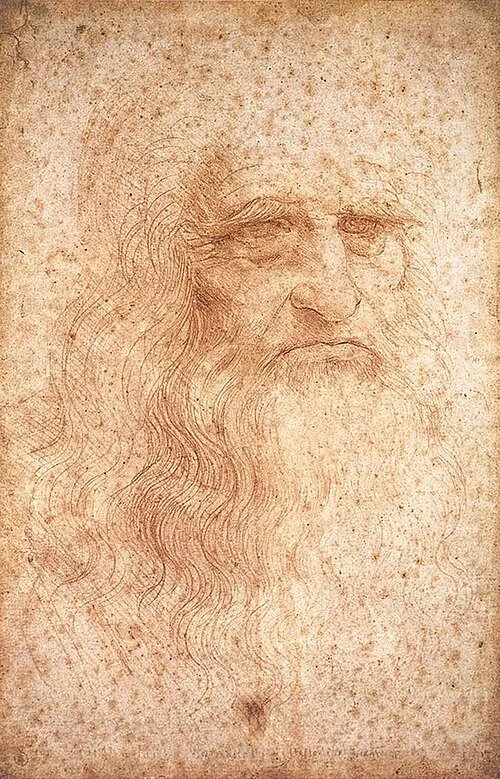
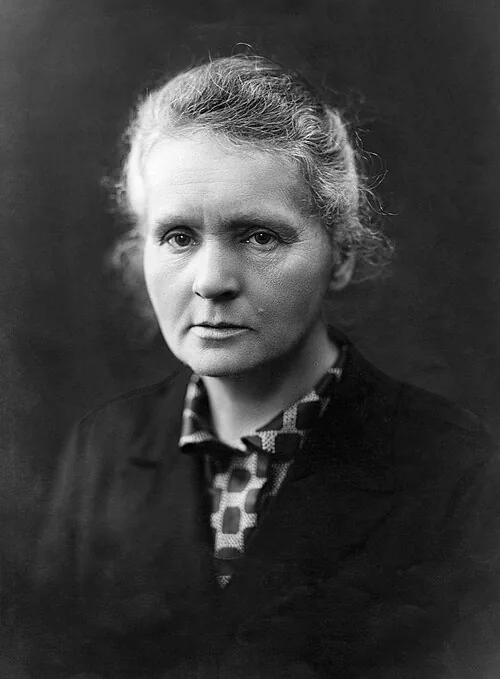
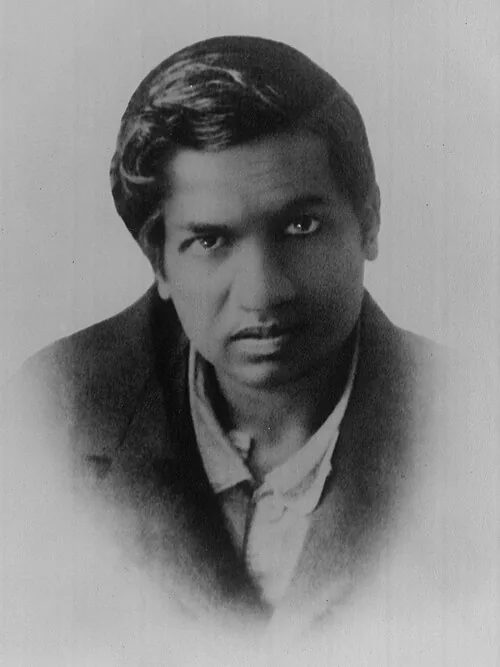
Presumed self-portrait, red chalk, c. 1512, via Wikimedia Commons, public domain. · Photograph by Henri Manuel (c. 1920), public domain. Background removed for the portrait above. · Photograph (1913) held by Trinity College, Cambridge, via Wikimedia Commons, CC BY 4.0.


.jpg)
An estimate is an inference.
Yours can be measured.
Thirty questions, scored against general-population benchmarks. Your score, your percentile, your ability breakdown and a printable IIF certificate.
Find your IQ score now! →